
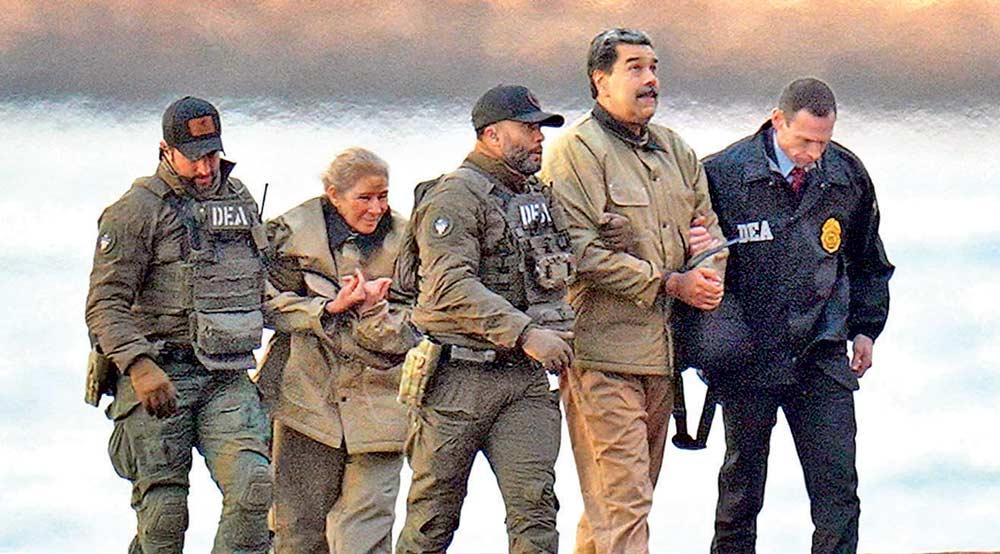
Perhaps the most shocking violation of international norms occurred on January 3, 2026, when U.S. special operations forces conducted a high-risk extraction in Caracas to capture Nicolás Maduro
 By 2026, the average U.S. tariff on imports has surged to nearly 27%, a level not seen since the 1930s
President Trump’s renewed interest in purchasing Greenland has pushed NATO to a breaking point
The dawn of 2026 marks a watershed moment in modern history. The traditional “Pax Americana” that defined the post-WWII era has fractured, replaced by a volatile landscape of unilateralism and aggressive protectionism. Under the leadership of President Donald Trump and Israeli Prime Minister Benjamin Netanyahu, a series of unprecedented diplomatic and military maneuvers has catalysed a global realignment. The central question now facing scholars and policymakers alike is no longer whether the United States and Israel are being isolated, but rather how permanent this shift driven by “America First” policies and localized conflict in Gaza will be for the world order.
1. The Gaza Crisis and the Collapse of Multilateral Legitimacy
A primary driver of this isolation is the continued military campaign in Gaza. While the United States has historically been Israel’s staunch protector, the scale of the conflict has forced a wedge between Washington and the rest of the world. In early 2025, the International Court of Justice (ICJ) issued a series of binding orders regarding the prevention of genocide, which the Netanyahu administration largely dismissed as politically motivated.
By continuing to provide unrestricted military aid and diplomatic cover at the UN Security Council, the Trump administration has effectively placed itself outside the consensus of international law. This has not only alienated the Global South but has created a moral and legal rift with European allies.
 Diplomatic Recalls: Countries like South Africa, Turkey, and Brazil have severed or downgraded ties.
Legal Precedent: The refusal to abide by ICJ rulings has weakened the perceived authority of the UN, leading many nations to seek alternative frameworks for justice and security.
2. Interventionism in the Americas: The Maduro Capture
Perhaps the most shocking violation of international norms occurred on January 3, 2026, when U.S. special operations forces conducted a high-risk extraction in Caracas to capture Nicolás Maduro. While the Trump administration justified this as a “law enforcement action” against a “narcotics-terrorist,” the global community viewed it as a blatant violation of national sovereignty.
This move has unified much of Latin America against U.S. “imperialism,” with even traditionally friendly governments in the region expressing alarm. The use of the Alien Enemies Act to deport individuals suspected of gang ties has further strained relations, turning the Western Hemisphere into a zone of deep suspicion toward Washington’s intentions.
3. The Greenland Gambit and the Strain on NATO
The geopolitical tension is not limited to adversaries. President Trump’s renewed interest in purchasing Greenland, this time accompanied by threats of economic sanctions against Denmark and hints of “military necessity” for Arctic defence, has pushed NATO to a breaking point.
The reaction from Europe has been defensive and unified. NATO officials have reportedly discussed contingency plans for “host nation control” of American bases on European soil, such as the Pituffik Space Base (formerly Thule), should the U.S. attempt to coerce Denmark into a territorial sale. This rhetoric has shifted the perception of the U.S. from a security guarantor to a potential security threat within its own alliance.
4. Economic Warfare: Tariffs and the Burden on Small States
The administration’s trade policy has moved from targeted protectionism to a global “Tariff Wall.” By 2026, the average U.S. tariff on imports has surged to nearly 27%, a level not seen since the 1930s.
Impact on Small States (Case Study: Sri Lanka)
For small, export-reliant economies like Sri Lanka, these policies are catastrophic.
A. Export Losses: With a 30% tariff on apparel and rubber, Sri Lanka’s primary export market has become effectively closed.
B. Debt Complexity: As Sri Lanka navigates its post-2022 debt restructuring, the lack of a stable U.S. dollar environment makes IMF led recoveries increasingly difficult.
C. Security Confusion: Small states are forced into a “binary choice” between U.S. security cooperation and Chinese/Russian economic investment, creating internal political instability.
5. De-Dollarization and the Rise of BRICS
Economically, the “weaponization” of the U.S. dollar through sanctions and tariffs has accelerated the search for alternatives. The BRICS+ bloc (Brazil, Russia, India, China, South Africa, and new members) is actively developing the “Unit,” a potential digital reserve currency backed by a basket of commodities and gold.
In 2025, several major oil-producing nations began accepting local currencies for energy trades, marking the beginning of the end for the “Petrodollar” era. As international trade is increasingly settled in Yuan, Euros, or local currencies, the U.S. loses its “exorbitant privilege” of printing the world’s primary reserve asset.
6. The Retreat from Global Governance
In his first year back, President Trump signed an executive order to withdraw from over 60 international treaties and organizations, including:
The WHO: Ending U.S. leadership in global health.
UNFCCC (Climate Change): Abandoning the Paris Agreement goals.
UNESCO and UNHRC: Ceding influence over education and human rights.
This retreat has created a power vacuum. China has moved quickly to fill leadership roles in these organizations, effectively rewriting the rules of global governance to favor a more “Westphalian” model of absolute state sovereignty, which appeals to many autocratic regimes but leaves global challenges like climate change and pandemics without a coordinated response.
7. The Possibility of a New Eurasian Security Architecture
The most significant long-term consequence may be the decoupling of Europe from the United States. Exhausted by trade wars and the unpredictability of Washington, several European leaders most notably from France and Germany have begun quiet negotiations for a “Continental Peace” with Russia.
This proposed treaty would aim to end the war in Ukraine through a “frozen conflict” model, potentially bypassing U.S. interests entirely. If Europe chooses to prioritize its own energy security and economic stability over the Transatlantic alliance, the U.S. would find itself strategically isolated on the world stage, relegated to a “Western Hemisphere power” rather than a global hegemon.
Conclusion: A World Realigned
The combined actions of the Trump and Netanyahu administrations have fundamentally challenged the post-Cold War world order. By prioritizing immediate national interests and unilateral force over established international law and multilateral cooperation, the U.S. and Israel have triggered a defensive reaction from the rest of the world.
Whether this isolation is a temporary “shock to the system” or the permanent end of American global leadership remains to be seen. However, as of 2026, the world is moving toward a multi-polar reality where the U.S. dollar is one of many currencies, and the “rules-based order” is being replaced by a fragmented series of regional alliances.
(The writer, Maj. Gen. Dr. Boniface Perera is a battle hardened Infantry Officer who served the Sri Lanka Army for over 36 years, dedicating 20 of those to active combat. In addition to his military service, Dr. Perera is a respected International Researcher and Writer, having authored more than 200 research articles and 16 books. He holds a PhD in economics and is an entrepreneur and International Analyst specialising in National Security, economics and politics. He can be reached at sirinimalb@hotmail.com)

No comments:
Post a Comment