
Post–Gaza, post–Venezuela, ours is a world ruled by power alone.

President Donald Trump and Israeli Prime Minister Benjamin Netanyahu at the White House on Sept. 29, 2025, during a phone call with the Qatari prime minister about the U.S. “peace plan” for Gaza. (White House / Daniel Torok)

It was the Israelis who prompted this discourse, as readers will easily recall, by way of their daily barbarities against the Palestinians of Gaza after the events of Oct. 7, 2023.
The Western powers compounded the shock of all that real-time savagery as they supported the Zionist terror machine — militarily, materially, politically, legally, diplomatically.
Alon Mizrahi, the Arab Jew who left Israel in protest three autumns ago, afterward made the point severally in The Mizrahi Perspective, his Substack newsletter:
This is what comes when a people are told that however atrocious their conduct toward others, however great their crimes, there will never be any consequence. Totalized impunity: In two words, this was Mizrahi’s preoccupation.
As 2025 drew mercifully to a close, I sat to share some observations concerning law and its perversion or absence or opposite — American law, European law, international law — with the Zionist regime much in mind.
The world’s most lawless state had just de-recognized the U.N. Relief and Works Agency, which bears primary responsibility for the welfare of Palestinians in Gaza, the West Bank, and Jordan, so stripping UNRWA of diplomatic immunity while sequestering its finances, blocking its supplies of electricity and water, and seizing its offices in East Jerusalem.
The Israelis also barred 37 aid organizations from the Gaza Strip, including — some big names here—the French, Belgian, and Spanish affiliates of Médecins sans Frontières, Mercy Corps, the International Rescue Committee.
As John Whitbeck, the tireless Parisian blogger, put it in response, “Israel’s finding a new way, virtually every day, to flaunt its contempt for the United Nations, international law, and human decency.”
With the move against UNRWA, it is indeed clear the Israelis intend to destroy the U.N. and all it stands for as completely as the world lets it. And so to a second source of outrage: It looks so far as if the world is going to let it.
Now the Trump regime, with its invasion of the Bolivarian Republic of Venezuela on Jan. 3, its abduction of President Nicolás Maduro, and its plans to occupy the nation and appropriate its petroleum reserves, has cast aside all thought of law, American and international alike.
It is as if Israel’s crimes-without-consequence these past two and some years (counting conservatively) were a kind of prelude — as if they had cleared the ground in some transformative way, an announcement that the law of our time is at bottom the lawlessness of those in power.
Questions arise. Two.
Did the Israelis draw the Western world into an era of lawlessness and the moral bankruptcy this state reflects, or did they merely demonstrate with unbearable clarity the essence of the world order during the past eight decades of American primacy?
What do we mean by “lawlessness”? Is this actually our word, or has another kind of law simply been unsheathed — this law a reality from which we have long flinched by a thousand different means?
If we are to be authentically in our moment — which is to say fully ourselves, as we must always strive to be — it is imperative we confront these questions.
I am against sloppy thinking and against forgetfulness in these matters (and of course in all others). Both are ultimately self-serving, whether or not the sloppy thinker or the forgetter understands this.
If we refuse to see our past in our present, or fail to name the present for what it is — this is paralyzing such that passivity cancels response, so making us complicit in the very disorder the law-of-lawlessness now imposes upon us.
Official Acquiescence
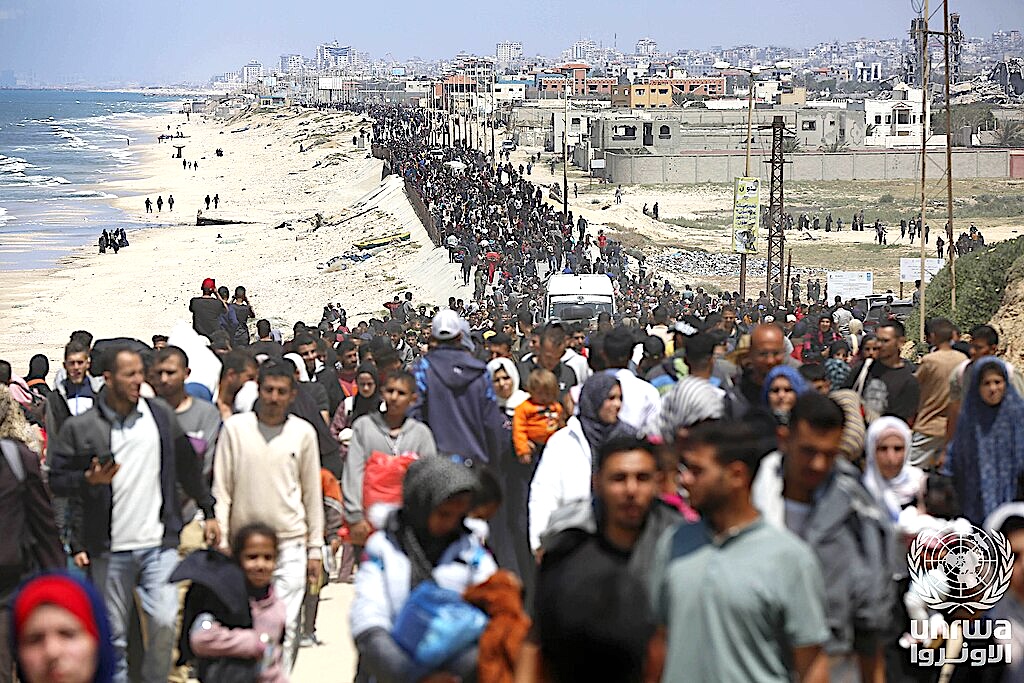
People displaced by Israeli attacks in April 2024 try to return to northern Gaza Strip by crossing the bridge over the estuary of the Wadi Gaza. (Ashraf Amra /United Nations Relief and Works Agency for Palestine Refugees in the Near East/ CC BY-SA 3.0 igo)
I have heard no murmur of censure or objection from any official quarter since the Zionist regime moved against Relief and Works and the 37 aid agencies now barred from entry into Gaza.
At writing, I read that the intent, shared by the Israelis and the Americans, is to take over all aid and welfare functions in the Gaza Strip, so eliminating any international presence in preparation for some kind of decisive cleansing.
Again silence in the Western capitals, and for that matter, in many others.
I would say this is almost as bad as what the Tel Aviv regime is now set on doing, except we don’t need any “almost.”
Official acquiescence, prevalent across the West, is just as bad — amounting to full-on abetment of the destruction of laws and legal structures that date to the signatures affixed in August 1945 to the U.N. Charter, including those of two Americans (President Harry Truman and James F. Byrnes, his secretary of state).
Do these laws and legal structures no longer have any defenders among the Western powers?
I pose the question while dreading the answer.
From the Zionist state’s multiple aggressions against the Palestinians of Gaza to the American state’s multiple aggressions against Venezuela and its people, breaches of law the running theme.
The Trump regime carried on for months this past year about the Maduro government’s illegitimacy, repression, corruption and complicity in drug-trafficking. This was mere pretense, as anyone capable of independent thought understood all along.
With Maduro now awaiting trial in the (profoundly corrupt) Southern District of New York, U.S. prosecutors have already begun to drop various of the charges against him, notably but I understand not only the allegation that Maduro led a cocaine-trafficking gang called Cartel de los Soles — which, it is now tacitly admitted, has never existed.
No, the Jan. 3 coup was never about drug interdiction and it is certainly not now about importing democracy — always a contradiction in terms — to the benefit of Venezuela’s 30 million people.
As Trump and his people are now willing to make baldly and boldly clear, this is about the unilateral seizure of Venezuelan petroleum resources, which Caracas nationalized — legally, with the assent of foreign concessionaires — 50 years ago.
This is an open admission that laws — American and international — are to be ignored.
I would add that ideological paranoia among the Washington policy cliques has driven the United States to subvert, on each occasion illegally, any form of social democracy in Latin America on numerous occasions — Guatemala, Cuba, Chile, etc. — and that Venezuela is another such case.
The ‘Iron Laws of the World’
In a much-noted interview Monday with Jake Tapper, the CNN presenter, Stephen Miller stunned us all with what I count the most significant statement to date to come from the Trump White House since the Jan. 3 invasion.
Miller is Trump’s deputy chief of staff (and one wonders whether he serves in the White House at the insistence of the Zionist donors who more or less own the Trumpster).
Miller’s topic in his exchange with Tapper was post–Venezuela geopolitics and included the White House’s puffed-up plan to assert sovereignty over Greenland.
For those who have not already seen the CNN segment or read a corporate media account of it:
“We live in a world in which you can talk all you want about international niceties and everything else, but we live in a world, in the real world, Jake, that is governed by strength, that is governed by force, that is governed by power. These are the iron laws of the world since the beginning of time.”
As to Greenland, where, by recent polls, 85 percent of its population opposes a U.S. takeover:
“The United States should have Greenland as part of the United States. There’s no need to even think or talk about this in the context that you’re asking of a military operation. Nobody’s going to fight the United States militarily over the future of Greenland.”
Once again, silence across the West in the face of these developments. Non–Western powers — China, Russia, Colombia, India, et al.— are to date the only nations to denounce the U.S. invasion and Maduro’s abduction.
Post-coup, Europe’s purported leaders offered profuse statements of support for international law but, when questioned, bobbed, weaved, and ducked as to whether the Jan. 3 intervention was legal or otherwise. Even the prospect of a U.S. takeover of Greenland leaves the European powers in the land of flaccid rhetoric.
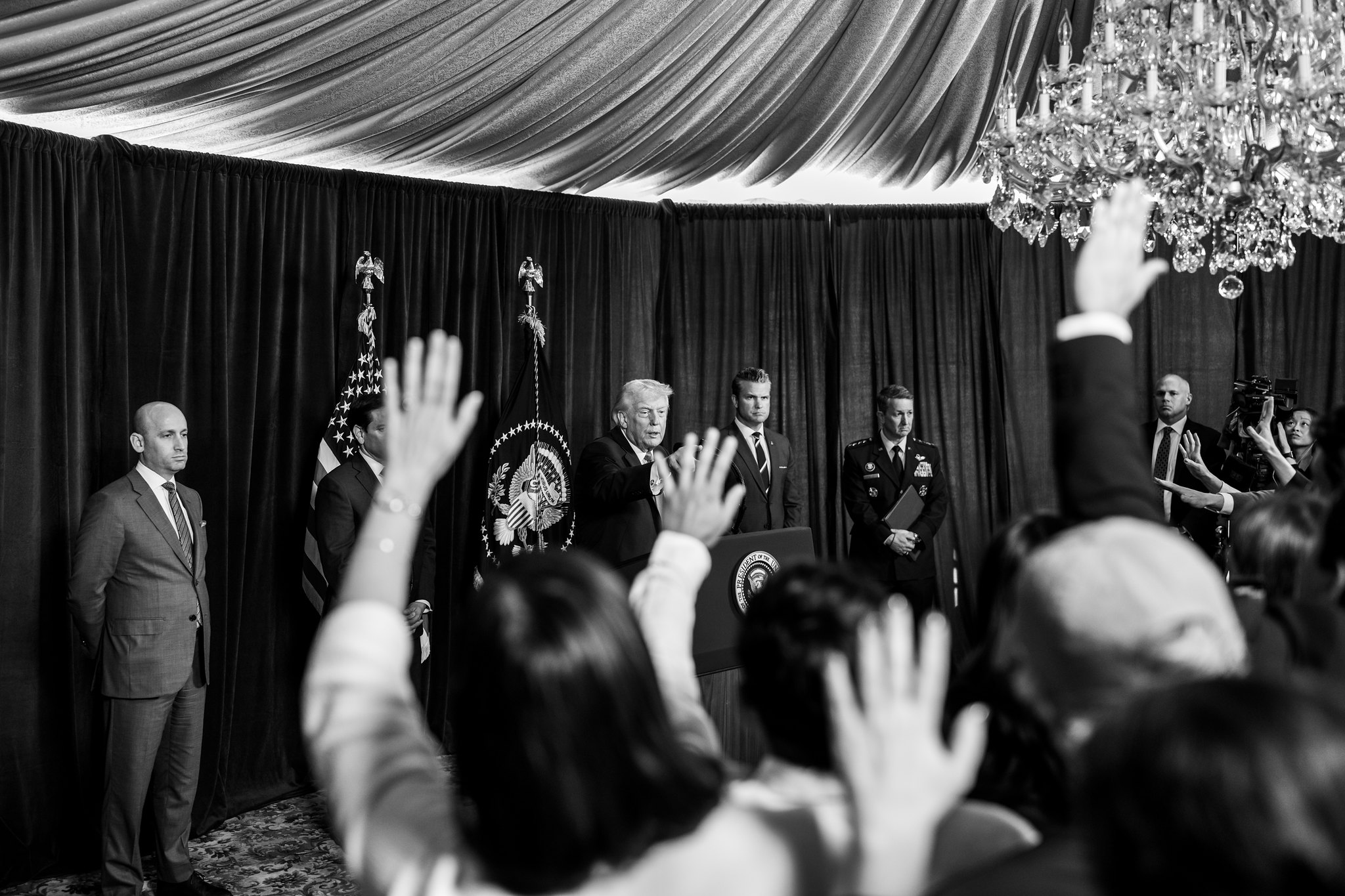
Trump during a press conference at Mar-a-Lago in Palm Beach, Florida, on Jan. 3, 2026, following the U.S. attack on Venezuela . Stephen Miller, deputy chief of staff for policy, on left. (White House / Molly Riley)
I have heard a dozen times the received wisdom as to Maduro’s unworthiness and the justice, therefore, of his removal by force.
Think for a moment, allowing for the sake of argument that these depictions of Maduro have any truth to them: What is this but an argument that ends justify means? History offers plentiful cases of where this principle leads, one more gruesome than the next.
But here we are, or here the Western powers are in the face of the strength, force, and power of which Stephen Miller spoke.
There is no expecting anything other from the Europeans, now that we have crossed the ocean.
You have the Brits profligately deploying their Draconian terrorism law, which dates to 2000, to detain anyone who merely speaks in public or holds a placard in support of Palestine Action, the honorable direct-action group — and increasingly in support of the Palestinian cause altogether.
Arbitrary arrests of those standing for a free Palestine and against Israeli terror, especially but not only in Germany, are now daily occurrences on the Continent.
In mid–December the European Union imposed sanctions on Jacques Baud, a highly distinguished commentator in independent media with a long record of official service behind him.
As I have written previously in this space, there was no known investigation before the E.U. moved against Baud, no legal proceeding, no trial: Baud is “guilty” — extrajudicially, and I do not distort or overstate the case here — of contradicting official accounts of events such as the provocations that led to Russia’s “special military operation” in Ukraine.
Such historically sound observations are now “against the law.”
Baud is the 57th European to find himself on a sanctions list Brussels is perfectly pleased to make public, and this list grows as we speak: It now runs to 59 names.
“The E.U. is using the sanctions list as a tool against critics and is maneuvering itself further and further into an abyss of lawlessness,” Michael von der Schulenburg and Ruth Firmenich, two German members of the European Parliament, remarked on the news of Baud’s fate.
Current Concerns, the twice-monthly journal published in German and French as well as English, has just published the von der Schulenburg–Firmenich statement.
In an abyss of lawlessness: Let us bookmark this phrase. It is our location as the new year begins.
Late Imperial America
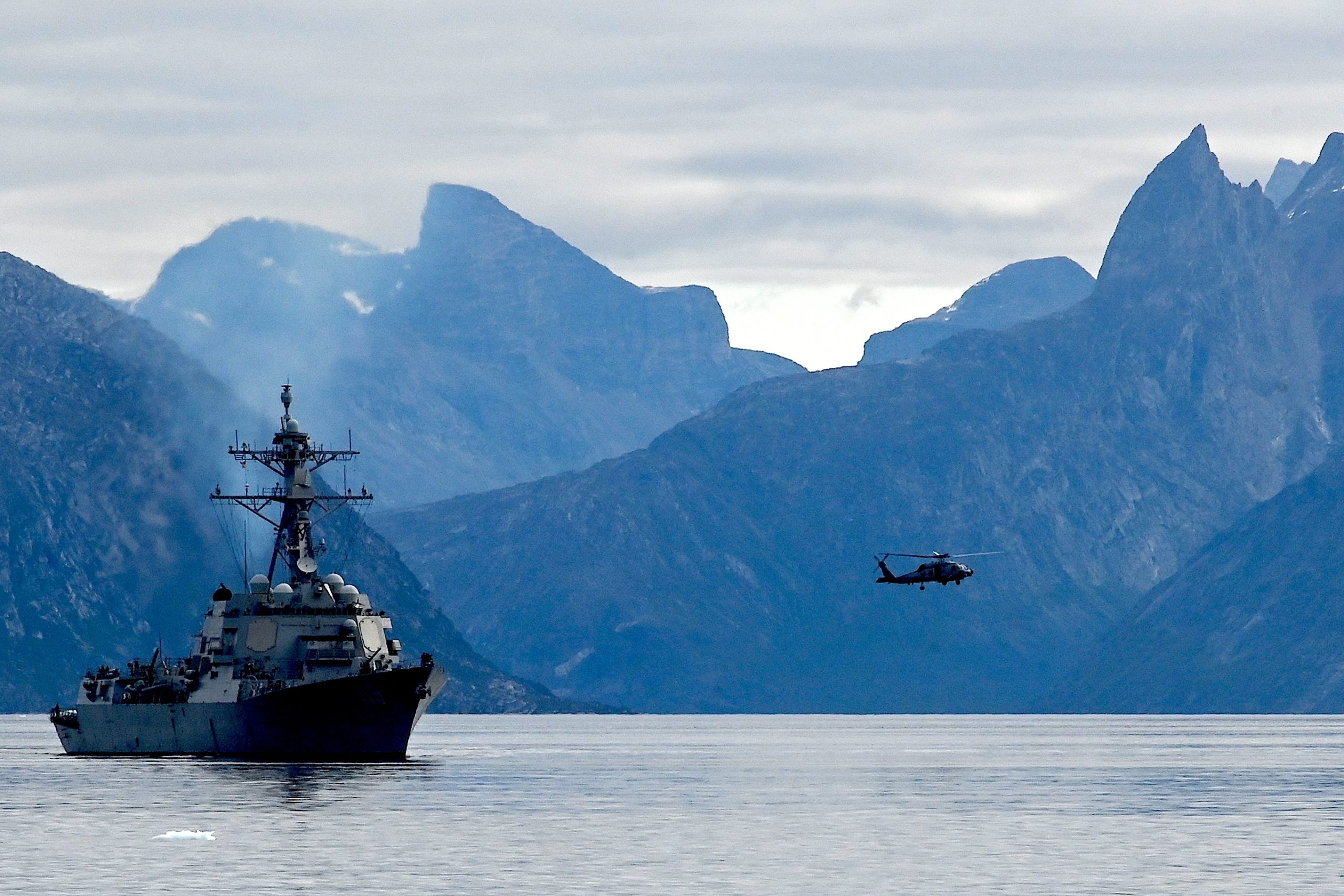
U.S. guided-missile destroyer USS Delbert D. Black and a U.S. Navy Seahawk helicopter aircrew in the Nuup Kagerlua Fjord, Aug. 21, 2024, near Nuuk, Greenland. (U.S. government/Wikimedia Commons/Public Domain)
Some years ago I reckoned that, counting from the attacks of Sept. 11, 2001, the United States had 25 years to decide whether to accept with wisdom, imagination, and a measure of courage that its decades of global primacy were ending, or to make a mess of itself and the rest of the world in a futile attempt to resist the turn of history’s wheel. I explored this thesis in Time No Longer: Americans After the American Century (Yale, 2013).
We now begin the 25th year, and what I thought held for the United States seems to me now to hold more or less equally for its trans–Atlantic dependencies, too.
An era is ending.
I understood even as I wrote that book the chance America would begin anew in a post-hegemonic, post-exceptionalist direction had to count as mostly theoretical.
But I never imagined the disarray and turmoil America and its trans–Atlantic clients were almost certain to cause would be this vicious, this desperate, this self-mutilating, this destructive of the laws the West had long counted essential to its strength and its claim to virtue.
Laws, to put a complex point simply, have an agreement implicit in them. Those living under one or another system of law have concurred among themselves to do so.
This is part of that “daily plebiscite” Ernest Renan wrote of in his famous 1882 lecture, Qu’est-ce qu’une nation? (“What is a Nation?”) “The consent of the governed” is the familiar phrase.
Properly conceived, law is impersonal: It is written to stand outside and above the interests of those who execute it as well as those who live under it. This constitutes a kind of pact.
It is not “the consent of the ruled.” Montesquieu considered this distinction, among his very many topics, in The Spirit of the Laws, his 1748 treatise, which was foundational to the thinking of America’s founders.
The celebrated baron was noted for the originality of “the separation of powers” — legislative, executive, judicial — as a theory of government.
Few principles have ever since been more fundamental to Western institutions. Another among these is the validity of legal precedent, which dates to the English system of common law.
Let us look around our abyss with these thoughts in mind.
The Trump regime only pretends to observe the separate power of the judiciary as it prosecutes Maduro in a New York jurisdiction. There is de facto no distinction between the executive and the judicial.
The same holds in spades in Jacque Baud’s case: The E.U. has sanctioned him, as noted above, and eliminated any independent judicial purview altogether.
As to legal precedent, in our abyss it counts for nothing. What is done one day leaves the doer free to act contrarily the next, while censuring some other power for doing the same thing.
The abuse of these principles, to finish the thought, is the front door, domestically and internationally, to the culture of impunity we see out our windows regardless of where we may be in the West.
“Lawless” is one way to describe what I and others count a new era we have entered upon. But I propose we take care to be clear about this term.
The West’s longstanding systems of law have been summarily discarded — I do not see this is as overstatement — and in this way we are without the laws we long counted legitimate.
But we have begun to live by other laws — laws determined by the principle of force alone, as Stephen Miller is pleased to tell us. There is no agreement or consent implicit in these laws.
They are used to rule, not govern. As Chas Freeman noted in a podcast interview the other day, “rule of law” gives way to “rule by law.”
And — very key, this — these laws are extravagantly arbitrary. Personal interests are often determinant, as in the obvious case of Donald Trump. This leads to a bitter paradox.
The fundamental principle of these new laws is that there is no law: They are applied to enforce what we call lawlessness — the condition we are required to accept. It becomes a question of nomenclature. Our time is lawless even as power imposes coercive regimes of law upon us.
The Zionists’ Role in the Collapse
Hardly was it difficult to foresee that America’s exceptionalist ideology, its elites’ lust for unending dominance, and various military-industrial interests would prevent any turn in the national ethos toward the good.
I assume I am not alone in failing to anticipate the shocking extent to which Israel and the powerful Zionists backing it would play so large a role in the West’s collapse into the abyss.
The power of the Zionist lobbies and the bribes used to corrupt law, the democratic process, and elected officials were plain enough. But I simply did not see the pervasive implications attaching to this power.
Our age of lawlessness has roots at least eight decades back in history, I insist we recognize.
It is bitter to acknowledge that what Stephen Miller dismissed as “international niceties” — the U.N. Charter, the Geneva Conventions, the International Court of Justice— have amounted, too much of the time, to little more than this since the United States assumed a position of global primacy after the 1945 victories.
Donald Trump, to put this point simply, is running the same empire that Presidents Johnson, Nixon, Carter, Reagan, Bush I, Clinton, Bush II, Obama, and Biden ran.
Trump is merely running it differently — more openly coercive, more nakedly dependent on power alone — because we are in a different time, and imperial America is now late-imperial America.
Our age of lawlessness is also our age of desperation, this is to say.
Shredding international law and domestic legal regimes while standing in front of a prime-time television camera is a response to an alternative world order swiftly taking shape in the non–West and, so, pressing itself upon the West.
The attack on Venezuela was also an attack on this order-in-formation.
The policy cliques and various elite constituencies in America have responded very badly — it could scarcely be worse — to the American century’s end. The Europeans, weakly and meekly, have merely followed.
But the state into which they have led the West is not sustainable. Disorder and lawlessness inevitably degenerate into more and graver disorder, lawlessness, and violence. This is not a winning strategy.
History teaches that the turmoil of our time — to describe our circumstance too mildly — can be, far from always, the mulch from which a new order will arise.
This may seem to us a very long game, but it is not so far off as one may imagine. That is up to us, the ruled at the moment.
What shall we do to govern ourselves once again?
Patrick Lawrence, a correspondent abroad for many years, chiefly for the International Herald Tribune, is a columnist, essayist, lecturer and author, most recently of Journalists and Their Shadows, available from Clarity Press or via Amazon. Other books include Time No Longer: Americans After the American Century. His Twitter account, @thefloutist, has been permanently censored.

No comments:
Post a Comment