
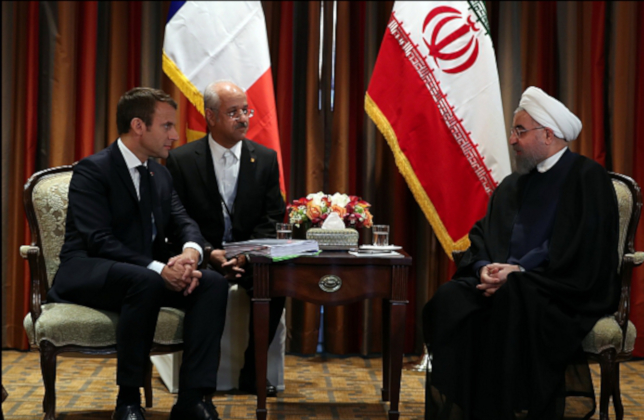
French President Emmanuel Macron and Iranian President Hassan Rouhani
by Shireen T. Hunter
Hopes for some sort of breakthrough in U.S.-Iran relations were thwarted at the United Nations General Assembly last week. A supposed deal struck by French President Emmanuel Macron to arrange a telephone conversation between Iranian President Hassan Rouhani and U.S. President Donald Trump did not go through. According to Iranian sources, Trump had agreed to at least give a verbal promise that he would lift sanctions against Iran in exchange for a talk with Rouhani. But Trump later seems to have changed his mind, tweeting that the Iranian side had demanded that sanctions be suspended before talks could take place and he said “No.” Rouhani issued a statement saying that Iran had accepted most of the French plan, but in the end the U.S. did not agree. Regardless of which of these versions is closer to the truth, no talks took place. Consequently, most likely the United States will continue with its so-called maximum pressure strategy and Iran will carry on with its so-called maximum resistance effort.
Iran did not score any points with European leaders at the UNGA either. The three key European states—France, Germany, and the United Kingdom—in a joint statement attributed responsibility for last month’s attacks on two oil installations in Saudi Arabia to Tehran, thus placing themselves solidly behind Riyadh and Washington.
A Slight Glimmer of Hope?
Despite setbacks at the international level to defuse Iran’s tensions with the U.S., a number of activities have recently happened at the regional level that might indicate a possible thaw in Iran’s relations with Saudi Arabia, and therefore with other Gulf Arab states.
The first step was taken by Tehran, when it introduced its not-so-new plan for regional cooperation with the goal of achieving stability and securing the safety of international shipping in the Persian Gulf, especially in the Strait of Hormuz. Iran’s plan envisages cooperation among eight regional states—the six members of the Gulf Cooperation Council plus Iran and Iraq. Earlier, Rouhani had said that Iran is willing to forget the past unfriendly actions of its Arab neighbors.
The Gulf states have not yet officially reacted to Iran’s latest proposal. But in an article in the Financial Times on September 30, Anwar Gargash, Minister of State for Foreign Affairs of the United Arab Emirates, laid out conditions for any reconciliation, let alone cooperation, with Tehran. His conditions include Iran giving up nuclear weapons (which Iran has already done), stopping the production of ballistic and other missiles, and ceasing its support for regional proxies so as to respect the sovereignty of other states. Moreover, Gargash wants an agreement that goes beyond the 2015 Iran nuclear deal (Joint Comprehensive Plan of Action or JCPOA) and involves the Gulf states in the negotiating process. There is no chance that Iran will accept any of these conditions from the UAE, if it has not done so when asked by the U.S. and Europe. Nevertheless, this may be just the UAE’s opening gambit. In light of meetings that took place earlier this year between Iranian and Emirati officials, Abu Dhabi is not keen for a military confrontation with Tehran.
A Potential Softening of the Saudi Position?
While the UAE, despite earlier efforts to prevent a military confrontation with Iran, seems to be sticking to its uncompromising position, there have been faint indications that Riyadh might be willing to engage in dialogue with Iran to ease tensions. Only a short time ago, Saudi Arabia was talking of taking the war inside Iran, and indeed in 2018 it tried to incite upheavals in Iran’s Khuzistan Province. But after the recent oil attacks, Riyadh appears to favor a political solution to its problems with Tehran.
Saudi Arabia’s setbacks in Yemen, the aftereffects of the Jamal Khashoggi murder, and, most importantly, the attacks on its oil installations seem to have had a sobering effect on Saudi Crown Prince Muhammad bin Salman. In fact, a spokesperson in Iran’s foreign ministry has acknowledged that Tehran has received messages from Riyadh. However, Saudi Minister of State for Foreign Affairs Adel al-Jubeir, via Twitter, has denied that claim. He only acknowledged that some countries friendly with both Tehran and Riyadh have been trying to ease tensions between the two states. This Saudi position is understandable because Riyadh would not want to give the impression that it has lost the game of influence to Tehran. In fact, if there is any hope for some form of breakthrough in Saudi-Iran relations, neither side can appear to be the loser.
Iraq As the Go Between
It appears that Iraqi Prime Minister Adel Abdul Mahdi, who visited Riyadh recently, might emerge as the go between for the Iranians and Saudis. While others, like Pakistani Prime Minister Imran Khan, might also be interested in serving that purpose, Iraq is better positioned as a potential mediator, in part because Islamabad is too close to Saudi Arabia. Iraq has good relations with Tehran and many of its Shia population would want Iran involved in regional affairs so as to offer a counterweight to the region’s Sunni governments. Meanwhile, its Sunni population has good ties with the Saudis and would like to see the kingdom balance Iranian influence and thus enable Iraq to play a more independent role in the region. In an ideal situation, Iraq , instead of being an arena of Saudi-Iranian competition, could become a place of accommodation between the two states and serve as a model for other parts of the Middle East.
However, recent unrest in Baghdad and other major Iraqi cities, coinciding with the approaching Arbaeen ceremonies—which annually bring large numbers of Iranian and other Shia pilgrims to Iraq to commemorate the 40th day after the seventh century martyrdom of the Shia Imam Hussein—could very well scuttle Iraq’s mediation efforts.
Iran’s initial response to these overtures has been positive. For example, Ali Larijani, the speaker of the Iranian parliament, has said that Tehran would welcome talks with Saudi Arabia. Iran, too, has valid reasons to want a reduction in tensions with Riyadh. Although the September 14 attacks on Saudi Arabia did not lead to a military riposte either by Saudi Arabia or the United States, there is no guarantee that similar incidents in the future—whether Tehran is responsible for them or not—would not result in military confrontation. In short, at this juncture, both Tehran and Riyadh might have realized how dangerous the current situation is and the magnitude of the risks that they are running. Therefore, they might be willing to compromise.
The Role of Outsiders
In view of the Persian Gulf’s geopolitical situation and the keen interest of outside players in its development, regional initiatives are unlikely to succeed unless they have the acquiescence of major players. Russia has already declared its support for the Iranian proposal. It is unlikely that China would object to it. However, the most important actor, the United States, is sure to oppose it. Already, the U.S. has revived the idea of creating an Arab version of the North Atlantic Treaty Organization (NATO). Israel, too, will oppose any reduction in tensions between Iran and the Gulf Arab states. Since 2003, Israel’s regional strategy has been based on exacerbating these tensions and thus moving the Gulf Arabs to its side.
In short, despite a glimmer of hope for reduced tensions in the Persian Gulf, formidable obstacles remain. Yet, given the risks involved in the current situation, regional and international players should encourage reduction of tensions in the Gulf. It has become abundantly clear that Arab-Iranian enmity will not solve the Middle East’s other major source of tension, namely the Palestine problem. It can only result in another devastating war. By contrast, if successful, a process of reconciliation in the Persian Gulf could help defuse tensions in the Levant as well.


