Showing posts with label Shireen T. Hunter. Show all posts

Saturday, October 05, 2019

Persian Gulf Arab States Should Accept Iran’s Olive Branch


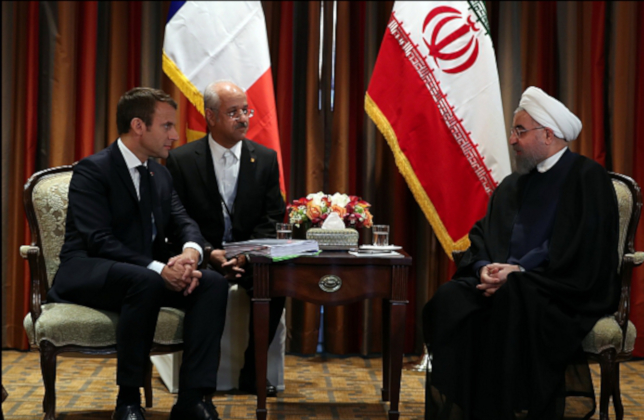
French President Emmanuel Macron and Iranian President Hassan Rouhani
by Shireen T. Hunter
Hopes for some sort of breakthrough in U.S.-Iran relations were thwarted at the United Nations General Assembly last week. A supposed deal struck by French President Emmanuel Macron to arrange a telephone conversation between Iranian President Hassan Rouhani and U.S. President Donald Trump did not go through. According to Iranian sources, Trump had agreed to at least give a verbal promise that he would lift sanctions against Iran in exchange for a talk with Rouhani. But Trump later seems to have changed his mind, tweeting that the Iranian side had demanded that sanctions be suspended before talks could take place and he said “No.” Rouhani issued a statement saying that Iran had accepted most of the French plan, but in the end the U.S. did not agree. Regardless of which of these versions is closer to the truth, no talks took place. Consequently, most likely the United States will continue with its so-called maximum pressure strategy and Iran will carry on with its so-called maximum resistance effort.
Iran did not score any points with European leaders at the UNGA either. The three key European states—France, Germany, and the United Kingdom—in a joint statement attributed responsibility for last month’s attacks on two oil installations in Saudi Arabia to Tehran, thus placing themselves solidly behind Riyadh and Washington.
A Slight Glimmer of Hope?
Despite setbacks at the international level to defuse Iran’s tensions with the U.S., a number of activities have recently happened at the regional level that might indicate a possible thaw in Iran’s relations with Saudi Arabia, and therefore with other Gulf Arab states.
The first step was taken by Tehran, when it introduced its not-so-new plan for regional cooperation with the goal of achieving stability and securing the safety of international shipping in the Persian Gulf, especially in the Strait of Hormuz. Iran’s plan envisages cooperation among eight regional states—the six members of the Gulf Cooperation Council plus Iran and Iraq. Earlier, Rouhani had said that Iran is willing to forget the past unfriendly actions of its Arab neighbors.
The Gulf states have not yet officially reacted to Iran’s latest proposal. But in an article in the Financial Times on September 30, Anwar Gargash, Minister of State for Foreign Affairs of the United Arab Emirates, laid out conditions for any reconciliation, let alone cooperation, with Tehran. His conditions include Iran giving up nuclear weapons (which Iran has already done), stopping the production of ballistic and other missiles, and ceasing its support for regional proxies so as to respect the sovereignty of other states. Moreover, Gargash wants an agreement that goes beyond the 2015 Iran nuclear deal (Joint Comprehensive Plan of Action or JCPOA) and involves the Gulf states in the negotiating process. There is no chance that Iran will accept any of these conditions from the UAE, if it has not done so when asked by the U.S. and Europe. Nevertheless, this may be just the UAE’s opening gambit. In light of meetings that took place earlier this year between Iranian and Emirati officials, Abu Dhabi is not keen for a military confrontation with Tehran.
A Potential Softening of the Saudi Position?
While the UAE, despite earlier efforts to prevent a military confrontation with Iran, seems to be sticking to its uncompromising position, there have been faint indications that Riyadh might be willing to engage in dialogue with Iran to ease tensions. Only a short time ago, Saudi Arabia was talking of taking the war inside Iran, and indeed in 2018 it tried to incite upheavals in Iran’s Khuzistan Province. But after the recent oil attacks, Riyadh appears to favor a political solution to its problems with Tehran.
Saudi Arabia’s setbacks in Yemen, the aftereffects of the Jamal Khashoggi murder, and, most importantly, the attacks on its oil installations seem to have had a sobering effect on Saudi Crown Prince Muhammad bin Salman. In fact, a spokesperson in Iran’s foreign ministry has acknowledged that Tehran has received messages from Riyadh. However, Saudi Minister of State for Foreign Affairs Adel al-Jubeir, via Twitter, has denied that claim. He only acknowledged that some countries friendly with both Tehran and Riyadh have been trying to ease tensions between the two states. This Saudi position is understandable because Riyadh would not want to give the impression that it has lost the game of influence to Tehran. In fact, if there is any hope for some form of breakthrough in Saudi-Iran relations, neither side can appear to be the loser.
Iraq As the Go Between
It appears that Iraqi Prime Minister Adel Abdul Mahdi, who visited Riyadh recently, might emerge as the go between for the Iranians and Saudis. While others, like Pakistani Prime Minister Imran Khan, might also be interested in serving that purpose, Iraq is better positioned as a potential mediator, in part because Islamabad is too close to Saudi Arabia. Iraq has good relations with Tehran and many of its Shia population would want Iran involved in regional affairs so as to offer a counterweight to the region’s Sunni governments. Meanwhile, its Sunni population has good ties with the Saudis and would like to see the kingdom balance Iranian influence and thus enable Iraq to play a more independent role in the region. In an ideal situation, Iraq , instead of being an arena of Saudi-Iranian competition, could become a place of accommodation between the two states and serve as a model for other parts of the Middle East.
However, recent unrest in Baghdad and other major Iraqi cities, coinciding with the approaching Arbaeen ceremonies—which annually bring large numbers of Iranian and other Shia pilgrims to Iraq to commemorate the 40th day after the seventh century martyrdom of the Shia Imam Hussein—could very well scuttle Iraq’s mediation efforts.
Iran’s initial response to these overtures has been positive. For example, Ali Larijani, the speaker of the Iranian parliament, has said that Tehran would welcome talks with Saudi Arabia. Iran, too, has valid reasons to want a reduction in tensions with Riyadh. Although the September 14 attacks on Saudi Arabia did not lead to a military riposte either by Saudi Arabia or the United States, there is no guarantee that similar incidents in the future—whether Tehran is responsible for them or not—would not result in military confrontation. In short, at this juncture, both Tehran and Riyadh might have realized how dangerous the current situation is and the magnitude of the risks that they are running. Therefore, they might be willing to compromise.
The Role of Outsiders
In view of the Persian Gulf’s geopolitical situation and the keen interest of outside players in its development, regional initiatives are unlikely to succeed unless they have the acquiescence of major players. Russia has already declared its support for the Iranian proposal. It is unlikely that China would object to it. However, the most important actor, the United States, is sure to oppose it. Already, the U.S. has revived the idea of creating an Arab version of the North Atlantic Treaty Organization (NATO). Israel, too, will oppose any reduction in tensions between Iran and the Gulf Arab states. Since 2003, Israel’s regional strategy has been based on exacerbating these tensions and thus moving the Gulf Arabs to its side.
In short, despite a glimmer of hope for reduced tensions in the Persian Gulf, formidable obstacles remain. Yet, given the risks involved in the current situation, regional and international players should encourage reduction of tensions in the Gulf. It has become abundantly clear that Arab-Iranian enmity will not solve the Middle East’s other major source of tension, namely the Palestine problem. It can only result in another devastating war. By contrast, if successful, a process of reconciliation in the Persian Gulf could help defuse tensions in the Levant as well.
avatar

SHIREEN HUNTER

Shireen Hunter is a University Associate with Georgetown University. From 2007 to 2014 She was a Visiting Professor and from 2014 until July 2019 she was a Research Professor at the School of Foreign Service. Her latest publication is Arab-Iranian Relations: Dynamics of Conflict and Accommodation, Rowman & Littlefield International, June 2019.

Saturday, July 13, 2019

War With Iran Would Not Mean Happy Ending For Middle East

by Shireen T. Hunter
A recent article by veteran Washington Post columnist David Ignatius urges Democratic Party politicians to adopt a harder posture on Iran. He seems to suggest that if Iran were to stop interfering in Middle East politics, all of the region’s problems would be solved. Ignatius quotes Karim Sajadpour of the Carnegie Endowment for Peace: “Tehran’s behavior is a constant source of friction in the region; really stability and security won’t be possible until Iran backs off.”
Such reasoning implies that Iran is at the root of all of the region’s problems. Yet a more balanced look at the history of Middle East’s problems and conflicts shows that since the Islamic revolution in 1979, Iran’s activities have at most complicated some of these conflicts rather than caused them.
Indeed, the Islamic revolution itself was partly the consequence of these disputes. For example, throughout the 1960s and the 1970s, various radical Arab states—from Nasser’s Egypt to Iraq’s Saddam Hussein and Libya’s Muammar Qadhafi plus various Palestinian groups—helped Islamist and leftist opposition groups in Iran with money and training, including in the PLO camps in Jordan and Lebanon.
The Israeli-Palestinian Dispute
According to a pervasive view since the 1990s, had it not been for Iran’s nefarious activities, the Palestinians and Israelis would now be living in peace.
True, Iran has supported some Palestinian groups such as Hamas. However, Iran has never been in a position to dictate to these groups or to prevent agreements between Israel and the Palestinian groups. For example, Iran could not prevent the Oslo accords of 1993. Nor was Iran responsible for their failure. Rather, the political dynamics of Israel and the Palestinians played the more decisive role.
Today, if President Donald Trump’s “Deal of the Century” is less than a resounding success—despite the support of Saudi Arabia, Bahrain, and the UAE along with the acquiescence of Jordan, Egypt, and Morocco—it will be because of the intrinsic dynamics of the problem. The bottom line is that no country can either force the Palestinians into an accommodation that they view as unfair or prevent them from reaching an accommodation if the offer is fair.  In short, no country can either deliver the Palestinians or block peace between them and Israel. Therefore, even in the aftermath of a war with Iran, the Palestinian issue would remain as intractable as it is today.
Lebanon, Syria, and Iraq
Lebanon’s present-day predicament is also a direct consequence of the Palestinian problem. Lebanon plunged into a long civil war when King Hussein of Jordan, during the so-called Black September Operations of 1970, kicked the PLO out of Jordan and into Lebanon. Then came the 1982 Israeli invasion of the country. This opened the way for now revolutionary Iran to create a toehold for itself. Iranian influence, through its relationship with the Hezbollah, has made Lebanese relations with Israel more problematic. However, Hezbollah is only able to do so because of the ongoing and unresolved Palestinian problem. If a viable agreement is reached between Israel and the Palestinians, Hezbollah’s ability to influence Arab politics would plummet.
No doubt, Iran’s help to Bashar al-Assad’s government in Syria has helped bolster it. But the real game- changer in the Syrian drama was Russia’s decision to stick by Assad. It was Russia’s entry into the conflict that raised the stakes of an extended American military intervention in Syria, not the presence of some ragtag Shia militia. Again, if the Israelis and the Western powers had offered Assad an attractive enough deal, such as the return of the Golan Heights, he would have ended his alliance of convenience with Iran. Even if Assad goes, no Syrian government with any legitimacy would forgo claims to the Golan. Thus Iran or no Iran, there would always be tension between Israel and any viable Syrian government. Only a truncated Syria could be persuaded to give up its claim to Golan.
Iran’s influence in Baghdad, which is much exaggerated, is the direct result of the 2003 American invasion of Iraq. This war was also waged under the misapprehension that once Saddam Hussein was gone, a thousand democratic flowers would bloom and the winds of democratic change would also topple Iran’s Islamist regime.
Yet the war only succeeded in bringing into the open Iraq’s ethnic and sectarian divisions and unleashing intense regional competition for influence within Iraq’s new political setup. If Iran disappeared from the map of the Middle East, Iraqi Shias would not likely submit to Saudi Arabia. In fact, more than Iranian machinations, it was the behavior of Iraq’s Sunnis towards the new government in Baghdad and the Saudi, Turkish, and Qatari sabotage of Iraq’s Shia-dominated government that led the country to turn towards Iran. It would also be naïve to assume that any Iranian government would have allowed Iraq to become a source of threat. The memory of Saddam Hussein’s 1980 invasion of Iran and the eight-year-long war is still very much alive.
Meanwhile, war with Iran would almost certainly extend into Iraq and could result in its total dismemberment.
Yemen
Yemen’s problems, too, have deeper roots related to its own ethnic and sectarian makeup and the impact of intra-Arab politics going back to the pro-Nasser coup d’etat of 1962 and the ensuing civil war. Saudi Arabia’s predatory approach to Yemen also dates back to the 1930s as part of the House of Saud’s conquest of Arabia. The current Houthi rebellion is the continuation of an as-yet-unresolved civil war.
Iran has used the Houthi rebellion as leverage against Saudi Arabia. However, when the Saudi King asks the United States to “cut the head of this snake”—Iran—no wonder Tehran wants to create trouble for Riyadh. Saudi Arabia is currently facing an utter mess not because of Iran but as a result of the behavior of its reckless crown prince Mohammad bin Salman. In a hurry to assert his position at home and in the Arab world, he embarked on a foolish adventure by launching the attack on Yemen. Moreover, the Yemen situation has become more complicated because another reckless crown prince, in the UAE, has seen the war as an opportunity to stake his claim to regional influence.
A war against Iran is more likely to complicate the situation in Yemen than to resolve it in any way satisfactory to the West and its Arab allies.
The notion that the Middle East’s problems are caused by a single country or a single personality has always been faulty. In the 1950s, it was thought that once you got rid of Mossadegh and later Gamal Abdel Nasser then everything would be fine. Then the focus shifted to Hafez al-Assad, Saddam Hussein, and Muammar Qadhafi. Even the shah of Iran, whose ambitions were once seen in the mid-1970s as dangerous for the Middle East, did not escape unscathed from this mind set.
None of these personalities has survived, and their countries are in turmoil. So is the Middle East despite many wars and coup d’etats. Another war would only make the situation worse for all concerned. In fact, the Middle East’s problems are partially the result of these external interventions. Real peace in the Middle East will come only if the legitimate security interests of all countries and peoples are addressed. Efforts at absolute subjugation always lead to new rebellions.
avatar

SHIREEN HUNTER

Shireen T. Hunter is a Research Professor at Georgetown University's School of Foreign Service. Her latest book is Iran's Relations with Arab States: Dynamics of Conflict and Accommodation (Rowman & Littlefield, forthcoming May 2019).