
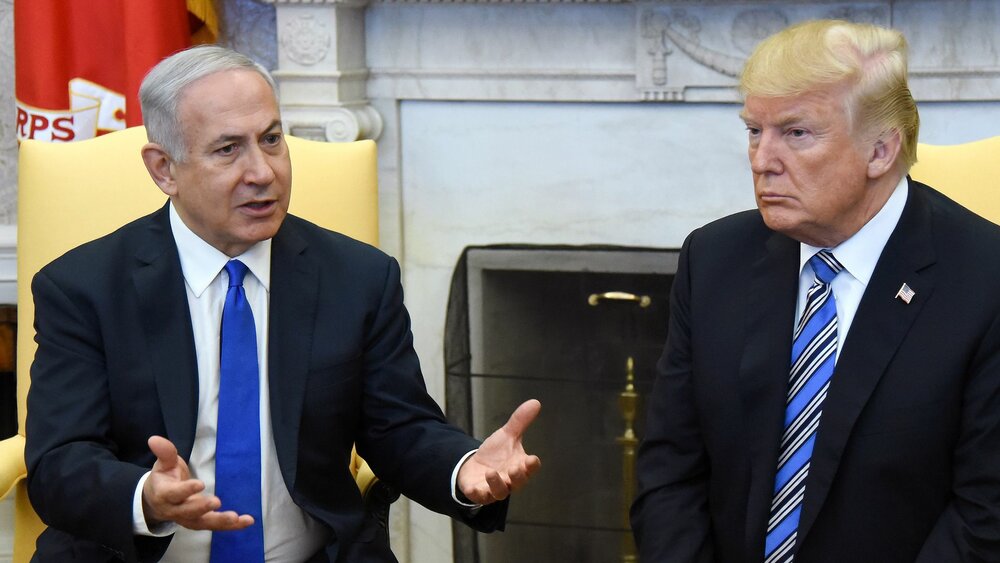
Israel Prime Minister Benjamin Netanyahu is headed to a record fifth term in office after narrowing defeating former military chief Benny Gantz. In a discussion with Democracy Now!’s Amy Goodman, Noam Chomsky talks about how President Trump directly interfered with the Israel election by repeatedly helping Netanyahu, from moving the U.S. Embassy to Jerusalem to recognizing Israel’s sovereignty over the Golan Heights in defiance of international law.
AMY GOODMAN: Noam, what about what’s happened in Israel, Prime Minister Netanyahu winning a record fifth term? Right before the election, he announces that he will annex illegal Israeli settlements in the occupied West Bank. Last month, Trump officially recognized Israeli sovereignty over the Golan Heights.
NOAM CHOMSKY: Well, first of all, if Benny Gantz had been elected instead of Netanyahu, the difference would not be very great. The difference between the two candidates is not substantial in terms of policy. Netanyahu—here’s another example of the extraterritorial reach of the United States. Netanyahu is somewhat more extreme. The United States desperately wanted him to be elected. And the Trump administration has been giving gift after gift to Netanyahu to try to get him elected. It was enough to carry him over the roughly 50/50—close to 50/50 election.
One of them, of course, was to move the embassy to Jerusalem, in violation of not only international law, but even Security Council resolutions that the U.S. had participated in. A very dramatic change.
A second, equally dramatic, was to authorize Israeli annexation of the Golan Heights. The Syrian Golan Heights are, under international law, occupied territory. Israel—every major institution, every relevant institution, Security Council, International Court of Justice, all agree on this. Israel did formally annex the Golan Heights. But the Security Council, U.N. Security Council, with the U.S. participating, declared that null and void. OK? Trump unilaterally reversed it—another gift to Netanyahu, saying, try to demonstrate to the Israeli public that, with U.S. backing, he can get anything they want.
The last was Trump’s latest, just before the election, his declaration that, if elected, he would annex parts of the West Bank. That was with tacit U.S. authorization.
These are strong measures that were taken to interfere radically with a foreign election. Have you heard something about how terrible it is to interfere in foreign elections? I think maybe that you noticed that somewhere. Here, it’s done radically. It’s considered fine. But exactly what are the actual consequences of that in terms of the way policy has been evolving? Fact of the matter is, not much.
So, take the annexation of the Golan Heights. In fact, it was declared null and void by the Security Council. It was condemned by the International Court of Justice. But did anybody do anything about it? Has any move been made to prevent Israel’s development of the Golan Heights, establishment of settlements, enterprises, development of ski resorts on Mount Hermon? Anything? No, nobody lifted a finger. And nobody lifted a finger for a simple reason: The U.S. won’tallow it. Nobody says that, but that’s the fact. Well, now it’s formally authorized, instead of just happening.
Take Netanyahu’s proposal to annex parts of the West Bank. That’s been going on for 50 years, literally. Right after the ’67 war, both political parties, both major groupings in Israel—the former Labor-based party, the Likud-based conglomerate—they have slightly different policies, but essentially they have been carrying out a development program in the West Bank which is geared towards the goal, the very clear goal, of creating what will be a kind of Greater Israel, in which Israel will take over whatever is of value in the West Bank, leave the Palestinian population concentrations—like in Nablus and Tulkarm—leave them isolated. In the rest of the region, there are maybe 150 or so little Palestinian enclaves, more or less surrounded by checkpoints, often separated from their fields, able to survive, but barely.
Meanwhile, Jewish settlements are developed. Cities have been constructed—a major city, Ma’ale Adumim, constructed mostly under Clinton, incidentally, under the Clinton years, east of Jerusalem. The road to it essentially bisects the West Bank. Further ones up north. Jerusalem itself is maybe five times the size of what it ever was historically. All of these are linked by highly developed infrastructure projects. You can take a trip. You can—this is basically creating pleasant suburbs of Tel Aviv and Jerusalem in the West Bank. You can travel from Ma’ale Adumim to Tel Aviv on a big highway, restricted to Israelis and tourists, not Palestinians, more easily than you can get from the South Shore to Boston—never seeing an Arab.
All of this has been steadily developed, year after year, with tacit U.S. support. U.S. provides the diplomatic support, a lot of the economic support, the military aid. And meanwhile, the government says, “We don’t like it. Stop doing it,” but providing the means for it. Well, the only difference in Netanyahu’s statement with Trump’s tacit backing is, “I’m going to go ahead and annex it, annex all of this, instead of just developing it, subject to eventual annexation.” These are the real things that have been happening.
Now, the Netanyahu victory, as I mentioned before, solidifies an alliance that is being—that has been developed, that’s been—parts of it have been kind of undercover for years, not formal, but functioning, now coming into the open, of the most reactionary Arab states—primarily Saudi Arabia, one of the most reactionary states in the world; Egypt, under the Sisi dictatorship, the worst dictatorship in Egypt’s history; the United Arab Emirates, similar; Israel, right in the center of it. It’s part of the international right-wing alliance system, the international reactionary, ultranationalist alliance system that’s taking shape with the U.S. leadership, a kind of a new global system that’s developing. South America, under Bolsonaro, is another part of it.
AMY GOODMAN: And yet, in the United States, there’s this growing awareness. For example, the Democratic-Republican vote against Saudi Arabia-UAE’s war in Yemen, fueled by the United States. Does that give you hope?
NOAM CHOMSKY: That’s a very interesting development. That’s actually Bernie Sanders. It’s what—and notice—and it is a very important development, but let’s notice what happened. The Saudi-United Arab Emirate war in Yemen has been a hideous atrocity. There’s probably—nobody knows—maybe 60,000, 70,000 people killed, half the population barely surviving. The U.N. describes it as the worst humanitarian disaster in the world. It’s a real monstrosity. It’s been going on year after year, using—Saudi Arabia, UAE are using U.S. weapons—secondarily, British weapons—U.S. intelligence support, U.S. intelligence directly working closely with the Saudis to target bombing and so on and so forth. All of this has been happening with no protest.
Then came the Khashoggi killing, brutal killing of a journalist for The Washington Post. That caused outrage. OK? It should have, but, you know, that’s not the reason why the Yemen war should have suddenly had the spotlight shined on it. But it was. Then Bernie Sanders came along, with a couple of others, and initiated the legislation, which put some crimps in the direct U.S. support for the war. Which is significant, but we should put it in the context of what in fact happened. And I think we can be pretty confident that the Trump-Pompeo-Bolton triumvirate will find a way around it and keep the war going—unless the public seriously protests.
Now, there is something else that’s worth paying attention to. The support for Israeli expansionism, repression, the whole alliance that’s developing, that support has shifted in the United States from the more liberal sectors—roughly, the Democratic Party—to the far right. Not very long ago, support for Israel was based passionately in the liberal sectors of the population. It was a Democratic issue. It isn’t anymore. In fact, if you look in the polls, people who identify themselves as Democrats by now tend to support Palestinian rights more than Israel. That’s a dramatic change. Support for Israel now is in the most reactionary parts of the population: evangelical Christians, ultranationalists. Basically, it’s a far-right issue. Among younger people, this is even more the case.
I mean, I can see it myself, just in my own personal experience. Up until about maybe 10 or 15 years ago, if I was giving a talk at a university on Israel-Palestine, even my own university, MIT, I had to have police protection, literally. Police would try to prevent the meeting from being broken up. They wouldn’t let me walk to my car alone. I had to be accompanied by police. Meetings were broken up. Nobody was objecting to any this. It was happening all the time. That’s changed totally. And it’s a very significant change. I think that sooner or later—I hope sooner—this may lead to a shift in U.S. policy.
There are some very simple moves that could be made in U.S. policy that would change the situation in the Middle East dramatically. So, for example, one simple proposal is that the United States government should live up to U.S. law. That doesn’t sound too dramatic. The United States has laws, like the so-called Leahy Law, Patrick Leahy Law, which requires that no military aid can be given to any military organization that is involved in systematic human rights abuses. Well, the Israeli army is involved in massive human rights abuses. If the U.S. were to live up to U.S. law, we would cut off aid to the IDF, the Israeli army. That step alone would have a major effect, not just the material aid, but the symbolic meaning of it. And it’s quite possible that with the shift of public opinion, especially among younger people, there might come a point when there will be a call for the United States to follow its own laws. OK? Again, not a very dramatic appeal. And it wouldn’t even be breaking new ground.
(Source: democracynow.org)

