Showing posts with label Kyrgyzstan. Show all posts

Wednesday, July 31, 2019

What Does the Future Hold for Turkmenistan?

TURK5435322
According to the World Happiness Report — 2019, which is published on a yearly basis by the United Nations Sustainable Development Solutions Network, Turkmenistan, quite a resource-rich player in the Caspian region, ended up in 87th place, thus becoming the unhappiest nation among its Central Asian neighbors based on this ranking. Assessment criteria, such as GDP per capita, life expectancy, social support and the effect freedom and corruption have on important decision making processes, were used. A 10-point scale was employed to rate each of these indicators, and then an average was calculated for each nation.
This country has approximately 10% of the world’s proven natural gas reserves (it has the largest natural gas deposits in the world and is in fourth place in terms of proven reserves) and access to the Caspian Sea. Hence leading world players focus a great deal of their attention on this nation.
According to global rating agencies, the potential for economic growth in Turkmenistan, as well as in other Central Asian countries, is significantly limited by the fact that these countries are not well integrated into the world trading system. In addition, the global trade-associated costs that Central Asian economies have to bear are comparable only to those of African nations with no ocean access. This is why Turkmenistan and other countries in Central Asia have actively supported China’s ‘Silk Road Economic Belt’ initiative and its lending policy to implement this project in the region, in the hope that on its completion, Central Asia, due to its location and wealth of resources, would be the biggest beneficiary.
Based on various estimates, Turkmenistan’s external debt amounts to from $9 to $11.16 billion. However, official agencies do not provide detailed information on who this nation owes money to or the size of these debts. All the economic initiatives in Turkmenistan, which Ashgabat defines as vitally important, are first and foremost in China’s interests. For example, more than 90% of Turkmenistan’s entire natural gas exports go the PRC. And the sale of this natural resource is the largest source of income for Ashgabat. Moreover, the lion’s share of the profits is used to pay off these Chinese loans. As a result, in its push towards independence from Russia, Turkmenistan has become increasingly indebted to China. And it is hard to say whether it will be able to escape from the debt trap.
In recent months, Turkmenistan has experienced hyperinflation, and more disturbingly a countrywide food shortage. Experts at the Cato Institute believe that the level of inflation in this nation was at 294% in June 2018.
Turkmenistan does not have a large population, and if sensible economic policies were employed, it would be possible to feed all these people. According to analysts at the World Bank, the population of Turkmenistan was 5.7 million in 2017. However, many experts believe that the actual number is substantially lower, amounting to approximately 3.3 million Turkmen citizens, and more than 1.5 million Turkmens in the past 10 years have supposedly left the nation.
A failed harvest dealt a serious blow to the country’s economy. Since wheat and barley crops were severely damaged by a flood, there was a shortage of flour in a number of regions and even in the capital. And, currently, its sale to the residents is restricted to no more than 5 kg per person a month. Even with this rationing, there is not always enough bread for everyone. As a result, every day there are long queues in front of shops, where serious fights break out and overcrowding leads to jostling. There have even been a few casualties (at least two people were killed while queuing for bread in March and April). Several observers partially attribute the flour shortage to the foreign policy gesture made by the nations’ President Gurbanguly Berdimuhamedow, who sent humanitarian aid to certain neighboring Afghani provinces where locals were also affected by the spring floods. But this aid did not come from reserves but instead from stocks meant for Turkmen citizens.
Many experts have been talking about the crises in Turkmenistan. For example, the Al Jazeera Media Network published an article entitled Hyperinflation and hunger: Turkmenistan on ‘edge of catastrophe’, which stated (with a reference to Britain’s Foreign Policy Centre) that Turkmenistan was facing the worst economic crisis in the last 30 years.
The International Partnership for Human Rights (IPHR) and the Turkmen Initiative for Human Rights (TIHR) accused the leadership of Turkmenistan of concealing the state of the economic crisis in the nation. The published report states that there is no official information about the economic situation, and that experts have not been allowed into the nation.
Observers have noted that rising discontent has not turned into anti-government protests as yet, which is, in large part, accounted for by the political behavior specific to Turkmenistan and the presence of powerful punitive structures in the nation.
According to a number of experts, the internal crisis in the country may very quickly transform into a large-scale catastrophe, mostly because of the recent rise of Daesh (a terrorist organization banned in the Russian Federation), which has been consolidating its forces in Afghanistan. It is common knowledge that this terrorist group is currently searching for a ‘home base’, where extremists could try and establish themselves and form new cells. After all, Daesh tends to flourish in places where there is a socio-economic crisis and ingrained social issues, and where governments are unable to meet even their most basic social obligations which, as a rule, any state bears towards its citizen. Increasing radicalization of citizens stems from a high level of poverty, unemployment, a large percentage of young people within the population, as well as an ideological vacuum, corruption and low levels of religious education.

Turkmenistan, as well as other Central Asian countries, is already in the sphere of influence of three geopolitical rivals in the Muslim world: Iran, Saudi Arabia and Turkey. For example, Turkey is lobbying for a faster unification of nations where Turkic languages are spoken, and is, at the same time, trying to consolidate its role as one of the new centers in favor of progressive Islam.

In comparison to Uzbekistan with its ongoing reforms, Tajikistan, which is undergoing a political transition, and democratic Kyrgyzstan, Turkmenistan is viewed by many foreign experts (who predict unavoidable changes in it) as an archaic nation. Changes in this country may be brought about, on the one hand, by a severe socio-economic crisis, and, on the other hand, by challenges posed by pro-Islamic movements, which could have consequences for Turkmenistan’s geopolitical players. For example, the attitude towards China may sour if things become worse for the Muslims living in the autonomous region of Xinjiang. A similar reaction may follow in relation to the United States, which has a checkered reputation in the Muslim world.

This is why, rivalry of regional and international interests with respect to Turkmenistan will only intensify in the nearest future.

Valery Kulikov, expert politologist, exclusively for the online magazine ‘New Eastern Outlook’. 

Monday, May 06, 2019

Closing Military Bases, Opening a New World

By David Swanson, Executive Director of World BEYOND War, May 2, 2019


In a day and age when many of us are taught to overcome prejudice and behave respectfully toward all, mainstream U.S. media and school texts still habitually portray U.S. lives as the only lives that really matter. A plane crash that kills dozens of human beings is reported, just like a war, with the bulk of the coverage on the handful of U.S. lives lost. A U.S. military commander’s decision to bomb a village rather than subject his troops to ground combat is depicted as an act of enlightenment. The U.S. Civil War is almost universally labeled the deadliest of all U.S. wars, despite the fact that many U.S. wars have killed many more human beings — including U.S. human beings if Filipinos were U.S. citizens during the Philippine-American war or World War II.
In an age when we are generally taught to solve our problems nonviolently, the exception for the organized mass murder of war remains. But wars are increasingly marketed, not as protection from the Adolf Hitler of the Month (last month’s weapons customer), but as acts of philanthropy and benevolence, preventing massacres by bombing cities, or delivering humanitarian aid by bombing cities, or developing democracies by bombing cities.
So, why does the United States maintain troops in at least 175 countries, and roughly 1,000 major military bases in over 80 countries outside the United States and its colonies? This is a practice whose development depended on racism. When old-fashioned colonies became unnecessary for rubber, tin, and other materials that chemists could create, the exception of oil remained, and the desire to maintain troops near potential new wars (how ever progressively marketed) remained. Now that it is clear to most of us that oil will render the earth uninhabitable, that the United States can get its planes, ships, drones, and troops to any spot on earth rapidly without any nearby base, and that all human beings are equally capable of creating such splendorous monuments to self-government as the campaign ad, the gerrymandered district, and the unverifiable voting machine, it’s mostly the belief that non-U.S. people don’t matter that remains.
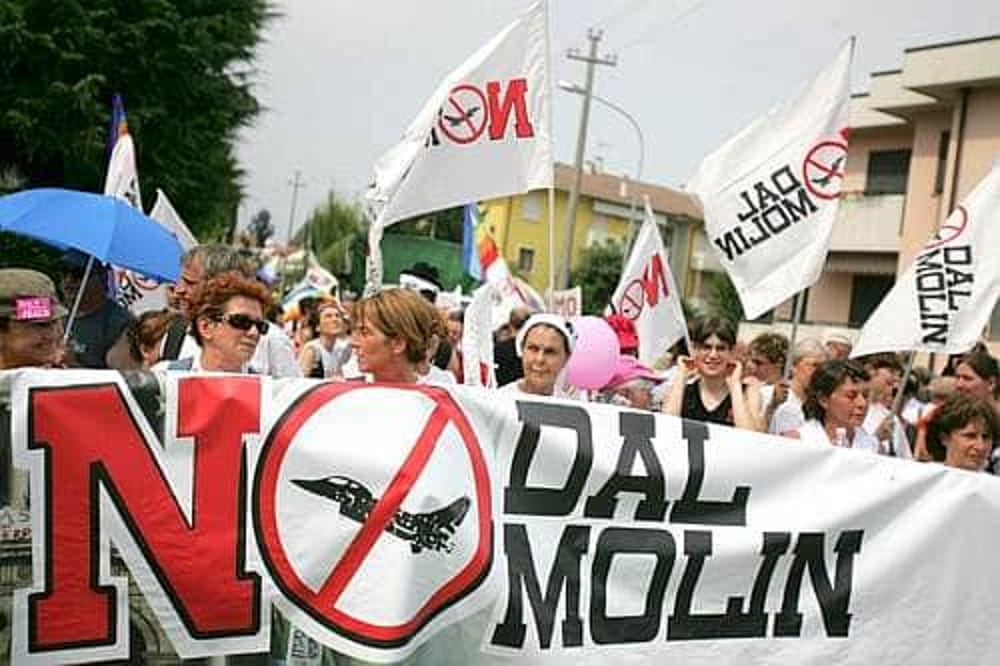
There are profits to be made, and weapons-buying or oil-selling or labor-exploiting dictatorships to be propped up. There’s the inertia of the way things are. There’s the perverse drive to dominate the globe. But the marketing scheme for the global archipelago of bases comes down to the need to police people for their own good, even though they mostly believe it harms them. The presence of not a single foreign U.S. or NATO base has been approved by a public referendum. Numerous such bases have been voted down by public referenda (including one in February 2019 in Okinawa), not a single one of which has been honored by the U.S. government. Many bases are the targets of massive nonviolent protests even before their construction, and for years or decades after.
Most bases are gated communities on steroids. The residents can come out, visit brothels, drink, crash their cars and sometimes airplanes, and commit crimes immune from local prosecution. The bases can emit pollutants and poisons, render the local drinking water deadly, and answer to nobody in the nation being “served” by the base. Those who live outside the base, unless employed there, cannot come in to visit the Little America built inside the walls: the super markets, fast food restaurants, schools, gyms, hospitals, childcare centers, golf courses.
An empire of bases is an empire of very little land, but it is no more land that was “available” than the Americas were empty and awaiting European “discovery.” Countless villages and farms have been eradicated, populations evicted from islands, those islands bombed and poisoned into uninhabitablity. This process describes significant portions of Hawaii, of the Aleutian Islands of Alaska, Bikini Atoll, Enewetak Atoll, Lib Island, Kwajalein Atoll, Ebeye, Vieques, Culebra, Okinawa, Thule, Diego Garcia, and other locations most people in the United States have never heard of. South Korea has evicted large numbers of people from their homes to make way for U.S. bases in recent years. Pagan Island is a new target for destruction.
While the rest of the world’s nations combined have a couple of dozen military bases outside their borders, and while the wealthier nations of the world are leaving the United States behind in health, happiness, life expectancy, education, and other measures of well-being, the United States goes right on building and maintaining more bases around the world at great expense (over $100 billion every year), and at great risk. This has been true during every recent U.S. presidency. President Donald Trump may yet get a big new base named for him in Poland, though it is in Asia and Africa that the heaviest base construction is underway.
Bases hold missiles as well as troops, and new bases in Romania and elsewhere have contributed to the highest ever risk of nuclear apocalypse. Bases have generated, motivated, and served as training grounds for terrorism, including such famous terrorist attacks as those of 9-11, driven by opposition to bases in Saudi Arabia, and groups like ISIS, organized in prison camps at U.S. bases in Iraq. An explicit purpose in launching and continuing many wars, including those on Afghanistan and Iraq, is to establish bases. Bases are also used as locations to torture people ostensibly outside the rule of any law. When Congress Members suspect that U.S. troops might someday leave Syria or South Korea, they are quick to insist upon a permanent presence, though they are somewhat mollified when White House officials suggest that any troops leaving Syria will only make it as far as Iraq, from which they will be able to quickly attack Iran as “needed.”
The good news is that sometimes people can shut down bases, as when farmers in Japanprevented the construction of a U.S. base in 1957, or when the people of Puerto Rico kicked the U.S. Navy out of Culebra in 1974, and after years of effort, out of Vieques in 2003. Native Americans evicted a Canadian military base from their land in 2013. People of the Marshall Islands shortened a U.S. base lease in 1983. The people of the Philippines kicked out all U.S. bases in 1992 (though the U.S. later returned). A women’s peace camp helped get U.S. missiles out of England in 1993. U.S. bases left Midway Island in 1993 and Bermuda in 1995. Hawaiians won back an island in 2003. In 2007 localities in the Czech Republic held referenda that matched national opinion polls and demonstrations; their opposition moved their government to refuse to host a U.S. base. Saudi Arabia closed its U.S. bases in 2003 (later reopened), as did Uzbekistan in 2005, Kyrgyzstan in 2009. The U.S. military decided it had done enough damage to Johnston/Kalama Atoll in 2004. In 2007, the President of Ecuador answered public demand, and exposed hypocrisy, by announcing the United States would need to host an Ecuadorean base or shut down its base in Ecuador.
There have been many incomplete victories. In Okinawa, when one base is blocked, another is proposed. But a broad and global movement is being built that is sharing strategies and providing assistance across borders. At World BEYOND War we are putting a major focus on this effort, and have helped to start up a D.C. insider coalition called Overseas Base Realignment and Closure Coalition, drawing heavily on the work of David Vine and his book Base Nation. We’ve also been part of launching a global activist coalition to educate and mobilize people for the closure of U.S. and NATO military bases. This effort has produced a conference in Baltimore, Md., in January 2018, and one in Dublin, Ireland, in November 2018.
Some of the angles finding traction and being shared around the world are environmental. U.S. bases are poisoning ground water, not just all over the United States, where the Pentagon is seeking to legalize such practices, but all over the world, where it needn’t bother. The reasons the Pentagon needn’t bother legalizing destruction abroad ultimately depend on the last remaining widely accepted bigotry in U.S. culture, namely that against every non-U.S. culture.
As the anti-base movement grows, it must work with activists who oppose Western Empire without opposing violence. Spreading the skills of nonviolent activism will be crucial. It must also figure out how to work with that uniquely U.S.ian creation: libertarianism. One way might be this: encourage pressure on Trump to continue demanding that nations occupied by (or “hosting”) U.S. bases pay larger fees for the “service.” We can do this while encouraging governments around the world to respond with a polite “Don’t let the door hit you on your way out.”
At the same time, we cannot lose track of the new world that would be made possible by moving resources away from the maintenance of bases, and away from the even more costly wars they instigate. With this kind of money, the United States could transformboth itself and global foreign aid.

David Swanson

David Swanson is an author, activist, journalist, and radio host. He is director of WorldBeyondWar.org and campaign coordinator for RootsAction.org. Swanson's books include War Is A Lie. He blogs at DavidSwanson.org and WarIsACrime.org. He hosts Talk Nation Radio and is a 2015 Nobel Peace Prize nominee.

Saturday, March 02, 2019

Analyzing the Politics of Central Asia

Islamic momentum being contained by totalitarian rule

By Ahmed Makhmoudov

Muslims around the world associate Central Asia with classical Islamic scholars like Muhammad al-Bukhari or Abu Mansur al-Maturidi and the so-called Muslim golden age. Thus, most Muslims have a romanticized and often unrealistic perception of contemporary Central Asia. Many Muslims simply do not realize that after living under Russian colonialism for 70 years as part of the communist and atheist USSR, many Muslim countries of Central Asia have become greatly detached from Islam.
Even worse, the current unelected regimes in Central Asia are as hostile to Islam as the Soviet Union was. In fact, today, in most non-Muslim states of the former Soviet Union (FSU), the basic rights of Muslims are far better guaranteed than in any Central Asian state.
With this in mind, let us briefly consider what to realistically expect in Central Asia in terms of socio-political developments in the near future. In Kazakhstan, Tajikistan, Turkmenistan, and Uzbekistan, all these countries’ ex-communist officials rule with an iron fist. They have established family-based ruling castes, except for Kyrgyzstan.
Over the past years, Crescent International has conducted several analyses on Central Asia, Kyrgyzstan and Tajikistan in particular. In our recent analysis on US-Russia relations in a post-Donald Trump presidency we have stated that “…NATO regimes see the Achilles heel of Russia. Thus, the campaign of destabilization in Central Asia is coming, as this will also create additional headaches for China. Beijing’s harsh measures against the Muslims of East Turkistan and the Western corporate media’s wide coverage of their plight are warning signals.” Taking this into consideration, let us briefly examine what likely developments might occur in each Central Asian country.
Turkmenistan was for decades ruled after its independence in the 1990s by a megalomaniac ex-Soviet official, Saparmurat Atayevich Niyazov. During his presidency, Niyazov wrote a “holy” book and hinted that he was a prophet. After Niyazov’s death in 2006, an equally ridiculous ruler replaced him, Gurbanguly Berdimuhamedow, who is grooming his son to succeed him. All the visible opposition to the regime exists only abroad, mainly in Western countries. The regime in Turkmenistan used to provide free gas, water, and electricity to people; this ended in October 2017. No one objected, not only due to the iron-fist rule but also because Turkmen society made no intellectual and institutional transformation from the Soviet era. For example, even though neighboring Azerbaijan has an autocratic regime, during the period 1988 to 1995, the Azerbaijani society had a short-lived break with Soviet style control, something Turkmens never experienced.
Thus, it is unrealistic to expect any sort of real socio-political transformation soon. One of the “problematic” features of Niyazov’s presidency was that he did not appoint a successor. He did not trust even his own family. Thus, after his death Berdimuhamedow took over. The current ruler is clearly grooming his son for succession.
There is very little authentic information about what is taking place in Turkmenistan. However, if at Niyazov’s death the system did not experience any shocks during the short power vacuum, it is highly unlikely that any changes will take place under the current circumstances.
After the death of dictator Islam Karimov in 2016, Uzbekistan witnessed a swap within the ruling elite. Karimov’s family was sidelined and the presidency was taken over by Karimov’s Prime Minister, Shavkat Miromonovich Mirziyoyev. Thus, it was a simple change of faces where no substantial policy or institutional transformation occurred.
Even though Uzbekistan possesses more internal politically active opposition groups in comparison with Turkmenistan and Kazakhstan, they are weak and under severe government pressure. The Islamic organizations in Uzbekistan have been harshly persecuted and the regime intentionally allowed the Wahhabi minded groups in the country to co-opt some of the youth to undercut authentic local Islamic organizations.
The smooth transition after Karimov’s death indicates that the ruling caste in Uzbekistan managed to organize itself into a coherent faction. Unless there is a severe economic crisis, the ruling caste is under no immediate threat. The socio-economic situation in Uzbekistan depends largely on how Moscow would treat the more than 1.5 million Uzbek migrant workers in Russia who send substantial amounts of remittances back home. It is highly unlikely that Moscow would deliberately sabotage its neighbors who could destabilize Russia itself. Thus, the autocratic regime in Uzbekistan is under no immediate threat.
Kazakhstan nearly the size of Western Europe, possesses vast natural resources and a population of about 17 million. It is one of the more prosperous states of Central Asia. Like its neighbors, it is ruled by an ex-communist official, Nursultan Nazarbayev. He has transformed the government of Kazakhstan into a family affair. Compared to other Central Asian states, the Kazakh society is the most Russified and secular. Kazakhstan is estimated to have 3.7 million Russians and since the days of the former Soviet Union, non-Muslim Russian cultural norms have been dominantwithin Kazakhstan. There is no strong opposition; the only potential upheaval may occur during the transition period when the 78-year-old Nazarbayev dies. Considering Kazakhstan’s better socio-economic situation than other Central Asian countries, there is no reason to believe that the ruling elite will not be able to repeat the transition pattern of Uzbekistan.

Kyrgyzstan has proved to be the country of major surprises in Central Asia. The Kyrgyz people overthrew the remnants of Soviet rule in 2005. Once the new government was formed in 2010, it began to openly slide toward corruption. This phenomenon was a major shock to regional despots and powers. Currently Kyrgyzstan is the least authoritarian state in Central Asia. 

Sooronbai Zheenbekov

It is highly unlikely that it will slide back to the same degree of authoritarianism as the people have mustered enough confidence to challenge any group in power. In terms of an Islamic movement rising to power in Kyrgyzstan, it is highly unlikely because it is disorganized and the Russian default position in Central Asia is to have less Islam in the public sphere. Thus, the secular Kyrgyz government can count on Moscow’s assistance in containing the limited Islamic revival within Kyrgyz society.
Tajikistan has always been the pioneer of Islamic revival in the post-Soviet era, a perspective confirmed by facts and even by the detractors of Islamic revival. However, overall, the track record of the most successful Islamic organization in Central Asia, the Islamic Renaissance Party of Tajikistan (IRPT) should serve as a lesson for all Islamic movements about how not to behave with despotic regimes and be defeated by them.
Currently, the regime of Emomali Rahmonov has successfully eliminated all challengers in Tajikistan and is promoting his son, Rustam to succeed him. The regime’s primary advantage is that it maintains a Russian military base in the country and can count on Moscow’s unequivocal support to sustain itself in power.
In Central Asia, every regime’s survival depends on how friendly it stays with Russia. The US might be powerful worldwide, but it is Russia that decides who rules in the post-Soviet space. Washington can destabilize situations and create headaches for Moscow in the post-Soviet regions, but its clout is limited and cannot establish functioning governments there. It failed in Georgia and Ukraine with Russia successfully aborting Washington’s plans in both locales.
One of the primary challenges for grassroots Islamic movements in Central Asia is that the Wahhabi narrative is gaining traction in the region, something Crescent International has discussed in-depth. This phenomenon is cultivated artificially by the regimes to justify the use of force against grassroots Islamic organizations. Another key obstacle is the regimes’ brutality and how easily they resort to force against even mild dissent. The two phenomena combined make a deadly mixture as it opens numerous manipulation mechanisms for the regimes.
Today Central Asia is fertile battleground for global powers. The only thing that can deter this from evolving into something very brutal and nasty is that all powers involved — NATO, China, and Russia — will suffer from regional destabilization instigated by whichever side.