Showing posts with label Joint Comprehensive Plan of Action (JCPOA). Show all posts

Saturday, November 16, 2019

JCPOA, Sunset Clauses and struggle of Americans

From the very beginning of its work, the Trump administration was trying to dismantle the nuclear deal and tried to push the Islamic Republic of Iran and the P5 + 1 out of the Joint Comprehensive Plan of action (JCPOA). To this end, Americans are now seriously pointing their fingers at the sunset clauses.
The trend and the way of the JCPOA through which its actors operate is such that some say it will not last long. However, its structure and processes are still in place, and the arms and missile sanctions imposed on Iran in the near future will be lifted.
The Islamic Republic of Iran has not withdrawn from this agreement, despite the slowdown in its commitments to the JCPOA, and all of Iran's actions have proceeded within the framework of this agreement. On the contrary, the persistence of the nuclear agreement means the end of international restrictions on a range of our country's arms activities.
The question that comes to mind is, what are the implications and limitations of the Resolution 2231 and the JCPOA on Iran's missile program? Importantly, the JCPOA did not mention Iran's missile activities, and this issue has been specifically and precisely addressed in Resolution 2231.
In Resolution 2231, the five-year time frame for arms trade is set, and the limit expires next year. The resolution also sets an eight-year limit on Iran's missile activities and after that time, Iran's activities in this area will return to normal.
The third paragraph of "Appendix B: Declaration" of a resolution issued by the Security Council in late July 2015 on Iran's weapons and missile issues reads: Iran is required eight years after the "day of agreement" or until the IAEA represents a report confirming the "broader conclusions" (whichever occurs sooner) not to take any activity related to ballistic missiles designed for the portability of nuclear weapons, including launching using such ballistic missile technologies.
The resolution, therefore, raised the ballistic missiles capable of carrying nuclear warheads. However, Iranian missiles are not designed for this purpose and are defensive in nature. That is why the US officials assess the Islamic Republic's missile activities as violating the spirit of a nuclear deal between Iran and P5 + 1 while acknowledging that Iran has adhered to its obligations.
Apart from weapons and missile activity, another US concern relates to the Sunset Clauses in the JCPOA, which allows Iran to increase enrichment centrifuges after 10 years and then allow increase low enriched uranium volume after 15 years. The clause was one of the most important achievements of Iran's nuclear advisers during the two-year negotiations.
This same time constraint has become an issue of concern for enemies both during nuclear talks and in the aftermath of the JCPOA. They believe that after the expiry of the scheduled time and the normalization of Iran's nuclear activities, Tehran will continue to move at a significant pace. With such an attitude, the adversaries have taken every opportunity to question this clause, but so far have not given way.
Overall, the American struggle in the coalition against Iran in the JCPOA has been in vain and the Islamic Republic has a short way to the end of the first limitation on arms sales. Therefore, even with the steps back in the JCPOA, Tehran has not withdrawn from the agreement and has already taken its fourfold steps under clauses 26 and 36.

Sunday, September 01, 2019

Enemies of Mankind Trying to Destroy the Planet

By: Kayhan Int’l

God Almighty created this vast, wonderful, and beautiful world for the benefit of the best of His creation, mankind, so that the gift of the intellect on the basis of faith in Him, would inspire and encourage the human race not just for promoting peace, prosperity, and justice in harmony with the nature and environment, but also for the superior goal of striving to achieve the bliss of paradise, whose lasting beauty is beyond imagination.
And if this dynamic balance between human life and ecology were to be disturbed by the ungrateful and faithless among mankind then the resulting havoc of injustice, aggression, exploitation, breach of agreements, wars, bloodshed, and the destruction of the environment, most surely presents the picture of the more intense fires of the eternal inferno awaiting the devils in human form in the Hereafter.
If Donald Trump the despicable enemy number one of humanity is the prime example of a denizen of hell, there are other who do not lag behind him, such as those who have ignited forest fires in the Amazon, in Central Africa, and other regions of the world, where the blazes have increased temperatures to 220 degrees centigrade. 
The US president not just withdrew his country from the Paris Climatic Accord coupled with his criminal violation of the Joint Comprehensive Plan Of Action (JCPOA) and launching of economic terrorism against Iran, but has ordered the manufacture of more deadly nuclear armaments. 
In related news, many environmentalists were dismissive of the $20m the G7 offered to support firefighting operations in the Amazon.
The Amazon fires make the point that the world is facing a very serious crisis. But it is not just the Amazon, the world is also facing the destruction of other forests and ecosystems, resulting in the broader and rapid degradation of nature.
Scientists fear that this could produce cascading collapses of natural systems.
The Amazon forest is not just burning in Brazil but fires have also engulfed other areas of South America. Most of the fires ravaging parts of the Amazon rainforest, have been set by farmers and ranchers.
According to reports, there are more than five times as many fires in central Africa than the Amazon. While the fires are mostly confined to savanna, they could threaten the Congo Basin.
The Congo Basin is the second largest rainforest in the world. As the forest fires in South America’s Amazon rainforest blaze on, concurrent disastrous fires are raging in large swathes of Central Africa and parts of Southern Africa.
One of the regions at risk is the Congo Basin forest, the second largest tropical rainforest in the world. The majority of the rainforest is in the Democratic Republic of Congo. The region absorbs a great deal of carbon dioxide and hosts rich and diverse animal and plant life.
To sum up, as long as criminals and terrorists such as Trump and his ilk rule the roost, humanity cannot be saved from disasters, and the Planet would turn into a picture of hell, rather of paradise.
However, there should not be any despair, especially for the true believers, as practical proven by the Islamic Republic of Iran and the faithful in the region and around the world, who fearless of the satanic plots of the US, have faith in the Mercy of God Almighty, and are awaiting the reappearance of the Redeemer of Mankind to end corruption and oppression on Earth through establishment of the global government of peace, prosperity, and justice of Imam Mahdi (AS). 

Tuesday, August 20, 2019

Release of Adrian Darya Iran's diplomatic victory over Britain

Release of Adrian Darya Iran's diplomatic victory over Britain

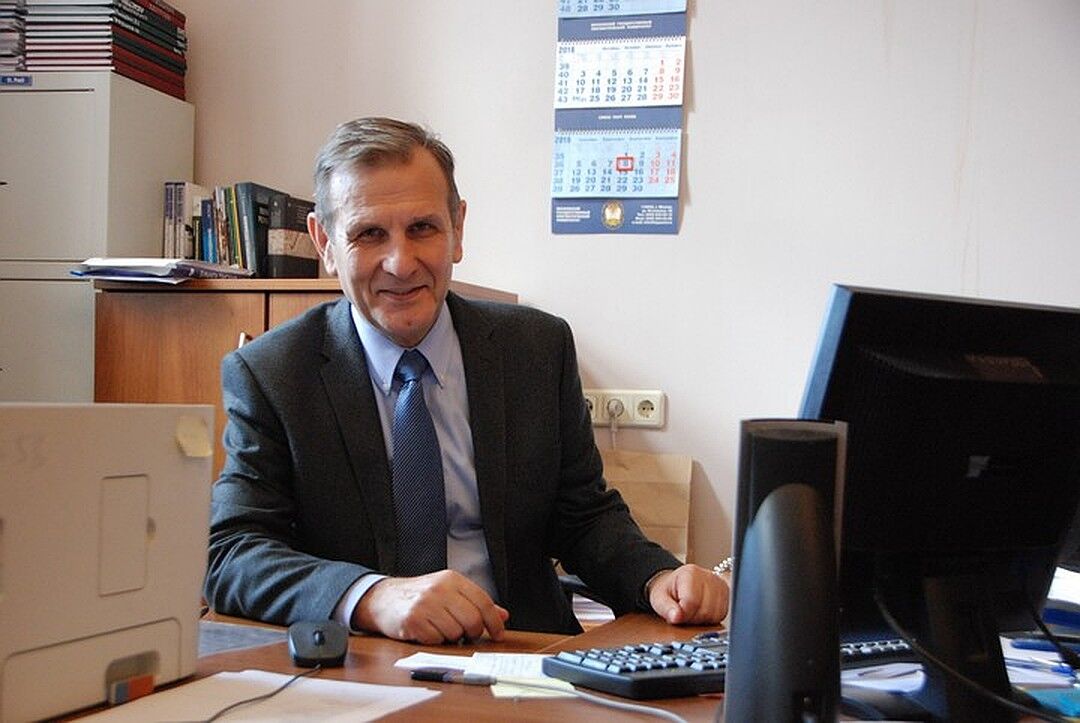
Moscow, IRNA - Head of the Department of Regional Studies Theory at Moscow State Linguistic University Vadim Makarenko believes that the release of Adrian Darya (Grace 1) in Gibraltar is Iran's diplomatic victory over Britain and once again demonstrated the skill of Iran's diplomatic apparatus to the world.
Vadim Makarenko said in an interview with IRNA on Monday that a number of factors contributed to this diplomatic victory, the most important of which was Iran's diplomatic efforts, including at the United Nations.
The expert added that the British government hoped, by following US policies against Iran, it would gain concessions, most notably support for the European Union on the Brexit issue and when it left the union, which is likely to occur in October.
He explained that Britain did not want to pay about $ 60 billion in separation from the EU and the British had announced they could pay up to $ 20 billion.
Makarenko said Iran showed by its actions that it was not willing to sacrifice its interests for the sake of others and was making every possible effort to gain its rights in international scene.
The Russian academician believes that the Joint Comprehensive Plan of Action (JCPOA) played a key role in Iran's pulling out of international isolation.
Makarenko highlighted that today the situation of Iran was better than those years, and those who were criticizing the Iranian government for signing the JCPOA would be better off comparing the current situation before the JCPOA.
At the same time, he believes that burial of the JCPOA is too early and efforts should be made, especially by European parties to implement Iran nuclear deal.
The Russian expert said Russia was on the side of Iran in implementing the JCPOA and was continuing its diplomatic efforts to support Tehran on the one hand and to implement the JCPOA on the other hand.
The Russian expert elsewhere on tensions in the Persian Gulf reiterated that this international waterway should be free of any tension and the countries of the region should work together to secure it.
The presence of foreign forces adds to the tensions in the region, creating a situation that could at any moment become an armed conflict, and the situation surrounding Iran's downing of the US spy drone has shown this fact, he stated.
Makarenko underlined that Russia was working to maintain stability and calm the region and to prevent Western plots in the region and a Persian Gulf security plan has been put forward for that purpose.
Oil tanker Grace 1 was renamed Adrian Daria and is now sailing towards Mediterranean Sea, said deputy head of Ports and Maritime Organization of Iran on Friday.
Jalil Eslami added that when the oil tanker was in detention in Gibraltar, Panama ended use of the country's flag for it, as the owner of the vessel requested for the oil tanker to carry Iranian flag.
"Grace 1 was renamed Adrian Daria whose next destination after detention is Mediterranean Sea," he said, noting that it seems it will face no specific problem en route for the sea and next destination.
The official hoped the incident will never occur for the Iranian vessels as well as those carrying Iranian goods.
Grace 1, a supertanker carrying Iranian oil, was seized last month by British Royal Marines off the coast of the British Mediterranean territory of Gibraltar on suspicion of violating sanctions against Syria.
The Gibraltar court decided to release the crew of the ship, but the US was trying to block the release of Grace 1.
The US was struggling to block the release of the tanker, but in defiance of its attempts, Gibraltar court issued a ruling to release the ship.

Tuesday, August 13, 2019

Multipolar World on Iran’s Side

 Viktor Mikhin

IR5645622
Many people in the West are gradually beginning to understand that the days of the unipolar world are numbered, a unipolar world the United States has been recklessly dominating for the past number of years, using nothing but brute force and military conflict in an attempt to impose its world order on other countries. New superpowers are coming to the forefront, whose aim is to strengthen world peace and to protect the legitimate right all people have to live according to their own national laws and customs, without interfering in other countries’ affairs. This is particularly visible in the Persian Gulf amid the so-called “Persian Gulf crisis”.

It initially looked as if reason had prevailed when the five permanent members of the UN Security Council as well as Germany signed the Joint Comprehensive Plan of Action (JCPOA), which gradually began to normalize the situation in the region. But then Donald Trump not only withdrew from the Iran nuclear deal, but also imposed fierce sanctions against Iran and the Iranian people, who value their independence. By imposing sanctions against Iran, the US has made it clear that it wants to “make the whole world bend to its will” – the Russian Foreign Ministry commented. “This is being done in order to deprive Iran of export revenue and to undermine the Iranian economy, because the United States has long been dissatisfied with Tehran’s independent policy, one reason being the fact that it prevents Americans from being able to feel like they fully dominate the strategically important region that is the Middle East,” the website of the Russian Foreign Ministry. In 2019, Iran responded by announcing it would suspend implementing two parts of the deal, and after that point the world seems to have begun moving towards armed conflict at an alarming pace.

But the world has changed, and a number of countries have taken urgent steps to stabilize the situation. French, German and UK Foreign Ministers have announced the creation of INSTEX, a new mechanism for facilitating legitimate trade with Iran. INSTEX will initially focus on delivering medicine, medical devices and agri-food goods to Iran. The decision to create a mechanism to facilitate trade with Iran that bypasses US sanctions was taken in order to establish normal trade relations with Tehran.

Moreover, European NATO member states were very skeptical about the US-led initiative to establish a joint international naval mission, which is meant to protect the shipping interests of the West in the Strait of Hormuz. German Foreign Minister Heiko Maas made a statement which clearly expresses this skepticism: “Germany will not take part in the naval mission proposed and planned by the United States.” US Ambassador to Germany Richard Grenell expressed his frustration, declaring he was “outraged” by Angela Merkel’s policy, as the German Chancellor had said Berlin did not intend to join the US mission in the Strait of Hormuz. In response to the decision Maas had announced, Grenell rudely barged in on Germany’s affairs and made a dogmatic statement, saying that “Germany is the biggest economic power in Europe. This success brings global responsibilities.” From what the American Ambassador has said, it is clear that he still sees Germany as an American protectorate, not an independent state, where American troops are still stationed.

“The presence of foreign forces does not only not contribute to the security of the region, but also will be the main cause of regional tensions,” Iranian President Hassan Rouhani said at a meeting with Oman’s Foreign Minister in Tehran. Recalling the fact that Iran and Oman bear most of the responsibility to ensure security in the Strait of Hormuz, President Rouhani added: “Iran has been, and will be, the main guardian of security and freedom of navigation in the Persian Gulf, the Strait of Hormuz and the Sea of Oman during history.”  At the same time, noting Iran has never and will never start a war, Rouhani made it clear that the current tension in the region stems from America’s unilateral rejection of the JCPOA and the illusion of the Trump administration. During this meeting, Oman’s Foreign Minister Yusuf Bin Alawi Bin Abdullah, in turn, described relations between Iran and Oman as “friendly and brotherly”, adding: “Today, the region is experiencing fabricated and proxy crises, and the establishment of sustainable security in the region will definitely not be possible without Iran’s involvement.”

In this regard, Iran and Russia are planning to begin carrying out joint naval exercises in the near future, Iranian Navy Commander Rear Admiral Hossein Khanzadi told IRNA (The Islamic Republic News Agency). According to Khanzadi, these joint naval exercises may take place in the northern part of the Indian Ocean, and in the Strait of Hormuz, which connects the Persian Gulf with the Gulf of Oman. The US media reported these plans, which they say have really frightened members of the Trump administration, because the news came as a big surprise, and now Washington simply does not know how to respond to these plans. The French newspaper Le Monde explicitly reported that conducting these naval exercises would spoil the whole game plan for Donald Trump and his team.

Against this background, Iran has begun taking a tougher stance against the United States and its leadership. One event which stands out is when Tehran bluntly turned down an offer from US Secretary of State Mike Pompeo to visit Iran and speak to the Iranian people. Pompeo appears to have become obsessed with the withered “laurels” of the notorious former Assistant Secretary of State Victoria Nuland, who visited Kiev’s Maidan Square back in the day, and handed out cookies to local residents. Ordinary people in Kiev did not understand the gesture, and thought that the Americans would later reward them with a million dollars for each cookie they took. They are still waiting for that reward.

Even close US allies – the Gulf States, especially Saudi Arabia and the UAE – are feeling the negative consequences of US sanctions, as the Gulf tanker crisis and threat to the freedom of navigation have led to a hike in insurance costs for their ships and cargo. Another threat to the oil market in the Persian Gulf is that countries in Asia such as China, India, Japan, South Korea and Taiwan, are already looking for alternatives, because they are afraid their oil supply will be disrupted if war breaks out and the Strait of Hormuz is closes. On top of all this, there is a significant outflow of investment from the Gulf countries, whose economies are partly dependent on the financial services of other States. According to US bankers from JP Morgan, Saudi Arabia lost $80 billion in investments last year, and the shares of the Persian Gulf countries plummeted, which had previously been highly valued by the financial market.

Many people around the world are right to believe that unqualified sanctions against Iran are a moral, political and legal failure on the part of the United States. Imposing sanctions against Iran means that the United States has failed to fulfill its obligations to international institutions, one of them being the United Nations. Everyone loses here – Europe suffers a setback, as does Iran and the whole world, Washington has brought the world to the brink of war, to both political and economic stagnation.

Viktor Mikhin, corresponding member of the Russian Academy of Natural Sciencesexclusively for the online magazine “New Eastern Outlook.

Friday, August 02, 2019

Iran Nuclear Deal and Western Hypocrisy

Zarif: a multilateral deal cannot be implemented unilaterally

Zafar Bangash
Last month when Iran scaled back its commitment to limit uranium enrichment, from 3.67 % to around 4.5%, the Western corporate-owned media went into frenzy. Taking a cue from their political and corporate masters, they thundered: Iran cannot be allowed to have a “nuclear bomb.”
But Iran is not building a bomb and it has no intention of doing so. This is what the Rahbar, Imam Seyyed Ali Khamenei has said repeatedly and even issued a fatwa about its prohibition. So why do Western officials and media outlets continue to indulge in this vile propaganda?
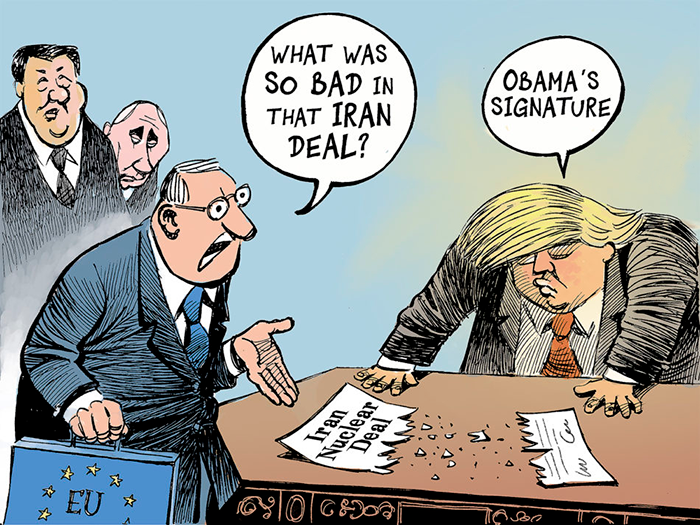
Since Western, primarily US, policy against Iran cannot be justified, they have to resort to lies. This is meant to mislead the gullible American public that is fed up of endless wars and wants resources to be allocated to social programs. In May 2018, when Donald Trump announced repudiation of the agreement, he said it was a “bad deal” and wanted to renegotiate it to include Iran’s missile program as well as other defensive capabilities. The real reason, as we now know through the leaked cables of ex-British Ambassador Kim Darroch is that credit for this went to former President Barack Obama. Trump simply could not stomach that!
The Joint Comprehensive Plan of Action (JCPOA), as it is officially called, is not about Iran’s defence capabilities and Tehran would under no circumstances put itself at the nonexistent mercies of predatory powers like the US. Unfortunately, the world is not governed by the rule of law but by the dictum, “might is right.”
Weakness only invites trouble. Not surprisingly, Iran is not prepared to accept any demands from any party that would limit its ability to defend itself. Washington’s demands have now escalated to “Iran must not have a nuclear bomb!”
The latest allegations intensified after Trump unilaterally repudiated the July 2015 nuclear deal. Islamic Iran and six other countries — Russia, China, France, Britain, the US and Germany — had signed the agreement. The European Union (EU) was also party to the negotiations (collectively called the E3/EU+3). The negotiations lasted several years.
The word Joint should be noted. It is not a bilateral agreement between the US and Iran. It is a multilateral agreement and all signatories must abide by it.
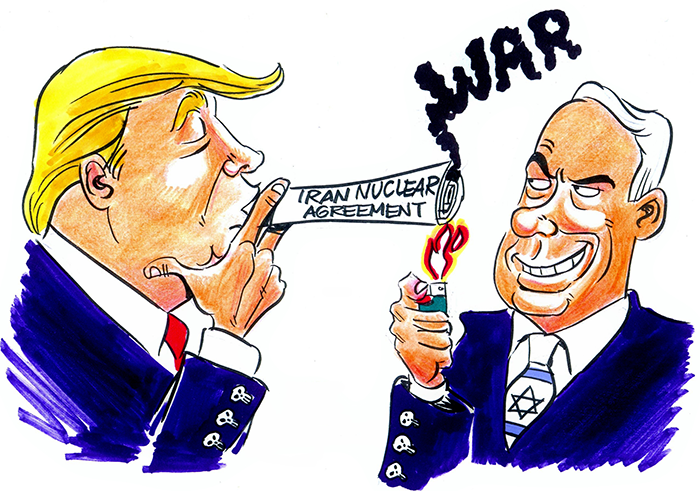
An artist’s rendition of what was behind the US’ material breach of a nuclear deal that unfairly put immeasurable pressure on Islamic Iran to comply with nuclear non-proliferation safeguards that ought to apply more to those countries possessing nuclear weapons than to those who have committed to having none at all. After all, the goal of nonproliferation is to have a world without any nuclear weapons; however it seems like the unwritten goal is for everyone and his brother to have a nuclear arsenal at the ready, but don’t let those “terrorist Muslims” have any nuclear capability to save your life. Truth be told, the JCPOA tied the US’ hands, preventing it from engaging in its dirty tricks campaign against Islamic Iran and any other Muslim majority country that is seeking an independent Islamic future. Relief from sanctions would have allowed the Islamic Republic to accelerate its economic growth and thereby expand its regional influence, and this is what could not be tolerated, especially after the dismemberment of Syria failed.
The JCPOA states that in return for Tehran accepting limits on its nuclear program (although permitted under the nuclear Non-proliferation Treaty – NPT), and allowing intrusive IAEA inspections, the other signatories agree to lift all nuclear related sanctions. UN Security Council resolution 2231 (July 20, 2015) endorsed the agreement and officially ended all UN sanctions against Iran (for the record, only the Security Council can impose sanctions on a country. US sanctions have no validity in international law; it is gangsterism!).
Trump’s repudiation of the agreement and imposition of sanctions against Iran violate article viii of the “Preamble and General Provisions” of the JCPOA, that states, inter alia, “The E3/EU+3 and Iran commit to implement this JCPOA in good faith and in a constructive atmosphere, based on mutual respect, and to refrain from any action inconsistent with the letter, spirit, and intent of this JCPOA that would undermine its successful implementation. The E3/EU+3 will refrain from imposing discriminatory regulatory and procedural requirements in lieu of the sanctions and restrictive measures covered by this JCPOA…”
Thus, far from imposing new sanctions, article viii of the preamble prohibits even “imposing discriminatory regulatory and procedural requirements” against Iran. It needs emphasizing that the US is a state party to this agreement. It was not signed with a particular US regime (Obama’s), contrary to assertions by some US officials that Trump has no obligation to abide by it. Agreements are signed with states, not a particular government or regime otherwise there would be no international agreements at all.
Despite the fact that Trump walked away from the JCPOA in May 2018 and imposed a raft of illegal sanctions, the Islamic Republic waited for an entire year to see whether the other signatories would come up with mechanisms to ensure Iran’s rights under the agreement are respected. On May 8, 2019, Iranian President Hassan Rouhani notified the remaining signatories in the JCPOA and gave them a 60-day notice to come up with a mechanism whereby Iran would be able to continue to trade and sell its oil. Failing to do so would leave Tehran with no choice but to scale back its compliance on uranium enrichment.
In an interview with the New York Times (published July 4), Iran’s Foreign Minister Dr. Mohammad Javad Zarif said Iran “will remain committed to the deal as long as the remaining participants (EU, France, Germany, UK, Russia and China) observe the deal.” He went on, “Survival or collapse of the JCPOA depends on the ability and willingness of all parties to invest in this undertaking. In a nutshell, a multilateral agreement cannot be implemented unilaterally.”
He also pointed out that Iran’s decision to reduce its commitments was based on its legal rights under paragraphs 26 and 36 of the nuclear deal, saying, “Paragraph 36 of JCPOA is a clear example that we negotiated this deal with the full understanding that we could not trust the commitment of the West.”
According to those in the know, when it came down to the upshot of it all, Trump could not tolerate a black man negotiating a good deal.
As soon as Iran scaled back its commitment, the European trio — France, Britain, and Germany — started accusing Iran of being in “breach” of the JCPOA. They totally ignored the fact that it was the US that had violated the deal that has led to the current crisis. Both Russia and China — the other signatories — supported Iran’s position despite saying they regretted its decision to increase enrichment. The Chinese went on to say that Washington was responsible for the impasse and insisted it must comply with the JCPOA.
Following the ministerial meeting of the Organization for Security and Cooperation in Europe on July 9, Russian Foreign Minister Sergey Lavrov was asked about the Iran nuclear deal. He replied, “The situation is paradoxical. The United States has pulled out of the JCPOA and does not comply with the UNSC resolution, but at the same time it prohibits the other parties to honor this resolution while pointing the finger at Iran.”
He also exposed American and Zionist hypocrisy over the issue, “One more thing: when the White House and the State Department demand that Iran honor its commitments under the JCPOA, and when Israeli Prime Minister Benjamin Netanyahu demands, as he did the day before yesterday [July 7], that the EU punish Iran for violating the JCPOA, this logically implies that the United States and Israel should recognize the legitimacy of the JCPOA. However, they recognize its legitimacy only in the current situation, when problems with the JCPOA can be used to mount pressure on Iran.
“It is not a wise approach. We are in favor of a search for solutions. We know very well who stands behind aggravating the confrontation. So far, there has been no investigation into the provocation concerning oil tankers. We do not see any way out of this situation other than demanding that all JCPOA signatories resume compliance with their commitments and the basic principles of the JCPOA. I do not see any other way” (Mid.ru, July 9, 2019).
On June 28, the European trio plus Russia and China met in Vienna to announce activation of INSTEX (Instrument in Support of Trade Exchange) with Iran. The Europeans put in a couple of million euros into the scheme and said it would cover Iran’s purchases of medicines and food items.
In gestation since first announced last January, INSTEX has fallen far short of Iran’s legitimate expectations. “It was a step forward, but it is still not enough and not meeting Iran’s expectations,” said Iran’s Deputy Foreign Minister Abbas Araqchi after four hours of talks in Vienna.
Foreign Minister Zarif was more explicit. He said INSTEX was just a prelude to the implementation of 11 commitments the Europeans have undertaken to save the JCPOA. These included Iran’s oil sales to Europe, secure financial returns from the sales and investment in Iran, as well as facilitation of transport, aviation, and shipping activities involving the country. Under INSTEX, no money will be exchanged. In return for Iranian oil, Europe will supply goods to Iran.
These are not favors to Iran but Europe’s obligations under the JCPOA. Both Russia and China have rejected US unilateral sanctions on Iran. At the G20 summit in Osaka, Japan (June 29), while meeting Chinese President Xi Jinping, Trump announced a waiver for China’s import of Iranian oil to meet its energy needs. Beijing had already said it would not accept American extraterritoriality over international trade and transactions.
The Europeans, however, are not acting in good faith. Britain in particular is acting as US poodle. On July 4, British marines boarded the Iranian oil tanker Grace 1 at the mouth of the Mediterranean Sea near Gibraltar. Britain said it took the action at the request of Gibraltar — a ludicrous claim since the latter is illegally occupied by Britain and is claimed by Spain. It alleged the tanker was taking oil to Syria that is under EU sanctions.
Iran rejected the allegation. Further, Iran is not a member of the EU and is not obliged to abide by European sanctions on Syria or anyone else. Iranian officials demanded the immediate release of the tanker, otherwise Tehran would take action against British tankers in the Persian Gulf. By July 13, the British had realized their folly undertaken at the behest of Washington and wanted to back out of the mess they had created.
In a telephone conversation with his British counterpart Jeremy Hunt, Dr. Zarif said that seizure of Grace 1 had been inspired by US sanctions on Iran. He said that Iran would continue to exhaust all avenues to export its oil despite the existing sanctions. “The Islamic Republic of Iran will continue its oil export under any circumstances,” said Dr. Zarif, according to an excerpt of the phone call with Hunt covered on the website of the Iranian Foreign Ministry. For his part, Hunt expressed hope that legal and judicial examinations in Gibraltar would lead to the immediate release of the tanker and its oil cargo.
The British foreign secretary admitted that Iran was entitled to its rights to export crude oil despite US sanctions, saying, however, that he was worried about escalated tensions in the Persian Gulf region where a series of military incidents over the past weeks have increased concerns about a potential conflict between Iran and the US.
If Hunt is sincere in his utterances, he should honor his commitments and end Britain’s role as America’s lapdog.

Monday, July 29, 2019

Iran Imposes Its Rule of Engagement: “An Eye for an Eye”

By Elijah J. Magnier


Iran has meticulously selected its political steps and military targets in recent months, both in the Gulf and the international arena. Its partial and gradual withdrawal – tactical yet lawful -from the Joint Comprehensive Plan of Action (JCPOA), known as the nuclear deal, is following a determined path. Its clear objective is to corner the US President and his European allies, and indeed Iran seems aiming for a final withdrawal from the JCPOA. Also, despite the effect the US sanctions are having on the Iranian economy – and despite Iran’s determination to reject US hegemony – Iranian officials have publicly put on hold a Russian offer to support its oil sales.
In Iran, sources confirm that
“China rejected the US sanctions and Russia offered to sell one million barrels daily for Iran, and to replace the European financial system with another if needed. But why would Iran make it easy on those who signed the deal (Europe)? If the European countries are divided and not in a position to honour the deal why did they sign it in the first place? Iran will pull out gradually, as stated in the nuclear agreement, up to a complete withdrawal. Iran is experiencing a recession (Trump is expected to be re-elected, which will prolong it), but is not in poverty, and is far from being on its knees economically and politically”.
Despite the harsh US sanctions, Iran is sending unusual and paradoxical signs, playing down the effect of the economic crisis and showing how less than relevant the Trump administration’s measures are: it has frozen the Russian offer designed to ease its financial burden by selling one million barrels of oil daily, and by stepping in to replace the European financial system. The only plausible interpretation is that Iran is determined to pull out of the nuclear deal if possible without invoking worldwide sanctions. In parallel, its military steps continue at a calculated pace.
IRGC Navy speed boats circling the British-flag tanker Stena Impero to slow it down before boarding it by Special Forces.
None of the several military objectives that have been hit in recent months was a casual or impulsive response, starting from the al-Fujeira sabotage, followed by the drone attacks on Aramco pumping stations, and ending with the damage to a Japanese tanker. The first action was not officially claimed by Iran. The second was claimed by the Houthis in Yemen. The third was against a Japanese tanker and the attacker is still at large, officially unknown.
However, Iran came out in public to announce its downing of the US surveillance drone and its capture of a British tanker in the Gulf of Oman. The ship was forced to sail into the Iranian port of Bandar Abbas. Every single reaction by Iran’s opponents was envisaged and calculated by the Iranian Revolutionary Guard Corps (IRGC), and the preparation of these attacks was perfectly planned and equally well executed. However, this doesn’t mean Iran did not take into consideration a possible war scenario where missiles could potentially fly in all directions. Iran is harassing, engaging, and even playing with Trump and Netanyahu’s threats of war, walking on the edge of the abyss.
Most Iranian leaders are repeating the clear message: no one will export oil if we can’t. It is also telling neighbouring countries that any attempt to export their oil by bypassing the Straits of Hormuz will be thwarted, hence the attacks on al-Fujeirah (the Emirates) and Aramco (Saudi Arabia). Both were potential substitutes, ways to export Middle Eastern oil without going through the Iranian controlled straits.
Iran chose to down an unmanned drone, where it could have downed a US spy aircraft with 38 officers onboard. The same US President- who was embarrassed by the lack of reaction to the downing of the drone – had to thank Iran for not shooting down the spy plane with the US personnel on board. That was a masterly planned decision: cool thinking by the IRGC leadership in the face of tough alternatives.
Trump could justify his failure to react by the lack of human victims; he was certainly aware that any military friction could blow up his chances of re-election: a factor very carefully calculated by Iran. Limited war is not an option available to Trump.
Moreover, after the UK Royal Marines landed by helicopter on the Iranian super tanker “Grace 1” to capture it – despite the fact that neither Iran nor Syria are part of the EU, and thus they are not legitimate targets for the sanctions to be applied and validated in this case – Iran first gave a chance to the French envoy Emmanuel Bonne to find an exit to the crisis. When the UK decided to keep “Grace 1” for another month, hours later Iranian IRGC special Forces captured – using the “cut and paste” style of boarding-the British tanker “Stena Impero”, a UK ship, just at the moment when that government was at its weakest, and the UK Prime Minister was bailing out. Again, very thoughtfully planned, and a well-calculated risk.
The US pushed the UK to move against Iran but stood idly by, watching the humiliation of the former “British Empire” which indirectly dominated Iran during the Shah era and before the Imam Khomeini came to power in 1979.
Iran took the UK tanker from the Gulf of Oman and offered a mediocre pretext, equal to the British one when capturing “Grace 1” in Gibraltar. Iran is telling the British that no war confrontation took place and no human losses are registered so far even if the Middle East is in the middle of a war-like situation with the US economic war on Iran.
So far, not one victim has been recorded, notwithstanding the massive and important events that involved several sabotage operations, the downing of one of the most sophisticated and expensive US drones, the capture of two tankers, and a warning to a US spy plane which escaped Iranian missiles by a hair’s breadth.
Iranian Leader Sayyed Ali Khamenei ordered the IRGC to continue developing its missile programme and injected billions of dollars into it. The leader criticised both President Hassan Rouhani and theForeign Minister Jawad Zarif for leading the country to a deal with the US and the EU when both are partners to each other and cannot be trusted. Therefore, the only exit seems the direction Iran is taking, particularly since Europe remains divided. The UK is heading towards selecting a Trump-like leader, Boris Johnson, the US President’s favourite candidate. The UK is in a critical situation where the “no-deal British exit” (hard Brexit) from the European community will weaken the country and isolate it- and certainly Trump will not bother to rescue it.
Iran is exposing its policy now: an eye for an eye. It is as prepared for war as much as US; prepared for the “absolute worst” as Trump has said. The US is building up its military capability by re-opening its air base in Saudi Arabia (Prince Sultan desert base) – the same base that the US used for its war against Saddam Hussein in 1990. Iran is active with its allies, Palestinian groups, the Lebanese Hezbollah, various Iraqi groups and Yemeni allies to provide these with enough missiles to sustain a long war if need be, yet without obviously provoking it.
Iran will continue its war in the shadows, and will continue harassing the western countries, disregarding the Arab states so that its war is not turned in a sectarian direction. Middle Eastern peoples are watching the dangerous bickering and can see Iran’s finger is on the trigger. It is gripping it firmly, without no hesitation to fire when appropriate, and regardless of who is the opponent or opponents.
The US most likely will have to wait and think carefully about its next move, particularly the building up of a maritime security coalition to patrol the Gulf and protect ships during the six hours needed for the transit of the Straits of Hormuz. The more western military presence there is in the vicinity of Iran, the richer the bank of objectives and targets offered to the IRGC, and the easier it becomes for Tehran to select its choice of target – in case of war – without launching long-range missiles against US bases established in the Middle East or any other long-distance target.
Washington won’t go to war if the outcome is not clear at least for itself. And, with Iran, no outcome can be predicted with certainty. Iran is aware of this US weakness, and is playing with it. It is showing that the West, for all its bulky muscles, is fragile and even vulnerable.

Thursday, July 25, 2019

Iran’s English dailies on British tanker’s legitimate detention

The prudent step taken by Iran’s coastal guard in the Strait of Hormuz in detaining a British-flagged tanker that was violating international navigational rules has been hailed by the nation, including the three leading English language dailies published from Tehran – Kayhan International, Tehran Times, and Iran Daily.
We present you excerpts of the editorials of the said three newspapers.
Kayhan International in its Viewpoint Column, titled “Detention of ‘Steno Impero’ Unconnected to British Buccaneering”, wrote: “Piracy never goes unpunished, even if the British buccaneers or corsairs or whatever you call those who continue to hide in the occupied Spanish territory of Gibraltar with the stolen super tanker “Grace I” and its cargo of two million-plus barrels of Iranian crude oil, think they are safe from justice.
“No, Friday’s detention of the British tanker ‘Stena Impero’ in the Strait of Hormuz by the Iranian coastal guards was not a form of punishment for the regime in London or a reprisal for its act of maritime terrorism on the high seas in the hijacking of ‘Grace I’.
“It is merely the case of a vessel violating international navigation rules and causing insecurity in the vital waterway through which a third of the world’s oil supplies flow, after it rammed into a fishing trawler and tried to flee by ignoring warnings from the Iranian navy which is responsible for ensuring the safety of sea traffic in this part of the Persian Gulf.
“‘Steno Impero’, however, couldn’t escape the ever-alert law-enforcement authorities of the area, and when it tried to call the British frigate ‘Montrose’ for help, the Iranian coastal guards warned the intruding warship of the dire consequences of meddling, and after boarding the lawless tanker (as confirmed by the footage released) steered it to the port of Bandar Abbas, where the judicial officials are investigating the case.”
As pointed out by Kayhan International: “Iran’s judiciary is known for its fairness, as was evident by its prompt release of another British tanker ‘Mesdar’ that had been guided to Bandar Abbas for due inspection, which means whatever verdict it will announce in the case of ‘Steno Impero’ after thorough investigation, will be just and deserving.
“It is unlike the kangaroo court of the British occupiers of Gibraltar which extended the illegal detention of ‘Grace I’ by a month after expiry of the initial fortnight forcible berthing order on the absurd charge that the Iranian crude was destined for Syria – a country under European Union sanctions for thwarting the terrorist bid to overthrow the legal government of President Bashar al-Assad.
“As Carl Bildt, the former Swedish prime minister and co-chair of the European council on foreign relations, has said by pinpointing the ambiguities of the British action in Gibraltar: “The legality of the UK seizure of a tanker heading for Syria with oil from Iran intrigues me. One refers to EU sanctions against Syria, but Iran is not a member of the EU. And the EU as a principle doesn’t impose its sanctions on others. That’s what the US does.”
“In view of these facts, the British regime, whose days of colonial terrorism are long past, is advised to stop its squealing and the rubbish talk of retaliation against the Islamic Republic of Iran, when the whole world knows that London cannot do anything except to drop its lip service of support for the Joint Comprehensive Plan of Action (JCPOA) and overtly side with the thuggish US administration of Donald Trump in its vain bid to browbeat Iran into submission.
“Iranian Foreign Minister Mohammad Javad Zarif has correctly summed up the situation in his Saturday’s tweet from Caracas, Venezuela, where he is attending a meeting of the Non Aligned Movement (NAM):
“Unlike the piracy in the Strait of Gibraltar, our action in the Persian Gulf is to uphold international maritime rules. As I said in New York (at the UN HQ), it is IRAN that guarantees the security of the Persian Gulf & the Strait of Hormuz. The UK must cease being an accessory to the Economic Terrorism of the US.”
Kayhan International concluded: “As for the case of ‘Grace I’ and the punishment for the British terrorists who hijacked it and continue to illegally hold it, justice will reach them sooner or later, irrespective of the ruling of the Iranian judiciary for the law-breaking British tanker ‘Steno Impero’”.
Tehran Times in its Op-Ed column by Hamid Bayati, titled “Britain confused on policies toward Tehran: easing the tension or increasing them”, said: “Britain has had a rough week after Iran detained a British oil tanker in the Strait of Hormuz. It seems that the British are confused what policy to adopt; first, British Secretary of State for Defense described the capture “hostile” and then, the British Foreign Secretary announced that they want to ease the tensions with Iran. 
“The British officials made the remarks after their second emergency meeting on Saturday. After the meeting, British Foreign Secretary Jeremy Hunt tweeted that they want to reduce the tensions. According to Hunt, the British government emergency meeting has discussed the safety of shipping in the Strait of Hormuz – but he didn’t say anything of the violation of international maritime rules by the British tanker.
“Tension between Iran and Britain escalated after Britain illegally seized a Panama-flagged super tanker ‘Grace I’ in the Strait of Gibraltar on July 4th, carrying 2-million-plus barrels of Iranian oil to customers in the Mediterranean Sea.
“Britain claimed that the supertanker was carrying oil to Syria, but the Iranian government announced that the tanker was heading another destination.
“After the illegal seizure of Grace 1 oil tanker, Iranian officials decided to resolve the issue through diplomacy and they had a meeting with Gibraltar officials but some other entities interfered in the matter and Gibraltar announced that the oil tanker will not be released.”
Tehran Times further said: “Hardliners in Britain are now saying that more pressure must be placed on Iran and some are even proposing the renewal of sanctions; however, this is a poor strategy that has been already tested by their closest ally, the United States, and has never come to any success.
“Britain is proposing that the European Union puts more pressure on Iran; however, London and Brussels are not at their best relationship right now as they have disagreements over a variety of subjects including Brexit.
Britain which seized ‘Grace I’ for satisfying the US, is now in a conundrum. Washington, who first encouraged Britain to seize the oil tanker. 
“Now, London has resorted to the United Nations Security Council to release its ship. Obviously, if the western countries take on a hostile stand toward Iran in this situation, it will only exacerbate the security of the Persian Gulf region and will be to the benefit of no one.
“The only strategy that can take Britain out of this crisis is to stay away from US and try to resolve the issues with Iran directly.
“Anyway, right now, Britain’s internal situation is also unsteady as the country will have a new Prime Minister in few days, so whatever the British officials say now cannot be trusted, because the country’s cabinet is changing and the new cabinet may have new members who have other opinions. 
What is, however, interesting now is that some countries like Bahrain are now acting like the seized ship belonged to them! Taking such an aggressive stance is very strange because the Arab countries around the Persian Gulf don’t have a steady situation themselves and are in constant conflict with one another, each trying to topple the others.”
Another Iranian English language newspaper ‘Iran Daily’, in its perspective column titled: “Britain should not become Trump’s ‘messengers’ over Iran” wrote: “Iran’s envoy to Britain warned against escalating tensions on Sunday as a UK official declined to rule out sanctions in response to Tehran’s detention of a British-flagged oil tanker.
“Britain needs to contain “those domestic political forces who want to escalate existing tension between Iran and the UK well beyond the issue of ships,” Iran’s Ambassador to Britain Hamid Baeidinejad said on Twitter.
“This is quite dangerous and unwise at a sensitive time in the region,” he said, adding that Iran “is firm and ready for different scenarios.”
“Britain’s Defence Secretary Tobias Ellwood reiterated calls for de-escalation on Sunday in an interview with Sky News. He said: “Well, firstly we need to try and de-escalate this. There has been a ratcheting-up of tensions in West Asia.”
“Ellwood also noted that the British Navy “is too small to manage our interests across the globe.”
“London has warned its ships to avoid the Strait of Hormuz, a chokepoint for about a third of the world’s seaborne oil.
“Iran said the detained tanker “risked maritime safety.”
“Allahmorad Afifipour, head of Iran’s Ports and Maritime Organization in Hormuzgan Province, said: “We are required by regulations to investigate the issue ... the duration of the investigation depends on the level of cooperation by the involved parties.”
“He added: All 23 crew members aboard the ship are “safe and in good health in Bandar Abbas port.
“The vessel’s Sweden-based owner, Stena Bulk, said it hoped to visit the crew, who are from India, Latvia, the Philippines and Russia. India has called on Iran to release the ship’s 18 Indian crew members.”