Showing posts with label Iraqi President Barham Salih. Show all posts

Thursday, June 27, 2019

Iraqi President: US Has No Right To Use Iraq As ‘Staging Post’ For Attack On Iran

by Andrea Germanos


https___cdn.cnn.com_cnnnext_dam_assets_190625193834-barham-salih-amanpour-bull
Iraqi President Barham Salih said Tuesday that the United States has no right to use his country as a launchpad for a strike against Iran.
Salih, in his interview with CNN‘s Christiane Amanpour, also talked about the adverse impacts his own country has felt as a result of U.S. imposed sanctions, stressed the need to prevent another war, and warned that tearing up the nuclear deal entirely “could be disastrous for the entire neighborhood as a whole.”
Their conversation, as Amanpour noted, came amid rising tensions between the U.S. and Iran, including new economic sanctions, the deployment of 1,000 more troops to the Middle East, and President Donald Trump’s threat Tuesday to “obliterate” areas of the country..
Salih said he welcomed Trump’s last minute decision last week to call off an initially-approved strike against Iran because, the Iraqi leader noted, “there is no military solution to this problem.”
Instead, he said, “the parties involved need to sit down together and focus on what is important—really combating violent extremism, focusing on regional integration and economic issues.”
“This part of the world needs fundamental solutions not another war,” said Salih, adding that “it’s best to de-escalate.”
“The way to solve the problem is dialogue,” he said, “sitting down [at] a table and really begin hammering out on the fundamental issues that are affecting that part of the world.”
The harms from the new sanctions the U.S. imposed against Tuesday—which Iranian President Hassan Rouhani called “outrageous and idiotic”—are impacts Salih said his country is well acquainted with.


“We in Iraq have suffered from sanctions,” Pres @BarhamSalih tells me.

He says there’s a “fundamental question” if sanctions change behavior.

Abandoning the Iran nuclear deal alltogether “could be disastrous for the whole neighborhood, not just for Iran, and not just for Iraq.”

86 people are talking about this

“We in Iraq have suffered from sanctions in the 1990s, and the devastation that has afflicted Iraqi society has been really enduring, even to date,” said Salih. “So we feel for the people of Iran.”
After Amanpour replayed part of an interview earlier this year in which Trump said he wanted to maintain a U.S. military presence in Iraq to “watch Iran,” Salih reaffirmed his stance that doing so is not part of the deal brokered between the U.S. and Iraq.
“The American troops, the coalition troops in Iraq are there… at the invitation of the Iraqi government for the specific, exclusive mission of fighting ISIS,” said Salih.
“We do not want our territory to be a staging post for any hostile action against any of our neighbors, including Iran,” he added. “And this is definitely not part of the agreement between the Iraqi government and the United States.”
Asked by Amanpour if he sees parallels between the lead-up to the Iraq war under the George W. Bush administration and the situation now between the U.S. and Iran, Salih suggested it was a different situation—but there’s a clear lesson to be learned.
“I think [Saddam Hussein] was a unique case in history but the parallel is as follows,” said Salih. “It’s easy to start a war but very, very difficult to end a war.”

Andrea Germanos is senior editor and a staff writer at Common Dreams.

Wednesday, June 05, 2019

Mecca summit and changing sound realities

Mecca summit and changing sound realities

Tehran, June 3, IRNA – The final statement of the diplomatic gathering called the Mecca Summit shows the projection of some Arab governments regarding instability in the Middle East while Riyadh's directing the show to undermine the region's realities and deception about the underlying cause of insecurity has sparked Arab states’ protest.
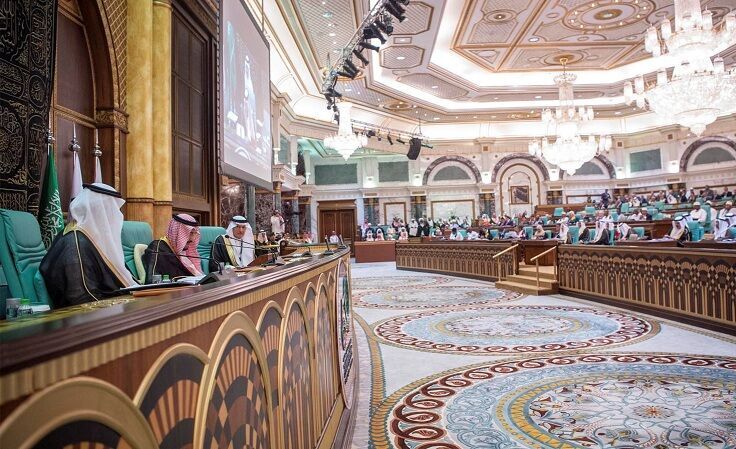
In the middle of the week, the city of Mecca hosted a group of Arab and Islamic governments that had traveled to Saudi Arabia to attend the Organization of Islamic Cooperation, but were also the guests of two other emergency meetings: the Persian Gulf Cooperation Council (PGCC) and the Arab League.
Although these meetings were held to justify the confrontation with sources of instability in the region, their final statements; however, showed that the organizers did not pursue any other goal except to approve Riyadh's claims and showing Iran as threats.
The cases mentioned in the final statements of the two extraordinary meetings of Mecca, show the objectives of its organizers well. What has been mentioned in these statements has been heard in the past days and weeks in various ways and repeatedly from the leaders of Saudi Arabia.
For example, the final statement of the Arab League Summit contains 10 clauses, all of which somehow condemn the regional role and foreign policy of the Islamic Republic of Iran, as if in the opinion of Saudi Arabia, the Middle East has no other "problem" other than Iran.
This statement cites what it calls "Iran's interference in the internal affairs of the countries of the region," "the firing of Iran's long-range missiles on Saudi Arabia," "supporting the Houthi rebels," "intervention in Bahrain's internal affairs," "interference in Syria," and condemns the Islamic Republic of Iran. Finally, it called for the Arab states to cooperate and synergy in countering "Iran's interference in the internal affairs of countries and restoring stability to the region."
There are similarities in the Persian Gulf Cooperation Council's final statement. The fourth clauses of the PGCC statement are dedicated to Iran. In this context, Iran has been called upon to respect the international obligations of good neighborliness relations and not risk the security of the region and the free flow of oil.
These statements not only did not mention the major factors of destabilization, such as the occupation by the Zionist regime, the invasion of Yemen, intervention in Syria, the support of the West and its allies from terrorist groups and extremists, US interventions in the region, and so on. It also announced its support for the US policy in the region.
The Mecca summit ended, while analysts referred to Saudi efforts to impose its views on other countries present at the meeting. According to reports, the Saudi leaders tried to impose their views on the final statement.
Iraqi President Barham Salih protested against the move by Riyadh in an explicit mentioning of the name of the Islamic Republic of Iran and accusing Iran of protecting terrorism in the final statement of the Arab League's summit. The move by Saudi Arabia indicated Riyadh's specific anti-Iran goals and motives at the meetings.
The president of Iraq stressed that the existing tensions with Iran could lead to regional and international war if not properly managed. He also expressed hope that Iran's security would not be questioned by other countries.
According to news sources, the Iraqi president, protesting in the shadow of other countries' silence, revealed that Saudi Arabia had not coordinated with Iraq in writing the final statement, and the country did not have any share in the statement.
Similarly, the heads or representatives of other countries, in contrast to Saudi Arabia's views, did not explicitly mention Iran in their speeches.
Salih's remarks and the actions by some Arab and Islamic leaders in mentioning Iran's name are indicative of their awareness of the realities of the region; the fact that observers have long warned President Donald Trump and his allies about it. Saudi Arabia has become a seditious activist in recent tensions between Iran and the United States, although this role has history by the leaders of Riyadh.
A short time ago, Arab media outlets referred to Saudi leaders’ agreement with the US to strengthen military presence in the region for a line-up against Tehran. The activism of the Saudi leadership led Trump after deciding to deploy the aircraft warships, patriot missile system and 52 bombers, to agree with selling arms to Saudi Arabia (worth $ 8 billion) via bypassing the Congress.
In such a space, many observers warn the leaders of Washington about the dangerous act of Saudi Arabia to push the United States to war with Iran.
Holding the Persian Gulf Cooperation Council (PGCC) and the Arab League summits and the attempt to show the unity of Arab and Islamic countries against Iran can also be analyzed in this context. Riyadh makes any effort to display a united regional front against Iran.
Meanwhile, observers say Saudi red carpet and Riyadh regional allies of the US for military intervention and militarism in the region as well as playing a leading role in the arms race, are among the most important factors of the instability of recent decades in the Middle East.
Saudi Arabia's attempt to mobilize the opinions of the neighboring and Arab countries is an endless process that the United States and the Zionist regime are following against the Islamic Republic. On the same token, Iranian president, on Friday, called on the leaders of the Islamic countries to take advantage of the summits to deal with the dangerous conspiracy of “The Deal of The Century” and the defense of Palestine.
But it seems that the Saudi leaders have been at loggerheads to pursue the hostility and the pugnacity against the Islamic Republic of Iran instead of confronting the main sources of insecurity in the region, such as the Zionist regime.

Sunday, November 25, 2018

Iraq Inching From Sectarianism to Patriotism: Expert

Alwaght- After the political marathon in Iraq to pick a new president and a prime minister, the country’s politics now witnesses a debate of how the experienced, technocratic Prime Minister-designate Adel Abdul Mahdi will form his cabinet. When Abdul Mahdi was named for the post, he vowed to put meritocracy first in choosing his ministers, adding that his government will be strong and cross-party including figures from all Iraqi political factions regardless of their ethnicity or religion.

Alwaght has talked to Sayed Mahdi Afqahi, an Iranian West Asia affairs expert, asking him for comments on the new government’s plans, as well as the challenges and obstacles ahead.
When asked about how the new cabinet will look like, Mr Afqahi told the parties in this year’s election talked against sectarian quota system in hope of attracting the maximum votes. This view was held by the Shiite alliances such as Saeroon and Fatah, as well as other blocs.
“With the parties’ shift of vision and expanding their horizons, I believe that Iraq will move, with a gentle slope, from the sectarian approach to a patriotic one to form a national unity government. In fact, the participant parties insisted on driving out the sectarian quota system and highlighted the need for Iraqis unity to beat the problems.”
Mr Afqahi continued that President Barham Salih, Speaker Mohamed al-Halbusi, and PM-designate Adel Abdul Mahdi all strongly believe in this political path and have recently raised the slogans anew. Abdul Mahdi, for example, vowed to form a government where no political party feels marginalized. He, thus, told the Shiite, Sunni, and Kurdish factions to each name four ministers for each post. This will pave the way for a national unity government, according to him.
“With regard to the pro-inclusion, cross-sectarian rhetoric of the Iraqi politicians, Abdul Mahdi works towards the realization of this aim.”
But Mr Afqahi pointed to the fact that uniting all Iraqis around this anti-sectarianism ideal is a difficult job, adding that to date none of the PMs managed to materialize this ideal. He, however, maintained that Abdul Mahdi enjoys wide-ranging acceptance and support by both the politicians and the clergy. So, he can learn from the previous governments' mistakes and form a technocratic government.
Alwaght also asked the expert about the key challenges the new government will face. He replied that the challenges are both at home and abroad. Domestically, according to him, Abdul Mahdi will face financial and administrative corruption, which is a hugely heavy case.
“If he forms the best cabinet but declines to seriously fight bribery and the labyrinthine network of banking and financial mafia– the heavy cases which remained unsolved by the previous PM Haider al-Abadi–, he will certainly fail to proceed with his programs.”
Essentially, the parties strongly insisted that corruption needs to be uprooted. Sayyed Muqtada al-Sadr, Saeroon's leader, has set an ultimatum for the new government to effectively fight corruption, warning that if it fails to meet the demand, he will sink the government. Fatah bloc, led by Hadi al-Amiri, also placed its main emphasis on the anti-corruption fight which has so far marred many development programs.
“Another internal issue,” Mr Afqahi told Alwaght, “is the reconstruction of Iraq. We can now say that Iraq is a ruined country. Three largest and most strategic provinces of Iraq have been destroyed by ISIS. Beside ISIS destruction, the Americans under the excuse of fighting ISIS reduced to rubble many areas in Nineveh, Salahaddin, and Anbar provinces, making them uninhabitable for years. I visited them in person.”
Another big issue at home is the unemployment, according to the Iranian expert. The oil sales income is only enough to pay the salaries of the state workers and armed forces personnel. So, the government’s hands to create jobs along with the pursuing rebuilding projects will be tied. If it seeks to borrow money from the World Bank or the International Monetary Fund, then it should meet the tough demands of the creditors. This, in turn, will lead to further reliance on abroad.
“So the government has to rely on home achievements of the fight against corruption and also expand cooperation with its strategic neighbor, Iran. Partnership with Tehran in areas like oil, gas, and electricity production, and technology transfer will be useful to Iraq. Baghdad apparently saw the fruits of anti-terror cooperation with Iran. But Saudi Arabia is an origin of terrorism. Turkey still occupies parts of Iraqi territories. Syria is itself in need of help amid the devastating war against terrorism. And the US, as another partnership choice, seeks to dominate Iraq and loot its oil.”
Yet another challenge the new government is facing is the American military presence. Now some 7,000 American troops are present in Iraq, which is contrary to the security pact between the two countries, signed in 2008 that was aimed at training the Iraqi army and helping it reorganize.
“The question for the Iraqis is that what these 7,000 troops under the guise of military advisors are doing in Iraq. Was this approved by the parliament, or is it a secret agreement between al-Abadi (former premier) and Washington? The US has under construction its biggest consulate in the world in Erbil, with a size of 24 hectares.”
Mr Afqahi also commented on the future of relations between Baghdad and the Kurds under Abdul Mahdi. He noted that this issue is related to the autonomous region’s demands from the central government. Masoud Barzani, the former president of the Kurdistan Regional Government, has recently called on Baghdad to hand back Kirkuk to the Kurds. “Certainly, neither the parliament nor the al-Hashd Al-Sha'abi [Arabic name for Popular Mobilization Forces] will allow Abdul Mahdi to return the oil-rich Kirkuk to Barzani to sell its oil to Israel and Turkey.”
Mr Afqahi also pointed to the foreign challenges of the new government. The first challenge, he said, is the American influence in Iraq's political, military, cultural, and financial areas, despite the fact that this year’s election indicated a sharp decline in the US sway in Iraq, which can be labeled a decline from strategic to tactical level. Abdul Mahdi and Salih's relationship with Washington will never be submissive as was that of Barzani and Osama al-Nujaifi, former parliament speaker. “Another foreign challenge is the Turkish military presence in Bashiqa region in northern Iraq,” he continued.
Afqahi also addressed the chances of victory over the challenges ahead, saying it depends on the makeup of the cabinet, genuine anti-corruption fight, and the popular and clergy help. He said the new PM should make priorities. First, he should solve the main problems like unemployment and meet the people’s basic needs. This will win him people’s support which is necessary for dealing with heavier problems. “Empty slogans only dangerously infuriate people,” the pundit concluded.