Showing posts with label Persian Gulf Cooperation Council (PGCC). Show all posts

Wednesday, June 05, 2019

Mecca summit and changing sound realities

Mecca summit and changing sound realities

Tehran, June 3, IRNA – The final statement of the diplomatic gathering called the Mecca Summit shows the projection of some Arab governments regarding instability in the Middle East while Riyadh's directing the show to undermine the region's realities and deception about the underlying cause of insecurity has sparked Arab states’ protest.
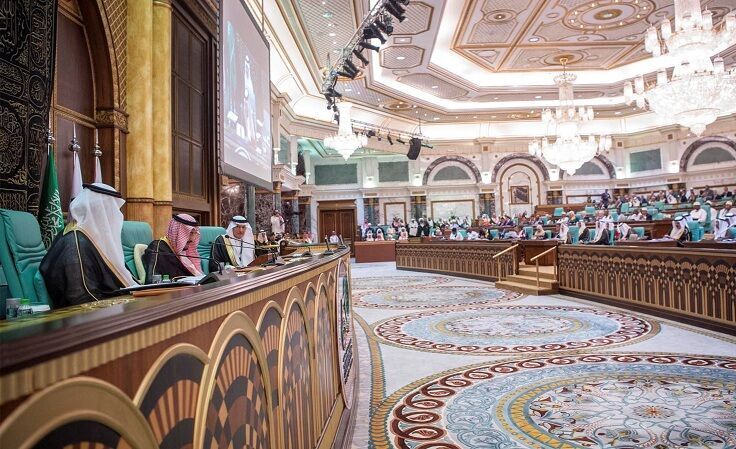
In the middle of the week, the city of Mecca hosted a group of Arab and Islamic governments that had traveled to Saudi Arabia to attend the Organization of Islamic Cooperation, but were also the guests of two other emergency meetings: the Persian Gulf Cooperation Council (PGCC) and the Arab League.
Although these meetings were held to justify the confrontation with sources of instability in the region, their final statements; however, showed that the organizers did not pursue any other goal except to approve Riyadh's claims and showing Iran as threats.
The cases mentioned in the final statements of the two extraordinary meetings of Mecca, show the objectives of its organizers well. What has been mentioned in these statements has been heard in the past days and weeks in various ways and repeatedly from the leaders of Saudi Arabia.
For example, the final statement of the Arab League Summit contains 10 clauses, all of which somehow condemn the regional role and foreign policy of the Islamic Republic of Iran, as if in the opinion of Saudi Arabia, the Middle East has no other "problem" other than Iran.
This statement cites what it calls "Iran's interference in the internal affairs of the countries of the region," "the firing of Iran's long-range missiles on Saudi Arabia," "supporting the Houthi rebels," "intervention in Bahrain's internal affairs," "interference in Syria," and condemns the Islamic Republic of Iran. Finally, it called for the Arab states to cooperate and synergy in countering "Iran's interference in the internal affairs of countries and restoring stability to the region."
There are similarities in the Persian Gulf Cooperation Council's final statement. The fourth clauses of the PGCC statement are dedicated to Iran. In this context, Iran has been called upon to respect the international obligations of good neighborliness relations and not risk the security of the region and the free flow of oil.
These statements not only did not mention the major factors of destabilization, such as the occupation by the Zionist regime, the invasion of Yemen, intervention in Syria, the support of the West and its allies from terrorist groups and extremists, US interventions in the region, and so on. It also announced its support for the US policy in the region.
The Mecca summit ended, while analysts referred to Saudi efforts to impose its views on other countries present at the meeting. According to reports, the Saudi leaders tried to impose their views on the final statement.
Iraqi President Barham Salih protested against the move by Riyadh in an explicit mentioning of the name of the Islamic Republic of Iran and accusing Iran of protecting terrorism in the final statement of the Arab League's summit. The move by Saudi Arabia indicated Riyadh's specific anti-Iran goals and motives at the meetings.
The president of Iraq stressed that the existing tensions with Iran could lead to regional and international war if not properly managed. He also expressed hope that Iran's security would not be questioned by other countries.
According to news sources, the Iraqi president, protesting in the shadow of other countries' silence, revealed that Saudi Arabia had not coordinated with Iraq in writing the final statement, and the country did not have any share in the statement.
Similarly, the heads or representatives of other countries, in contrast to Saudi Arabia's views, did not explicitly mention Iran in their speeches.
Salih's remarks and the actions by some Arab and Islamic leaders in mentioning Iran's name are indicative of their awareness of the realities of the region; the fact that observers have long warned President Donald Trump and his allies about it. Saudi Arabia has become a seditious activist in recent tensions between Iran and the United States, although this role has history by the leaders of Riyadh.
A short time ago, Arab media outlets referred to Saudi leaders’ agreement with the US to strengthen military presence in the region for a line-up against Tehran. The activism of the Saudi leadership led Trump after deciding to deploy the aircraft warships, patriot missile system and 52 bombers, to agree with selling arms to Saudi Arabia (worth $ 8 billion) via bypassing the Congress.
In such a space, many observers warn the leaders of Washington about the dangerous act of Saudi Arabia to push the United States to war with Iran.
Holding the Persian Gulf Cooperation Council (PGCC) and the Arab League summits and the attempt to show the unity of Arab and Islamic countries against Iran can also be analyzed in this context. Riyadh makes any effort to display a united regional front against Iran.
Meanwhile, observers say Saudi red carpet and Riyadh regional allies of the US for military intervention and militarism in the region as well as playing a leading role in the arms race, are among the most important factors of the instability of recent decades in the Middle East.
Saudi Arabia's attempt to mobilize the opinions of the neighboring and Arab countries is an endless process that the United States and the Zionist regime are following against the Islamic Republic. On the same token, Iranian president, on Friday, called on the leaders of the Islamic countries to take advantage of the summits to deal with the dangerous conspiracy of “The Deal of The Century” and the defense of Palestine.
But it seems that the Saudi leaders have been at loggerheads to pursue the hostility and the pugnacity against the Islamic Republic of Iran instead of confronting the main sources of insecurity in the region, such as the Zionist regime.


Saturday, December 15, 2018

PGCC might survive in name only: Chicago professor

By Javad Heirannia

TEHRAN – Robert R. Bianchi, a Professor at the University of Chicago, believes that “Nowadays, China and Russia are acquiring greater influence in Iran and the Persian Gulf nations so it is natural that Doha and Muscat are inviting them to balance the destabilizing consequences of American and Saudi policies.”
Professor Bianchi, who also teaches at the Shanghai International Studies University (SISU), adds that “It’s possible to say that Saudi Arabia and the UAE have virtually broken with the PGCC by forming a separate defense agreement that excludes the other members.”
He adds that “The PGCC might survive in name only.”
Following is the complete text of the interview:
Q: The Persian Gulf Cooperation Council's (PGCC) annual summit was held in Riyadh while the Qatari emir and the Sultan of Oman refrained from joining. What are the reasons behind this refusal?
A: Qatar and Oman are responding intelligently to profound shifts in the balance of power, both globally and in their immediate neighborhood. Doha and Muscat see the Trump administration trying to downgrade America’s responsibilities in the Middle East while inviting Saudi Arabia to escalate proxy wars with Iran all across the region. This has led to greater bloodshed in Yemen, Somalia, Iraq, Syria, and Lebanon. Such a polarized environment severely threatens the longstanding practice in Qatar and Oman of preserving good relations with Iran and Washington at the same time. 
When small nations feel that a once friendly great power is withdrawing its protection, they usually seek alternative backing from strong states who can help them maintain their independence vis-à-vis quarrelling neighbors. Nowadays, China and Russia are acquiring greater influence in Iran and the Persian Gulf nations so it is natural that Doha and Muscat are inviting them to balance the destabilizing consequences of American and Saudi policies. Building new partnerships with Russia and China can encourage the U.S. to prolong its Persian Gulf involvement in the short run and prepare the way for replacing it in the long term. Hence, the diplomatic skills of Qatar and Oman pose a striking contrast to Saudi Arabia’s self-defeating path of overreach and isolation.
Q: Qatar left OPEC and according to some reports, it might break-up with PGCC. Do you think that Qatar will leave the PGCC?
A: It’s possible to say that Saudi Arabia and the UAE have virtually broken with the PGCC by forming a separate defense agreement that excludes the other members. In successfully weathering the Saudi-Emirati boycott, Qatar has shown it can flourish with or without the PGCC’s blessing. Doha has built extensive economic and diplomatic ties with the Far East, Russia, and Europe—ties that quickly deepened during the boycott, making Qatar a stronger global actor than its adversaries.
Q: The PGCC failed to find a purely internal collective solution to the Qatar crisis. With regard to this failure, how do you see the future of PGCC?
A: The PGCC might survive in name only. A continued U.S. effort to weaponize the PGCC by turning it into a Saudi-led coalition against Iran will cripple the organization and might eventually destroy it altogether. A viable PGCC needs to resist domination by a single member such as Saudi Arabia, prevent manipulation by a great power—particularly the U.S. or Britain—and avoid picking fights with powerful neighbors like Iran and Turkey.
Q: In case of Qatar's exit from PGCC, is there any possibility of a new alliance between Qatar and Turkey?
A: A formal alliance is unlikely and unnecessary. Doha and Ankara both prefer quiet understandings that are fluid, specific, and non-binding. In the language of international relations, such arrangements are often called quasi-alliances or partial pacts. They allow both sides to hedge their bets and pursue multi-directional diplomacy as shifting circumstances require. Qatari and Turkish leaders realize they will not always agree on dealing with fast-moving events in such volatile areas as Libya, Somalia, Iraq, Syria, and Egypt. Informal understandings can let them cooperate when possible and go their separate ways when necessary.

Wednesday, December 12, 2018

A Requiem in Riyadh for (P)GCC

By: S. Nawabzadeh 

A brief get-together of a few hours last Sunday, complete with a lavish meal and sumptuous drinks, in a modern luxurious palace in the midst of the Arabian Desert by a bunch of oil-rich princes, failed to conjure up fantasies of the "Arabian Nights” (Alif Layla wa Layla) – ironically compiled by a Persian.
Even the less-than-an-hour closed-door meeting in Riyadh, the capital of the British created fiefdom of Saudi Arabia, among the four despotic heads of state, joined by a prime minister and a minister of state for foreign affairs of two other member countries of the 6-nation (Persian) Gulf Cooperation Council, failed to remove the gloom from the faces of the participants, who sat around a table in awkward silence at the close before a bland final communique was read out.

The 7-point communique of the 39th summit was as barren as the land of Najd with stereotyped emphasis on unity of a divided body, economic challenges, and the threats to regional stability – not by the intruding Americans, neither by the Zionists, nor by the joint Saudi-UAE massacre of the innocents in Yemen, but by the Islamic Republic of Iran.
The anti-Iranian tone of the gathering had been set by the inaugural address of the host, King Salman the Senile, who, as predicted, accused Tehran of meddling and support for terrorism, while he read (without realizing what he was a reading) an opening statement probably prepared jointly by his murderous Heir Apparent MBS and the Jewish-looking Foreign Minister Adel al-Jubeir, under the directions of the US and Israel.

The PGCC, set up in May 1981 during the US imposed war on the Islamic Republic through Saddam of the tyrannical Ba’th minority regime of Baghdad at a time when the heroic resistance and counterattacks of the Iranians had bogged down the Iraqi invasion, was aimed at countering what the Americans told the Persian Gulf potentates "Iran’s revolutionary influence on the Arab Muslim masses” – groaning under sandals of the hereditary British-installed rulers.

In 1990, when a defeated Saddam thanklessly turned on his own generous financers of the disastrous 8-year war and his periodic massacres of Iraq’s Shi’a Arab majority and ethnic Kurds, by swallowing up Kuwait and firing missiles at Saudi Arabia, the PGCC began to realize that the Islamic Republic of Iran was not an enemy.

The neo-rich Sheikhs, although some of them tried their best to build bridges with Iran, couldn’t fully succeed, because of the pressures from Washington and London, in addition to the blind hatred of anything Iranian or Shi’a Muslim by the heretical Wahhabi cult of Saudi Arabia, especially after Lebanon’s legendry anti-terrorism movement, the Hezbollah, inspired by Islamic Iran, shattered the myth of Zionist invincibility in 2006 during the 33-day war – the first time an Arab force (not a national army) had defeated Israel.

This victory in turn encouraged the Palestinians to blunt the Israeli invasion of Gaza during the 22-day conflict of 2008, ringing alarm bells in not just Tel Aviv, but in the capitals of the pro-Zionist West, which now resorted to the dirty plot to destabilize Syria, the Frontline Resistant Nation, which along with a democratic post-Saddam Iraq, became a potential point for the cherished Islamic goal of liberation of Bayt al-Moqaddas.

These developments, along with Iran’s moral support for the oppressed people of Bahrain, as well as of Yemen who are struggling to preserve the only republican state of the Arabian Peninsula, led to divisions in the 6-member PGCC, as some of its members opposed the free reign given to the macabre takfiri terrorists in Syria and later in Iraq, and some of them to the state terrorism of Saudi Arabia and the UAE in Yemen.

Iran for its part, sensing the danger of the intricate American-Zionist plot to destabilize the whole of West Asia and if possible Judaize it through the services of the takfiris, positively responded to the requests for help from the governments and peoples of Syria and Iraq, and succeeded in saving the two countries, the fate of their masses, their historical-cultural heritage, and their rich religious legacy, to the chagrin of Washington, Tel Aviv, and Riyadh – the unholy trinity all set for the devilish plan to sell out Islam’s first qibla and obliterate the Palestinian cause.


In the meantime, the impetuous MBS, dreaming of at least a 50-year reign as king of Saudi Arabia (actually a slave of the US), picked up a fight with Doha for its total subservience to Riyadh and along with like-minded PGCC members tried in vain to isolate it – a move that has badly backfired, similar to his planned week-long invasion of Yemen, which is now in its 4th year with no signs of ending as casualties and economic woes mount for the aggressors.


In view of these facts, it was a wise decision by the Emir of Qatar against biting the bait of an invitation from Saudi Arabia for the Riyadh summit, where he would have been humiliated by MBS, who is writhing in pain like an injured snake as calls grow worldwide for bringing him to justice for his ordering of the gruesome murder of journalist Adnan Khashogchi in the Saudi consulate in Istanbul, Turkey.

Thus, in such a situation the 39th PGCC summit should be called a requiem in Riyadh for a fast disintegrating body which is no longer of use to the US and in next year’s summit to be held in Abu Dhabi, might be formally dissolved and replaced by the new American grouping against Iran "MESA” (Middle East Strategic Alliance) that in addition to some Persian Gulf states includes Egypt and Jordan, and will most certainly boomerang on all American meddling in the region, along with the end of Israel and Arab reactionary regimes.

A fitting finale indeed to the exhaustive Arabian Nights tale related by Sheherzad to Shahriyar.

Tuesday, December 11, 2018

PGCC was never effective organization: Shireen Hunter

By Javad Heirannia
TEHRAN - Shireen Tahmaasb Hunter, a professor of political science at Georgetown University, tells the Tehran Times that “the PGCC was never an effective organization. Certainly, it has been an unequal partnership in the sense that Saudi Arabia has dominated the Organization.”
“The PGCC was also created as a response to the 1979 Iranian revolution and the Iran-Iraq war, especially the perceived Iranian threat to the Persian Gulf security,” Hunter tells the Tehran Times.
She adds that “Now Iraq is practically out of the strategic equation at least for the foreseeable future. Iran no longer poses a viable ideological or security threat for the Gulf Arab states.”
Following is the text the interview:
Q: The Persian Gulf Cooperation Council's (PGCC) annual summit was held in Riyadh while the Qatari emir and the Sultan of Oman refrained from joining. What are the reasons behind this refusal?
A: The reluctance of Oman's and Qatar's leaders to attend the PGCC Summit and instead send lower level representation, reflects their differences with Saudi Arabia and their resentment of Riyadh's efforts to dominate the PGCC. Saudi Arabia's current problems following the assassination of Jamal Khashoggi has undermined its position and prestige, thus making it easier for Doha and Muscat to snub the kingdom.
Q: Qatar left OPEC and according to some reports, it might break-up with PGCC. Do you think that Qatar will leave the PGCC?
A: Qatar's decision to exit OPEC does not necessarily mean that it will leave the PGCC. However, given the divisions within the PGCC and the fact that most PGCC members sided with Saudi Arabia in its dispute with Qatar, it is conceivable that Qatar might leave the organization. However, given continued U.S. support for the PGCC, at least in the short term, such a decision might undermine Qatar's security as well as its position in confrontation with Saudi Arabia.
Q: The PGCC failed to find a purely internal collective solution to the Qatar crisis. With regard to this failure, how do you see the future of PGCC?
A: The PGCC was never an effective organization. Certainly, it has been an unequal partnership in the sense that Saudi Arabia has dominated the Organization. The PGCC was also created as a response to the 1979 Iranian revolution and the Iran-Iraq war, especially the perceived Iranian threat to the Persian Gulf security. Now Iraq is practically out of the strategic equation at least for the foreseeable future. Iran no longer poses a viable ideological or security threat for the Gulf Arab states. By contrast, it is the Saudi and Emirati ambitions and behavior that is destabilizing the region. In other words the very raison d'etre of the PGCC has disappeared. Therefore, it is no wonder that the PGCC failed to reconcile Qatar's and Saudi Arabia's diverging interests and outlooks.
Q: In case of Qatar's exit from PGCC, is there any possibility of a new alliance between Qatar and Turkey?
A: In the short term, the PGCC will survive, although its efficacy will be further undermined. In the long term, much would depend on what happens in Saudi Arabia and in Iran. A change in Saudi attitude in the direction of more cooperation and less bullying of regional actors might revitalize the PGCC. Iran's reintegration into the international community, could even provide an opportunity to transform the PGCC into a more inclusive regional organization, with Iraq and Iran also joining it. As to a closer Turkish -Qatari alliance, it is not clear what shape such alliance could take. Anything beyond what already exists, especially extensive military cooperation and greater Turkish military presence in the Persian Gulf, would trigger concerns in other regional states, including Iran and Saudi Arabia regarding Turkey's long term goals and ambitions. Greater Turkish military presence in the Persian Gulf could also cause anxieties among European countries.  In general bilateral alliances between Persian Gulf states and extra-regional states, including Turkey could be destabilizing. A viable security organization must include all of the Persian Gulf's littoral states. Other states such as Pakistan, Turkey and possibly Egypt could be affiliate members or participate as observers.