Showing posts with label Denmark. Show all posts

Monday, September 02, 2019

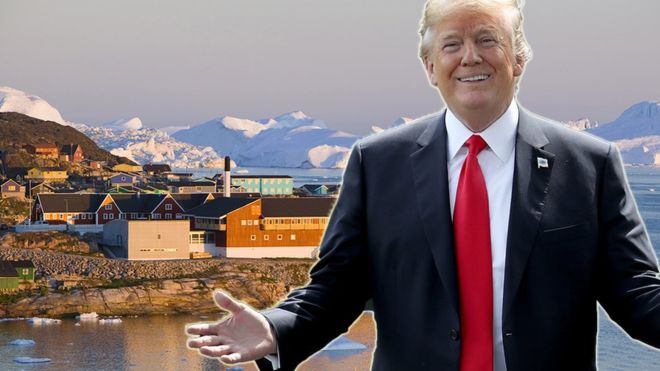
Forget Annexing Greenland, Start Breaking Up the US.

Doug Bandow


With Donald Trump’s arrogant demand on purchase of Greenland dismissed as absurd by the prime minister of Denmark, there are talks in international circles of the eventual disintegration of America.
Stay with us for an article on the ‘Antiwar’ site by Doug Bandow, a senior fellow at the Cato Institute and former special assistant to President Ronald Reagan, titled: “Forget Annexing Greenland, Start Breaking Up the US.”  
The problems of the US are caused not by a lack of territory but increasingly disjointed cultural identities. There's only one solution.
The Danes aren’t impressed. Denmark’s Prime Minister Mette Frederiksen said: “Greenland is not for sale. Greenland is not Danish. Greenland belongs to Greenland.”
Greenlanders were a bit blunter. Inuit Maya Sialuk told the Wall Street Journal: “We are still trying to recover from a colonization period of almost 300 years. Then there is this white dude in the States who’s talking about purchasing us.”
Trump called the Danish Prime Minister’s response “nasty” on Wednesday and abruptly canceled a bi-lateral meeting with her government planned for next month.
In 1867, Secretary of State William Seward, who orchestrated the acquisition of Alaska from Czarist Russia, proposed buying Greenland. In 1946, the Truman administration did likewise. Both times, the Danes said no.
Greenland is not just a place; it is a territory of 56,000 people who largely govern themselves—with a parliament and prime minister—other than in international affairs, which Copenhagen manages, though in consultation with the locals. In fact, internationally Greenlanders are viewed as an independent people. The original residents were Inuits. Vikings showed up in the 10th century, and the territory eventually became part of Norway, and then Denmark.
Greenland is obviously strategic—it is close to America and hosts Thule Air Base. However, one should not oversell its value to American interests. The Washington Examiner grandly declared that Thule “gives the US military the means to deter and defeat prospective aggression.” Aggression by whom? A sneak attack by the Russkies or Chinese launched from the Arctic seems, well, unlikely.
Anyway, no one expects NATO member Denmark to hand over the island to a hostile power. Last year, Washington opposed Chinese financing of three airports, and Denmark’s government found other funders. Canada and Mexico are even more strategic and the US isn’t trying to buy them. (Although Americans once unsuccessfully attempted to conquer Canada and considered annexing all of Mexico, instead of the half that Washington seized after winning the Mexican-American War.)
Most everyone is making the issue about America; at least the Examiner remembered that the US would be, er, buying people. But, it explained, don’t worry, “this isn’t just about American interests. Greenland’s small population also has everything to gain from a massive influx of American investment. The surge in tourism alone would surely offer a vast untapped potential.”
It’s not clear why US firms would suddenly invest in a largely icebound territory that lies mostly north of the Arctic Circle. And what is stopping tourists from going today? Maybe Greenlanders don’t want to be overwhelmed by their much larger neighbors.
While talking about the potential financial benefits for Denmark, columnist Quin Hillyer pronounced, “The wishes of Greenland’s current population should be considered.” Only “considered”? They rule themselves. Would the US seriously contemplate taking control if they didn’t want to join the American colossus? Surely thousands of people should not be bartered as if they’re an oil field or coal mine.
While the Examiner lauds the possibility of Greenland’s inhabitants joining what he calls the US national family, they might not have the same desire to be ruled by the imperial city of Washington, D.C. Can’t say I blame them. America remains exceptional in many ways, but it’s ruled by an abusive, hypocritical, irresponsible, sanctimonious, and incompetent elite—at best legal guardians, not parents—living far distant and with only minimal concern for the “family’s” welfare.
Power is increasingly concentrated in Washington. The federal government exercises ever more authority over ever more aspects of Americans’ lives. Interest group politics has grown more feverish and vicious. In recent years the US has even been moving in the wrong direction on economic liberty. Although it remains ahead of Denmark on the Economic Freedom of the World ratings, on the similar Index of Economic Freedom, Denmark is just one position and a fraction of a point behind America. Most of the Scandinavian countries are redistributionist rather than socialist, and employ less intrusive regulation than the US.
People have long been concocting new schemes to expand the American Empire. In the early days, Washington conquered nearby territories; then it acquired more distant possessions. These days, outright aggression is frowned upon, so expansionists must be more nuanced. For instance, before the possibility of Canada dissolving was mooted, even Patrick Buchanan, who had long argued against America’s warfare state, listed the seceding pieces Washington should snag.
However, the US already is too big. With nearly 330 million people, there is no “national family.” California is a fabulous place, but a majority of its citizens want to base policy on dirigiste economics and identity politics. Why not let them go their own way, rather than whine when the Electoral College prevents them from imposing their self-absorbed fantasies on everyone else?
Equally caustic judgments could be made against other sections of America, such as the South, Rust Belt, and New England. Books have been written about breaking the US into pieces. In this case, secession, or “separation,” would have nothing to do with race and slavery. Rather it would be about community, commitment, family, communication, unity, compassion, responsibility, humanity, and scale. Americans from everywhere should live in peace. But there is no reason why everyone needs to be forced into the same massive political aggregation, with one faction or another constantly attempting to seize control of the whole.
Thinking creatively could yield additional benefits. Why not sell off California to the highest bidder? That could raise a good chunk of money to pay down the national debt. Put Hawaii on the market. Mark Zuckerberg, Bill Gates, or perhaps some Russian or Middle Eastern billionaire might make it worth Americans’ while to yield the Pacific paradise. If not Hawaii, then perhaps American Samoa and the Commonwealth of Northern Marianna Islands.
The Midwest, with its big agricultural production, would be in high demand. China might pay a hefty price—after all, it has a lot of people to feed! There might even be a market for progressive enclaves: San Francisco, Austin, Madison, New York City, Atlanta, and more. Bundle them together and see what the market will bear. Maybe a British government under Prime Minister Jeremy Corbyn would make an offer. It would be a once in a lifetime opportunity to acquire America’s commanding heights of left-progressivism.
Another alternative would be to have US communities go the way of Greenland—that is, become autonomous territories under Danish control. For example, Springfield, Virginia, where I live, could offer to sell to Denmark. No more being forced to support the American imperium.
What is not to like about Greenland’s situation? Once an active, militaristic, and colonial power, Denmark has left those days behind. Now it is a small, inoffensive, constitutional monarchy. It survived World War II and protected its Jewish population. It’s a small, human-sized country, with fewer than six million people; it’s wealthy, democratic, and, according to a UN survey, for what that’s worth, the world’s happiest place.
Perhaps most important, the Danish military has only about 27,000 people in uniform. New York City alone has 36,000 police officers. That means Denmark really can’t wander the globe bombing, invading, and occupying other nations, unlike Washington, which seems to believe Americans cannot be happy unless they’re at war.
Denmark exercised exceptionally good judgment by remaining neutral in World War I, perhaps the stupidest modern war with the greatest long-term consequences. In contrast, America, led by the sanctimonious megalomaniac Woodrow Wilson, voluntarily, even enthusiastically, entered that conflict. World War I brought forth communism, fascism, Nazism, and World War II. Had Washington stayed out, a compromise peace was most likely; the result would have been unsatisfying, but far better for humankind. Denmark’s perspective was the right one, and American policymakers were wrong.
President Trump should leave Greenland alone. It isn’t Denmark’s to sell and it isn’t in America’s interest to buy. This nation’s problems have resulted not from a lack of territory, but from its transformation from a democratic republic to a global imperium. No wonder Mute Bourup Egede, who heads a Greenland independence party, observed: “America will always have an interest in Greenland. Our country will always be ours.” As it should be.

Saturday, August 24, 2019

Imperial Sentiments: Donald Trump, Greenland and Colonial Real Estate

Haven’t the critics worked it out yet?  US President Donald Trump chugs to the coal of nonsense that may come in the wrapping of some sense. Initial mad-cat comments, when cobbled together, might reveal some pattern in time.
Take, for instance, the recent offer to purchase Greenland.  Considered laughable, purchasing territories has notable, historical precedent in US foreign policy.  Territorial aggrandizement through such means has been something of a US specialty, complementing the usual technique of brutal military conquest.
The Louisiana Purchase of 1803 was a steal by President Thomas Jefferson, almost doubling the territory of the United States.  Alaska also went the way of purchase, being transferred by Russia to the US in 1867 for $7.2 million.  It was something the Russians would come to rue: within a half-century, that amount had been earned back a hundred times over.
That same decade saw US State Department officials turn their attention to Greenland.  An 1868 publication for the department compiled by Benjamin Mills Peirce casts more than a fleeting eye on the resources of both Iceland and Greenland, acknowledging the treaty with Denmark which was ostensibly meant to cede control of the islands of St. Thomas and St. John to the US.  (The US State Department describes this attempt on the part of Secretary of State William Henry Seward to acquire the Danish West Indies rather laconically as “peaceful territorial expansion”.)
This observation in the report comes with its inaccuracies, largely based on premature optimism: the US Senate spitefully rejected the treaty, despite being ratified by the Danish parliament and its approval by the very limited suffrage plebiscite.  Anger was expressed at Seward’s persistent support for the troubled President Andrew Jackson during impeachment proceedings.  US interest persisted, though it was the turn of the Danish upper house to return the serve of repudiation in 1902 in refusing to ratify the agreement.  It took the winds of the First World War to encourage a formal transfer of the Danish West Indies on April 1, 1917.
The 1868 report uses rather familiar language to Trump’s, both in political and economic terms.  The Danish authorities are held to task for their great neglect of invaluable development opportunities.  Iceland is praised for “pasture and arable lands, its valuable mines, its splendid fisheries, and its unsurpassed hydraulic power”.  Fully developed (read, by US efforts), a population of one million might be sustained.  The population of Greenland is similarly “neglected by Denmark”, despite the island having vast quantities of fauna varieties for the kill, among them “whale, walrus, seal, and shark, cod, ivory-cod, salmon, salmon-trout, and herring”.  Obtaining it for the US would make good political and commercial sense: it would flank “British America on the Arctic and Pacific” and force her away from Britain “to become a part of the American Union.”
Enough seriousness was given to Trump’s offer to warrant copy across the media spectrum.  The Brookings Institution’s Scott R. Anderson was not hopeful that discussions would go anywhere. “Unfortunately for the president, buying and selling Greenland is, in all likelihood, a legal and political impossibility.”
Anderson acknowledges a traditional acquisitiveness towards Greenland, being a gem of mineral and natural resource wealth. Furthermore, its proximity to Russia and the Arctic, in Anderson’s words, “makes it a major strategic asset for staging various military and intelligence facilities.”  This point is already noted by a US presence at the Thule Air Base, something maintained since the Second World War with Danish consent.  Admittedly, that presence was encouraged by Nazi Germany’s occupation of the kingdom in 1940, leaving Greenland to slide into the American orbit. Six years later, President Harry Truman wanted to formalise the move by suggesting a sum of $100 million for the island.
Given that the Danish government already permits a degree of US influence, it might have been more prudent of Trump to simply exercise it via traditional forms of seemingly benign encroachment.  That approach can be seen in Australia, where an increased US military presence is being felt by way of US marines on rotation in the Northern Territory.  But such a technique seems all too quiet for the Trump boardroom of hiring and firing.  On Wednesday, he cancelled a planned visit to Denmark, deeming the comments made by Danish Prime Minister Mette Frederiksen “nasty”.
Frederiksen’s degree of nastiness was simply one of puzzlement.  Talking about purchasing Greenland was “an absurd discussion”, even though the US did acquire the Danish West Indies through purchase and has kept a roaming eye, wallet at the ready, to expansion in the Atlantic.  On Sunday, she told a television reporter that, “Thankfully, the time when you buy and sell other countries and populations is over. Let’s leave it there.”  She did make one gentle concession.  “Jokes aside, we would naturally love to have an even closer strategic relationship with the US.”  Deeper cooperation “on Arctic affairs” is still on the table.
Despite Frederiksen’s occasional asides at the United States, Danish foreign policy has been closely aligned with the United States since the attacks of September 11, 2001, bucking a long history of non-interventionism.  The Danish Parliament gave its unqualified approval to US actions in retaliation and committed troops to the warring enterprises in Afghanistan, Iraq and Syria.  Danish military casualties per capita are the highest of any of the coalition partners in those haphazard efforts.  This shedding of blood has led to such emetic observations as those of former Prime Minister Anders Fogh Rasmussen, describing the kingdom as “America’s largest and smallest ally”. (An exhibition at the Museum of Danish America in 2017 proclaimed without reserve that the US and Denmark “have the longest unbroken diplomatic relationship in the world, beginning in 1801.”)
There is also Denmark’s strained and blighted relationship with Greenland, making it susceptible to foreign influence.  The largely self-governing entity has capitalised on Danish indifference, attempting to lure Chinese investment to develop three airports to secure better connections to the US and Europe.  (Denmark reluctantly caved in last year in an effort to keep the PRC at bay.)  Greenland’s Ministry of Foreign Affairs has, however, drawn the line over a proposed sale. “We’re open for business,” went an official tweet, “not for sale”.
The Greenland spat has revealed the obstinate ahistorical context of Trump’s world.  Allies, for one, are to be hectored, their efforts dismissed as paltry.  Despite Danish contributions to the foolhardy efforts of the US imperium, Denmark could still be scolded for spending a mere 1.35% of GDP on NATO.  “They are a wealthy country,” tweeted Trump, “and should be at 2%”.
The president had been insulted, his ego put down by the prime minister of a small state.  “You don’t talk to the United States in that way, at least under me,” he told reporters in Washington.  “I thought it was not a nice statement, the way she blew me off.”  The US was never blown off and remains the oversized fly in the ointment of Denmark’s foreign policy.  As for Greenland, Trump might have asked its own prime minister, Kim Kielsen.
Dr. Binoy Kampmark was a Commonwealth Scholar at Selwyn College, Cambridge.  He lectures at RMIT University, Melbourne.

Tuesday, June 04, 2019

Is far right conquering Europe?

Saeed Sobhani

TEHRAN - Many European politicians prefer not to deny the results of the European Parliamentary elections, especially the victory of anti-Euro-nationalist and nationalist factions in this election. However, it seems that in the near future, traditional European parties will try to determine their own proportions with nationalist movements.
The main question here is, what is the right European far right now, what is the position in the eurozone and the European Union, and how Western analysts interpret the results of the European parliamentary elections? Here are some reports and analyzes on the impact of nationalist currents on Europe:
No new dawn for far right in European election
As Deutsche Welle reported,Support for extremist parties remains limited, with signs of protest voting around single issues. While euro skeptics fared well in several countries, DW research suggests more modest gains for the far-right.The party of Geert Wilders, the Islamophobic Dutch politician, lost all its seats in the European election.
Italy's deputy prime minister, Matteo Salvini, said this week that Europe is changing. The leader of the far-right League party hailed the results of elections to the European Parliament, referring to the success of parties led by France's Marine Le Pen and Britain's Nigel Farage as well as to his own.
But a close look at the results for the far right — parties characterized by extreme authoritarian, xenophobic and nationalist politics — suggests the shifts have been more subtle than populist rhetoric might suggest.In countries that had a very small far-right vote in 2014, extremists have gained ground, in some places putting them on a par with mainstream opposition parties for the first time.
But where the far right had already taken root, such as in France and Austria, there was little sign of a major surge beyond previous levels of support.
In France, Le Pen's National Rally (formerly known as the National Front) came up on top of the European poll, with just under 24% of the vote. But that was, in fact, a slight decrease in their 2014 result. And in elections to the country’s national parliament in 2017, the party received about half that — 13%, suggesting the far-right party may have some appeal as a protest vote, but not when it comes to choosing who runs the country.
Liz Fekete, director of the Institute for Race Relations, said Le Pen had benefited from the failure of French president Emmanuel Macron to deliver on his promise of an alternative to establishment politics. But she warned against reading too much into the National Rally's strong performance in elections to the Brussels parliament. "Their achievements can be over-estimated because European elections tend to throw up quite strange results," she told DW.
In Britain, Farage's newly formed Brexit Party also came first in the election to the European parliament. But with little in the way of policy other than opposition to EU membership, the single-issue party's success does not suggest widespread support for a wider far-right platform.
Salvini's own party surged from the 6% it received in the 2014 European election to almost 34%. However, in a national election just last year, it collected a much lower share of the vote, at 17%. That was enough the make it the second-largest party on the country's parliament, but also shows the limits of its support."Salvini is a powerful orator and manipulator of media and media images," said Liz Fekete. "He's managed to establish a hegemony for his ideas."
But she sounded a note of skepticism over further increases in his support, pointing to a growing resistance in response to the League's fervent anti-migrant stance and its moves to shut down dissent.
"Key figures are emerging as uncorrupt, decent people, prepared to take on the system, and others are rallying around them." Fekete cited the example of Domenico Lucano, the former mayor of Riace who attracted worldwide attention when he welcomed refugees to his village in 2011. Lucano is now facing criminal charges of aiding illegal immigration, and his case has become a cause célèbre for those opposed to Salvini's far-right politics.
The country with the biggest increase in support for a far-right party was Slovakia. There, almost 120,000 people (12%) voted for the neo-Nazi 'Our Slovakia' party, compared to 9,000 in the 2014 election. That put them in third place, not far behind Slovakia's social democrats, and gave them two seats in the European parliament.
Led by Marian Kotleba, its platform includes rhetoric against Slovakia's minority Roma community, while its leading members include people associated with anti-Semitism, Nazism and Holocaust denial.A court in Slovakia declined to ban the party earlier in the month. Its breakthrough in the European election builds on the 8% vote share it received in the 2016 national election, raising the prospect that it could be on an upward trajectory.
In Belgium, the Vlaams Belang party made a breakthrough after marshaling opposition to the UN migration pact, which it claimed would increase immigration.Germany, Sweden and Spain also saw increases in votes for the far right. Fekete said in some countries they were boosted by the lower turnout in European elections than national elections. However, it is also worth noting the swell of support for anti-Brexit parties. In terms of the overall vote share, the vote for hard Brexit parties — the Brexit Party and UKIP — amounted to 35%, while the vote for pro-Remain parties totaled almost 42%.
In Hungary, the vote for the nationalist Jobbik dwindled but the governing Fidesz party, which has adopted a far-right stance under prime minister Viktor Orban, received 52% of the vote in a joint list with the country's Christian Democrats.In Greece and Denmark, far-right parties lost support compared to 2014. In the Netherlands, the party of far-right politician Geert Wilders lost all four of its seats in the European parliament.The vote share for Greece's 'Golden Dawn' was down from 9% to just under 5%.
Denmark's 'People’s Party,' which had received 27% of the votes in 2014, plummeted to 11%. That collapse in support may be confirmed in elections to the country’s national parliament next week, where the group could lose its position as the second-largest party.
Liz Fekete said the far right had fragmented in Denmark and the Netherlands, casting doubt on Salvini's idea of a grand coalition of right-wing populist parties, which has attracted wide media coverage. She also noted that Farage's former party Ukip had been demolished by voters in Britain after taking a rightward turn.
DW analyzed the official results alongside data from ParlGov, compiled by researchers at the University of Bremen, to identify far-right parties that won seats in last week's elections to the European Parliament. The researchers classify parties into one of eight families according to their economic and social positions.
In the end, a promised populist surge turned out to be more of a ripple. After months of boasts, bluster and apocalyptic rhetoric about the end of the old Europe, the far right made striking gains in some countries but losses in others.
There were expected strong showings for leading figures of the European far right, such as Hungary’s anti-immigration prime minister, Viktor Orb?n, whose Fidesz party took more than half the vote, and Italy’s interior minister, Matteo Salvini, whose Lega was the biggest party. Marine Le Pen’s National Rally also narrowly topped the polls in France.Salvini said the vote showed “Europe is changing”. Orb?n spoke of “a new era in European politics.
But although there were losses for traditional big parties in many countries, far from all of those votes went to far-right or populist parties, with greens and other pro-European forces also doing well.Péter Krek?, who runs the Political Capital thinktank in Budapest, said: “I see a bit of a shift to the right but it’s not something that will endanger the operation of the EU. Pro-European forces were also mobilised in these elections.”
Nationalist and far-right parties will certainly have more representation in this European parliament than in any previous one. Salvini had attempted to capitalise on the mood, launching what he hoped would become a grand coalition before the vote, to bring all the anti-immigrant far-right parties under one umbrella.
But a combination of egos, policy differences on issues such as cooperation with Russia, and the existing network of European alliances meant even those far-right parties that have done well may struggle to build a coherent bloc in the new parliament.Cas Mudde, an expert on populism and professor at the University of Georgia, said: “I don’t see one strong far-right group emerging soon.”
The electoral picture for far-right parties varied from country to country: in Slovenia, an anti-immigration party got the most number of votes, while in Slovakia, a progressive coalition that stood on a pro-European platform of tolerance came in first place. In Poland, the populist governing party won big but an extreme-right coalition failed to cross the 5% threshold.In Belgium, the far-right Vlaams Belang party was on course to win two MEP seats. In Holland, the anti-Islam Freedom party was due to lose all four of its seats, including that of its leader, Geert Wilders. Thierry Baudet, the new Dutch populist leader who has been taking votes from Wilders, is due to take three seats, which is fewer than opinion polls suggested.
The Danish People’s party, which enthusiastically signed up to Salvini’s new coalition, was decimated at the polls and on course to lose three of its four existing seats. Germany’s AfD came fourth in the polls, winning a projected 11 seats.
Declaring victory outside the campaign headquarters of Fidesz, on the banks of the Danube in central Budapest on Sunday night, Orb?n said the elections had given him a refreshed mandate to help build a different kind of Europe. Fidesz took 52% of the votes and 13 of Hungary’s 21 seats.“We are small but we want to change Europe,” he said, describing the elections as “the beginning of a new era against migration”.
Fidesz is still hanging onto its membership of the centre-right European People’s party grouping by a thread but Orb?n has called Salvini a “hero” and hinted in recent months he may want to join forces with Salvini’s new bloc after the elections.
Hungary’s foreign minister, Péter Szijj?rt?, said “the status quo is over” in the European parliament. “Until now, after European elections, the puzzle was quite simple, the EPP and the socialists came together, counted the votes and there was a comfortable majority … Now nobody is able to say what the final composition of the majority will look like.”
That much is true, and the new European parliament will have a different feel to the old one, as the grip of traditional, old parties is further weakened.“The fragmentation of Europe’s party systems is yet again the big story, as it already was, or should have been, in 2014,” said Mudde. “There are fewer big parties, mainstream parties are now medium-sized, and some even small, while they are replaced by more and more medium-sized anti-establishment and new parties.”
Among the anti-immigration and far-right parties, there are fissures on various issues, with Polish and Scandinavian parties deeply sceptical of Salvini and Le Pen’s admiration for the Russian president, Vladimir Putin. Even if the far-right parties do vote together on certain issues, they will not necessarily be able to dominate the agenda.
Krek? said that even aggregating all the populist and anti-establishment parties from across the spectrum, they will not total more than one-third of all the seats in the new parliament. “Because most decisions only need a simple majority, all the talk of a blocking minority doesn’t make much sense,” he said.
A fact that should not be ignored!
What is clear is that, despite the decline in the number and support of European public opinion in Europe from nationalist parties, these parties have grown in crucial countries such as France, Britain, Germany and Italy. The same thing can have a negative impact on the fate of the European Union and the euro area in the near future. From now on, people like Marine Le Pen, the leader of the French National Front, have taken steps to lead the political and executive equations of their countries. An issue that could increase the threats posed by the serious presence of nationalist currents in the European Union.