Showing posts with label Bernie Sanders. Show all posts

Thursday, December 05, 2019

The cyclical discourse of humanitarian aid for Palestinians

More than 70 years after the Nakba, US politicians are rendering the Nakba irrelevant, even as the Holocaust narrative, by no means solely a Jewish narrative, is being exploited to support Israel’s colonial presence in Palestine. 
During the Democratic presidential primary debate on Wednesday the 20th of November, US Senator and presidential contender Bernie Sanders appeared to have, at face value, distinguished himself from other candidates by speaking, unprompted, about Palestine and Israel. Yet his comments were framed against the prevailing Zionist narrative in the US. 
“It is no longer good enough for us simply to be pro-Israel. I am pro-Israel, but we must treat the Palestinian people as well with the respect and dignity that they deserve,” he stated. To put it succinctly, Sanders is asserting that any concessions to the Palestinian people – respect and dignity is not tantamount to political rights – must not overstep the boundaries of being pro-Israel, which he asserts yet again as a prelude to the rest of his statement. 
During Israel’s latest assault on Gaza this month, following the killing of Islamic Jihad Leader Bahaa Abu Al-Ata, Sanders tweeted a false equivalence between the coloniser and the colonised, also stating: “The US must lead the effort to end the crisis in Gaza and the persistent violence that threatens everyone.” On what grounds should the US be leading is left unspecified. 
Rival Democratic contender Pete Buttigieg unequivocally supported Israel’s “right to defend itself against acts of terror”, with reference to the rocket fire from Gaza in retaliation to Israel’s resumption of targeted assassinations of resistance leaders. 
Is there a choice to be made when Palestinians will ultimately have to deal with yet another US presidency which, at best, will maintain the status quo of US diplomacy and its preferential treatment for Israel? 
At the J Street conference last October, Sanders suggested a fragment of the $3.8 billion allocated to Israel annually for military aid “should go right now into humanitarian aid in Gaza.” J Street describes itself as an entity that “organises and mobilises pro-Israel, pro-peace Americans who want Israel to be secure, democratic and the national home of the Jewish people.” For this aim, Nakba narratives are, of course, irrelevant to J Street.
Yet, despite the divergence in rhetoric, Sanders is not moving away from the Zionist narrative. More than 70 years after the Nakba, US politicians are rendering the Nakba irrelevant, even as the Holocaust narrative, by no means solely a Jewish narrative, is being exploited to support Israel’s colonial presence in Palestine. 
In addition, the refusal to acknowledge the Nakba sets the foundations for eliminating the necessary discussion about Palestinian political rights. There is political affirmation in Sanders stating he is pro-Israel. To offer a fragment of Israel’s US-allocated billions in military aid to Palestinians in Gaza for humanitarian reasons is a departure point in US politics, yet it can also be read as inadequate compensation for colluding in thwarting Palestinian rights. Furthermore, within the context of the Trump administration’s withholding of financial aid for Palestinians, Sanders’ suggestion stands in greater contrast, while still offering little in terms of altering Israel’s colonial violence. 
Since US President Donald Trump took office, the US has become increasingly overt in expressing its collusion with Israel. The withholding of humanitarian aid, its unilateral declaration of Jerusalem as Israel’s capital, as well as the recent statement regarding Israeli settlements, have set the US apart from the international community in terms of what has long been deemed international consensus regarding the two-state paradigm. Would Sanders revoke these US decisions, or would the possible allocation of humanitarian aid to Gaza have to contend with an increasing backdrop and lenience for Israel to retain the violations it has committed?
In the end, the narrative is not really about humanitarian aid for Gaza, but rather seeking the means to justify US military aid for Israel. The humanitarian narrative has already been set by the international community – Sanders’ return to this paradigm, albeit from the military budget allocated to Israel by the US, does not speak much in terms of Palestinian rights. The bottom line is that politicians worldwide speak about Palestinians as an afterthought, in reaction to committed violations and always through elimination of the Palestinian narrative. So far, Sanders has failed to prove otherwise. 

Tuesday, August 20, 2019

'Perfect Illustration of Israel's Racist Apartheid Policies': Netanyahu Denounced for Barring Muslim Congresswomen Omar and Tlaib

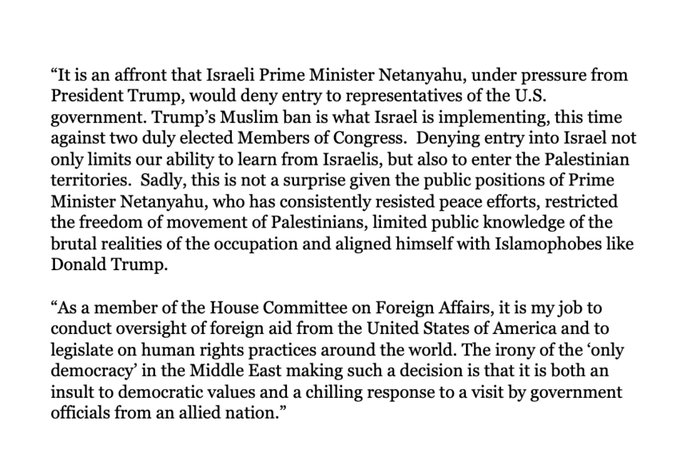
"It is an affront that Israeli Prime Minister Netanyahu, under pressure from President Trump, would deny entry to representatives of the U.S. government."


Reps. Ilhan Omar (D-Minn.) and Rashida Tlaib (D-Mich.), pictured at the Capitol on March 13, 2019, were barred from visiting Israel on Thursday by the Netanyahu government.
Reps. Ilhan Omar (D-Minn.) and Rashida Tlaib (D-Mich.), pictured at the Capitol on March 13, 2019, were barred from visiting Israel on Thursday by the Netanyahu government. (Photo: Tom Williams/CQ Roll Call)
Anger over Israel's barring of Reps. Rashida Tlaib and Ilhan Omar from the country dominated the news on Thursday as progressive politicians, groups, and commentators joined together to condemn the decision. 
"We must stand together against those who promote hatred and racism in Israel, Palestine, the U.S. and everywhere."
—Sen. Bernie Sanders
Omar, a Democrat of Minnesota, and Tlaib, a Democrat from Michigan, have each seen their profiles raise alongside controversies over their critiques of Israel and the U.S. and how the two countries pursue imperialist policies.
"It is an affront that Israeli Prime Minister Netanyahu, under pressure from President Trump, would deny entry to representatives of the U.S. government," Omar said in a tweet announcing her statement on the decision.

It is an affront that Israeli Prime Minister Netanyahu, under pressure from President Trump, would deny entry to representatives of the U.S. government.

My full statement:
View image on Twitter
Tlaib, who is of Palestinian descent and still has family living in the Occupied West Bank, planned to lead a congressional delegation into the territories controlled by the Israeli military this Saturday to show lawmakers the human cost of funding the ongoing occupation.
But the right-wing government of Prime Minister Benjamin Netanyahu blocked that trip, and any others that the two would like to make, with Thursday's decision. In a tweet featuring a photo of her grandmother, Talib explained what that ruling means for her family. 
"This woman right here is my sity," tweeted Tlaib. "She deserves to live in peace and with human dignity. I am who I am because of her."
"The decision by Israel to bar her granddaughter, a U.S. Congresswoman, is a sign of weakness," Tlaib continued, "because the truth of what is happening to Palestinians is frightening."
This woman right here is my sity. She deserves to live in peace & with human dignity. I am who I am because of her. The decision by Israel to bar her granddaughter, a U.S. Congresswoman, is a sign of weakness b/c the truth of what is happening to Palestinians is frightening.
View image on Twitter

35.2K people are talking about this 

One of the stated reasons for the ban is Tlaib and Omar's support for the nonviolent resistance movement known as BDS—Boycott, Divestment, and Sanctions—that aims to target the Israeli state for its repressive policies through tactics that worked against apartheid South Africa. 
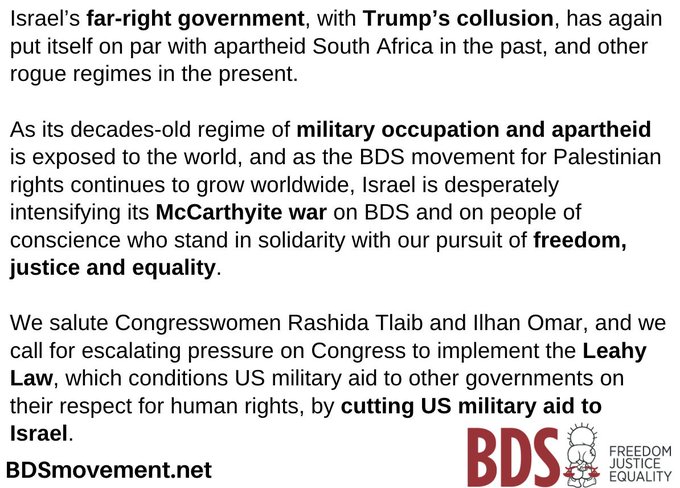
The BDS movement responded to the Israeli decision on Thursday with a statement that condemned "the far-right Israeli government's McCarthyite decision to prevent Congresswomen Tlaib and Omar from visiting the Occupied Palestinian Territory over their support for Palestinian freedom."
"We call for cutting US military aid to Israel," the group added.

The Palestinian-led BDS movement condemns the far-right Israeli government’s McCarthyite decision to prevent Congresswomen Tlaib and Omar from visiting the Occupied Palestinian Territory over their support for Palestinian freedom. We call for cutting US military aid to Israel.
View image on Twitter

618 people are talking about this

As Splinter's Paul Blest explained, the congresswomen's support for BDS doesn't display itself so much in full-throated advocacy as in simple support for the civil rights of Americans:
In practice, it should be noted, Omar and Tlaib’s offenses during their congressional careers amount to voting against a congressional resolution opposing BDS, and sponsoring legislation Omar introduced reaffirming the right of Americans to take part in peaceful protest. One of the boycotts by "Americans of conscience" cited in the legislation is the boycott against Nazi Germany "in response to the dehumanization of the Jewish people in the lead-up to the Holocaust."
The Israeli move came with the support of President Donald Trump, whose antipathy to the pair is well known.
A Thursday morning tweet which smeared the two congresswomen as anti-Semitic was met with harsh criticism from Sen. Bernie Sanders (I-Vt.), one of the frontrunners for the Democratic presidential nomination in 2020.
"Opposing Netanyahu's policies is not 'hating the Jewish people,'" tweeted Sanders. "We must stand together against those who promote hatred and racism in Israel, Palestine, the U.S. and everywhere."
On Thursday afternoon, Trump doubled down on his comments. 
"Representatives Omar and Tlaib are the face of the Democrat Party," the president tweeted, "and they HATE Israel!"
Trump's comments came in for specific criticism from the Council on American-Islamic Relations (CAIR). In a statement decrying the Israeli government's decision, the group's national executive director Nihad Awad drew a line in the sand. 
"Elected officials of all political parties must make a choice between supporting a foreign segregationist government occupying another people or backing two American Congresswomen of color who are being targeted by a racist, Islamophobic and white supremacist president," said Awad.
"Criticizing Israel's policies isn't violence."
—Molly Malekar, Amnesty International
That perception of Israel was echoed by Jewish Voice for Peace executive director Rebecca Vilkomerson. 
"For Israel to bar the entry of members of Congress based on their political views is unconscionable," Vilkomerson said in a statement, "but also the perfect illustration of Israel's racist apartheid policies in practice."
Given the allies of the Netanyahu government, Amnesty International Israel's director Molly Malekar said in a statement, barring critics on ideologically flimsy grounds claiming anti-Semitism while allowing right-wing bigots from across the world into the country suggests that the issue is more that two Muslim women who have political power are using it to criticize Israel. 
"The Israeli government allows free entry to world leaders accused of gross violations of human rights, war crimes, and crimes against humanity, such as Myanmars generals and Duterte of the Philippines, proudly embracing leaders identified with supporting neo-Nazi and anti-semitic groups such as Hungary's Orbán or Brazil's Bolsonaro," said Malekar, "but automatically calls anti-Semitic anyone who dare criticize it."
"Israel bars entry on the basis of political views to those who critique it," Malekar added. "Criticizing Israel's policies isn't violence."
Ultimately, however, the attempt to silence hard truths about the occupation will backfire, Palestinian-American poet Remi Kanazi opined on Twitter. 
"Palestinians are not afraid to have a conversation on Palestine, we aren't afraid to debate or make the case, because we have the truth on our side," said Kanazi. "And no matter how much one tries to extinguish it, that truth seeps through, it gets to the core of people, and quickly shifts them."

Thursday, June 27, 2019

Any Dem Who Wants to Be President Should Reject War with Iran, Not Hide Behind Process Criticisms

Here's where 2020 Democratic hopefuls stand

Democratic presidential hopefuls for 2020 join US Representative Jim Clyburn (7th R) on stage at his World Famous Jim Clyburn Fish Fry at the EdVenture Children's Museum in Columbia, SC on June, 21 2019. - The Democratic candidates running for president are in Columbia to make appearances at the South Carolina Democratic Party Convention and the Planned Parenthood Election Forum on June 22. (Photo: Logan Cyrus / AFP)
Democratic presidential hopefuls for 2020 join US Representative Jim Clyburn (7th R) on stage at his World Famous Jim Clyburn Fish Fry at the EdVenture Children's Museum in Columbia, SC on June, 21 2019. (Photo: Logan Cyrus / AFP)
On the evening of June 20, Donald Trump reportedly gave initial authorization to launch strikes on Iran, then revoked the order at the eleventh hour. The move—which was the latest action in a long-simmering campaign to wage war against Iran—was falsely framed by the Trump administration as retaliatory: Earlier on the same day, reports surfaced that a U.S. Navy surveillance drone violated Iran’s airspace border, prompting the Revolutionary Guard to shoot it down, which Trump called “a big mistake.”
The previous week, shepherded by neocon National Security Advisor John Bolton, the administration alleged, with no conclusive evidence, that Iran was responsible for attacks on two commercial oil tankers near the Gulf of Oman on June 13. This occurred just over a year after the Trump administration withdrew from the 2015 Joint Comprehensive Plan of Action, also known as the Iran nuclear deal, putting the U.S. on a path to greater aggression towards Iran.
Iran has denied the Trump administration’s oil-tanker claims, which remain unsubstantiated. On June 14, the U.S. military released indistinct video footage, which the U.S. military insisted showed an Iranian military patrol boat approaching one of the tankers. The Pentagon followed this with additional “clearer” photos meant to “prove” Iran’s involvement in the attack, and claimed that the Islamic Revolutionary Guard Corps (IRGC) removed an unexploded limpet mine from one of the ships, yet failed to prove that these mines were even attached to the ship. Further, the head of the Japanese company Kokuka Sangyo Co., which owns one of the ships, contradictedthe U.S. military’s allegations.
The crisis, fueled by the Trump administration’s bellicose rhetoric and dangerous provocations, has offered a glimpse into the foreign-policy platforms of some of the leading 2020 Democratic hopefuls. The responses of these candidates—Kamala Harris, Pete Buttigieg, Joe Biden, Elizabeth Warren, and Bernie Sanders—ranged from expressing skepticism about the U.S. narrative on Iran’s actions and condemning “forever wars” to handwringing about whether Trump is following the right process for starting a war and reinforcing the White House narrative that Iran as a “threat.” While Sanders appears to adopt the strongest and most morally informed oppositional stance, Warren trails just behind him, owed to her slightly weaker legislative record on Iran. Meanwhile, candidates like Harris and Biden, who continue to espouse rhetoric about the supposed national security threat posed by Iran and focus more on procedural critiques, rank among the weakest.
Kamala Harris
California Senator and presidential candidate Kamala Harris has vowed to rejoin the Iran nuclear deal if elected, commenting that Trump’s decision to withdraw “was not only not smart, because so far it was working, but it was also unilateral action, not bringing along and apparently not consulting our allies around the globe who are also invested in the right outcome.”
The Iran nuclear deal was an agreement between the U.S., UK, France, China, Russia and Germany in which Iran would restrict supposed nuclear-weapons development in exchange for lifted economic sanctions. While the deal is a step towards deescalation, it meets a low bar, as it is premised on a power imbalance: U.S. intelligence agencies acknowledged in 2007 and 2012 that Iran does not have a nuclear-weapons program. What’s more, per the agreement, the U.S. is allowed to retain nuclear weapons, despite its horrific nuclear history. Nonetheless, U.S. withdrawal is disastrous, as it puts the U.S. on a path to greater confrontation with Iran, and because of this, the deal should be defended.
Harris, however, has remained largely mum on the oil-tanker canard. In May, when Secretary of State Mike Pompeo suggested that the U.S. could leverage the post-9/11 Authorization for Use of Military Force (AUMF) as legal justification to attack Iran, Harris stated that she was unaware of the comments. To her credit, Harris became a cosponsor of the “Prevention of Unconstitutional War with Iran Act of 2019,” which prohibits funds from being used for a war with Iran without congressional approval. But she was more than three weeks behind Warren, who signed up as a cosponsor on May 14, and even further behind Sanders, who cosponsored the day the bill was introduced: April 4. Troublingly, Harris voted in favor of and co-sponsored a 2017 bill that imposed new sanctions on Iran by bundling them with sanctions against Russia and North Korea. Warren voted in favor of this bill but did not cosponsor, and Sanders was the only congressperson in the House or Senate who caucuses with the Democrats to vote against.
Harris has questioned Washington’s Iran narrative, but frames it not in terms of morality—say, sparing the lives of Iranian people—but in terms of national security. On June 18, she tweeted:
“This president likes to talk tough, but for six months now, we've gone without a permanent Secretary of Defense and he just withdrew his nominee — all as Trump marches us toward conflict with Iran. The president is making us less safe.”
She continued on June 20:
“Either the Trump Administration is angling for another disastrous war in the Middle East, or they've spent two years saber-rattling against Iran with no strategy and no endgame. This president is making America weaker and less safe.”
Harris’ comments boil down to a substanceless process critique. The lack of a Secretary of Defense isn’t the problem: The problem is a political establishment clamoring for war with Iran. Harris, then, ignores the moral stakes of the issue, while accepting the Trump administration’s charge that Iran is a threat to “national security.”
Pete Buttigieg
South Bend, Indiana Mayor Pete Buttigieg, whose campaign is informed by a “policy details later” approach, has endorsed the unsubstantiated claim that Iran orchestrated the attacks. In a June 16 interview on “Meet the Press,” he called the evidence that Iran orchestrated the attacks “compelling” and stated:
“It’s a little distressing to think that because this administration's credibility is so low in general, I think a lot of people are thinking twice at a moment when America’s word should be decisive.
When the U.S. says this is something that has happened and this is the consensus of our administration, that should be something that goes without question. But of course, that’s just not the case in an administration that has been extremely unreliable in so many ways.”
The same day, Buttigieg expressed disagreement with Bolton’s efforts to ratchet up aggression when he told CNN’s Jake Tapper that “we need a measured assessment of information as it continues to come in.” Buttigieg added:
“There's no question that Iran has a pattern of malign activities. There's also no question that there is a pattern that is disturbingly reminiscent of the run-up to the war in Iraq, in some cases being driven by the same people.
I mean, the fact that one of the architects of the Iraq War is the President's National Security Adviser right now, when the president himself has pretended that he was against the Iraq War all along, this is shocking. And it should be extremely disturbing to all of us.”
Buttigieg is right to condemn those who orchestrated the Iraq War and to warn of the parallels between Iraq and Iran as targets of U.S. military action. However, he is mistaken to ignore the power assymetry between the U.S. and Iran.
Joe Biden
Joe Biden’s history as Vice President from 2009 to 2017—which included overseeing the Iran nuclear deal—colors his response to the White House. Like Harris, Biden has remained mostly silent in response to the Pentagon’s recent account, but as of 2017, rejected Trump’s intent to withdraw from the Iran nuclear deal. Like Harris, his rationale gave primacy to the “security” of the U.S. and Israel. “[The Iran nuclear deal] is working,” he wrote on Facebook. “It is making the United States and our allies, including Israel, more secure.” He added, “The Iran deal does one thing: remove the immediate threat that a nuclear-armed Iran would present to the region, Israel, and the United States.”
After the Navy drone was shot down, Biden called Trump’s Iran strategy “a self-inflicted disaster.” He continued:
“Trump also promised that walking away would somehow lead to a better deal—instead, the predictable has happened: Iran is building back up its nuclear capability. It’s sadly ironic that the State Department is now calling on Iran to abide by the very deal the Trump administration abandoned.”
“By walking away from diplomacy, Trump has made military conflict more likely. Another war in the Middle East is the last thing we need.”
The same day, Biden also tweeted:
“Make no mistake: Iran continues to be a bad actor that abuses human rights and supports terrorist activities throughout the region.
What we need is presidential leadership that will take strategic action to counter the Iranian threat, restore America's standing in the world, recognize the value of principled diplomacy, and strengthen our nation and our security by working strategically with our allies.”
While Trump’s stratagems should be rebuked, Biden misplaces his focus on the supposed danger of Iran, rather than the violent posturing of the Trump administration.
Elizabeth Warren
Senator Elizabeth Warren (D-Mass.), who has supported the nuclear agreement since its inception, has levied criticism toward the White House. On June 18, in response to a New York Times report titled, “Trump Adds Troops After Iran Says It Will Breach Nuclear Deal” (a questionable media framing given that the U.S. had already violated the deal), she tweeted:
“I hope Iran chooses a different path. But let’s be clear: Trump provoked this crisis. He has no strategy to contain it, he’s burned through our friends and allies, and now he’s doubling down on military force. We can’t afford another forever war.”
While Warren was correct to argue against war, she opens by appearing to place blame against Iran, neglecting to acknowledge the U.S.’s role in villainizing Iran in the first place.
On June 20, after reports of the Navy drone were published, Warren elaborated on her comments, adopting a stronger oppositional stance to the prospect of war with Iran.
“Trump provoked this crisis, and his reckless foreign policy by tweet will only worsen it. I've co-sponsored legislation to prohibit a war with Iran. We need to de-escalate tensions—not let the war hawks in this administration drag us into conflict. #NoWarWithIran”
That same day, she followed with
“Donald Trump promised to bring our troops home. Instead he has pulled out of a deal that was working and instigated another unnecessary conflict. There is no justification for further escalating this crisis—we need to step back from the brink of war.”
Here, Warren uses stronger language to denounce Trump’s actions, but still falls short of a moral denunciation of U.S. violence or a more incisive analysis of the Iran nuclear deal’s power relations. Meanwhile, Warren’s vote for new sanctions against Iran in 2017 weakens her legislative record.
Bernie Sanders
Like Warren, Senator Bernie Sanders (and Independent from Vermont who is seeking the Democratic domination) has taken a decidedly oppositional stance, explicitly questioning the official Washington narrative. In a June 18 interview on MSNBC, he commented:
“If you look at the recent history of this country, I think we understand that the two worst foreign policy disasters [the Vietnam War and the Iraq War] were based on lies that came from the White House.”
He added:
“Let me just say this: I will do everything I personally can as a United States Senator to stop the United States attacking Iran. If we go into a war with Iran, this will be an asymmetrical war which will go on and on and on. There will be never-ending wars in the Middle East…So we have got to do everything we can to bring the antagonists, Saudi Arabia, which is a brutal dictatorship, together with Iran…Use the power of the United States to work out a diplomatic solution, not a military solution.”
Sanders repeated these points on Twitter on June 18, noting Trump has “no legal authority to launch an attack on Iran,” and on June 20:  
“If you think the invasion of Iraq was a disaster, a war with Iran would be worse. The United States must bring Iran and Saudi Arabia to the negotiating table, not foment a never-ending, unconstitutional war in the region.”
And in a June 20 MSNBC interview following the surveillance drone reports:
“I think if there was a war with Iran, it would be an absolute disaster for our country, for Iran, for the region, and for the world.”
Sanders, who voted against new sanctions against Iran in 2017, acknowledges U.S. provocation and rejects the notion that Iran is a true threat. Because of this, Sanders’  censure of the White House’s latest war attempt offers the most robust rejection of war with Iran.
Sanders’ was the only campaign that immediately responded to In These Times’ request for comment, sending the following statement (which had previously been publicly released).
“Attacks on oil tankers in the Gulf of Oman are unacceptable and must be fully investigated. But this incident must not be used as a pretext for a war with Iran, a war which would be an unmitigated disaster for the United States, Iran, the region and the world. The time is now for the United States to exert international leadership and bring the countries in the region together to forge a diplomatic solution to the growing tensions. I would also remind President Trump that there is no congressional authorization for a war with Iran. A unilateral U.S. attack on Iran would be illegal and unconstitutional.”
Candidates, of course, are right to criticize the power of Trump to wage war without Congress, thanks in part to the expansion of presidential war-making powers under George W. Bush and Obama. But on the eve of possible war, it won’t suffice to point out this procedural breakdown. Candidates need to make it clear they're against a possible war itself, rather than simply the means by which Trump is executing it.
The moral stakes of Washington’s escalating actions against Iran couldn’t be higher. The war the White House seeks is, as Sanders notes, based on lies, and it would unequivocally do untold harm to Iranian people. The evidence doesn’t show that Iran is a “threat,” but rather that the U.S. has manufactured a pretext for yet another brutal war.