Showing posts with label Amnesty International. Show all posts

Friday, October 11, 2019

A Generation Deleted: American Bombs in Yemen Are Costing an Entire Generation Their Future

Ahmed ABDULKAREEM
Third-grader Farah Abbas al-Halimi didn’t get the UNICEF backpack or textbook she was hoping for this year. Instead, she was given an advanced U.S bomb delivered on an F-16 courtesy of the Saudi Air Force. That bomb fell on Farah’s school on September 24 and killed Farah, two of her sisters, and her father who was working at the school. It will undoubtedly have an irrevocable effect on the safety and psyche of schoolchildren across the region.
Over the course of Yemen’s pre-war history, which locals fondly refer to as the happy Yemen years, never has an entire generation been subjected to the level of disaster and suffering as that levied upon Farah’s generation by the Saudi-led Coalition, which has used high-tech weapons supplied by the United States and other Western powers to devastating effect since it began its military campaign against Yemen in 2015.
Last week a new school year in Yemen began, the fifth school year since the war started, and little has changed for Yemen’s schoolchildren aside from the fact that the Coalition’s weapons have become more precise and even more deadly, leaving the futures of the country’s more than one million schoolchildren in limbo.
“I want to go to school, I can’t wait any longer,” a relative of six-year-old Ayman al-Kindi told MintPress, recalling how Ayman, surrounded by proud family members, waited impatiently to leave for his first day of school. Ayman would never make it to school; in fact, he never even made it outside. “Ayman wanted to become a doctor but a bomb took him away from school. What these American bombs do to our children is terrifying,” his relative told us.
In late June 2019, Coalition aircraft targeted Ayman’s family home located on their farm in the Warzan area, south of Taiz province in southwestern Yemen. Six of Ayman’s family members were killed, including three children aged 12, nine and six. According to  Amnesty International, the laser-guided precision weapon used in the attack was made by Raytheon. Amnesty’s arms experts analyzed photos of the remnants of the weapon recovered from the scene of the attack by family members and identified it as a U.S.-made 500-pound GBU-12 Paveway II.
The use of a U.S.-made weapon in the attack on the al-Kindi home was no anomaly: most of the weapons possessed by Saudi Arabia and the United Arab Emirates, which between them have carried out a quarter of a million raids on Yemen since the beginning of the war, are American-made. This week, families who lost loved ones in Coalition airstrikes held an exhibition called “Criminal Evidence” in the city of Sana`a. The event was an opportunity to consolidate evidence of potential war crimes and prompted hundreds of Yemeni civilians to attend the event with remnants of U.S.-made weapons in tow, remnants recovered from the rubble of the attacks that killed their loved ones.
Photos from an Amnesty investigation show the 
Al-Kindi home and the Raytheon bomb that destroyed it.
The airstrike on the al-Kindi home was one of nearly a dozen carried out by Saudi Arabia using U.S. weapons that were included in a recent UN report. A team of investigators appointed by the UN Human Rights Council found numerous cases of Saudi airstrikes that violated international humanitarian law and, for the first time, directly implicated the United States, Britain, France and Australia for supplying the weapons used in the attacks.
Charles Garraway, a former military lawyer and one of the experts behind the report, recently told PBS, “We have a war that’s going on. It’s causing immense suffering and frankly most of that suffering is caused by arms.” Garraway continued, “The tragedy in Yemen is so awful at the moment that somehow one has got to reach some form of settlement to stop the war.”
Despite the abundance of evidence proving that Saudi Arabia and the UAE have routinely targeted schools and other civilian facilities, the United States continues to replenish the Coalition’s arsenal. Earlier this year, the Trump administration tried to force through an $8.1 billion arms deal to Saudi Arabia, the United Arab Emirates, and Jordan; and, despite growing opposition within his own government, President Donald Trump seems determined to maintain the flow of U.S. weapons to Saudi Arabia and its allies.
Not your normal “back-to-school” day
Eleven-year-old Mohammed AbdulRaham al-Haddi is one the few schoolchildren to have survived the horrific August 9, 2018, Saudi airstrike on a school bus on the outskirts of Dahyan in Yemen’s northwestern province of Saada. The attack killed more than 35 of his classmates, but Mohammed miraculously survived. Today, he returns to school for the first time since the deadly attack, but to an underserved school and without his classmates. Al-Faleh, Mohammed’s new school, lies nestled in a dusty valley near Yemen’s northeastern border with Saudi Arabia
Mohammed al-Haddi, a survivor of an August 2018 airstrike 
on a school bus, returns to school for the first time since 
the attack. Ali al Shurgbai | MintPress
The attack on Mohammed’s school bus was carried out using a Mark 82 (MK-82) bomb, jointly manufactured by U.S. weapons companies Lockheed Martin and General Dynamics. The MK-82, along with other general-purpose MK-series bombs, has been sold to the Saudi-led Coalition by the United States through a series of contracts made in 2016 and 2017. In addition to last year’s atrocity, the Coalition has used the MK-82 to target Yemeni civilians in the past, such as its bombing of a funeral in 2016 that left over 140 dead and 525 wounded.
As the war in Yemen enters its fifth year, the tragic consequences of these weapons deals are difficult to describe, but their effects are noticed everywhere. Some 3,526 educational buildings have been at least partially destroyed by bombs since the war began, with most yet to be rebuilt. Of those, 402 were completely destroyed, according to a new field survey conducted by the Ministry of Education. Approximately 900 of Yemen’s schools are still being used as shelters for the internally displaced. And 700 schools have been closed as a result of ongoing clashes.
The United Nations Children’s Fund (UNICEF) estimates that two million children are out of school in Yemen. “A fourth of the two million Yemeni children have dropped out since the beginning of the Saudi war in March 2015,” UNICEF representative in Yemen Sara Beysolow Nyanti said in a statement released last Wednesday.
Beysolow raised concerns about the future of Yemeni children, saying:
[They] face increased risks of all forms of exploitation including being forced to join the fighting, child labor and early marriage. They lose the opportunity to develop and grow in a caring and stimulating environment, ultimately becoming trapped in a life of poverty and hardship.”
According to the Geneva-based human rights monitoring organization, SAM, four hundred thousand schoolchildren in Yemen suffer from acute malnutrition, exposing them to the risk of sudden death, 7 million schoolchildren face hunger, and more than 2 million do not go to school.
Even before the war began, the education system in Yemen, the Arab world’s poorest country, was not in good health; a lack of equipment, unqualified teachers, and a shortage of textbooks plagued the country’s schools, which were bursting at the seams with overcrowding. Coalition bombs and a blockade supported by the United States have effectively destroyed what was left, just as schools were beginning to show signs of recovery.
Many of Yemen’s teachers have not received a paycheck in years and some, unable to eke out a living, have sought work as soldiers-for-hire on Yemen’s battlefields, leaving millions of children without prospects for education and the country as a whole with a 70 percent rate of illiteracy. Beysolow warned that the education of a further 3.7 million Yemeni children is at risk, as teachers have not received their salaries for over two years, adding that one fifth of schools in Yemen can no longer be used as a direct result of the conflict. “Violence, displacement and attacks on schools are preventing many children from accessing school,” she said.
In a bid to stop teachers from leaving schools, the Ministry of Education, based in Sana`a, has imposed a fee on students of $2 per month to pay teacher salaries, but that seemingly nominal fee has added a huge burden to families with more than one child, many of whom are living in extreme poverty as a result of the war and siege. “I have six students, meaning that I need to pay $12 a month; I can’t save that amount,” one mother told us. She lost her husband in the clashes that erupted between the former president Ali Saleh and opposition tribes on Hasabah Street in 2011. Now, her only source of income is begging and it is not enough to feed her six children, let alone send them to school.
To make matters worse, just weeks before the new school year began, the Saudi-led Coalition prevented 11 oil tankers from entering Yemen. The move sparked an acute shortage of fuel, which meant that school buses could no longer run, leaving even those with the means to pay school fees unable to send their children to school.
The severe psychological toll
The effect of U.S.-made weapons upon Yemen’s children does not end there. Children who have survived the fighting are often left with physical disabilities and severe and chronic psychological symptoms, turning their environment into the worst place in the world, according to UNICEF.
Beyond the direct casualties from airstrikes, the largely unnoticed and unrecorded (by the world) sounds of explosions and buzzing warplanes are leaving Yemen’s children with irreversible psychological damage.
Terrified children take cover at the entrance of a cave used 
as makeshift shelter in the Maran border area, September 
30, 2019. Taha al Shurgbai | MintPress
Like other students, Mohammed often gets distracted while at home or sitting in class, unable to focus and laden with severe anxiety. While students the world over occupy their minds with the day-to-day matters that should accompany adolescence, Yemen`s students, especially those who live in border districts, are filled with an ever-present fear of an impending airstrike.
Since the school year began on September 15, the Saudi-led Coalition has reportedly dropped more than a thousand bombs and missiles in 400 separate airstrikes targeting border districts including Sadaa, Hajjah, Sana`a, Amran, Dhali, and Hodeida. The hundreds of sorties are accompanied by frightening whizzing noise and have left great panic in the hearts of civilians, especially Yemen’s schoolchildren.
“Before the war, the sound of planes meant happiness for families who were expecting loved-ones returning [from abroad], but now the sound of planes mean destruction, death, blood,” Dr. AbdulSalam Ashish, a consultant for psychological and neurological diseases, told MintPress. Dr. Ashish continued, “Now, the planes bring nothing but fear and panic and are a reminder of tragedies and crimes that were committed with U.S., British, and French weapons.”
“It was 1:45 p.m., when we heard a missile strike; we were able to calm the students down but when the third strike hit we lost control of the students as they began to scream and chaos spread throughout the school,” Hana Al Awlaqi, a school agent at the  “Martyr Ahmed Abdul Wahab Al Samawi” School, said, recounting the moment a Saudi attack took place just tens of meters away from the school. “The sound of the fourth bomb made matters worse, as the school was being broken into by panicked parents and many teachers were fainting.”
School children react to bombs dropped outside of the Martyr 
Ahmed Abdul Wahab Al Samawi school on Nov 11, 2017. 
Mohammed al Alkabsi | Yamanyoon
Al Awlaqi went on to say that many students convulse into spasms when they hear the sound of airplanes, while others have refused to come back to school. “The sound of an explosion or the buzz of the aircraft stays in the mind. The sound of an aircraft can send these children into severe panic attacks and anxiety,” Dr. Ashish confirmed.
Jalal Al-Omeisi, a pediatric nurse at the Psychiatric and Neurological Hospital in Sana`a told MintPress that most of the cases that arrive at the hospital are from areas subjected to intensive Saudi Coalition raids, such as Sana`a, Hodeida, and Saada, as well as the border areas. Al-Omeisi went on to say that most medics lack the training to deal with the complex psychological issues that these children are developing.
Such experiences in children go well beyond the temporary impact on their education and, without proper care and the knowledge necessary to address treat these psychological issues, many will suffer life-long consequences that hinder their ability to obtain an education. This is especially true in light of the lack of programs, centers or hospitals for the rehabilitation of war-affected children in Yemen.
Asking Americans to open their eyes
Schoolchildren living along Yemen’s porous border with Saudi Arabia and throughout its southern districts face a reality even more grim than that faced by their peers. Many are recruited or even forced to join the fight to defend the Saudi border via local trafficking networks, which funnel children into training and recruitment camps in the southern Saudi provinces of Jizan and Najran, as well as to Yemen’s southern districts.
According to a recent report by SAM, Saudi Arabia has been enlisting thousands of Yemeni children to fight along its southern border with Yemen over the past four years. Those have who died as a result of the fighting at the border are often buried in the Kingdom without their families’ knowledge. At least 300 had to have their limbs amputated as a result of their military injuries.
A 17 year-old boy holds his weapon in High dam in Marib, 
Yemen, July 30, 2018. Nariman El-Mofty | AP
MintPress managed to speak to dozens of school-aged 
Yemeni children who were captured in a recent Houthi 
operation that saw thousands of militiamen, 
including dozens of schoolchildren, and Saudi officers 
taken into captivity. Fifteen-year-old Adel was among 
those captured. He left his home in the southern 
city of Taiz, chasing promises of a regular paycheck 
of up to 3,000 Saudi riyals ($800). Adel told MintPress: 
We were left alone in Wadi Abu to face our destiny. Older recruits were fleeing on pickup trucks and armored personnel carriers; Saudi airstrikes hit us as we were surrendering to the Houthis.”
Saudi warplanes targeted the captured mercenaries in Wadi Abu Jubarah, killing more than 300 of their own recruits.
Adel, who left school for the promise of a paycheck, went on to say, “Me and the others were recruited to wash the clothes of Saudi soldiers but they gave us rifles and forced us to go to battlefields.” When asked what he would do when freed, Adel said simply, “I want to go back to my mom and school. I don’t want to fight.”
The recruitment of Yemeni children by Saudi Arabia is not without precedent. Although the Kingdom signed the international protocol banning the involvement of children in armed conflict in 2007 and again in 2011, it was accused of recruiting Sudanese children from Darfur to fight in Yemen on its behalf as late as 2018.
Mohammed, who often visits the memorial to his classmates located only a few hundred meters away from his new school, said he will continue to attend school every day, regardless of how much bombing there is. He asked that Americans open their eyes to see what their weapons are doing to Yemen’s children.

Friday, October 04, 2019

One Year After Khashoggi Murder, Chorus of Demands for Saudi Govt. to Face Consequences

"Despite the backlash directed at the kingdom, the Saudis haven't faced serious consequences for the slaying of Khashoggi or its slaughter of civilians in Yemen."


The late Jamal Khashoggi, pictured speaking during POMED's "Mohammed bin Salman's Saudi Arabia: A Deeper Look."
The late Jamal Khashoggi, pictured speaking during POMED's "Mohammed bin Salman's Saudi Arabia: A Deeper Look." (Photo: April Brady/Project on Middle East Democracy via flickr/cc)
Saudi Arabian rights activists joined with advocacy groups to mark the one-year anniversary of journalist Jamal Khashoggi's death Wednesday with actions and calls for accountability.
"Any talk of assuming responsibility for Jamal Khashoggi's killing is meaningless if not met with the immediate and unconditional release of dozens of individuals who continue to languish in prison, and who continue to be at risk of torture and other ill-treatment, solely for having expressed their opinion in a peaceful manner," said Amnesty International's Middle East research director Lynn Maalouf.
Khashoggi was murdered on October 2, 2018 in the Saudi consulate in Turkey. Common Dreams reported Wednesday that an official complaint was filed with the International Criminal Court over the incident. 
In the year since the killing, Saudi Arabia has dumped funding into public relations to improve the kingdom's standing in the U.S., according to Open Secrets.
Saudi Arabian interests reported spending just over $16 million on foreign influence operations from October 2, 2017, until October 2, 2018, according to OpenSecrets' analysis. In the year since Khashoggi's death, Saudi interests have poured more than $27 million into influence operations disclosed in Foreign Agent Registration Act filings in OpenSecrets’ Foreign Lobby Watch database.
CodePink co-founder Medea Benjamin, in an opinion piece for Common Dreams Tuesday, wrote that those who buy the explanation from Saudi Crown Prince Mohammed bin Salman, who is known as MBS, are complicit in the kingdom's rewriting of the facts of the murder.
"Who is more evil," said Benjamin, "the maniacal Saudi crown prince responsible for Khashoggi's murder and the murder of tens of thousands of  Yemenis, or the mendacious world leaders and businesspeople who continue to embrace what should be a pariah state?"
The prince's acknowledgement over the weekend that he bore general responsibility for the murder—a statement that left out any direct admission of responsibility or apology—spurred Human Rights Watch's Middle East director Sarah Leah Whitson to call the comments "insufficient."
"If he's serious, the crown prince and his government should provide transparency into the ongoing trial and reveal everything they know about the planning, execution, and aftermath of Khashoggi's murder," said Whitson. "Instead, Saudi authorities are doubling down on repression and continuing to silence independent Saudi voices that Khashoggi sought to defend."
In a statement, Amnesty said it is supporting the launch of a podcast for Saudi expats fighting for free expression in the kingdom. Saudi scholar Hala al-Dosari said that the podcast "will present a powerful platform for Saudi journalists, scholars, and activists to counter the state-led propaganda and misinformation campaign."
"It will engage the Saudi people in a rare and free discussion on issues such as public participation, rule of law, feminism and other issues related to human rights," said al-Dosari. 
There are a number of people  in Saudi prisons who need solidarity, Amnesty said:
To date, Amnesty International has documented the cases of at least 30 prisoners of conscience who are behind bars serving prison sentences of between five and 30 years solely for peacefully exercising their rights to freedom of expression, association and peaceful assembly. Amongst those currently detained are Mohammad al-Qahtani, a founding member of the Saudi Civil and Political Rights Association who called for the protection and promotion of human rights and provided legal support to families of detainees, and Waleed Abu al-Khair, a lawyer who defended human rights defenders before his imprisonment. Mohammad al-Qahtani and Waleed Abu al-Khair were tried and sentenced before the counter-terror court to 10 and 15 years in prison, respectively, for their peaceful human rights work.
Critics of President Donald Trump pointed to a pattern of coddling MBS from the White House as a reason that, a year after the murder, next to nothing has been done. 
"Despite the backlash directed at the kingdom, the Saudis haven't faced serious consequences for the slaying of Khashoggi or its slaughter of civilians in Yemen," the Center for International Policy's Ben Freeman and William D. Hartung wrote Wednesday. "That is thanks in large part to one man—President Trump. He has loudly and emphatically defended Saudi Arabia at every opportunity."
In a tweet, Sen. Elizabeth Warren (D-Mass.) called for action. 
"A year has passed, but Donald Trump and his administration have done nothing to hold Saudi Arabia accountable for the murder of Jamal Khashoggi," said Sen. Elizabeth Warren (D-Mass.). "He and his family deserve justice."

Tuesday, August 20, 2019

'Perfect Illustration of Israel's Racist Apartheid Policies': Netanyahu Denounced for Barring Muslim Congresswomen Omar and Tlaib

"It is an affront that Israeli Prime Minister Netanyahu, under pressure from President Trump, would deny entry to representatives of the U.S. government."


Reps. Ilhan Omar (D-Minn.) and Rashida Tlaib (D-Mich.), pictured at the Capitol on March 13, 2019, were barred from visiting Israel on Thursday by the Netanyahu government.
Reps. Ilhan Omar (D-Minn.) and Rashida Tlaib (D-Mich.), pictured at the Capitol on March 13, 2019, were barred from visiting Israel on Thursday by the Netanyahu government. (Photo: Tom Williams/CQ Roll Call)
Anger over Israel's barring of Reps. Rashida Tlaib and Ilhan Omar from the country dominated the news on Thursday as progressive politicians, groups, and commentators joined together to condemn the decision. 
"We must stand together against those who promote hatred and racism in Israel, Palestine, the U.S. and everywhere."
—Sen. Bernie Sanders
Omar, a Democrat of Minnesota, and Tlaib, a Democrat from Michigan, have each seen their profiles raise alongside controversies over their critiques of Israel and the U.S. and how the two countries pursue imperialist policies.
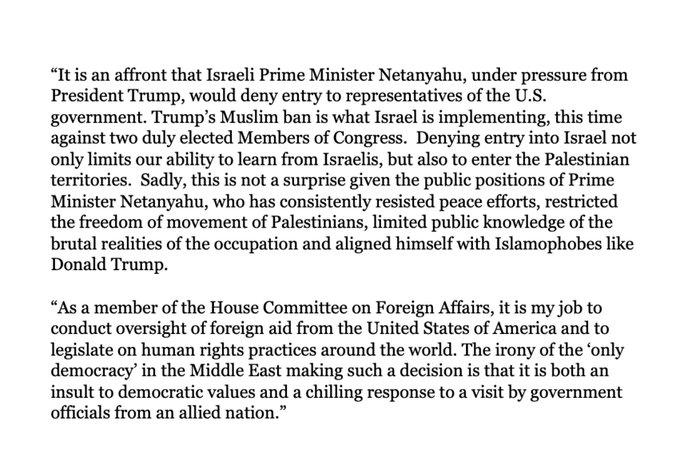
"It is an affront that Israeli Prime Minister Netanyahu, under pressure from President Trump, would deny entry to representatives of the U.S. government," Omar said in a tweet announcing her statement on the decision.

It is an affront that Israeli Prime Minister Netanyahu, under pressure from President Trump, would deny entry to representatives of the U.S. government.

My full statement:
View image on Twitter
Tlaib, who is of Palestinian descent and still has family living in the Occupied West Bank, planned to lead a congressional delegation into the territories controlled by the Israeli military this Saturday to show lawmakers the human cost of funding the ongoing occupation.
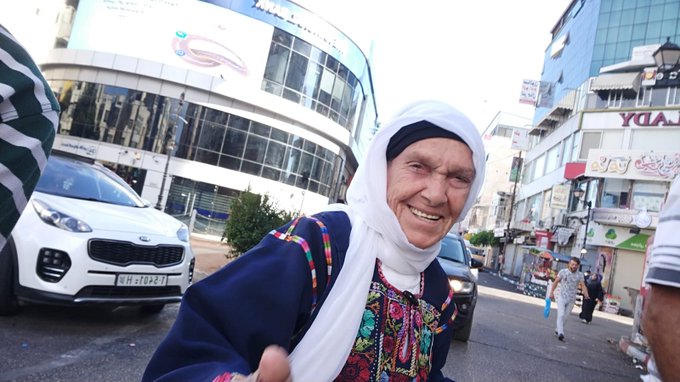
But the right-wing government of Prime Minister Benjamin Netanyahu blocked that trip, and any others that the two would like to make, with Thursday's decision. In a tweet featuring a photo of her grandmother, Talib explained what that ruling means for her family. 
"This woman right here is my sity," tweeted Tlaib. "She deserves to live in peace and with human dignity. I am who I am because of her."
"The decision by Israel to bar her granddaughter, a U.S. Congresswoman, is a sign of weakness," Tlaib continued, "because the truth of what is happening to Palestinians is frightening."
This woman right here is my sity. She deserves to live in peace & with human dignity. I am who I am because of her. The decision by Israel to bar her granddaughter, a U.S. Congresswoman, is a sign of weakness b/c the truth of what is happening to Palestinians is frightening.
View image on Twitter

35.2K people are talking about this 

One of the stated reasons for the ban is Tlaib and Omar's support for the nonviolent resistance movement known as BDS—Boycott, Divestment, and Sanctions—that aims to target the Israeli state for its repressive policies through tactics that worked against apartheid South Africa. 
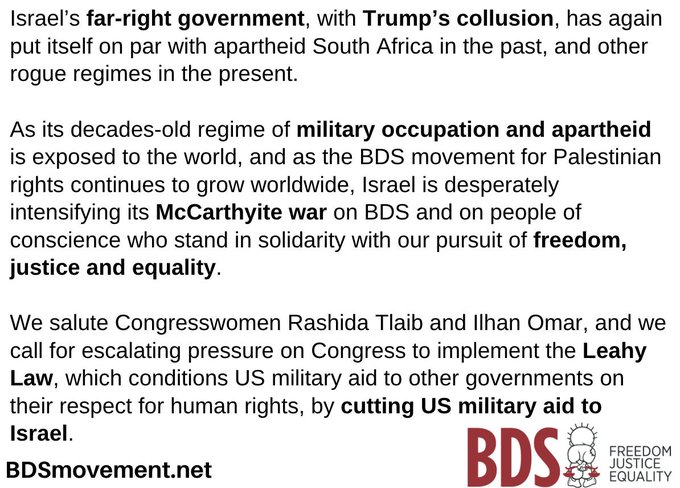
The BDS movement responded to the Israeli decision on Thursday with a statement that condemned "the far-right Israeli government's McCarthyite decision to prevent Congresswomen Tlaib and Omar from visiting the Occupied Palestinian Territory over their support for Palestinian freedom."
"We call for cutting US military aid to Israel," the group added.

The Palestinian-led BDS movement condemns the far-right Israeli government’s McCarthyite decision to prevent Congresswomen Tlaib and Omar from visiting the Occupied Palestinian Territory over their support for Palestinian freedom. We call for cutting US military aid to Israel.
View image on Twitter

618 people are talking about this

As Splinter's Paul Blest explained, the congresswomen's support for BDS doesn't display itself so much in full-throated advocacy as in simple support for the civil rights of Americans:
In practice, it should be noted, Omar and Tlaib’s offenses during their congressional careers amount to voting against a congressional resolution opposing BDS, and sponsoring legislation Omar introduced reaffirming the right of Americans to take part in peaceful protest. One of the boycotts by "Americans of conscience" cited in the legislation is the boycott against Nazi Germany "in response to the dehumanization of the Jewish people in the lead-up to the Holocaust."
The Israeli move came with the support of President Donald Trump, whose antipathy to the pair is well known.
A Thursday morning tweet which smeared the two congresswomen as anti-Semitic was met with harsh criticism from Sen. Bernie Sanders (I-Vt.), one of the frontrunners for the Democratic presidential nomination in 2020.
"Opposing Netanyahu's policies is not 'hating the Jewish people,'" tweeted Sanders. "We must stand together against those who promote hatred and racism in Israel, Palestine, the U.S. and everywhere."
On Thursday afternoon, Trump doubled down on his comments. 
"Representatives Omar and Tlaib are the face of the Democrat Party," the president tweeted, "and they HATE Israel!"
Trump's comments came in for specific criticism from the Council on American-Islamic Relations (CAIR). In a statement decrying the Israeli government's decision, the group's national executive director Nihad Awad drew a line in the sand. 
"Elected officials of all political parties must make a choice between supporting a foreign segregationist government occupying another people or backing two American Congresswomen of color who are being targeted by a racist, Islamophobic and white supremacist president," said Awad.
"Criticizing Israel's policies isn't violence."
—Molly Malekar, Amnesty International
That perception of Israel was echoed by Jewish Voice for Peace executive director Rebecca Vilkomerson. 
"For Israel to bar the entry of members of Congress based on their political views is unconscionable," Vilkomerson said in a statement, "but also the perfect illustration of Israel's racist apartheid policies in practice."
Given the allies of the Netanyahu government, Amnesty International Israel's director Molly Malekar said in a statement, barring critics on ideologically flimsy grounds claiming anti-Semitism while allowing right-wing bigots from across the world into the country suggests that the issue is more that two Muslim women who have political power are using it to criticize Israel. 
"The Israeli government allows free entry to world leaders accused of gross violations of human rights, war crimes, and crimes against humanity, such as Myanmars generals and Duterte of the Philippines, proudly embracing leaders identified with supporting neo-Nazi and anti-semitic groups such as Hungary's Orbán or Brazil's Bolsonaro," said Malekar, "but automatically calls anti-Semitic anyone who dare criticize it."
"Israel bars entry on the basis of political views to those who critique it," Malekar added. "Criticizing Israel's policies isn't violence."
Ultimately, however, the attempt to silence hard truths about the occupation will backfire, Palestinian-American poet Remi Kanazi opined on Twitter. 
"Palestinians are not afraid to have a conversation on Palestine, we aren't afraid to debate or make the case, because we have the truth on our side," said Kanazi. "And no matter how much one tries to extinguish it, that truth seeps through, it gets to the core of people, and quickly shifts them."

Wednesday, April 24, 2019

UN rights boss condemns mass executions by Saudi Arabia

The United Nations human rights chief has condemned the recent mass execution of nearly 40 people in a single day across Saudi Arabia, as a crackdown led by Crown Prince Mohammed bin Salman against dissidents widens in the kingdom.
UN High Commissioner for Human Rights Michelle Bachelet said in a statement issued in Geneva on Wednesday that most of those beheaded were minority Shia Muslims. She also voiced concern about a lack of due process and fair trial in the kingdom amid allegations that confessions were obtained through torture.
"It is particularly abhorrent that at least three of those killed were minors at the time of their sentencing," Bachelet said.
Elsewhere in the statement, she called on Saudi authorities to review counterterrorism legislation and halt pending executions.
Earlier on Tuesday, the Saudi Interior Ministry said in a statement carried by state-run media that it had put 37 citizens to death for their alleged "adoption of extremist, terrorist ideology and forming terrorist cells to corrupt and disturb security, spread chaos and cause sectarian discord."
Reports said the beheaded body of one of the victims, Khaled bin Abdel Karim al-Tuwaijri, was attached to a pole for several hours. 
Adam Coogle, who monitors Saudi Arabia for Human Rights Watch, said at least 33 of those executed were Saudi Shias, noting that some of the victims had been convicted based on confessions made under torture.
Also on Tuesday, Amnesty International slammed the executions, saying that the victims had been convicted "after sham trials," which relied on "confessions extracted through torture."
The rights body stated that 14 of those executed had participated in anti-government protests in the kingdom's oil-rich Eastern Province in 2011-2012. It also said one of them, Abdulkareem al-Hawaj, was arrested when he was 16, making his execution a "flagrant violation of international law."
The European Union foreign policy chief, Federica Mogherini, said the executions heightened doubts about respect for the right to a fair trial in Saudi Arabia and could fuel sectarian violence.
The mass execution is the largest in Saudi Arabia since January 2016, when 47 men were executed in a single day, including outspoken Shia religious scholar Sheikh Nimr Baqir al-Nimr.

Monday, April 22, 2019

Amnesty Int’l silent on al-Qaeda war crimes in Syria

The double standard of the US and the so-called world agencies on the crisis in Syria is not only deplorable but diabolical, in view of their distortion of facts and efforts to protect the terrorist outfits and instead try to criminalize Syria.
Vanessa Beeley, an independent investigative journalist and associate editor at 21st Century Wire, has compiled a factual report in this regard for Russian TV, titled: “Amnesty International silent on al-Qaeda war crimes in Syria”.
Amnesty International’s biased and misleading report ignores the suffering of communities under attack from the CIA-created terrorist outfit al-Qaeda and its affiliates in Syria’s Idlib.
Tensions are being ratcheted up in the north-westerly provinces of Idlib and Northern Hama while the Zionist-controlled western media prepares itself for the revival of the notorious “last doctor” meme.
Back in September 2018 Russian and Turkish negotiators had agreed to establish a demilitarized zone in Idlib which should have been completed by October 15, 2018. The reality is that the withdrawal of heavy weaponry has only been partially successful and the remaining armed groups dominated by Hayat Tahrir ash-Sham (HTS), effectively a rebrand of al-Qaeda or an-Nusra Front, have consistently violated the ceasefire and targeted cities, towns and villages on the borders of the so-called “safe zone.”
Was UK paying White Helmets to produce Syria ‘chemical weapon’ public relations propaganda as cover for the Saudi-supported terrorist outfit, Jaish al- Islam?
Think tanks and globalist organisations that serve to bolster NATO’s aggressive interventionist policy in Syria are advocating an increase of Turkey’s military footprint in Idlib, ostensibly to curtail the HTS expansionism, but, clearly, and perhaps foolishly relying upon Turkey’s NATO membership to offer them a compliant occupier in the northwest while the US coalition increases its own military presence in the vast band of Syrian territory east of the Euphrates – despite President Trump’s hollow withdrawal-of-US-troops rhetoric in December 2018.
In amongst all this geopolitical jockeying for position and supremacy, civilians in the region are suffering and few more so than those who live in the towns that border Idlib and areas of Northern Hama still under control of the armed groups and their HTS overlords. These are the Syrian people entirely ignored by NATO-aligned media and “human rights” groups that have sustained narratives that traditionally only criminalize one side in a complex and externally imposed eight-year war.
The most recent example of this extreme bias in favor of the US supremacist alliance is the Amnesty International report dated 28th March 2019 entitled “Syria: Government forces have bombed medical facilities, school and bakery in Idlib.” The title has unequivocally laid out the report’s intent, to criminalize the Syrian government.
The report opens with Lynn Maalouf, Middle East Research Director at Amnesty International claiming: “The report covers “six recent attacks” in Idlib that Amnesty claim to be “verified.”
The report provides no context during this “verification” process. No names of witnesses are provided, we are expected to accept the testimony of anonymous sources whose affiliations are not questioned. We are expected to rely upon the “evidence” provided by “verified open source information, social media photos and videos” which have been “corroborated” remotely by Amnesty’s recently established “Digital Verification Corps” (DVC) in Toronto, California, UK or South Africa. Despite this alleged verification process, none of these videos or photos are shown in the Amnesty report.
Amnesty claims to have interviewed witnesses themselves but does not provide identity of the alleged Amnesty staff on the ground in an area infested by al-Qaeda affiliates who are known to kidnap and endanger the lives of anyone that might question their motives. Were these witnesses interviewed via Skype by the DVC or were anonymous proxies instructed to conduct interviews in an area controlled by HTS? The report does not clarify.
What is familiar about this report are the claims of Syrian government aggression against “civilian” targets in an area occupied by hostile armed groups financed and armed by hostile NATO member states and their allies whose intent is to topple the Syrian government and impose a tyrannical sectarian regime in its place.
We have heard identical, sensationalist rhetoric during the Syrian Arab Army campaigns to cleanse eastern Aleppo and eastern Ghouta of the same extremist occupiers that were then transported to Idlib as part of the Syrian/Russian amnesty and reconciliation deals.
This report criminally erases the atrocities committed by HTS and subordinate groups against the towns and villages clustered inside Syrian government secured territory on the borders with the last terrorist stronghold in Syria. The report misleads an unsuspecting public to believe the Syrian government is conducting unprovoked attacks against a civilian population. This is an outright lie.
So, let’s add some vital context to this biased and misrepresentative report. Amnesty mention attacks by the Syrian government on March 9 and 11, in Saraqeb and Talmans, southern Idlib. There are claims that hospitals and blood banks were the main targets, while in February bakeries and makeshift medical clinics had been hit.
Acclaimed journalist, Sharmine Narwani, had previously conducted an investigation into the systematic destruction of bakeries, flour mills and deliberate decimation of wheat production by Western-backed armed groups to increase pressure on the Syrian government and collectively punish the Syrian people that have resisted the Western-sponsored extremist bid to take over their country.
According to Narwani, “the West's terrorists drove wheat production from 2.5 M tons per year to 100K. In a Syria flour mill. NATO-GCC 'rebels' systematically targeted food sources - see big mortar hole in the back wall.”
It is worth noting that several of the Amnesty testimonies come from members of the NATO-member-state financed and promoted White Helmets embedded with HTS in the region. It is also worth noting that a British government draft document published in April 2017 demonstrates that the White Helmets are the most “routinely reliable source” for both Amnesty International and Human Rights Watch. So a biased source provides “reliable” and unverified corroboration of biased reports that serve the imperialist agenda.
What is not mentioned in the report is the reality that armed groups have systematically occupied hospitals, schools, and medical centers across all areas they have previously controlled in Syria, converting many of them into prisons, military centers and ammunition stores and factories.
What is also not mentioned are the daily attacks from these HTS enclaves against the Syrian Christian towns of as-Suqaylabiyah and Mhardeh and surrounding villages.
In the weeks leading up to March 9, these attacks intensified. I visited the area on March 9 and was shown the destruction of civilian homes in as-Suqaylabiyah by one attack on March 7. The Amnesty report highlights the alleged displacement of civilians as a result of Syrian government attacks but does not mention the homelessness brought about by such attacks by HTS against the civilian populations of these towns.
Nabeel al-Abdallah, the commander of the as-Suqaylabiyah volunteer National Defence Forces told me that the extremists were using a new, more powerful C4 explosive in their Grad rockets as the damage was so extensive to entire neighborhoods in the town. The town’s monastery had also been targeted in these attacks, a monastery which doubles as a community center and school for the children of the town. Since the escalation of attacks by armed groups, the children have not been able to attend school as the risk of death or injury is too great. These children are disappeared by Amnesty, their schools don’t count.
After March 9, the merciless attacks against civilians and infrastructure in Mhardeh and as-Suqaylabiyah continued unabated. On March 16, terrorists targeted another residential area in Suqaylabiyah.
Salma Boutros Khalil was seriously injured by shrapnel, her home was destroyed. Her daughter in law, Ayat al-Mahmoud, a Palestinian originally from Damascus, was killed. Ayat was pregnant, her baby was due in one week. Salma’s grandson was also terribly injured by shrapnel and was rushed to Hama National hospital. Two other children were grievously wounded in this attack.
These attacks do not target military centers, they target only residential areas and civilians. They are, in many instances, war crimes, but according to Amnesty International, these attacks never happened.
On March 26, if the Amnesty report is to be believed, Syrian government forces fired rockets “at a school in Sheikh Idriss.” Again the context is non-existent.
On March 23, a suspected chemical weapon attack was carried out by HTS against villages around 10km to the northwest of as-Suqaylabiyah – ar-Raseef, al-Aziziyyeh, al-Khandaq, and al-Jayyid. The attack came in from the north, in fact close to Sheikh Idriss.
I was in as-Suqaylabiyah when this attack took place and I was able to visit the local hospital that received the 34 victims which included three children, one severely affected with respiratory problems. Victims complained of breathing difficulties, skin blisters, eye sensitivity, nausea and shock syndrome after the attack.
One victim, Nawfal Tawbar, described the 1m high dense white smoke that enveloped the area after the mortars had exploded, saying: “Without the Syrian government’s retaliatory measures, these extremist attacks would only increase.”
The attacks are motivated primarily by sectarian hatred against the Syrian Christian or Alawite communities or simply against those who remain loyal to their government. One of the recorded messages from the terrorist groups during this period demanded that as-Suqaylabiyah “release its Nusairi inhabitants” to the terrorists (for execution) to avoid their city being “burned.” Nusairi is the commonly used terrorist term for the Alawites.
In the Amnesty report, Maalouf makes the statement: “Deliberate attacks on civilians and on civilian objects, including hospitals and other medical facilities, and indiscriminate attacks that kill or injure civilians are war crimes.”
Maalouf fails entirely to identify or qualify the HTS-led attacks against civilians as war crimes which is an egregious negation of the suffering of entire communities in the region.
The Amnesty report goes on to further shoot itself in the foot. I asked former UK Ambassador to Syria, Peter Ford for a review of the report. Ford described the report as the “pseudo-findings on Syria by a Corps that has obviously taken up its place in the battle order of Western propagandists seeking to justify endless war on Syria.”
Ford points out that the Amnesty report implicitly acknowledges that the areas targeted by the Syrian government are awash with al-Qaeda (HTS) militants while their student so-called experts “cite the testimony of 'residents' that no HTS were present, indeed couldn't have been present because the areas were part of the demilitarized zone.”
Ford punches a hole in this claim, saying: “Amnesty, you have just shot yourself in the foot! Any truly independent observer would have been aware from multiple open sources, including US mainstream media, that the demilitarized zone has not in fact been rid of HTS fighters and their weapons. Far from it. Unacknowledged by Amnesty, the takfiris have been shelling civilians in villages on the government side. Any credibility which might have been attached to these reports goes straight out of the window with these crucial highly revealing errors and omissions.”
To further reinforce Ford’s point, the Amnesty report - which contradicts itself - ends with the foot-shooting statement: “Saraqeb is under the control of the Brigade of the Revolutionary Front of Saraqeb and Countryside, which comes under overall HTS control.”
A video, published on February 26 2019, showed that these Amnesty-whitewashed “rebels” targeting Abu Dhuhour, by their own admission – presumably targeting civilian refugees who have fled this brutal terrorist occupation via the Syrian/Russian established and protected humanitarian corridor to the perceived safety of Abu Dhuhour. Another inconvenient fact omitted by the Amnesty report.
Needless to say, colonial media in the West re-published the Amnesty report without correction or investigation – The Guardian, Middle East Eye and Jaish al Islam-affiliate, Scott Lucas of EA Worldview, among the first to trumpet the distorted Amnesty headlines and content within the state-aligned-western-media sphere.
This is nothing less than protectionism for al-Qaeda. This Amnesty report, verified by its student Corps in remote locations who identify war crimes that only serve to increase the real terrorist war crimes against real civilians in Syria, is a travesty. As Peter Ford said “Sorry, Amnesty, you are going to have to up your game. How about demilitarizing yourself for a start?”