Showing posts with label Joe Biden. Show all posts

Monday, November 04, 2019

Democrats take a gamble on Trump’s impeachment

By Javad Heirannia

TEHRAN - Despite all ups and downs, Democrats finally brought impeachment inquiry into President Donald Trump to the House of Representatives, a move which made Trump’s prediction come true.
The House of Representatives passed a resolution on Thursday to launch an impeachment inquiry into Trump, thereby making formal investigations against him possible. The resolution was approved by a vote of 232 to 196.
Accordingly, the House of Intelligence Committee carries out the investigations into the impeachment and reports its findings to the Judiciary Committee that comments on the process of impeachment.
Trump has said that the House will get enough votes to impeach him, but he is certain that the Senate will acquit him of charges.
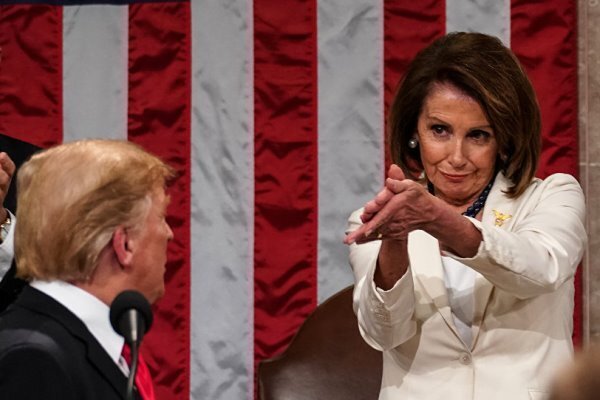
Investigations into Trump’s impeachment began on September 24 following the official order of Speaker of U.S. House of Representatives Nancy Pelosi.
The order came after reports about Trump’s telephone call with Ukrainian president for investigation into his possible rival Joe Biden.
During the conversation Trump asked his Ukrainian counterpart Volodymyr Zelensky for a “favor”. He pressured Zelensky to investigate Joe Biden, his possible Democratic rival for the 2020 presidential election, and his son Hunter Biden who was on the board of a Ukrainian oil and gas factory.  At the time, Trump had suspended $400 million military aid to Ukraine as a quid pro quo.
Why Nancy Pelosi risks?
It should be noted that some Democrats have called for Trump’s impeachment since his first months of his presidency. The impeachment inquiry was popular among Democratic voters, with a recent poll showing that %73 of them favoring the impeachment.
But Republicans are strongly opposed to impeachment, and the country generally relies on Republicans. That is why Nancy Pelosi and other leading Democrats were first reluctant to officially begin an impeachment. Their calculations have so far revealed that impeachment against Trump will not have much effect on the opinion of Republicans and his supporters, a situation which will make it more difficult to remove him from the 2020 election.
Trump has described the impeachment as “fake”.  Pelosi said that Trump has affirmed that he had asked the Ukrainian president to take actions in favor of his political position, claiming the measures of Trump’s administration were undermining U.S. national security.
“The release of the notes of the call by the White House confirms that the president engaged in behavior that undermines the integrity of our elections, the dignity of the office he holds and our national security,” Pelosi said in a statement.
House Intelligence Committee Chairman Adam Schiff also said that the president should prioritize national interests rather than his personal interests. Schiff added that they will study whether Trump has exploited military aid to Ukraine to meet his demands. 
Consequences of Trump’s impeachment
Experts argue that Trump’s impeachment and lack of a decisive leader will make the U.S. more vulnerable to other countries’ plots. As Robert W. Merry recently said in The National Interest magazine, “When the president is weakened at home, then America is weakened abroad.”
However, Washington’s friends and enemies consider U.S. foreign policy insignificant due to political infighting at home. Instead, the great power players are seeking to limit the influence of the country rather than cooperating with it.
The recent accusations against Trump can be easily stated as a national security issue, which needs to be reformed immediately. Theoretically, military aid will be provided only if U.S. officials become convinced that they can achieve main security objectives of Washington. Therefore refusing to provide aid because of political reasons is a serious wrongdoing, showing that the personal interests of the president is superior to U.S. national interests. 
Will the impeachment inquiry get the necessary vote?
Now that the House has launched an impeachment inquiry into the president, the Senate will play an important role in the process. In this case, the Senate will act as a court that decides on Trump’s dismissal or survival.
To oust Trump, the votes of 67 members of the Senate is needed, which would be two-thirds of their population. Currently, there are 53 Republicans and 47 Democrats in the Senate. Therefore, Democrats need the support of 20 Republican senators.
Since the Republicans have not supported Trump's impeachment, it is highly unlikely that Trump's impeachment leads to his dismissal.
Impact of the impeachment on the 2020 presidential election
The impact of Trump’s impeachment on the presidential election depends on his defense and the credibility of accusations against him. Democrats are well aware that accusing Trump of corruption and incompetence will not affect American voters. Democrats probably knew that those allegations were not strong enough to undermine Trump, but on the contrary they would undermine their positions.
By stating an issue related to U.S. national security, Democrats took the risk of impeachment. To make the impeachment strategy successful, Democrats should prove that the president has endangered U.S. national security and he may do the same in future. This claim can go beyond party politics and put unbearable pressure on Trump, Republicans and uncertain voters.

Saturday, October 05, 2019

Democracy Dies Amid Lies, And So Does Sound Policy

Donald Trump
by Paul R. Pillar
Two leading scholars of democracy, Larry Diamond and James Fishkin of Stanford, recently reported on an intriguing exercise that they say constitutes good news for those who worry about the state of American democracy. A representative sample of 523 registered voters from across the United States were brought together for four days of facilitated discussions on an assortment of leading public policy issues. The substantive input they received included, besides the comments of their fellow participants, a “handbook” with arguments on each side of the issues as well as question-and-answer sessions with subject experts and presidential candidates. The participants were polled, before and after the event, about their opinions on the issues discussed. The encouraging result, according to Fishkin and Diamond, was that the event caused significant shift in participants’ views, in which the overwhelming majority of the shifts involved discarding more extreme views and increasing consensus in support of centrist or moderate proposals.
The shifts were evident in all the issue areas discussed, including immigration, health care, the economy, and the environment. “Somewhat to our surprise,” write Fishkin and Diamond, there also were large changes on foreign policy, mostly because of changes among self-identified Republicans. Support for the Trans-Pacific Partnership increased from about half the participants to about three-quarters. “Perhaps most striking,” the authors say, “was the spike in support among Republicans for recommitting to the Iran nuclear agreement.”
Several processes probably underlie the observed shifts in opinion. Placing people in an environment in which the usual partisan tribalism does not predominate explains much of the shifts. Exposure to the views of people from other backgrounds and other party allegiances demonstrates that fellow citizens on the other side of domestic divides are not hostile aliens and can express a reasonable point of view. People on different sides of those divides could see that they share similar day-to-day frustrations and challenges. As journalists who observed the discussions report, on an issue such as health care, there were many empathy-generating personal stories about problems such as onerous medical bills.
There also is a simpler explanation, which almost certainly accounts for most of the observed shift, especially marked among Republicans, on foreign policy: people were exposed to the truth. Unlike with issues of domestic policy, views did not shift because of empathy and the experience of hearing fellow participants’ first-hand stories about difficulties in obtaining affordable health care. They shifted because the participants were provided information (and, given the format of the exercise, were pretty much forced to listen to the information) that dispelled falsehoods perpetrated in the tribal orbits that they regularly inhabit. It should be no surprise that there was a striking shift among Republican participants in support of the Iran nuclear agreement, because on that subject, such falsehoods have had an especially marked effect in corrupting public debate—falsehoods such as that the agreement will permit Iran to build a nuclear weapon in a few years, or that the United States “gave” Iran vast sums of money as part of the deal.
An Administration of Lies
The wider implications of this are all the more profound given how much the current U.S. presidency is built on lies and how desperate and unrestrained the president has become in counterattacking against impending impeachment. Given the centrality of the Ukrainian affair to the impeachment investigation, the prime lie that Donald Trump is pushing at the moment is that Joe Biden, when vice president, pressured the Ukrainian government not to investigate corruption in a company with which his son was involved. That accusation is not just “unsubstantiated,” as some striving-to-be-neutral press outlets would have it, but rather an intentional fabrication that is the opposite of what actually happened.
Given that few members of the intended audience for this lie have participated in anything like Fishkin and Diamond’s exercise, the lie is working. According to a recent Monmouth University poll, 42 percent of respondents, including 67 percent of Republicans, incorrectly believe that Biden exerted pressure on Ukraine to prevent a corruption investigation.
The effect on—more bluntly, the corruption of—U.S. foreign policy that the president’s tactics already have engendered is significant. Relations at the presidential level between the United States and Ukraine—a country of 44 million people that is at the center of important strategic and economic issues involving both Russia and Europe—have been completely subsumed, if the notorious phone call is an indication, into Trump’s quest for dirt on domestic political opponents. Relations with China might be the next to be affected by the quest. The White House’s related effort to discredit Robert Mueller’s investigation into Russian interference into the 2016 election has impinged on U.S. relationships from Australia to Europe, as well as accounting for many travel hours of not only the secretary of state but also the attorney general.
Even more profound are the implications, given Trump’s demonstrated authoritarian tendencies, for the answer to the question, as Thomas Edsall poses it, of ”How and when will President Trump leave the White House?”—and more specifically, will he willingly leave it after either removal through the impeachment process or defeat in the next presidential election? The question raises genuinely scary scenarios in which relevant issues include the loyalties of the Secret Service and the U.S. military. As several of the expert observers Edsall queried speculate, the answer to the question rests mainly with senior Republicans in Congress, and their behavior will depend on what line comes out of Fox and other right-wing media. And that line in turn is connected to how many people in their audience and Donald Trump’s political base will continue to believe the lies that are part of his counterattack.
Removal from Office, Then and Now
When Senator Barry Goldwater, the 1964 Republican presidential candidate and respected Mr. Conservative, turned against President Richard Nixon in August 1974, he said at a Senate Republican Conference lunch, “There are only so many lies you can take, and now there has been one too many. Nixon should get his ass out of the White House—today!” The next day, Goldwater and the Republican leaders of the House and Senate went to the White House and told Nixon he had lost most of his party’s support on Capitol Hill. Two days later, Nixon resigned.
Although Goldwater talked about lies, two important differences about presidential lying distinguish the situation in 1974 from today. One was that Nixon’s duplicity over Watergate was more a matter of concealing truths than of offensive use of lies to discredit legitimate investigations and smear political opponents. (Something similar could be said about the failure of Bill Clinton, the other president in the modern era to be a target of impeachment, to come clean about a sexual fling with an intern.)
The other difference was that at the time of Watergate, Walter Cronkite was the most trusted man in America and the perceptions of most Americans about what was true and what was not in public affairs came mainly from their exposure to responsible mainstream media. Once a lie was exposed as a lie, that was usually the end of it. Today’s fractionated audiences and multitude of politically oriented outlets, which include not only Fox and Rush Limbaugh but countless online sites with committed followers, presents a far different situation. Even after being thoroughly debunked, lies can live on, with major political impact, in the circle of ideologically driven promoters of the lie and their loyal audiences. It would be wonderful to put the entire population through a reality-checking experience like what Fishkin and Diamond put 523 people through, but of course that is not possible.
“Democracy Dies in Darkness” is the Washington Post’s masthead motto, and the newspaper’s role in illuminating what was concealed by the darkness of Watergate no doubt played a role in selecting that slogan. Bringing to light malfeasance that hides in the dark is indeed important in preserving American democracy. But today the health of that democracy depends just as much on somehow taking down lies that are brazenly and repeatedly proclaimed and, far from being hidden in the dark, are part of the blinding fire of political combat. 

For Trump, Regime Change Begins At Home

Donald Trump
by John Feffer
A month after he won the 2016 presidential election, Donald Trump gave a speech in North Carolina where he declared that “we will stop racing to topple foreign regimes that we know nothing about, that we shouldn’t be involved with.”
It’s still commonplace for foreign policy analysts of the leftright, and center to distinguish Trump from his predecessors by pointing out that he hasn’t pursued the regime-policies of either neoconservatives or liberal internationalists. After all, there’s been no Iraq or Libya on Trump’s watch.
It’s a pretty myth.
True, Trump has no beef against dictators who write him “beautiful” letters, so regime change is off the table for the time being with North Korea. But Trump developed a specific animus against Nicolas Maduro of Venezuela and did what he could to push him out of office. First, Trump talked about the military option. Then he ratcheted up sanctions against the country. Finally, he supported what might have been a coup if the plotters hadn’t made such a mess of it.
With Iran, the regime-change policy has been both subtler and more aggressive. Rather than encourage a coup within the country, Trump has developed a variety of different strategies to squeeze the regime.
First, he withdrew from the Iran nuclear deal (over the objections of a number of his key advisors). Then he imposed ever-more punitive sanctions on the country and pressed hard against nations that continued to import energy from Tehran. Finally, he has continued to stand by Saudi Arabia as it seeks to destabilize Iran.
So far, Trump hasn’t sent in the soldiers. But the goal of the administration remains the same.
Of course, Trump denies that regime change is his objective. But it doesn’t really matter what Trump says. His rhetoric floats above reality like smog over a city.
Rather than debate the finer points of Trump’s objectives — which change from day to day, perhaps minute to minute — let’s reverse the lens. If it’s difficult to determine precisely what Trump’s intentions are toward countries he knows nothing about, it’s much easier to figure out what Trump wants to do in the one country he does know something about.
Trump wants regime change in the United States. He’s not interested in changing the leadership in the White House, as long as he’s occupying the Oval Office. But he does want to change the very nature of the government.
Fox News and others love to talk about a “coup” by a “deep state” desperate to remove Trump from power. It’s but one more example of the radical right projecting its covert hopes and fears onto its adversaries.
The coup is real. But it’s all about Trump transforming American governance from within and expanding executive power to the max. It’s not Trump vs. the “deep state.” It’s Trump vs. the state, full stop.
Incredibly, Trump has been busy enlisting the services of foreign leaders who can help make that happen. And it’s this malfeasance — on top of his other crimes — that has now driven Nancy Pelosi and the Democrats to attempt a regime change of their own.
From Norway to Ukraine
Trump has flouted U.S. rules and regulations, relying on the incorrigible American love of outlaws to maintain his political base. The publication of the Mueller report, which detailed the wrongdoing of the Trump campaign and its connections to Russia, should have made the president think twice about once again enlisting the services of a foreign government to improve his own electoral chances.
But when asked by ABC’s George Stephanopoulos on June 13, Trump responded, “If somebody called from a country, Norway, ‘We have information on your opponent,’ oh, I think I’d want to hear it…It’s not an interference, they have information — I think I’d take it.” Federal law, of course, prohibits the solicitation of anything of value from a foreign government in connection with an election.
The next month, Trump flipped the script. Instead of a foreign leader phoning in with a juicy morsel of information, Trump himself was trying to extract the intel from an unwilling or at least uncomfortable interlocutor. In a phone call with Volodymyr Zelensky, Trump reportedly pressured the Ukrainian president to initiate a corruption investigation into the business dealings of Hunter Biden, Joe Biden’s son.
Someone in the intelligence community who listened in on the phone call — and possibly Trump’s other communications with foreign leaders — decided that the president crossed a line. This person blew the whistle, which is how the phone call came to public notice.
Trump admits that he talked about Biden with the Ukrainian leader. He even admits that he put a hold on U.S. military aid to Ukraine prior to the phone call. But Trump denies any wrongdoing, including any hint that U.S. aid would stop flowing if Zelensky didn’t comply with the request.
Trump, as usual, has tried to turn the tables by accusing both Joe Biden and his son of impropriety. Hunter Biden had served on the board of a large Ukrainian natural-gas company, Burisma, while his father was vice president.
Although there is no evidence that Hunter Biden’s position affected Obama administration policy toward Ukraine, that hasn’t prevented Trump’s attack dog, Rudy Giuliani, from trying to manufacture such a connection. In 2018, Giuliani started building a case that Biden pressured the Ukrainian government to fire its prosecutor general Viktor Shokin because he was investigating Hunter Biden and Burisma’s co-founder Mykola Zlochevsky.
As Adam Entous explains in The New Yorker:
There is no credible evidence that Biden sought Shokin’s removal in order to protect Hunter. According to Amos Hochstein, the Obama Administration’s special envoy for energy policy, Shokin was removed because of concerns by the International Monetary Fund, the European Union, and the U.S. government that he wasn’t pursuing corruption investigations. Contrary to the assertions that Shokin was fired because he was investigating Burisma and Zlochevsky, Hochstein said, “many of us in the U.S. government believed that Shokin was the one protecting Zlochevsky.”
Facts be damned, Republican supporters of Trump are scrambling to get ahead of the scandal. The top Republican on the House Intelligence Committee, Devin Nunes (R-CA), reading the old cue cards from Russiagate, immediately blamed everything on Hillary Clinton and the opposition research she’d dug up on Hunter Biden’s Ukrainian connections to counter his father’s possible presidential candidacy in 2016. Senator Lindsey Graham (R-SC) urged Trump to release a transcript of the phone conversation because he’s convinced that it will exonerate Trump.
It’s not the scandal itself that reveals Trump’s executive overreach. It’s his blithe disregard of all rules in his quest for absolute power. He simply refuses to be handcuffed (literally and figuratively).
In a democracy, the state — its checks-and-balances, its bureaucracy — is the box that contains any potential autocrats. The Republican Party adopted its anti-statist philosophy largely to benefit businesses and the wealthy. Trump has a different agenda. He’s against the American state largely to benefit himself.
The Siren Call of Impeachment
The Democrats have been in a quandary since practically day one of the Trump administration.
Here was a president whose crimes and misdemeanors preceded his assumption of office. But for the first two years of Trump’s term, the Democrats were a minority in both houses of Congress. After 2018, they controlled the House, which meant that they could launch a series of investigations that the president and his team have stonewalled. Because the Senate remains in Republican hands, impeachment continues to be a long shot.
And yet, Trump continues to act with impunity. So, the Ukraine call has emerged as the proverbial line in the sand. A number of prominent Democrats threatened to proceed with impeachment if Trump didn’t disclose the full contents of his call with Zelensky. Some otherwise centrist Democrats, like Dean Phillips of Minnesota and Abigail Spanberger of Virginia, joined the bandwagon.
Trump backed down by promising to release both a transcript of his phone call with Zelensky and the whistleblower’s complaint. But Pelosi decided on Tuesday to press forward with an impeachment inquiry nonetheless. Right now, it looks as though the impeachment inquiry will focus only on the Ukraine matter rather than the other obstruction and financial issues that congressional committees are investigating.
Impeachment of Trump, at this point, is both a legal and moral necessity. It’s also very likely a political trap.
Trump relishes the role of an underdog, persecuted by the powerful. It’s what enables him to connect to a political base that, aside from his deep-pocket funders, feels disempowered by a rigged economy and a sclerotic political system. Impeachment, for this constituency, vindicates the narrative of the “deep state.”
Indeed, it suggests that the entire state is out to get Trump – which it is and should. But impeachment is the only thing that can turn the most powerful man in the world into a cornered victim and thus, for a significant number of American voters, a sympathetic character.
Even better for Trump if impeachment hinges on this particular scandal. The rough transcript of the phone call, released on Wednesday, does not exonerate the president. It demonstrates that he brought up the Bidens as part of an implied offer of greater assistance to Ukraine. But it’s not a slam-dunk either, since there was no specific quid pro quo. A more comprehensive transcript as well as the whistleblower’s full complaint might provide more details. But inevitably there will be room for interpretation, and Trump will drive the bulldozer of his reelection campaign right through that gap.
Public opinion, at this early juncture, is against impeachment. According to a Quinnipiac poll released on Wednesday morning, which doesn’t reflect the events of the last few days, shows that 37 percent of Americans favor impeachment and 57 percent are opposed. Virtually no Republicans support impeachment.
Yet, if the Dems had continued to equivocate, they would have appeared weak and lacking the leadership necessary to govern the country. Appeasing Trump is not a good election strategy.
There’s no easy way out of this impossible situation. But let’s think inside the box. Or, rather, inside the boxing ring.
At a rally last year, Biden said of Trump, “If we were in high school, I’d take him behind the gym and beat the hell out of him.” Trump responded by tweet: “He doesn’t know me, but he would go down fast and hard, crying all the way.”
So, let Trump and Biden fight a battle royal, just the two of them out back of the White House. If the country gets lucky, they’ll knock each other out — and out of the running for 2020. It would be a gift of regime change for both political parties. And maybe someone who’s not so punchdrunk will occupy the Oval Office in 2021.

Thursday, August 08, 2019

Will Kushner become the Achilles' heel of the Republicans?

By Mohammad Ghaderi

TEHRAN - It seems that democrats are going to break their silence about the foreign policy mistakes of Jared Kushner, the senior advisor to the American President Donald Trump who is also his father-in-law. 
Kushner’s terrible mistakes in handing some of U.S. foreign policy issues is probably one of the main criticisms that democrats will address at Trump’s administration, especially if people like Joe Biden and Kamala Harris get to the final round of U.S. presidential elections. 
In fact, one of the main problems of Rex Tillerson, former U.S. Secretary of State with Trump was over Kushner’s interference in the country’s foreign policy; to the point that Tillerson was not even aware of some of meetings between Kushner and Saudi Arabia or Zionist officials.  
By the way, the story doesn’t end here! Kushner’s footprint can even be traced back to the murder of Jamal Khashoggi, the journalist who was an outspoken critic of Saudi Arabia’s regime. If this subject will finds its way into the presidential elections, Trump will be in very big trouble. 
Recently, Washington Post has requested Democrats of the congress (both members of the Senate and the House of Representatives) to investigate about the relationship between Kushner and Mohammad Bin Salman, the crown prince of Saudi Arabia.
According to Washington Post and New York Times, Kushner and Bin Salman had had a long, secret relationship that goes before the murder of Khashoggi. 
A relationship that led to very friendly relationships and following deals between the two sides. Some experts believe that Bin Salman had told Kushner that Saudi is planning to murder Jamal Khashoggi. 
Anyhow, leaking any information about Kushner’s involvement in the murder of Khashoggi has always been a serious red line for Trump’s administration. 
Undoubtedly in near future, more secret files and information will be accumulated and the media will expose many new security and political aspects of the relations between Bin Salman and Kushner. 
This information will be very useful to democrats for attacking Trump’s foreign policy in regard to Saudi Arabia. Many criticisms will also be addressed to Trump for giving his son-in-law the freedom to seriously meddle in the country’s foreign policies. In this case, Trump cannot possibly excuse himself. 

Thursday, June 27, 2019

Any Dem Who Wants to Be President Should Reject War with Iran, Not Hide Behind Process Criticisms

Here's where 2020 Democratic hopefuls stand

Democratic presidential hopefuls for 2020 join US Representative Jim Clyburn (7th R) on stage at his World Famous Jim Clyburn Fish Fry at the EdVenture Children's Museum in Columbia, SC on June, 21 2019. - The Democratic candidates running for president are in Columbia to make appearances at the South Carolina Democratic Party Convention and the Planned Parenthood Election Forum on June 22. (Photo: Logan Cyrus / AFP)
Democratic presidential hopefuls for 2020 join US Representative Jim Clyburn (7th R) on stage at his World Famous Jim Clyburn Fish Fry at the EdVenture Children's Museum in Columbia, SC on June, 21 2019. (Photo: Logan Cyrus / AFP)
On the evening of June 20, Donald Trump reportedly gave initial authorization to launch strikes on Iran, then revoked the order at the eleventh hour. The move—which was the latest action in a long-simmering campaign to wage war against Iran—was falsely framed by the Trump administration as retaliatory: Earlier on the same day, reports surfaced that a U.S. Navy surveillance drone violated Iran’s airspace border, prompting the Revolutionary Guard to shoot it down, which Trump called “a big mistake.”
The previous week, shepherded by neocon National Security Advisor John Bolton, the administration alleged, with no conclusive evidence, that Iran was responsible for attacks on two commercial oil tankers near the Gulf of Oman on June 13. This occurred just over a year after the Trump administration withdrew from the 2015 Joint Comprehensive Plan of Action, also known as the Iran nuclear deal, putting the U.S. on a path to greater aggression towards Iran.
Iran has denied the Trump administration’s oil-tanker claims, which remain unsubstantiated. On June 14, the U.S. military released indistinct video footage, which the U.S. military insisted showed an Iranian military patrol boat approaching one of the tankers. The Pentagon followed this with additional “clearer” photos meant to “prove” Iran’s involvement in the attack, and claimed that the Islamic Revolutionary Guard Corps (IRGC) removed an unexploded limpet mine from one of the ships, yet failed to prove that these mines were even attached to the ship. Further, the head of the Japanese company Kokuka Sangyo Co., which owns one of the ships, contradictedthe U.S. military’s allegations.
The crisis, fueled by the Trump administration’s bellicose rhetoric and dangerous provocations, has offered a glimpse into the foreign-policy platforms of some of the leading 2020 Democratic hopefuls. The responses of these candidates—Kamala Harris, Pete Buttigieg, Joe Biden, Elizabeth Warren, and Bernie Sanders—ranged from expressing skepticism about the U.S. narrative on Iran’s actions and condemning “forever wars” to handwringing about whether Trump is following the right process for starting a war and reinforcing the White House narrative that Iran as a “threat.” While Sanders appears to adopt the strongest and most morally informed oppositional stance, Warren trails just behind him, owed to her slightly weaker legislative record on Iran. Meanwhile, candidates like Harris and Biden, who continue to espouse rhetoric about the supposed national security threat posed by Iran and focus more on procedural critiques, rank among the weakest.
Kamala Harris
California Senator and presidential candidate Kamala Harris has vowed to rejoin the Iran nuclear deal if elected, commenting that Trump’s decision to withdraw “was not only not smart, because so far it was working, but it was also unilateral action, not bringing along and apparently not consulting our allies around the globe who are also invested in the right outcome.”
The Iran nuclear deal was an agreement between the U.S., UK, France, China, Russia and Germany in which Iran would restrict supposed nuclear-weapons development in exchange for lifted economic sanctions. While the deal is a step towards deescalation, it meets a low bar, as it is premised on a power imbalance: U.S. intelligence agencies acknowledged in 2007 and 2012 that Iran does not have a nuclear-weapons program. What’s more, per the agreement, the U.S. is allowed to retain nuclear weapons, despite its horrific nuclear history. Nonetheless, U.S. withdrawal is disastrous, as it puts the U.S. on a path to greater confrontation with Iran, and because of this, the deal should be defended.
Harris, however, has remained largely mum on the oil-tanker canard. In May, when Secretary of State Mike Pompeo suggested that the U.S. could leverage the post-9/11 Authorization for Use of Military Force (AUMF) as legal justification to attack Iran, Harris stated that she was unaware of the comments. To her credit, Harris became a cosponsor of the “Prevention of Unconstitutional War with Iran Act of 2019,” which prohibits funds from being used for a war with Iran without congressional approval. But she was more than three weeks behind Warren, who signed up as a cosponsor on May 14, and even further behind Sanders, who cosponsored the day the bill was introduced: April 4. Troublingly, Harris voted in favor of and co-sponsored a 2017 bill that imposed new sanctions on Iran by bundling them with sanctions against Russia and North Korea. Warren voted in favor of this bill but did not cosponsor, and Sanders was the only congressperson in the House or Senate who caucuses with the Democrats to vote against.
Harris has questioned Washington’s Iran narrative, but frames it not in terms of morality—say, sparing the lives of Iranian people—but in terms of national security. On June 18, she tweeted:
“This president likes to talk tough, but for six months now, we've gone without a permanent Secretary of Defense and he just withdrew his nominee — all as Trump marches us toward conflict with Iran. The president is making us less safe.”
She continued on June 20:
“Either the Trump Administration is angling for another disastrous war in the Middle East, or they've spent two years saber-rattling against Iran with no strategy and no endgame. This president is making America weaker and less safe.”
Harris’ comments boil down to a substanceless process critique. The lack of a Secretary of Defense isn’t the problem: The problem is a political establishment clamoring for war with Iran. Harris, then, ignores the moral stakes of the issue, while accepting the Trump administration’s charge that Iran is a threat to “national security.”
Pete Buttigieg
South Bend, Indiana Mayor Pete Buttigieg, whose campaign is informed by a “policy details later” approach, has endorsed the unsubstantiated claim that Iran orchestrated the attacks. In a June 16 interview on “Meet the Press,” he called the evidence that Iran orchestrated the attacks “compelling” and stated:
“It’s a little distressing to think that because this administration's credibility is so low in general, I think a lot of people are thinking twice at a moment when America’s word should be decisive.
When the U.S. says this is something that has happened and this is the consensus of our administration, that should be something that goes without question. But of course, that’s just not the case in an administration that has been extremely unreliable in so many ways.”
The same day, Buttigieg expressed disagreement with Bolton’s efforts to ratchet up aggression when he told CNN’s Jake Tapper that “we need a measured assessment of information as it continues to come in.” Buttigieg added:
“There's no question that Iran has a pattern of malign activities. There's also no question that there is a pattern that is disturbingly reminiscent of the run-up to the war in Iraq, in some cases being driven by the same people.
I mean, the fact that one of the architects of the Iraq War is the President's National Security Adviser right now, when the president himself has pretended that he was against the Iraq War all along, this is shocking. And it should be extremely disturbing to all of us.”
Buttigieg is right to condemn those who orchestrated the Iraq War and to warn of the parallels between Iraq and Iran as targets of U.S. military action. However, he is mistaken to ignore the power assymetry between the U.S. and Iran.
Joe Biden
Joe Biden’s history as Vice President from 2009 to 2017—which included overseeing the Iran nuclear deal—colors his response to the White House. Like Harris, Biden has remained mostly silent in response to the Pentagon’s recent account, but as of 2017, rejected Trump’s intent to withdraw from the Iran nuclear deal. Like Harris, his rationale gave primacy to the “security” of the U.S. and Israel. “[The Iran nuclear deal] is working,” he wrote on Facebook. “It is making the United States and our allies, including Israel, more secure.” He added, “The Iran deal does one thing: remove the immediate threat that a nuclear-armed Iran would present to the region, Israel, and the United States.”
After the Navy drone was shot down, Biden called Trump’s Iran strategy “a self-inflicted disaster.” He continued:
“Trump also promised that walking away would somehow lead to a better deal—instead, the predictable has happened: Iran is building back up its nuclear capability. It’s sadly ironic that the State Department is now calling on Iran to abide by the very deal the Trump administration abandoned.”
“By walking away from diplomacy, Trump has made military conflict more likely. Another war in the Middle East is the last thing we need.”
The same day, Biden also tweeted:
“Make no mistake: Iran continues to be a bad actor that abuses human rights and supports terrorist activities throughout the region.
What we need is presidential leadership that will take strategic action to counter the Iranian threat, restore America's standing in the world, recognize the value of principled diplomacy, and strengthen our nation and our security by working strategically with our allies.”
While Trump’s stratagems should be rebuked, Biden misplaces his focus on the supposed danger of Iran, rather than the violent posturing of the Trump administration.
Elizabeth Warren
Senator Elizabeth Warren (D-Mass.), who has supported the nuclear agreement since its inception, has levied criticism toward the White House. On June 18, in response to a New York Times report titled, “Trump Adds Troops After Iran Says It Will Breach Nuclear Deal” (a questionable media framing given that the U.S. had already violated the deal), she tweeted:
“I hope Iran chooses a different path. But let’s be clear: Trump provoked this crisis. He has no strategy to contain it, he’s burned through our friends and allies, and now he’s doubling down on military force. We can’t afford another forever war.”
While Warren was correct to argue against war, she opens by appearing to place blame against Iran, neglecting to acknowledge the U.S.’s role in villainizing Iran in the first place.
On June 20, after reports of the Navy drone were published, Warren elaborated on her comments, adopting a stronger oppositional stance to the prospect of war with Iran.
“Trump provoked this crisis, and his reckless foreign policy by tweet will only worsen it. I've co-sponsored legislation to prohibit a war with Iran. We need to de-escalate tensions—not let the war hawks in this administration drag us into conflict. #NoWarWithIran
That same day, she followed with
“Donald Trump promised to bring our troops home. Instead he has pulled out of a deal that was working and instigated another unnecessary conflict. There is no justification for further escalating this crisis—we need to step back from the brink of war.”
Here, Warren uses stronger language to denounce Trump’s actions, but still falls short of a moral denunciation of U.S. violence or a more incisive analysis of the Iran nuclear deal’s power relations. Meanwhile, Warren’s vote for new sanctions against Iran in 2017 weakens her legislative record.
Bernie Sanders
Like Warren, Senator Bernie Sanders (and Independent from Vermont who is seeking the Democratic domination) has taken a decidedly oppositional stance, explicitly questioning the official Washington narrative. In a June 18 interview on MSNBC, he commented:
“If you look at the recent history of this country, I think we understand that the two worst foreign policy disasters [the Vietnam War and the Iraq War] were based on lies that came from the White House.”
He added:
“Let me just say this: I will do everything I personally can as a United States Senator to stop the United States attacking Iran. If we go into a war with Iran, this will be an asymmetrical war which will go on and on and on. There will be never-ending wars in the Middle East…So we have got to do everything we can to bring the antagonists, Saudi Arabia, which is a brutal dictatorship, together with Iran…Use the power of the United States to work out a diplomatic solution, not a military solution.”
Sanders repeated these points on Twitter on June 18, noting Trump has “no legal authority to launch an attack on Iran,” and on June 20:  
“If you think the invasion of Iraq was a disaster, a war with Iran would be worse. The United States must bring Iran and Saudi Arabia to the negotiating table, not foment a never-ending, unconstitutional war in the region.”
And in a June 20 MSNBC interview following the surveillance drone reports:
“I think if there was a war with Iran, it would be an absolute disaster for our country, for Iran, for the region, and for the world.”
Sanders, who voted against new sanctions against Iran in 2017, acknowledges U.S. provocation and rejects the notion that Iran is a true threat. Because of this, Sanders’  censure of the White House’s latest war attempt offers the most robust rejection of war with Iran.
Sanders’ was the only campaign that immediately responded to In These Times’ request for comment, sending the following statement (which had previously been publicly released).
“Attacks on oil tankers in the Gulf of Oman are unacceptable and must be fully investigated. But this incident must not be used as a pretext for a war with Iran, a war which would be an unmitigated disaster for the United States, Iran, the region and the world. The time is now for the United States to exert international leadership and bring the countries in the region together to forge a diplomatic solution to the growing tensions. I would also remind President Trump that there is no congressional authorization for a war with Iran. A unilateral U.S. attack on Iran would be illegal and unconstitutional.”
Candidates, of course, are right to criticize the power of Trump to wage war without Congress, thanks in part to the expansion of presidential war-making powers under George W. Bush and Obama. But on the eve of possible war, it won’t suffice to point out this procedural breakdown. Candidates need to make it clear they're against a possible war itself, rather than simply the means by which Trump is executing it.
The moral stakes of Washington’s escalating actions against Iran couldn’t be higher. The war the White House seeks is, as Sanders notes, based on lies, and it would unequivocally do untold harm to Iranian people. The evidence doesn’t show that Iran is a “threat,” but rather that the U.S. has manufactured a pretext for yet another brutal war.

Tuesday, May 07, 2019

Will Joe Biden revive Iran nuclear deal?

By Hamid Bayati
TEHRAN - These days the name of Joe Biden, former U.S. vice president, is on the top news everywhere in U.S.  
The latest polls in Democratic Party has shown that Biden is likely to become the party’s primary candidate to run for 2020 presidential elections against Donald Trump. 
Many U.S. analysts have predicted that Biden will beat his fellow democrat candidates, Elizabeth Warren and Bernie Sanders and will enter the final 2020 presidential race. 
Meanwhile, some western media discuss whether Biden will go back on U.S. nuclear agreement with Iran, officially known as the Joint Comprehensive Plan of Action (JCPOA).
According to AL Monitor, Ben Fishman, a former adviser to Obama on Middle East policy says “As he [Biden] puts together his campaign staff, Biden is expected to draw from a pool of experts that participated in years of negotiations with Iran. That should leave him well-positioned to defend specifics of the deal while also addressing lingering bipartisan concerns about Iran’s role in the region.
“His first-hand knowledge of the details will allow him to articulate a policy not just on the nuclear elements of Iran, but the regional destabilization elements that Iran is still pursuing actively — including in Iraq.”
Biden’s strategy, then, will be demanding more concessions from Iran for superficially reentering the nuclear deal. This idea was also proposed before by Ilan Goldenberg, the senior advisor to John Kerry, former U.S. Secretary of State. 
It is clear what democrats mean by “demanding more concessions”; they seek to constrain Iran’s missile program and power in the region, in exchange for reviving the “dead” and “distorted” JCPOA with putting even more restrictions on Iran in comparison to when Barack Obama was in office.  
This game devised by Joe Biden and John Kerry for Iran will become even more complicated when they start to request other international players to enter the game. 
If Biden wins the 2020 presidential election, he will definitely try to drag the European troika into this game of “redefining the JCPOA based on U.S. benefits”, the same as what Trump did in 2017 before he finally thwarted the deal. 
However, the democrats’ game is different from that of Trump’s, as democrats are trying to forge general consensus to “restrain powerful Iran”. 
It is also worth noting that Trump’s withdrawal from the nuclear deal only became possible due to the set of legal and political conditions that democrats installed in the first place! In fact, before leaving the nuclear deal altogether, Trump used these conditions as “triggers” which allowed him to justify himself in abandoning the deal. 
Moreover, it was democrats who set a precedent so as the U.S. president should “waive the Comprehensive Iran Sanctions” every 120 days. They were democrats who put the fate of the Iran nuclear deal in the hands of every incumbent president. So, it can be concluded that, apart from Trump administration, democrats should also be widely blamed for the shutdown of Iran nuclear deal.