Showing posts with label Adil Abdul-Mahdi. Show all posts

Thursday, October 24, 2019

Misusing popular protests in Iraq

* By Mohammad Ghaderi
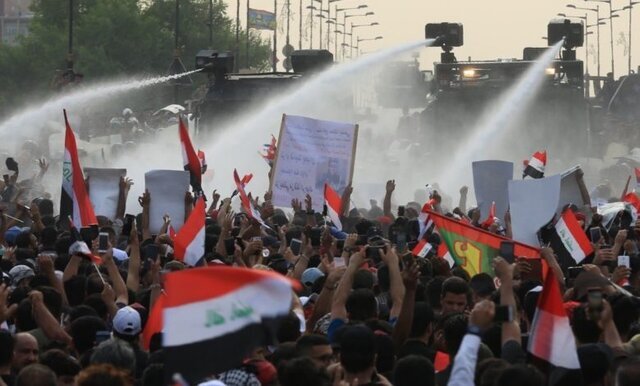
All documents suggest that a widespread attempt is underway by the enemies of Iraq to undermine security in the country. They want to create a new wave of domestic violence. 
Since March 2003, when the United States invaded Iraq, the chief aim of the West has been to create chronic crises in the country.
Washington and its Western and regional allies believe that in an unstable Iraq they can justify their presence in the country and also interfere in its internal affairs.
 
In line with this policy, over the last 16 years Washington officials have left no stone unturned to create chaos in Iraq. These moves have been ranging from creating Daesh and other Takfiri groups to misusing and derailing the popular protests in the country.
Now Iraq is in a sensitive and delicate situation. Undoubtedly, the magnificent and miraculous Arbaeen march has been one of the greatest positive episodes in Iraq. That fact that Adil Abdul Mahdi’s government was organizing such a huge ceremony and simultaneously working to reshuffle the cabinet and counter corruption was a great success. 
Moreover, an insistence by the ulema (religious scholars) that protesters show restraint and that officials pay due attention to the demands of the public is an effective step to find a way of the current crisis. 
At the same time, the government has formed a committee to investigate the killing of 106 people and asked to the body to present its findings soon. 
In fact, Iraq is moving on the path that has been shown by the ulema. 
Though certain political groups are trying to use the protests as an excuse to advance their own political agenda, the men of thought and political wisdom know that there is not better option that Abdul Mahdi as an experienced, hardworking and clean politician as the head of the government.
What is regrettable is that despite an insistence by the ulema and government that the people have the right to peaceful demonstration and it is necessary to meet their demands, certain foreign countries led by the U.S. coupled with certain local groups are working to revive an atmosphere of violence in Iraq.
On the other hand, the way the Western media outlets are covering demonstrations in Iraq shows that the United States, in harmony with leaders of social media groups, newspapers and TV networks, are seeking to put a great pressure on the Iraqi government to create insecurity inside Iraq. 
To realize this issue more clearly, for example, Facebook omits any comment in support or against protests in Iraq and Lebanon. 
In such as situation, it is necessary that the Iraqi government and nation show vigilance in the face of these provocative moves by regional and extra-regional countries, who have been providing arms to terrorist groups to make Iraq insecure at the cost of the lives of thousands of people.
Now what can help settle the crisis is unity between political groups and parties in line with meeting the legitimate demands of the people without seeking a share in the government.
It is quite clear that the prerequisite to materialize this goals is to back the legal government to resolve the economic problems by building upon the advice by the ulema. In that situation, the evil plots against the Iraqis will reach nowhere.
* Author: Mohammad Ghaderi , Tehran Times editor in chief 

Sunday, October 20, 2019

Tehran, Riyadh's steps to de-escalate tensions

Tehran, Riyadh's steps to de-escalate tensions TEHRAN, (MNA) – Past tensions between Iran and Saudi Arabia in recent days have been replaced by positive signals for engagement and negotiation; the signs are evident in the speeches and statements of the Islamic Republic of Iran and Saudi Arabia’s officials.

According to a report by IRNA, After years of tension and disagreement in various fields between Iran and Riyadh, there are now positive and promising signs from the authorities of two sides.
Rejection of war with Iran by Saudi Crown Prince Mohammed bin Salman and emphasis on the effectiveness of diplomatic relations with Iran indicates a clear shift in the position of Saudi leaders.
The readiness of some regional actors such as Iraqi Prime Minister Adil Abdul-Mahdi and Pakistani Prime Minister Imran Khan to mediate between Iran and Saudi Arabia also shows that they hope to find a peaceful resolution of the Tehran-Riyadh disputes. 
In addition, Iranian Government Spokesman Ali Rabiei recently revealed Saudi Arabia's message to Tehran, which Saudi Arabia had their own interpretation for their domestic public opinion and foreign allies.
For instance, Saudi Minister of State for Foreign Affairs Adel al-Jubeir wrote oh his twitter that what Iranian Government Spokesman said was not accurate about the message of Saudi Arabia to Iranians. What happened is that some countries were trying to reduce the tension; we also told them that Saudi Arabia was constantly trying to create security and stability in the region.
The Islamic Republic of Iran, which has always sought to improve its relations with neighboring and regional countries, such as Saudi Arabia, continues to emphasize its approach in the current situation.
In this regard, Iranian Foreign Minister Mohammad Javad Zarif told Turkey's TRT World that Iran has always been ready to negotiate on all issues with Saudi Arabia. It is Iran’s neighbor. There is no choice but to talk to each other. Negotiation with Saudi Arabia can be direct or through mediation. Iran never rejects mediation.
Iran's peace plan, named Hormuz Peace Endeavor (HOPE), proposed by President Hassan Rouhani at the annual meeting of the UN General Assembly this year in early September, showed the importance of endogenous security to achieve peace in the region.
Addressing the UN General Assembly session, Rouhani described ensuring security, peace, stability, and progress in the Persian Gulf and Strait of Hormuz as Iran’s historical responsibility and invited all countries that are affected by the Persian Gulf and Strait of Hormuz developments to join the Hormuz Peace Endeavour (HOPE) initiative.
The Initiative is based on the fact that all regional states are duty-bound to ensure peace, stability, and prosperity in the region. They along with the global community have common interests in maintaining freedom of navigation and transfer of energy. HOPE is designed to include all countries of the region and aims to expand cooperation beyond regional security.
The Initiative promotes solidarity, mutual understanding and peaceful and friendly relations and cooperation among regional states as well as boosting collaboration in uprooting terrorism, extremism, and sectarian tensions and making sure about energy security, freedom of shipping and free flow of oil are among the objectives of the initiative.
Rouhani's Initiative came days after Yemen's missile strikes on Saudi Aramco facilities inflicting heavy cost on the Saudis. In this regard, some of Iran's enemies sought to exert pressure on Iran by taking advantage of this incident and claiming that Tehran was responsible for the attack.
Nearly a month after the Aramco attacks, US President Donald Trump is still seeking to take the most advantage of the attack for his multi-purpose goals, such as isolating and pressuring Iran, increasing disparities in the region, especially between countries of the Persian Gulf and the Oman Sea, sending American weapons to these countries, justifying military presence and intervention in the region, and so on.
The US Secretary of Defense Mark Esper said on Friday 19 October that US has approved the deployment of 3,000 additional troops and military hardware to Saudi Arabia, boosting the country's defense capability after attacks on its oil installations. He authorized the deployment of two more Patriot missile batteries, one THAAD ballistic missile interception system, two fighter squadrons, and one air expeditionary wing, according to Pentagon statement.
Observers believe that the sale of military equipment and weapons, along with the significant US military presence in Saudi Arabia, will be used to militarize the region and bring the money of selling of the Saudi Arabian oil products to the United States. The danger that has even caught the attention of congressmen, who have repeatedly protested the effects of Trump's greed for weapons sales and stood in front of the president, but have so far failed to succeed.

Wednesday, October 09, 2019

Foreign Embassies ‘Stirring Up’ Situation in Iraq: UK Analyst

TEHRAN  – A political analyst from London said the embassies of the US and UK in Baghdad are taking advantage of Iraq’s poor economic conditions following the defeat of Daesh by “deliberately stirring up trouble” in the Arab country.
“If there are insufficient jobs, there must be some form of basic income. Yes, the foreign embassies -- US, UK and the Netherlands-- are deliberately stirring up trouble but that is always easy to do when people are economically insecure. Also all American, British and Israeli forces should be kicked out,” Rodney Shakespeare told Tasnim when asked about the reason behind recent sporadic unrest in Iraq that has led to several casualties.
Iraqi Prime Minister Adil Abdul-Mahdi on Thursday expressed regret that the ongoing protests have become violent, saying he is ready to meet with representatives of the protesters to discuss their demands.
Speaking on Thursday night, the Iraqi prime minister said certain elements have been able to derail the protests from their peaceful path.
The unrest comes as millions of pilgrims are preparing to travel to the Iraqi holy cities of Najaf and Karbala to attend Arbaeen, marking the fortieth day after the martyrdom of their third Imam, Hussein ibn Ali (AS).
U.S. Shifting to Political Rather Than Military Divide-and-Conquer Strategy
Kevin Barret, an author, and analyst from Madison, also told Tasnim that “as Iraq grows more stable and confident, and gets its finances and infrastructure rebuilt, it grows more and more potentially independent.”
He added that an “independent Iraq will inevitably lean towards or join the Axis of Resistance to imperialism and Zionism, for two reasons: First, the Shiite-majority population of Iraq has obvious affinities with other members of the Axis of Resistance; and second and most importantly, if Iraq wants to return to the path of using its resources to benefit its population, it will ultimately need to help eject parasitical outsiders from the region. And the only group of countries that is working toward that end, rather than cooperating with the invaders, occupiers, and plunderers, is the Axis of Resistance.”
“The US-led, Zionist-instigated war on Iraq was designed to cripple and destabilize that country. The invaders pretend to fight terrorism. They pretend to be working to stabilize the situation. But even as one side of the US-led Occupation helped the Iraqi government fight takfiri terrorists, the other side was sponsoring terrorism. Today, they seem to be shifting to a political rather than military divide-and-conquer strategy, by sponsoring color revolution style protests designed to keep Iraq unstable and unable to take its place as a genuinely independent country working towards full regional independence,” Barret said.
U.S., Other Western Spy Agencies Have Long History of Interfering in Domestic Affairs of Nations
Dennis Etler, political analyst and a former professor of anthropology based in California, said the US and other Western intelligence services have a “long history of interfering in the domestic affairs of nations” they wish to control by fomenting anti-government protests. They try to destabilize targeted countries in the hope of advancing their own agenda in regions where they wish to assert or maintain political influence”.
He further told Tasnim that Iran has recently pledged to further support Iraq's reconstruction after the defeat of Daesh and the US and its allies want to disrupt these friendly relations and the recent riots can be seen as an attempt to sabotage Iraq's attempts at reconstruction.
“A failed Iraqi state serves the interests of US imperialism in its attempts to contain Iran's influence in the region,” he said.
(Source: Tasnim) 

Tuesday, December 25, 2018

Iraq Says US Forces Will Never Leave Middle East

By
 IFP Editorial Staff

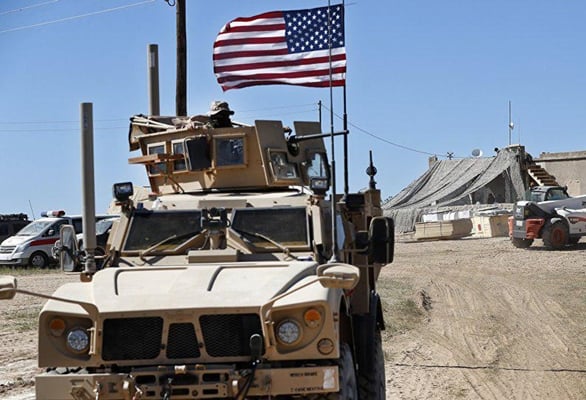
A US armored vehicle at the front line between the US-backed Syrian Manbij Military Council and the Turkish-backed fighters, in Manbij, Syria, on April 4, 2018 / Photo by AP
An Iraqi lawmaker has described Donald Trump’s decision to withdraw the US forces from Syria as Washington’s new tactic, saying it is an illusion to think the decision would eventually result in the pullout of all US troops from the region.
The remarks were made by Mahmoud al-Rubaie, a member of the Asa’ib Ahl al-Haq Party, in an interview with Dijlah TV satellite network.
He also said American troops failed to do anything when ISIS terrorists entered Iraq and occupied large parts of the country.
Rubaie underlined that the resistance front thwarted the United States’ plan to remain in Iraq after occupying the country.
“The US seeks to create failed and tension-stricken countries which need the US presence in order to survive,” the party member said.
“The Americans only liberated two cities of Mosul and Ramadi after destroying them,” he noted.
“The US troopers targeted Iraqi forces and Popular Mobilization Forces,” said Rubaie, adding that the ISIS terrorist group was created by the United States in order to implement its plans.
Rubaie referred to the allegations about Iran’s military presence in Iraq, saying that Iranian forces are not present in Iraq, but that American forces are present in the country and no one knows the exact number of the troops and their bases.
He further praised the advisory assistance of IRGC Quds Force and its commander Major General Qassem Soleimani, and said the top general travels to Iraq through official channels.
Rubaie said Iranian military advisors are present in Iraq with Baghdad’s knowledge and at the Iraqi government’s request, and General Soleimani travels to Iraq officially and through the airport, and visits different areas.
He also touched upon the toppling of the rule of former Iraqi strongman Saddam Hussein in 2003, and said it was the Iraqi people who ousted Saddam Hussein with their uprising, and Iran was not involved in Iraq’s developments, whatsoever.
Majid Shankali, a member of the Kurdistan Democratic Party, also weighed in on the presence of American and Iranian troops in Iraq in a separate interview with Dijlah TV.
Shankali said some voluntary Iranian individuals are members of the Popular Mobilization Forces, but underlined that no official Iranian military troops are present in Iraq unlike US forces who are present in Iraq without the agreement of the government.
He said the phone talk between Iraqi Prime Minister Adil Abdul-Mahdi and US Secretary of State Mike Pompeo revolved around the maintenance of security and stability in Iraq as well as US troops’ pullout from Syria.
Abdul-Mahdi is said to have hailed Pompeo in that phone conversation for renewing the waiver on a ban on electricity and natural gas imports from Iran.
He also pointed to the withdrawal of US troops from Syria, and said, “Given the presence of Russian and Iranian troops and Turkey’s threats to Kurds, US troops’ withdrawal from Syria will not be an easy issue,” he added.
The remarks by the two Iraqi party members come as opponents of Iran have always accused the country of having a military presence in the region and interfering in other countries’ affairs.