
By Hassan Lafi
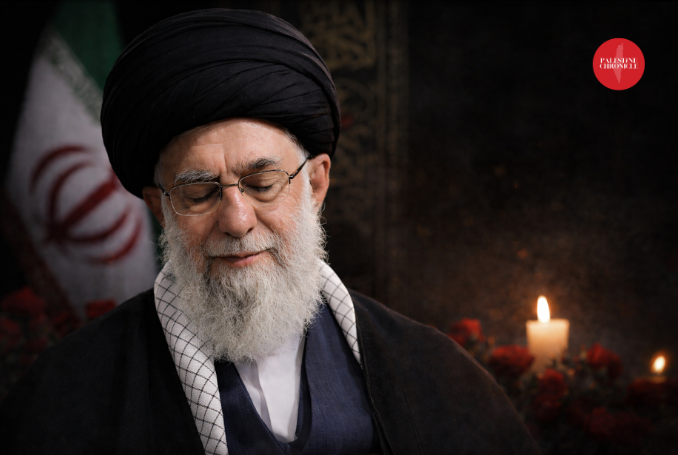 Iran confirmed the killing of Supreme Leader, Ayatollah Ali Khamenei. (Photo: Illustration by Palestine Chronicle)
Removing one leader does not lead to the collapse of the system, and even assassinating multiple leaders does not result in the collapse of the state. Why?
The assassination of Supreme Leader Ayatollah Ali Khamenei, may God have mercy on him, and the elimination of the top military leadership alongside him in the initial strike of the war, followed by the rise of a provisional leadership council headed by Dr. Ali Larijani, and then his assassination shortly afterward along with security and political figures—this scenario represents the ultimate practical application of the “decapitation strategy,” which targets top leadership as the “center of gravity” (Carl von Clausewitz), a concept further developed by John Warden III as the most sensitive link within the state.
However, recent studies, such as the work of Gina Jordan, confirm that its impact is limited in ideological and institutional systems, as clearly demonstrated in the Iranian experience.
If we link the Israeli and American focus on continuing the assassinations of Iranian leaders with the main objective of this war—which is to overthrow the Iranian political system, or at least create the conditions for its collapse, as Israeli Prime Minister Benjamin Netanyahu has stated on more than one occasion—we realize that “Israel” and the United States are using assassinations as a multi-directional psychological warfare tool. Therefore, the policy of assassinations is not limited to achieving direct military objectives, but rather represents a central instrument of psychological warfare targeting three simultaneous circles:
The Iranian interior, the opposition, and the Israeli and American home front.
Damaging Morale inside Iran
The repeated targeting of senior leaders—especially within short periods of time—aims to create a general perception that the political system is compromised in terms of security, that the leadership is unable to protect itself, and, most importantly, that the state is gradually losing control.
In times of war, this effect is no less important than military strikes, as it can lead to the erosion of public trust, widespread anxiety and uncertainty, and a weakening of internal cohesion.
Stimulating the Iranian Opposition and Creating a ‘Moment of Opportunity’
The successive assassinations may be interpreted within opposition circles as the beginning of the system’s disintegration and a historic opportunity for change. Here, an indirect but extremely important objective emerges: prompting internal actors to take action instead of merely observing.
In other words, assassination does not, in itself, topple the political system, but it may create a psychological and political environment conducive to attempts to overthrow it. However, this effect remains conditional on the existence of an organized and capable opposition, which is not fully present.
Managing the Image of Victory in Israel and the US
In contrast, assassinations play a central role in managing the home front in Israel and the United States. If the war lasts longer than expected, the Israeli home front continues to be subjected to missile attacks, and the impact of closing the Strait of Hormuz and targeting American bases in the region intensifies.
In this case, assassinations become a means to present tangible achievements to the public, demonstrate that the war is moving in the right direction, and maintain political and military support within the US and Israel.
This can be understood within what is known as ‘the economy of achievement in protracted wars’.
Governments require periodic results to sustain internal legitimacy. Overall, assassinations here transform from a mere security tool into a means of demoralizing the opponent, stimulating internal dynamics against it, and boosting the morale of the executing party’s home front.
Assassinations are undoubtedly a tactical success for Israel and the United States, producing military impact, political pressure, and psychological shock, but the final outcome depends on one key factor: the flexibility of the targeted system and its susceptibility to collapse.
Removing one leader does not lead to the collapse of the system, and even assassinating multiple leaders does not result in the collapse of the state. Why?
First, ideological systems like the Iranian one are not defined solely by individual leadership represented by the Supreme Leader of the Islamic Revolution, but rather by a complex, multi-layered structure that includes the Presidency, the Revolutionary Guard, the Assembly of Experts, religious institutions, and multiple security agencies, all operating within a network of ideological and religious loyalty to the principles of the Islamic Revolution.
This structure is designed to absorb shocks and prevent disruption. The state has clear constitutional mechanisms for selecting alternative leadership, which was implemented through the appointment of a temporary leadership council, until Mr. Mojtaba Khamenei was chosen as the new Supreme Leader. In other words, there is no vacuum that would affect the cohesion of the political system or the management of the war.
Second, the ideological dimension and the reproduction of legitimacy. The limited impact of assassinations in the Iranian case cannot be understood without considering the ideological dimension of the state, which constitutes one of the most important sources of its cohesion and continuity.
The Iranian political system rests on a blend of religious and revolutionary legitimacy, where concepts of state and ideology are intertwined, granting it a greater capacity to absorb shocks compared to purely bureaucratic systems. The presence of a supreme religious authority, such as the Supreme Leader, represents not only political leadership but also an extension of symbolic, ideologically driven power.
In this context, assassinations do not create a vacuum, but rather symbols. The targeted figures—especially those with religious or revolutionary significance—quickly become “martyrs” in official discourse, a designation carrying high symbolic weight in Iranian political culture.
Here lies the distinctiveness of the Shi’a tradition, which places the concept of martyrdom at its core, drawing inspiration from foundational historical events such as the Battle of Karbala, associated with the figure of Imam Hussein ibn Ali (peace be upon him). This symbolism reframes assassination not as a loss, but as an act of sacrifice that reinforces legitimacy and fuels continuity.
Therefore, assassinating leaders could—conversely—lead to strengthening internal cohesion instead of dismantling it, increasing levels of popular mobilization, and producing a resistance narrative that reinforces the state’s legitimacy.
This dimension explains why strikes targeting the “head” may instead become a factor that reproduces the symbolic power of the state’s legitimacy, rather than leading to its collapse.
Thus, in ideological systems like the Iranian one, the impact of assassination is not measured by the type or number of those killed, but by the state’s ability to transform them into symbols—and here, loss becomes a mobilization tool that reinforces cohesion and popular support.
In conclusion, the assassination strategy proves to be a tactically effective tool, but one with limited strategic impact, especially when confronting ideologically driven regimes like the Iranian system, which possesses a cohesive institutional structure and a high capacity for reproducing legitimacy. This is particularly true given the absence of a politically and organizationally prepared internal opposition to serve as an alternative.
While assassinations may inflict psychological shock and achieve short-term gains, they do not guarantee the regime’s downfall. In fact, they may at times contribute to strengthening its cohesion, remobilizing its forces, and facilitating the emergence of new, potentially more hardline leaders than their predecessors. Therefore, the ultimate outcome remains contingent on the regime’s susceptibility to attrition and collapse, not on the number of leaders targeted.

No comments:
Post a Comment