
A pattern has emerged in the war that the U.S. and Israel can’t shake after three weeks: they hit Iran and Iran answers with the same attack. This time though, Trump has backed down.
Donald Trump has backed down after threatening to destroy Iran’s electrical grid if the Strait of Hormuz was not reopened by Monday night. To save face for his humiliating climbdown, Trump has put forward a story that Iran “called — I didn’t call, they called” to engage in “very strong” peace talks to end the war.
Realizing he boxed himself in with his 48-hour deadline after Iran said it would respond to his threat by destroying the Gulf region’s electricity as well as desalination plants, Trump put out a statement Monday morning about “productive conversations” with Iran that allows him to extend his deadline by five days.
Arab Gulf leaders, some of his advisers, somebody must have gotten to him to tell him that the Iranians have so far always followed up on their threats to match whatever Israel and the U.S. have done to them first. They see them and then raise the stakes — this time threatening fresh water for millions of people. Somebody got through to Trump about the disaster he was about to unleash with his stupid 48-hour deadline.
So he came up with this elaborate story of direct talks with Iran involving his two freelance negotiators, Steve Witkoff and Jared Kushner, whose credibility with the Iranians (and probably the Russians too) is totally shot after twice pretending to negotiate while providing cover for a sneak military attack on Iran.
Iran stridently denied that any such talks with the U.S. are taking place, either “directly or indirectly.”
“No negotiations have been held with the US,” said Mohammad Bagher Ghalibaf, Iran’s parliament speaker. He is rumored to be the official Trump has referred to as a possible leader the U.S. would want to install, as if that is up to the U.S. Ghalibaf said Trump’s postponement of his deadline was to “escape the quagmire in which the US and Israel are trapped.”
On the tarmac at Palm Beach International Airport Monday Trump was asked by reporters about these denials by Iran. It is worth publishing here below the full transcript of Trump’s remarks, as he tries to claim some extraordinary things, such as that regime change has already taken place because the leaders the U.S. and Israel have killed. The Islamic Republic, its constitutions and its institutions still exist. The government has not been overthrown.
Trump says the direct negotiations are taking place with an Iranian leader the U.S. seems to trust (possibly meant to be Ghalibaf, who denied any talks). Trump twice dodged the question about direct talks, very likely because there aren’t any. The Iranian foreign ministry spokesman would only say there have been some messages passed through intermediaries.
Trump also told reporters Iran has already agreed to no further enrichment of any kind (something they were open to in the Oman talks before the U.S. double-crossed them by starting to bomb). After twice being fooled, Iran has been pretty clear about not agreeing to a ceasefire until several demands are met. These demands include reparations, firm international security guarantees for Iran, Lebanon and Iraq and the removal of the U.S. military from the region. If they don’t get this Tehran says it’s prepared to fight on.
With Iran more than holding its own against Israel and the U.S. after three weeks, it makes little sense for Iran to seek a ceasefire. Lots of people around the world are on social media hoping Iran will go further in striking a serious blow to Israel to make it think twice about attacking anyone again.
In the meantime, the war continues.
Trump Rambles With Reporters
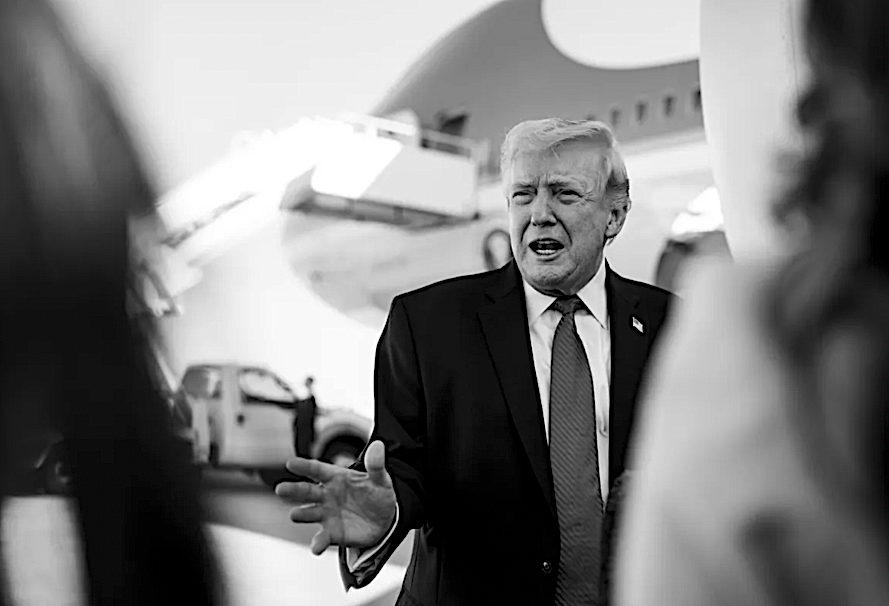
Trump with reporters on Monday. (White House)
“Reporter: Mr. President, Iran’s foreign ministry says you’re not telling the truth when it comes to productive conversations to end the war.
Trump: Well, they’re going to have to get themselves better public relations people. We have had very, very strong talks. We’ll see where they lead. We have major points of agreement; I would say almost all points of agreement. Perhaps that hasn’t been conveyed. The communication, as you know, has been blown to pieces. They’re unable to talk to each other.
But we’ve had very strong talks. Mr. Witkoff and Mr. Kushner had them. They went, I would say, perfectly. I would say that if they carry through with that, it’ll end that conflict, and I think it will end it very, very substantially. We have very much in mind our partners in the Middle East. We have great relationships with a lot of them… They want very much to make a deal. We’d like to make a deal too…
So, they called — I didn’t call, they called. They want to make a deal. We’re doing a five-day period. We’ll see how that goes. And if it goes well, we’re going to end up with settling this. Otherwise, we’ll just keep bombing our little hearts out.
Reporter: Who is Steve speaking with, Mr. President?
Trump: A top person. Don’t forget, we’ve wiped out the leadership phase one, phase two, and largely phase three. But we’re dealing with a man who I believe is the most respected and the leader… No, not the supreme leader. We don’t — well, nobody’s ever — nobody heard of the second supreme leader, the son… I can’t [name him], because I don’t want them to be killed. OK? I don’t want them to be killed. Nobody wants to be that — nobody wants that job right now, you know?
Reporter: What exactly are you looking for in these talks, Mr. President?
Trump: We’re looking for all of the things that we’ve been talking about. We want to see no nuclear bomb, no nuclear weapon, not even close to it… We want to see peace in the Middle East… no enrichment, but we also want the enriched uranium… It’s a great start for Iran to build itself back and it’s everything that we want. And it’s also great for Israel and… Saudi Arabia, UAE, Qatar… So it’s great for all of them.
Reporter: If the war is ending, do you still need $200 billion?
Trump: Well, it’s very easy. If we have a deal with them, we’re going down and we’ll take it ourselves… I just want to have as much oil in the system as possible… Rather than keep it there, I would rather see it go to the system. Any small amount of money that Iran gets is not going to have any difference in this war, but I want to have the system be lubricated.
Reporter: [On Marines or strategy in the region.]
Trump: What are you talking about? … Crazy question. We don’t talk about strategy.
Reporter: Are we directly talking with Iran? If you end up hitting those Iranian power plants, how is that different from what Russia is doing in Ukraine…?
Trump: Well, I think it’s a lot different… I’m not a fan of what Russia is doing either… But it’s a lot different. You’re talking about a country that has been evil for 47 years. They’ve been horrible… they wanted to take over the Middle East, and they wanted to knock out Israel permanently. And if they had a nuclear weapon, they would have been able to do that.
Reporter: [On Joe Kent.]
Trump: Look, I’m not a fan of the guy… He was all for everything. All of a sudden, he wasn’t… Being a nice guy doesn’t pay off too much… he goes out and he says that Iran is not a threat to get publicity.
Reporter: Are we talking to Iran directly? … Have they agreed to no enrichment whatsoever even for medical purposes, civilian purposes?
Trump: They have.
Reporter: What about the Strait of Hormuz? Who’s going to be in control of that?
Trump: That’ll be opened very soon if this works… Immediately… It’ll be jointly controlled. Maybe me… Me and the Ayatollah, whoever the Ayatollah is… whoever the next Ayatollah is. Look, and there’ll also be a form of a very serious form of a regime change. Now in all fairness, everybody’s been killed from the regime. They’re really starting off. There’s automatically a regime change. But we’re dealing with some people that I find to be very reasonable, very solid… The price of oil will drop like a rock as soon as a deal is done… We have a very serious chance of making a deal. That doesn’t guarantee anything.”
It will be interesting to see what happens in five days when his new deadline comes up. Trump probably hopes the world will forget about his idle threats. He may just forget about it himself.
[A satirical look at this exchange with reporters.]
A Pattern of Retaliation
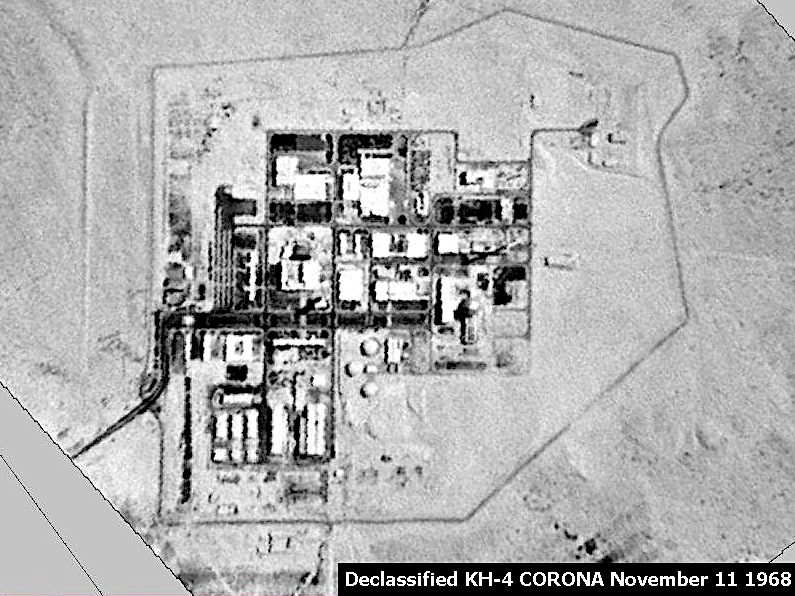
The Shimon Peres Negev Nuclear Research Center in Dimona as viewed from a Corona satellite in the late 1960s. (Public domain/ Wikimedia Commons)
While the Western MSM won’t call the U.S.-Israel attack on Iran unprovoked aggression — though it is undoubtedly both — it does generally frame Iran’s military action as retaliation.
That is a back door way of admitting that Iran didn’t start the war. Instead Iran has been responding in kind to the attacks against it. The exception has been until now not to respond to a war crime with another.
For instance, when the U.S. killed around 175 schoolgirls in the opening hours of the aggression, Iran did not bomb an enemy’s school in the region. While Israel attacked the Gandhi Hospital in Tehran on the second day of the war, there are no reports of Iran bombing any hospital in Israel.
Destroying a civilian target like desalination plants upon which millions of people in the Gulf depend for drinking water, would be classified as a war crime, however. That would be in direct response to Trump’s threat to destroy civilian electricity generation, which if done deliberately and without military necessity would also be a war crime.
Iran ups the ante with each threat to respond.
As the U.S. and Israel attacked Iran’s military and industrial infrastructure, Iran responded by attacking U.S. bases in the region as well as the countries hosting those bases in an attempt to get the U.S. and Israel to stop their aggression. That hasn’t worked so far.
The tit-for-tat extended on Friday to energy installations. After Israel attacked an oil depot in Tehran, Iran said it would hit Gulf Arab energy facilities if it were repeated. When Israel ignored the warning and last week struck the South Pars natural gas field in the Gulf, which Iran shares with Qatar, Iran retaliated by striking Qatar’s Ras Laffan energy complex, the world’s largest liquefied natural gas processing and export facilities.
That led Trump to at first say the U.S. didn’t know about the Israeli strike. He later admitted the U.S. knew but did not approve Israel’s attack. Trump wants to keep energy prices down and covets Iran’s oil and gas. Netanyahu said Israel acted alone and wouldn’t do so again. Unnamed U.S. official said however that the U.S. did approve the strike in advance.
Given what Joe Kent, the whistleblower who resigned as the U.S. chief of counter-terrorism, said about the U.S. going to war for Israel, as well as what U.S. Secretary of State Marco Rubio said about the U.S. joining the war after Israel’s decision, it is reasonable to conclude that Israel is at least equal with the U.S. in calling the shots against Iran.
The U.S. and Israel have overlapping imperial interests in the Middle East. Israel’s is a regional empire, and the U.S. interest is global, with the Middle East a crucial part of Washington’s quest for world domination.
Trump and Netanyahu are now confronted with the fact that Tehran has been able to respond to everything they’ve thrown at Iran. After the exchange of destruction of significant energy installations on both sides, Israel hit two of Iran’s nuclear facilities last week. On Saturday, Israel struck the Natantz facility.
Later on Saturday, Tehran responded with perhaps the most shocking counterattack of all against Israel when its ballistic missiles reached the towns of Dimona and Arad on Saturday, just miles from Israel’s Dimona nuclear facility where plutonium is made for Israel’s nuclear arsenal. Israel’s interceptors failed.
This has apparently frozen minds in Tel Aviv and Washington. How far do they want to take this war? How far will Iran let them?
*Joe Lauria is editor-in-chief of Consortium News and a former U.N. correspondent for The Wall Street Journal, Boston Globe, and other newspapers, including The Montreal Gazette, the London Daily Mail and The Star of Johannesburg. He was an investigative reporter for the Sunday Times of London, a financial reporter for Bloomberg News and began his professional work as a 19-year old stringer for The New York Times. He is the author of two books, A Political Odyssey, with Sen. Mike Gravel, foreword by Daniel Ellsberg; and How I Lost By Hillary Clinton, foreword by Julian Assange.

No comments:
Post a Comment