
Iranians and Saudis see historic opportunity from the war to remake the region. Iran wants the U.S. and Gulf monarchies out, while Saudis want control. Israel has its own ideas, writes Joe Lauria.
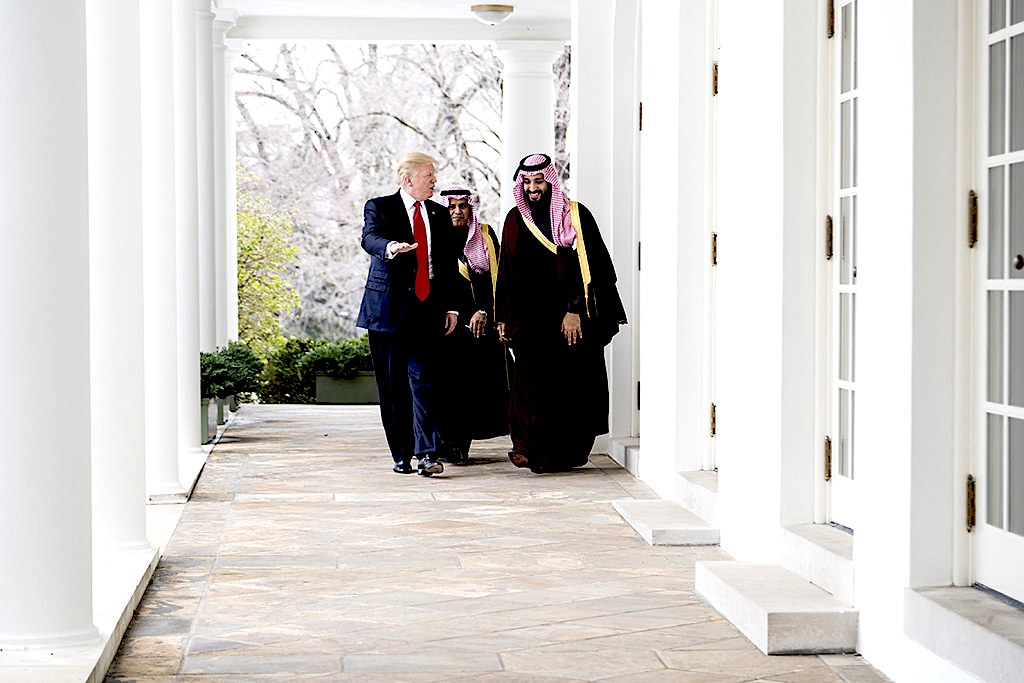
President Donald Trump with Mohammed bin Salman bin Abdulaziz Al Saud, or MbS, then the deputy crown prince of Saudi Arabia, in March 2017. (White House/Shealah Craighead)
Tuesday, March 24 to Sunday, March 29

The war in the Middle East after the first month has evolved into a battle between nations with conflicting visions of how to remake the region.
Saudi Arabia seeks to influence if not dominate Arab governments from North Africa to the Gulf.
Iran wants the United States military out of the region altogether and security guarantees for Lebanese, Palestinians, Yemenis, Bahranis and themselves.
Meanwhile, Israel conspires to the run the entire region.
Back in Washington, Donald Trump scrambles for a way out of the disaster he created, while the Saudis, Iranians and Israelis, for their own reasons, want the war to go on.
Saudis to Trump: Keep Fighting
Crown Prince Mohammed bin Salman, Saudi Arabia’s de facto ruler, has been pushing Trump to keep fighting Iran because of an “historic opportunity” for Saudi Arabia to remake the Middle East, The New York Times reported on Tuesday.
The paper said:
“In a series of conversations over the last week, Prince Mohammed has conveyed to Mr. Trump that he must press toward the destruction of Iran’s hard-line government, the people familiar with the conversations said.
Prince Mohammed, the people familiar with the discussions said, has argued that Iran poses a long-term threat to the Gulf that can only be eliminated by getting rid of the government. […]
Prince Mohammed has argued that the United States should consider putting troops in Iran to seize energy infrastructure and force the government out of power, according to the people briefed by U.S. officials. […]
Some [U.S.] government intelligence analysts have told other officials that they think Prince Mohammed sees the war as an opportunity for him to increase Saudi Arabia’s influence throughout the Middle East, and that he believes Saudi Arabia can protect itself even if the war continues. […]”
The Saudi Vision
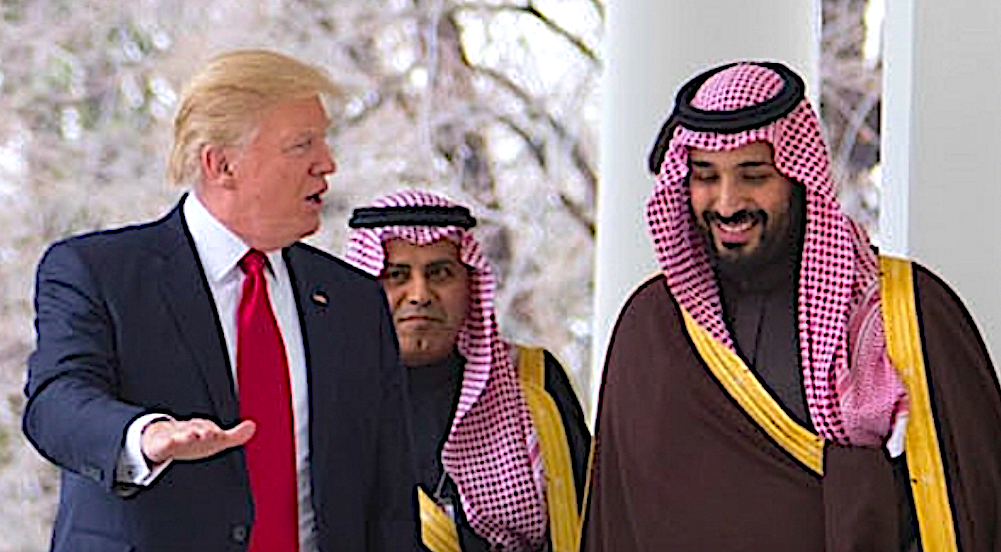
President Trump and the Saudi Crown Prince at the White House. (White House/Shealah Craighead/Wikimedia Commons)
That bin Salman wants the war to go on, despite Trump’s erratic talk about supposed “peace talks,” would confirm a Washington Post report that bin Salman was influential in pushing Trump to attack to begin with.
The oil-rich Saudis have for decades sought influence over the region, beginning with efforts to counter the secular, republican movement of Egypt’s Gamal Abdel Nasser following Nasser’s seizure of power in 1952. The 1957 Eisenhower Doctrine backed the Saudis and other regional monarchies against Nasserism and supposed Soviet influence.
Egypt and Saudi Arabia clashed directly in the 1970s Yemen civil war between the monarchists and republicans. After Nasser’s death in 1970 Saudi-Egyptian ties normalized under pro-U.S. Anwar el-Sadat. Throughout the 1970s the Saudis extended their influence under the U.S. umbrella and normalized relations with Egypt and the Shah’s Iran.
But after the 1979 Iranian revolution relations deteriorated. Ayatollah Ruhollah Khomeini called the Saudis “American lackeys” and “Wahhabi deviants.” Thus Iran was seen in Riyadh as the obstacle to Saudi regional influence.
Destroying the Iranian revolution was the Saudi goal. It helped arm and finance Saddam Hussein’s Iraq to invade Iran in 1980 with the aim of crushing the one-year old revolution.
In the 1980s the Saudis backed the Mujahideen in its war against the Soviets in Afghanistan. In this decade, the Saudis extended their influence across the region and abroad with its well-financed project to spread its brand of austere, Wahhabi Islam.
The rivalry with Shia Iran led to proxy wars across the region particularly after 2011 in Syria, Iraq and Yemen. In these places Saudi (and other Gulf)-backed Sunni terrorist groups like ISIS and al-Qaeda and their offshoots battled Iranian-backed militia in Iraq and Yemen and the government in Syria. Iranian and Saudi interests also clashed in Lebanon and Bahrain.
‘The Head of the Snake’
After the U.S. overthrow of Saddam in 2003 (with Saudi backing) led to Iran’s increased influence in Iraq, Saudi intentions for Iran were revealed in a widely-cited 2008 WikiLeaks U.S. cable release:
“[Saudi ambassador to the U.S. Adel] Al-Jubeir recalled the [Saudi] King [Abdullah bin Abd al-Aziz]’s frequent exhortations to the US to attack Iran and so put an end to its nuclear weapons program. ‘He told you to cut off the head of the snake,’ he recalled to the Charge’, adding that working with the US to roll back Iranian influence in Iraq is a strategic priority for the King and his government.”
That bin Salman would have told Trump last week to keep the war going because of an historic opportunity to essentially cut the snake’s head off in Tehran is totally in line with this history. Here is the best chance the Saudis may ever have to crush their major obstacle to leadership of the region.
Iran’s Vision
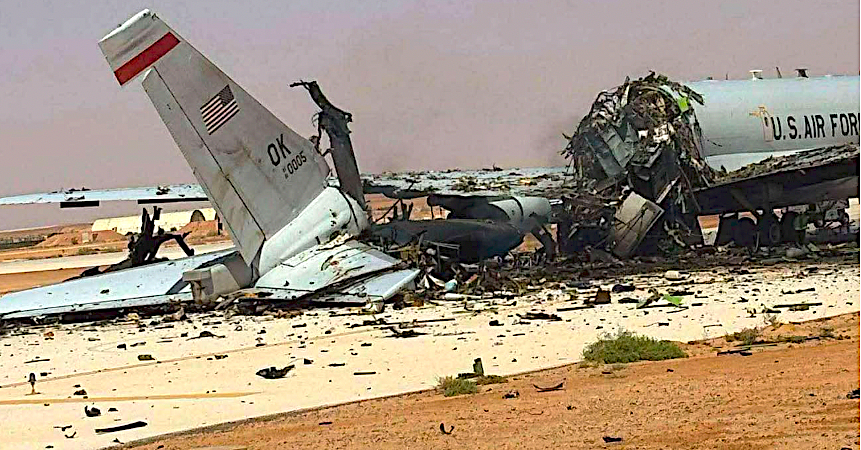
The destroyed E-3 Sentry AWACS at Prince Sultan Air Base in Saudi Arabia. (Air Force amn/nco/snco/Facebook)
Iran wants to prolong the war too because it believes it is winning and has an historic opportunity to remake the region by demanding U.S. troops leave. That would be a monumentally historic change that would transform the region similar to when the French and British left direct control of the Middle East in the early and mid-20th century.
Iran has already caused significant damage to the U.S. bases and equipment in the Gulf. Even The New York Times admits,
“Many of the 13 military bases in the region used by American troops are all but uninhabitable, with the ones in Kuwait, which is next door to Iran, suffering perhaps the most damage.”
Iran continues to hit those bases having taken out hugely expensive U.S. radar systems needed for missile interceptors. On Saturday it destroyed a flying radar, E-3 Sentry AWACS plane on the ground at Sultan Air Base in Saudi Arabia. Cost: $540 million. It was replacing the radar Iran had already destroyed.
Repairing all this damage to U.S. bases would would cost billions of dollars so far.
After this debacle would it be worth it for the U.S. to rebuild the bases? Would the Gulf Arab states want them back after housing them brought disaster upon them rather than protection?
U.S. troops are dislocated now, living in hotels that Iran is targeting. U.S. forces are already leaving Iraq. The only U.S. troops remain in the autonomous Kurdish north, which is being attacked by Iranian-allied Iraqi militia.
Israel’s Vision
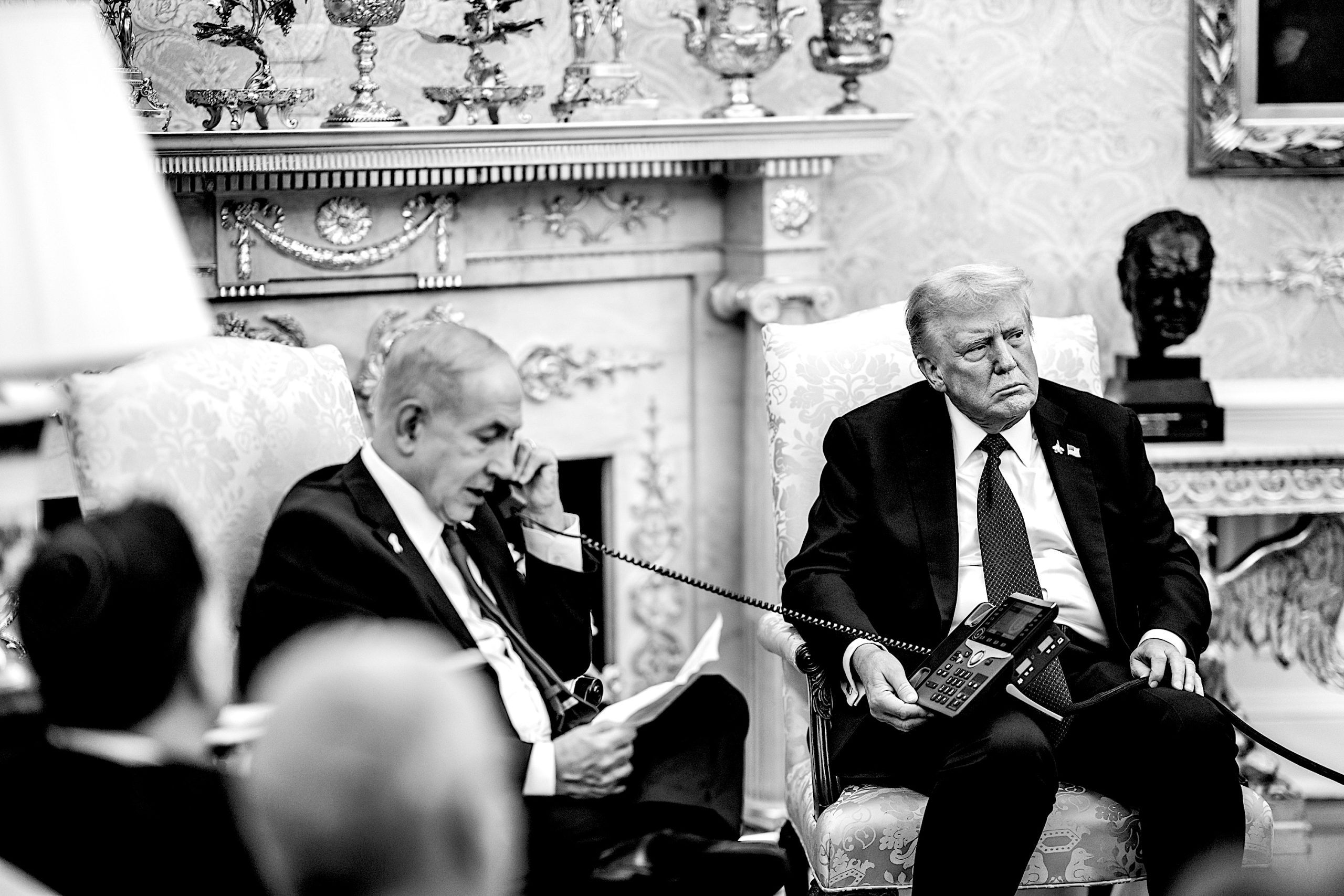
Israeli Prime Minister Netanyahu, with President Donald Trump holding the phone, during a meeting on Gaza, Sept. 29, 2025, in the Oval Office. (White House /Daniel Took)
Bin Salman’s desire coincides with Netanyahu’s to prolong the war. Out of fear that it might end soon, Haaretz reports that Netanyahu is stepping up Israel’s bombing campaign.
Netanyahu said he had been trying for 40 years to get the U.S. to join Israel’s attack on Iran, but every president had refused because they were told what the consequences would be: ruined U.S. bases, devastation of parts of Israel and the Gulf states, and a global economic crisis of historic proportions when Iran closes the Strait of Hormuz.
Then Netanyahu found Trump. The results are just what all the presidents had been warned about.
But this is the moment of greatest historic opportunity for an Israel that — since the days of first prime minister David Ben Gurion — has envisioned building a Biblical Greater Israel, stretching from the Nile to the Euphrates.
With the extremists he gathered in his cabinet, Netanyahu has been going for broke, beginning with the ethnic cleansing and genocide in Gaza, then the anti-Palestinian pogroms on the West Bank, and now the unprovoked aggression against Iran and the invasion of Lebanon.
Just seven months ago, Netanyahu was asked on Israeli television if he adhered to a “vision” for a “Greater Israel.” Netanyahu said, “Absolutely.”
Asked if he felt connected to the “Greater Israel” vision, Netanyahu said: “Very much.” His answers sparked an outcry in the region. But he had put them on the record.
In his now infamous interview with Tucker Carlson, Mike Huckabee, the U.S. ambassador to Israel, presumably speaking for the United States, said it would be “fine if they [Israel] took it all” when asked by Carlson about biblical claims to territory from the Nile to the Euphrates.
To conquer Greater Israel, Tel Aviv needs the United States to fight for it. For the United States, the Middle East is a vital part of its global empire that Israel can manage for it in overlapping regional and world empires.
But there are differences. Trump would need to prevent further destruction of energy facilities of both Iran and the Gulf states if he wants to stabilize oil prices — which have risen 50 percent in a month — and to seize Iran’s deposits.
He told the Financial Times on Sunday that he wants to “take the oil in Iran” and that his “preference would be to take the oil” the way he took Venezuela’s.
But why would Netanyahu care about the destruction of the Gulf Arabs’ spectacular, oil-based wealth when Israel’s desire since the 1982 Yinon Plan and the 30-year old, 1996 policy paper, “A Clean Break: A New Strategy for Securing the Realm” has been to reduce surrounding Muslim lands to ruin, the better to project Israeli dominance over the entire Near East and its resources?
The biggest difference right now between Israel and the U.S. is that Trump wants out of the mess he created while Netanyahu needs the U.S. to continue attacking Iran if it wants to reach its expansionist goals, even though Israeli defensive missiles dwindle and damage to Israel from Iranian missiles and drones multiplies daily.
Three Scenarios
There are several ways this might play out. First, Iran wins as it continues to press its apparent missile advantage to wreak continuing damage on Israel, the Gulf states and U.S. bases.
It seems impossible to imagine, but if Israel and the U.S. do not opt for total war out of frustration at being unable to overthrow the Iranian government and at running out of interceptor missiles, Iran could achieve an almost unthinkable victory by getting the U.S. military to leave the Middle East.
There could be a further Iranian victory if Israel is pushed out of Lebanon and if some or all of the Gulf monarchies collapse.
Second, Saudi Arabia can come out on top if Iran is overwhelmed, its government and economy collapses and a pro-U.S. regime is installed. It would help if Saudi Arabia sustains less damage than Israel and the other monarchies.
But the collapse of Iran is also what Israel wants. So the two U.S. allies could wind up vying for control of the region. The difference is that Saudi Arabia fears a destabilized Iran broken into ethnic enclaves, while that is what Israel apparently seeks.
Third, Iran and the Gulf states, including Saudi Arabia, are shattered, Hezbollah is defeated and Israel escapes major damage. With U.S. backing, Israel emerges as the predominant force in the Middle East, establishing a Greater Israel over a devastated region.
But there is a fourth possibility.
Total War
In this scenario, no one emerges a clear winner with utter devastation all around. This can come about by the United States and Israel unleashing a sustained, all-out aerial offensive against Iran’s civilian infrastructure until its institutions are smashed and Iran is no longer a functioning society.
Armed Kurds, Azeris, and Baluchis could seek to take control of their areas. But in the process, Israel and the Gulf states would be also be devastated by Iran.
If Iran does not demonstrate that it has developed a handful of deliverable nuclear warheads by then, Israel could deploy a nuclear weapon against Iran — if Israel thought its existence was at stake.
Where We Stand: U.S. ‘Negotiating With Themselves’
The stakes keep getting higher. The Houthis entered the war over the past five days and threaten to shut down the Bab al-Mandab at the bottom of the Red Sea through which as much as 12 percent of the world’s seaborne trade exits, having passed through the Suez Canal.
Trump has extended his very flexible deadline to April 6 before he decides whether to hit Iranian power plants and energy infrastructure. Iran has threatened to respond in kind against energy facilities in the Gulf and also to hit desalination plants, which could produce a humanitarian catastrophe.
That would be the road towards total war.
At this point no one knows what to believe about what an increasingly unhinged Trump says. He claims the U.S. is in direct talks with Iran but the Iranians say the U.S. is negotiating with themselves. Only messages are being passed back and forth through the Pakistanis.
The U.S. is rushing more ground troops to the Gulf region, but Secretary of State Marco Rubio says there’s no need for a ground invasion. There doesn’t seem to be anywhere the U.S. could invade without facing a bloodbath.
Despite the bravado of Trump and War Secretary Pete Hegseth claiming victory at Thursday’s cabinet meeting — boasting that Iran’s navy and missile stockpiles and launchers have been destroyed — Iran continues its barrages against U.S. military installations and Israel, again striking Dimona.
Trump tries to laugh when he nervously tells the camera at the cabinet meeting, “I read a story today that I’m desperate to make a deal. I’m not. I’m the opposite of desperate. I don’t care. … They [the Iranians] have been just beat to shit. They are begging to make a deal. Not me. They’re begging to work out a deal.”
An Easter Truce
There is another option for the desperate Trump to get out of this without a humiliating exit from the war, which would be seen as defeat by everyone but himself and his cronies.
That would be to announce that the war is not over, but that the U.S. will begin a unilateral pause — an Easter truce — during which Washington will reassess where the war stands.
Iran may continue to attack for a day or two, but its immediate objective has been all along, to cause the other side enough pain so they stop the aggression against it.
If the aggression is put on hold, space could open for genuine talks to find a compromise out of this extreme danger for everyone.
Next Sunday is Easter.
Joe Lauria is editor-in-chief of Consortium News and a former U.N. correspondent for The Wall Street Journal, Boston Globe, and other newspapers, including The Montreal Gazette, the London Daily Mail and The Star of Johannesburg. He was an investigative reporter for the Sunday Times of London, a financial reporter for Bloomberg News and began his professional work as a 19-year old stringer for The New York Times. He is the author of two books, A Political Odyssey, with Sen. Mike Gravel, foreword by Daniel Ellsberg; and How I Lost By Hillary Clinton, foreword by Julian Assange.

No comments:
Post a Comment