
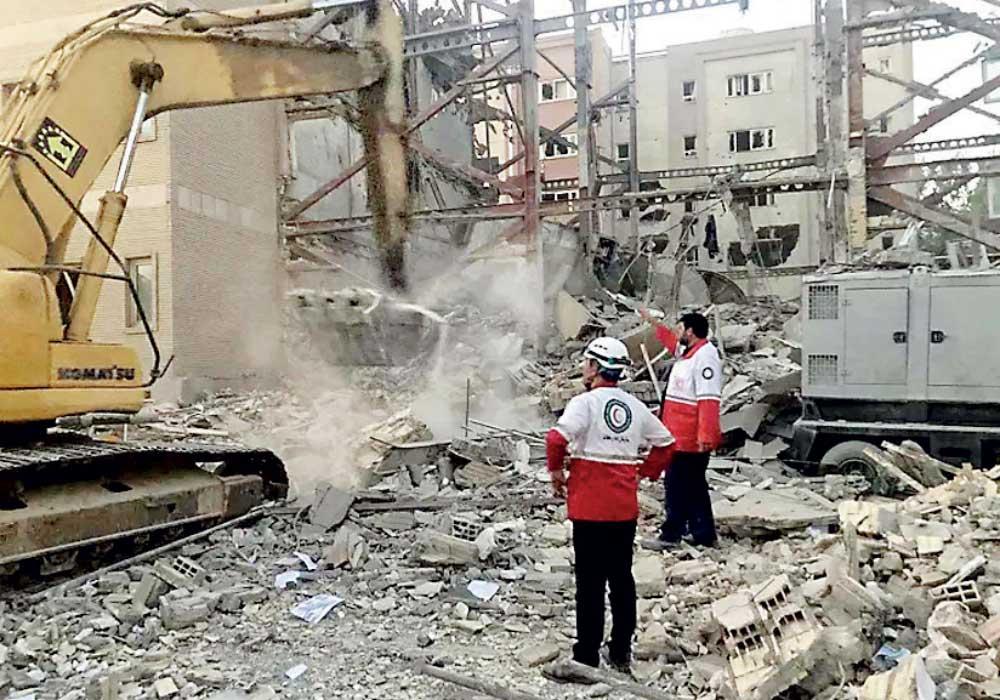
A handout image provided by the Iranian Red Crescent Society shows members of their rescue teams clearing debris at a building destroyed during an Israeli attack in Tehran [Iranian Red Crescent/AFP]

The US‑Israeli war on Iran does not appear to be moving toward a ceasefire, despite United States President Donald Trump’s claim that talks are underway. The subtext of Trump’s speeches, however couched in arrogant rhetoric, tells another story—American militarism is no match for Iran’s strategy.
Deeply mired in an unwinnable war against an enemy whose greatest strength lies in its strategic resolve to resist imperialist aggression and Zionist hegemonic designs in West Asia, the US has advanced a maximalist 15‑point ceasefire formula, only to have it rejected outright by Iran. All 15 points are non‑starters. They offer no carrots or concessions—only a surrender formula for Iran. No wonder it was dead on arrival in Tehran.
Iran, for its part, presented five conditions, adopting an equally tough and maximalist position for a ceasefire. These include guarantees against future aggression, dismantling of US bases in the region, and war reparations.
Besides, how can Iran talk peace with a country that has betrayed it not once but twice while peace talks were progressing—conduct that clearly qualifies as uncivilised state behaviour? What guarantees does Iran have that the US would not betray it again during negotiations? None.
Israel has no intention of ending the war right now. It has a different war plan—even distinct from that of the US. Its objective is not merely to enslave Iran, as it has done with Arab countries in the region. Rather, it wants to see the region burn and be reduced to the Stone Age—an ideal path toward its ultimate goal of establishing Eretz Israel, or Greater Israel.
Part of this plan involves stories planted in the New York Times. Reports there claim that Saudi Arabia has urged the Trump administration not to stop the war but to seize the opportunity to destroy Iran. Hidden in these stories is the Zionist subterfuge aimed at dragging Saudi Arabia into joining the war against Iran.
The danger of such an eventuality is that it could also draw Pakistan into the conflict, in line with the recently signed Saudi‑Pak defence agreement, according to which an attack on one country is considered an attack on the other.
Pakistan is playing the intermediary role in trying to bring about a ceasefire. However, if the war escalates, it will face a dilemma. On the one hand, it has treaty obligations to join the war in defence of Saudi Arabia. On the other, it is restrained by China and by the possibility of internal uprisings. Pakistan has the largest Shiite Muslim community outside Iran. Moreover, popular resentment against the US and Israel among the Sunni Muslims in Pakistan is at an all‑time high. Many Muslims believe that the US and Israel are their biggest enemies. They cite the Qur’an’s chapter 5, verse 51: “O you who believe, do not take the Jews and Christians as guardians—for they are guardians of each other. Whoever does so will be counted as one of them. Surely, Allah does not guide the wrongdoing people.”
The Qur’an condemns those who race for their guardianship, saying such people have sickness in their hearts (5:52). In chapter 60, verses 8 and 9, it further clarifies Muslims’ relations with non‑Muslims: “Allah does not forbid you from dealing kindly and fairly with those who have neither fought you nor driven you out of your homes. Surely Allah loves those who are just. Allah only forbids you from befriending those who have fought you on account of your faith, driven you out of your homes, or supported others in doing so. And whoever takes them as friends are the wrongdoers.”
The context of these verses may be the hostility that existed during the Prophet Muhammad’s time. Yet their resonance with today’s reality is stark, as Palestinians are massacred and expelled from their homes while Arab nations race to befriend the very aggressor committing such crimes against Muslims.
If Pakistan and Saudi Arabia, along with other Gulf Muslim countries, attack Iran, their action will be seen by Muslims worldwide as joining the US‑Israeli axis in total disregard of the Qur’anic injunctions.
The United States has lost all credibility as a nation that stands by its word. The way it handles international relations does not befit civilized behavior. Its conduct is utterly barbaric. Otherwise, would it have kidnapped Venezuela’s president and his wife and brought them to the US to face a sham trial? Would it have started a war against Iran in violation of the United Nations Charter? Would it have committed a war crime by bombing an Iranian girls’ school and killing some 170 primary schoolchildren? America is an oil pirate. Venezuela and Iraq sell their oil in dollars, but the revenue does not directly go to them. It first goes to the US Federal Reserve and is then released piecemeal. The US controls these countries’ wealth illegally. Call this civilized and accepted state practice? My foot. This is what they plan for Iran.
If there were a prize for immorality and barbarism, the US and Israel would share first place. It must also be noted that while the world’s focus is on the Iran war, Israel continues its horrors in occupied Palestine. A heart‑rending story that did not make headlines in Western media this week describes brutish Israeli soldiers extinguishing their cigarettes on the legs of a Gaza girl, barely two years old, in front of her mother while arresting her father.
It is sad to see the United States, a nation that has contributed so much to human progress, lower itself to such a base level—so abominable in international politics. It shows no respect for international law or the rules‑based world order. By supporting Israel, it becomes an accomplice in genocide against the Palestinian people.
One month into the war, all signs point to darker days ahead. The looming worst‑case scenario is devastation beyond imagination. Already, Kuwait has issued radiation warnings for citizens as fears mount over the US‑Israel attack on Iran’s Bushehr nuclear plant. Besides the nuclear hazard, the possibility of US boots on the ground is also high if Iran does not open the Strait of Hormuz before the five‑day deadline Trump has set. That deadline ends tomorrow. If Iran holds firm, Trump has warned that the US will strike Iranian power plants and other strategic locations.
What options does Iran have if its power plants are targeted and the US sends in ground troops? Iran cannot hit back directly at the US, but the pattern of its retaliation suggests it would target the power infrastructure of neighboring Gulf states—most of which are indirect aggressors by virtue of hosting US bases. Without power, Gulf nations—dependent on desalination plants—would also lose access to drinking water. Iran may also strike power and desalination plants in Israel, which is putting on a straight face while enduring severe blows from Iran’s missile and drone attacks.
Boots on the ground is easier said than done. Many military analysts say that such a move would be suicidal, and the disastrous outcome could make the defeat the Americans suffered in Vietnam seem like a victory.
The war is as much a US‑Israeli effort to defang Iran as it is to destroy the Arab world. The sooner Saudi Arabia and other Gulf nations understand the Israeli design and pressurise Trump to end the war, the better it will be for their survival. Remember, Iran did not start the war; it was started by Gulf nations’ American and Israeli protectors.

No comments:
Post a Comment