
By Shaher al-Shaher
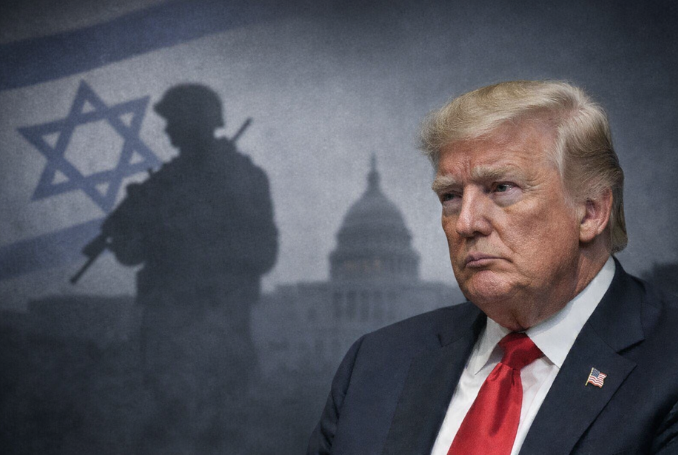 Israel’s objectives in the war may diverge from Washington’s. (Photo: Wikimedia. Design: Palestine Chronicle)
Today’s war is not merely aimed at toppling the political system in Iran, but at bringing an end to the Middle East as we know it. Washington seeks to control the world’s vital arteries, perhaps even extending its reach to the Bosphorus and Gibraltar.
The American-Israeli war on Iran continues, but with unclear objectives, especially as the target bank has reportedly been exhausted, according to statements issued by both sides.
The war’s objectives were clear and specific: to change the political system in Iran, destroy its missile capabilities, dismantle the Iranian Revolutionary Guard, obtain enriched uranium, dismantle the Basij, bring in mercenaries, and impose a political system subservient to Israel inside Iran.
Iran’s continued targeting of the Israeli interior and American bases in the region confirms its ability to sustain the confrontation, particularly since those attacking Tehran intended the conflict to become a zero-sum war.
Tehran has shifted from the tactic of “missile flooding” to the use of “precision strikes,” where a single missile is now capable of causing widespread destruction. Stealth aircraft are no longer as effective after Tehran succeeded in targeting them with an air defense system developed following the 12-day war.
The survival of the political system signifies the failure of the higher political objective of the aggression. The continuation of Iranian missile strikes reflects the failure of American and Israeli military and technological superiority. The collapse of the mercenary environment, both inside and outside Iran, signals the failure of the hybrid war aimed at inciting internal unrest.
It is a war without limits or clear expectations, and no one can predict its end scenario. What is certain, however, is that the region after this war will not resemble what it was before, and that this war will not be the last in the region.
Consequently, the theater of operations has evolved into a global threat to energy transit and security. Here lies a critical principle: when America fails to achieve its strategic objectives, it not only loses the battle but is also forced to redefine its position within the conflict and the broader international system.
The gap between realities on the ground and the official Israeli narrative has widened significantly, especially as the Zionist government has imposed strict military censorship limiting the disclosure of Israeli losses.
Trump’s contradictory statements reflect a state of chaos and internal pressure within the United States. The man who spoke eight months ago about eliminating Iran’s nuclear program has returned to wage a new war against Iran.
Talk of Netanyahu’s ability to draw Trump into this war has become increasingly evident, and it appears that some countries in the region may also be dragged into a confrontation they are ill-equipped to fight.
Iran’s targeting of these countries has placed them in a difficult position. Silence is no longer viable in light of Iranian strikes and the clear American pressure on these states to participate in defending their “security and sovereignty.”
The July 2006 war, described by Condoleezza Rice as the “birth pangs of a new Middle East,” failed to achieve its objectives. The current war appears intended to fulfill that same vision.
The region stands at a historic crossroads, and for Arab countries that assess the situation strategically—beyond past grievances and reservations about Iran—the idea of Iran’s collapse may be more dangerous than its survival.
The rivalry between Arab states and Iran is real, but it stems from Arab weakness, which created a vacuum that Tehran filled—just as Turkey has done in other contexts. Nature abhors a vacuum, and any space left unoccupied will inevitably be filled by another actor.
The Gulf states’ decision not to become involved in the war is, for now, the wisest course of action. The debate over whether the Gulf is Arab or Persian is no longer relevant. A defeat for Tehran would likely render the future of the Gulf American and Zionist.
The American military presence in the region now constitutes more than half of its global deployments. The United States has used nearly every type of weapon, short of nuclear arms—which it has not hesitated to use in the past.
Statements by the US ambassador to the entity, made days before the war, regarding what he described as the “biblical right” of Israel to full control over the Middle East, did not exclude Arab countries from being targeted.
Netanyahu’s remarks about a six-party regional alliance targeting both the “deteriorating Shiite” and “rising Sunni” axes render continued discussion of a “Sunni-Shiite conflict” simplistic and misleading.
The objective is for Israel to dominate the region, and Netanyahu views Iran as the primary existential threat to the survival of the Israeli entity—one that must therefore be weakened.
Claims by some Arab voices about an “Iranian-American-Israeli triad” reflect little more than naivety and an attempt to deflect from their own inaction in the face of repeated Israeli violations. Iran has maintained its confrontation with Israel, while Arab states have largely abstained, prompting efforts to justify that inaction.
Türkiye has begun to recognize the danger, understanding that the defeat of Iran would likely be followed by Israeli moves against it. This confrontation may not be direct, but it is already evident in arenas such as Syria.
The Middle East is at a crossroads, all of whose paths lead to disaster. The region is entering a dangerous and potentially irreversible phase, while it is still being treated with the detachment of a passive audience.
The attack on the shared Iran-Qatar gas field was not merely tactical, but a complex geo-economic shock. The Pars field—the largest gas field in the world—is a cornerstone of multiple economies. Germany, for example, imports a significant portion of its gas from this field, while Japan, South Korea, and India also depend heavily on it.
This represents a fatal strategic paradox: the strike targeting Iran ultimately damaged the very energy infrastructure on which America’s allies rely, driving prices up by nearly 80 percent. In effect, Washington has undermined Europe’s energy lifeline with its own actions, turning its allies into victims.
Israel’s bombing of Iran’s Pars gas field prompted Tehran to strike Qatar’s Ras Laffan facility, further driving up oil and gas prices and signaling a new phase of escalation, as both sides attempt to establish new rules of engagement.
The war began with clear objectives, foremost among them the overthrow of the Iranian political system—an objective that has yet to be achieved.
The deployment of US Marines from near Japan to occupy Iran’s Kharg Island coincided with US reports claiming that China would not invade Taiwan in 2026, highlighting the inconsistency and questionable credibility of earlier American assessments.
The gap between declared objectives and actual outcomes remains the primary measure of victory or defeat. However, traditional definitions of victory and defeat do not fully apply to this form of asymmetric warfare, where conventional military power intersects with long-term strategic endurance and complex Iranian policy frameworks.
Today’s war is not only about Iran. It is about reshaping the Middle East and controlling the world’s strategic chokepoints—Hormuz, Bab al-Mandeb, and the Suez Canal—possibly extending further to the Bosphorus and Gibraltar, as part of a broader effort to contain China.
The Strait of Hormuz has not simply been closed—it has been redefined. Iran has reengineered the conditions of navigation according to its own rules. Ships are now subject to an Iranian system requiring a $2 million transit fee per tanker, rerouting vessels through Iranian territorial waters and permitting passage only for approved ships. This effectively shifts control from international law to the Iranian field authority.
Control of the strait no longer belongs to those who possess naval fleets, but to those who dictate the rules of passage. In this sense, the Strait of Hormuz has been transformed from an international corridor into an Iranian-controlled platform—marking what can be described as a strategic setback for the United States, where the war has produced the opposite of its intended outcomes.
Although these developments indicate a level of escalation that is difficult to contain, assessments of a “point of no return” remain tied to the ability of international actors to intervene and impose a political or military settlement, as seen in previous conflicts such as the June 2015 ceasefire.
However, the current intensity of operations, the multiplicity of conflict zones, and the overlap of regional and international actors make a return to diplomacy far more complex.
The concern that the conflict is approaching a point of no return is driven by two main factors: the rising intensity of military operations, which increases both the cost of negotiations and the vulnerability of civilian infrastructure, and the divergence of international and regional interests, which weakens the prospects for a rapid, mutually agreed settlement.
Therefore, the point of no return should be assessed not only by the scale of military escalation, but also by the level of trust between the parties, the depletion of humanitarian resources, and the absence of a credible negotiating framework capable of ensuring de-escalation.

No comments:
Post a Comment