
Fissures have opened in the bloc over the U.S.-Israel war on Iran, writes Betwa Sharma. India has perhaps been most divisive. Let alone as a global power, India isn’t even projecting itself as a truly independent, regional one.
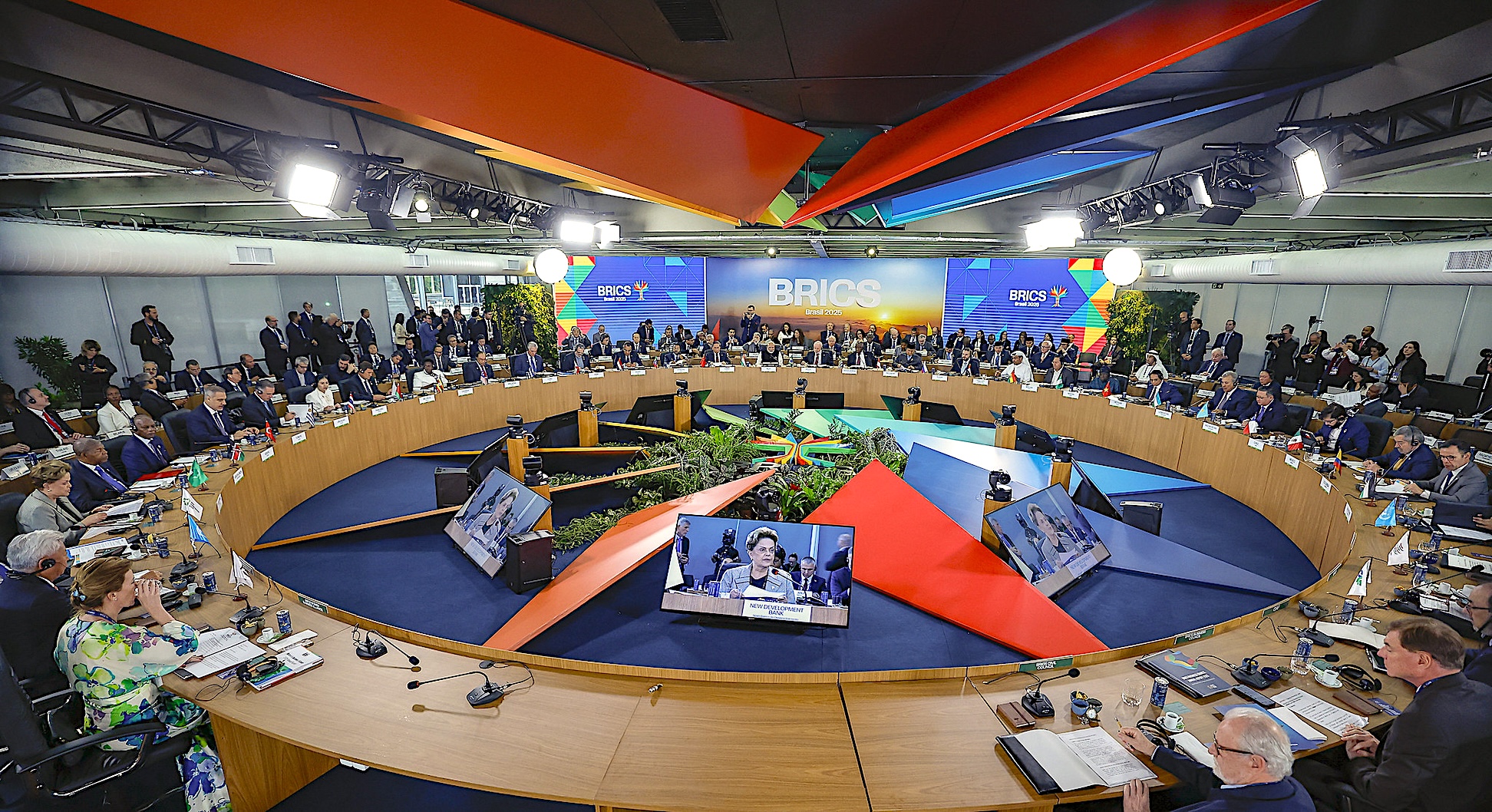
A BRICS plenary session on Strengthening Multilateralism, Economic and Financial Affairs and Artificial Intelligence in Rio de Janeiro on July 6, 2025. (Palácio do Planalto /Flickr/ CC0/Wikimedia Commons)

U.S. economic pressure and geopolitical shocks, especially the attack on Iran, have revealed BRICS less as a unified bloc with a common strategic goal, than a collection of countries with overlapping interests that diverge sharply under pressure.
Brazil, Russia, India, China and South Africa began BRICS in 2009 as an intergovernmental organization with the common aim of challenging U.S. dominance and establishing a multipolar world.
It has since expanded to 11 full members, including Egypt, Ethiopia, Iran, the UAE and Indonesia. It also has nine “partner countries”: Belarus, Bolivia, Cuba, Kazakhstan, Malaysia, Thailand, Uganda, Uzbekistan and Nigeria. The presidency is rotated annually. India currently holds the chair.
BRICS is not a military alliance. It mostly works on economic cooperation, like creating a joint development bank and lessening dependence on the U.S. dollar.
The great hope among many around the world who support BRICS is that it will achieve an alternative banking, trade and financial system that will shut the West out of a thriving, independent Global South.
It is seen by some as an extension of the Non-Aligned Movement begun in 1961 in Belgrade based on the 1955 Bandung Conference. It was led as its founding by the historic figures of Yugoslavia’s Josip Broz Tito, Egypt’s Gamal Abdel Nasser, Ghana’s Kwame Nkrumah, Indonesia’s Sukarno and India’s Jawaharlal Nehru who together forged considerable political unity in opposition to colonialism and the Cold War.
Political differences within BRICS, which are normally played down, have been exposed by the attack on Iran preventing consensus on the war.
BRICS has not, for instance, issued a joint statement condemning the U.S.-Israeli aggression as violation of international law, as it did on the June 2025 attack on Iran. Tehran’s appeal to issue a condemnation this time has gone unheeded. [See: PATRICK LAWRENCE: Internationalism Then & Now]
Russia and China, the most powerful BRICS members, both strongly condemned the U.S.-Israeli attack as unprovoked aggression and a violation of the U.N. charter. Both condemned the killing of Ayatollah Ali Khamenei on the first day of the attack.
However, both Moscow and Beijing abandoned Tehran by abstaining on a March 11 U.N. Security Council resolution that falsely portrayed Iran as the aggressor. China and Russia’s own interests evidently took precedence over a BRICS partner under attack at the Security Council.
On the battlefield where it counts most, however, both Moscow and Beijing have been helping Tehran. But Iran does not have the unified backing of BRICS to make it the frontline state in a battle for a post-U.S. world.
Brazil has been unequivocal in its condemnation of both the United States and Israel for its unprovoked attack on Iran. President Luiz Inácio Lula da Silva said on March 4:
“My message to the United States, Israel, and Iran is simple: the world is tired of your conflicts. Diplomacy is not a sign of weakness; it is the highest expression of human intelligence. Those who die are not the ones signing the attack orders in Washington or Tel Aviv; those who die are the innocents. Brazil demands an immediate ceasefire and the opening of a negotiation table that is not tainted by arms trade interests.”
On March 21, Lula said: “Iran has been invaded under the pretext that Iran was building a nuclear bomb. Where are Saddam Hussein’s chemical weapons? Where are they? Who found them?”
Other BRICS leaders have been more subdued. South African President Cyril Ramaphosa called the attack on Iran “madness.” He urged an immediate ceasefire, dialogue and adherence to international law (while also expressing concern over Iranian retaliation).
Egypt broke with other BRICS members by lining up with the U.S. and Israel, strongly condemning Iran’s retaliation against the Gulf States as “intolerable violations of sovereignty.”
Ethiopia aligned with Egypt, remaining neutral about the initial attack but condemning Iran’s response against the Gulf States as “atrocious.”
Indonesia has remained neutral, simply expressing “deep regret” over the war and pushing diplomatic solution. At least, President Prabowo Subianto said he stands ready to travel to Tehran to seek a solution.
Saudi Arabia and the U.A.E. naturally both strongly condemned Iran for its retaliation, calling it “blatant aggression” even though the aggression was against Iran from U.S. bases in Gulf States, including the U.A.E. and Saudi Arabia.
With the majority of BRICS siding with the Arab Gulf monarchies against Iran, a clear fissure has opened in the group.
The only BRICS nations that condemned Israel and the U.S. were four of the five original members. The fifth, India, despite its historic friendship with Iran, did not.
India Criticizes Iran
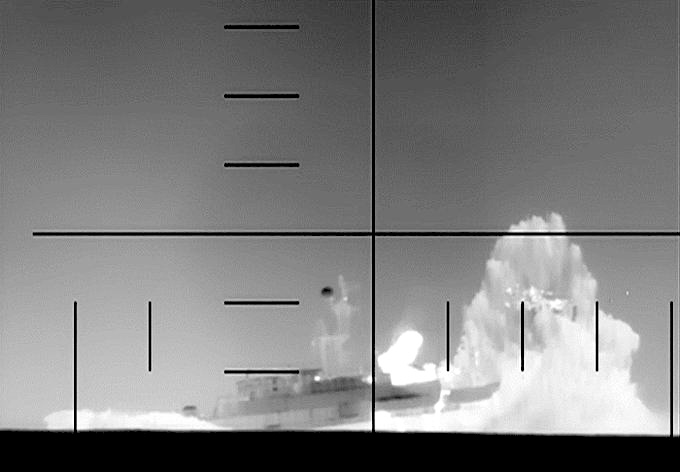
U.S. Department of War photo of IRIS Dena being sunk by a torpedo in the Indian Ocean on March 4, 2026. (DoW/Wikimedia Commons/Public Domain)
Prime Minister Narendra Modi was in Jerusalem literally embracing Israeli Prime Minister Benjamin Netanyahu two days before the attack began. The two men signed a Special Strategic Partnership. Naturally, instead of condemning Israel, India has criticized Iran for its retaliation and distanced itself from Tehran.
This has been perhaps best illustrated by the sinking of the Iranian frigate IRIS Dena off the coast of Sri Lanka on March 4, just five days after the U.S. and Israel launched their attack on Iran.
On that day the frigate was sunk by a torpedo from a United States submarine in the Indian Ocean.
The vessel had just participated in a multinational naval exercise hosted by India. It was en route back to Iranian waters when it was hit, on the high seas, killing almost 90 sailors, while several others were rescued by the Sri Lankan navy and coast guard.
India’s response, or rather, its silence, has been striking.
A major U.S. military strike occurred almost at India’s doorstep, targeting a ship that had just participated in a naval exercise hosted by India, in a region, the Indian Ocean, that India considers part of its extended maritime neighbourhood and where New Delhi has long aimed to establish itself as a “net security provider” and yet Modi’s government did not condemn the attack.
Despite Tehran’s direct requests for Indian support, three weeks into the attack on its BRICS partner, New Delhi still refuses to criticize the U.S. and Israel, sticking mainly to vapid calls for restraint and diplomacy. As the 2026 BRICS chair, New Delhi has made no apparent effort at crafting a common response, given its own pro-Israel stance.
The Limits of Indian Policy
India’s foreign policy has long been guided by “strategic autonomy,” the ability to engage with competing powers on its own terms without being drawn into their conflicts.
But the IRIS Dena episode shows the limits of this approach.
When a long-standing partner like Iran expects support, staying neutral or speaking cautiously can be seen as weakness.
There’s no doubt that India is in a difficult spot.
Over the past decade, its ties with the U.S. have grown much closer, especially in defence and technology. Shared concerns about China’s rise, participation in the QUAD — a strategic grouping of India, the U.S., Japan, and Australia — and the Indo-Pacific strategy have all pulled New Delhi closer to Washington.
Modi has been in the unenviable position of dealing with a maverick U.S. president like Donald Trump, who in 2025 raised tariffs on Indian goods as high as 50 percent, and then lowered them on condition that India stop buying Russian oil.
The U.S. Supreme Court struck down the Trump-era tariffs, easing pressure on India. But even with the much lower 15 percent duty, New Delhi continues to bend to Washington’s demands.
The U.S. has lifted sanctions on Russian oil because of the Hormuz crisis. India is buying from Moscow but the Russians have removed the steep discount they had been previously giving New Delhi and are now selling to India at spot market prices.
Last year, India also pulled back from the Chabahar port project in Iran under pressure from the U.S., even though the port offered India direct access to Afghanistan and Central Asia while bypassing Pakistan.
India and BRICS
Pepe Escobar, a well-connected Brazilian journalist and geopolitical analyst, thinks BRICS would have grounds to suspend or even expel India “considering that India betrayed sequentially two top BRICS — founding member Russia, and a new member, Iran, on several levels, because of American pressure.”
Escobar told the webcast Judging Freedom:
“Forty-eight hours before the decapitation strike that killed Ayatollah Khamenei and very important people at the top of the government in Tehran, Modi was in Israel being best buddies with the war criminal Netanyahu because he wanted to clinch weapons deals with Israel, which they did by the way. So we have a founding BRICS member completely aligned with Israel which for the other BRICS — practically all the other ones and the partners as well — this is unthinkable.”
He went on :
“It’s very, very enlightening to see very well-prepared, educated Indian analysts and scholars … venting, they don’t even know how to express it. They are appalled and they say we we cannot explain this to the rest of the global south because we Indians are always saying we are one of the leaders of the global south. After that forget it.
They sided with the empire and they sided with Israel right before the attack on Iran. So it’s going to be very hard to patch these things together and especially in a year where the chairmanship of BRICS later this year is India and the annual BRICS summit is going to be in Delhi.”
Iran’s Patience With India
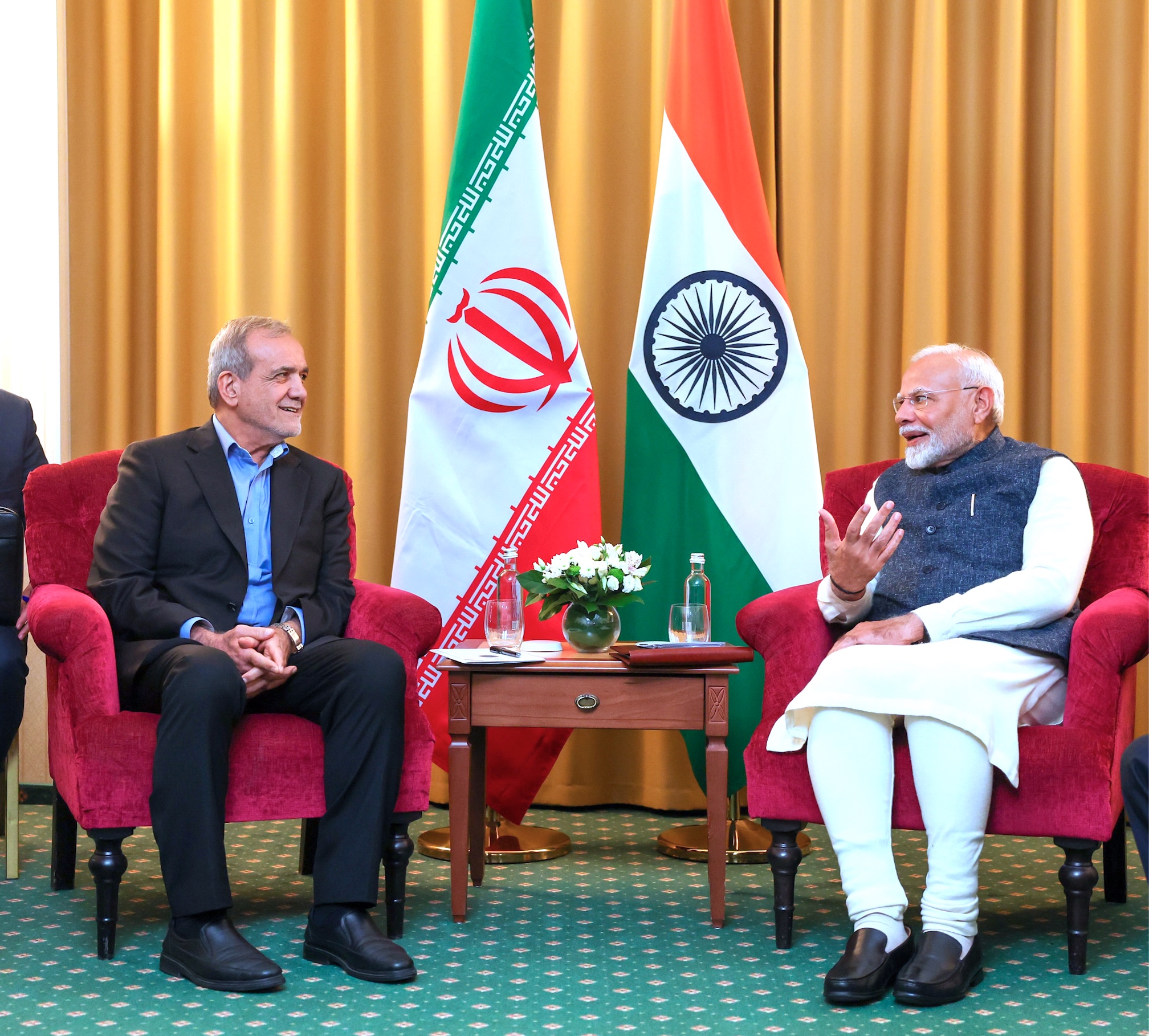
Iranian President Masoud Pezeshkian meeting with Modi at the 16th BRICS summit in Kazan, Russia, Oct. 22, 2024. (Prime Minister’s Office/Government of India/Wikimedia Commons/GODL-India)
Iran’s restraint is remarkable despite the diplomatic gymnastics New Delhi has been performing to appease the U.S. This patience likely comes from a longer view of India–Iran ties being deeply historical and cultural, predating the existence of the United States.
India has a sizable Shia Muslim population, many of whom look to the Ayatollah as a spiritual and religious leader. The city of Lucknow, capital of India’s most populous state, was once home to Shia Nawabs, whose heritage has left its cultural mark on the city.
Iran knows the relationship will outlast Modi’s tunnel vision and New Delhi’s troubles with Trump.
India is already feeling the pinch, frustrated and embarrassed as the world watches the country struggle to defend a partner attacked in its own backyard.
New Delhi has scrambled to smooth things over with Tehran after the closure of the Strait of Hormuz cut LPG supplies, causing a domestic cooking-gas shortage. Shops and restaurants were forced to close, and people queued for hours just to get cylinders for home use.
Add Russia to the picture and the situation gets even more tangled for India.
Russia and Iran have grown closer, brought together by sanctions and a shared pushback against Western dominance. Moscow is believed to be helping Iran with intelligence, like satellite images and battlefield information. Russia isn’t expecting BRICS to stay neutral, but would rather see support for Iran, or at least stronger diplomatic backing.
India and Russia’s long-standing, steady relationship is also facing strain. The 50 percent tariffs the U.S. imposed last year forced India to reduce its crude oil imports from Russia.
At the same time, the Trump administration has repeatedly claimed that India has either stopped buying Russian oil or is being “allowed” to continue only because of current shortages. In reality, Russia remains India’s largest oil supplier, and neither country has publicly responded to these remarks.
An Appearance of Strength
BRICS represents a significant share of the global population and economy. But in response to the attack on a member state, BRICS has not acted as a bloc.
There is no agreement on how to handle conflicts involving a member state, no shared security doctrine, and no coordinated diplomatic response.
Trump has repeatedly mocked BRICS, at one point declaring “BRICS is dead” and warning that any attempt to challenge the U.S. dollar would be met with tariffs, even telling member countries they could “go find another sucker nation.”
Economically, too, the effects of the war are uneven. Rising oil prices may boost Russia while hurting India and China.
The Iran war has exposed the limits and faultlines of BRICS.
For India, playing the balancing power and fence-sitting isn’t working this time. Rather than projecting itself as a global power, it is not even coming across as a truly independent regional one.
Betwa Sharma is the managing editor of Article 14, the former politics editor at HuffPost India, and the former U.N./New York correspondent for the Press Trust of India. She has also reported for numerous publications, including The New York Times and The Intercept.

No comments:
Post a Comment