
By Palestine Chronicle Staff
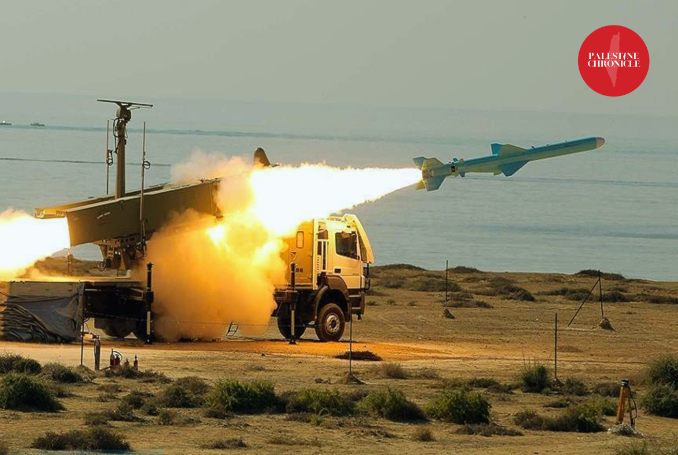 File photo of an Iranian cruise missile launched during previous military exercises. (Photo: via Al-Mayadeen)
Iran outlines six conditions to end the war, asserting military dominance and rejecting ceasefire without structural regional changes.
War Enters New Phase
As more of Iran’s missile capabilities, operational endurance, and strategic leverage over the Strait of Hormuz come into sharper focus, Iranian officials are beginning to articulate, with increasing clarity, the country’s conditions for ending the war.
In a significant development, a senior Iranian political-security official revealed six core conditions required for a ceasefire in remarks to the Lebanese outlet Al Mayadeen.
The statement marks the most detailed and structured position issued by Tehran since the escalation began.
The announcement follows a series of powerful and devastating Iranian strikes across Israel, particularly in Arad and Dimona, which appear to have reshaped the military and political dynamics of the confrontation.
Despite strict military censorship and severe restrictions imposed on Israeli journalists, emerging images and fragmented reports indicate dozens killed and wounded, alongside widespread destruction in targeted areas. The scale of the damage, though only partially visible due to reporting limitations, suggests a significant breach in Israel’s defensive posture.
New Strategic Framework
Until now, Iranian officials had spoken in broader terms about ending the war, typically emphasizing the need for guarantees against renewed aggression by Israel and the United States, alongside calls for lifting sanctions. However, these statements remained largely general and lacked a clearly defined framework.
The latest remarks signal a notable shift.
According to the Iranian official speaking to Al Mayadeen, Tehran has now formalized its position within what he described as a “new legal and strategic equation,” reflecting both battlefield developments and evolving geopolitical realities.
The official noted that regional mediators and various international actors had conveyed proposals to Tehran aimed at halting the war. However, he stressed that Iran’s conditions “must be taken seriously,” indicating that the balance of power has shifted sufficiently for Tehran to dictate terms rather than merely respond to proposals.
The Six Conditions
The six conditions outlined by the Iranian official represent a comprehensive restructuring of the conflict’s political and security framework.
- First, Iran demands binding guarantees that war will not be repeated, signaling a rejection of temporary or symbolic ceasefire arrangements.
- Second, Tehran calls for the closure of US military bases across the region, a demand that directly challenges the broader American military presence in West Asia.
- Third, Iran insists that the aggressors pay compensation for damages inflicted during the war.
- Fourth, it calls for an end to all ongoing wars across regional fronts, positioning the current confrontation within a wider regional context rather than an isolated conflict.
- Fifth, Tehran seeks the establishment of a new legal regime governing the Strait of Hormuz, a critical global energy artery over which Iran holds strategic influence.
- Sixth, the Iranian demand extends into the media sphere, calling for the prosecution and extradition of individuals affiliated with what it describes as hostile media operations targeting Iran.
Taken together, these conditions go far beyond conventional ceasefire terms, reflecting an attempt to redefine not only the outcome of the current war but also the regional order that underpins it.
Strategic Patience
The Iranian official emphasized that Tehran’s actions are not reactive, but rather part of a pre-planned strategy.
“What Iran is implementing in its defensive war is a plan prepared months ago,” he said, adding that the strategy is being executed “stage by stage, with great strategic patience.”
This assertion aligns with the observable shift in Iran’s military approach. While earlier phases of the conflict relied on saturation-style missile launches, recent operations appear more precise, targeting critical infrastructure and high-value sites.
The official further claimed that Iran has now achieved “full control over the skies of the enemy,” following the destruction of key air defense infrastructure.
No Immediate Ceasefire
Despite the articulation of conditions, Tehran does not appear to be seeking an immediate halt to hostilities.
On the contrary, the Iranian official indicated that, given the current military balance, Iran “does not see a near horizon for a ceasefire.” Instead, Tehran intends to continue what it described as a policy of “punishing the aggressor” until a “historic lesson” is delivered to both Israel and the United States.
This position reflects a broader strategic calculation.
What initially appeared to be a high-risk escalation has, from Tehran’s perspective, evolved into an opportunity to consolidate deterrence, reshape regional dynamics, and force adversaries into a defensive posture.
A War Reframed
The emergence of clearly defined Iranian conditions also coincides with growing indications that Washington is seeking an exit from an increasingly complex and costly confrontation.
Early objectives attributed to the US-Israeli campaign—reportedly including the weakening of Iran’s military capabilities and even the transformation of its political system—have not materialized. Instead, the war of aggression appears to have strengthened Iran’s regional standing and bargaining position.
By formalizing its demands, Tehran is not merely outlining terms for ending the war; it is reframing the conflict itself.
No longer confined to immediate military exchanges, the war is now being projected onto a broader strategic plane—one that encompasses military presence, economic structures, legal regimes, and information warfare.
In this evolving landscape, Iran’s message is clear: any ceasefire will not be a return to the status quo, but the beginning of a new regional equation shaped by the realities of the battlefield.
(Al Mayadeen, Palestine Chronicle)

No comments:
Post a Comment