
It’s a long shot but here are five steps to stop this war, which could easily turn into a global conflagration, effectively into World War III, write Jeffrey Sachs and Sybil Fares.
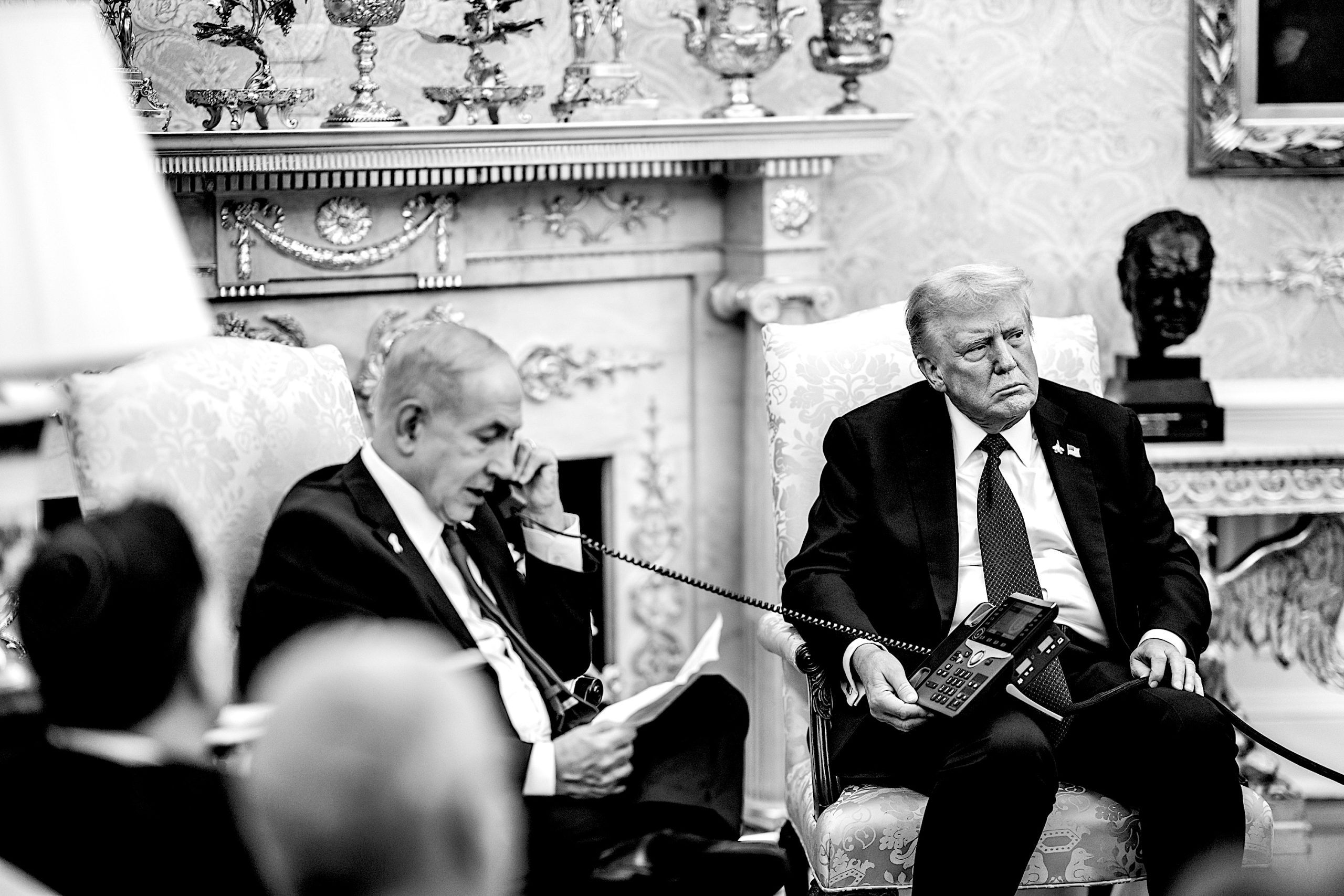
Israeli Prime Minister Netanyahu, with President Donald Trump during a meeting on Gaza, Sept. 29, 2025, in the Oval Office. (White House /Daniel Took)
By Jeffrey D. Sachs and Sybil Fares


The economic consequences are already severe and could become catastrophic. The Strait of Hormuz carries approximately one-fifth of all oil traded globally, and 30 percent of the world’s liquefied natural gas (LNG).
A sustained closure of the Strait would trigger an energy shock without modern precedent.
The conflict is likely to spiral out of control because the U.S. and Israel are dead set on hegemony in the Arab world and West Asia – one that combines Israeli territorial expansion with American-backed regime control across the region.
The ultimate goal is a Greater Israel that absorbs all historic Palestine, combined with compliant Arab and Islamic governments stripped of genuine sovereignty, including on choices as to how and where they export their oil and gas.
This is delusional. No country across the region wants Israel to run wild as it is doing, murdering civilians across the entire region, destroying Gaza and the West Bank, invading Lebanon, striking Iraq and Yemen, and carpet-bombing Tehran.
No country wants its hydrocarbon exports under effective U.S. control. The war will end if and only if global revulsion at U.S. and Israeli aggression force these countries to stop.
Short of that, we are likely to see the Middle East in flames and the world in an energy and economic crisis unprecedented in modern history. The war could easily turn into a global conflagration, effectively into World War III.
Yet, there exists an alternative.
The war could stop on rational grounds if Israel and the U.S. are decisively called to account by the rest of the world.
Ending the war requires a set of interlinked steps to provide basic security for all parties, and indeed for the world.
Iran needs a permanent end to the U.S.-Israel aggression. The Gulf countries need an end to Iran’s retaliatory strikes.
The Palestinians need an independent state. Israel needs lasting security and the disarmament of Hamas and Hezbollah. The whole world needs the opening of the Strait of Hormuz, and international monitoring of Iran’s nuclear program to ensure it abides by the Nuclear Non-Proliferation Treaty, as Iran says it wants to do.
And all countries want, or should want, real sovereignty for themselves and their region.
Collective security could be achieved in five interconnected measures.
First, the U.S. and Israel would immediately end their armed aggression across the entire region and withdraw their forces.
Second, Iran would stop its retaliatory strikes across the Gulf Cooperation Council (GCC) and resubmit to monitoring by the International Atomic Energy Agency (IAEA) under a revised Joint Comprehensive Plan of Action (JCPOA), which President Trump recklessly abandoned in 2018.
Third, the Strait of Hormuz would reopen with mutual agreement of Iran and the GCC.
Fourth, the two-state solution would be immediately implemented by admitting Palestine as a full member state of the U.N.
Israel would be required to end its occupation of the West Bank and East Jerusalem and to withdraw its forces from Lebanon and Syria.
Fifth, the U.N. recognition of the State of Palestine would form the basis for a comprehensive regional disarmament of all non-state actors, verified under international monitoring. The end result would be a return to international law and the U.N. Charter.
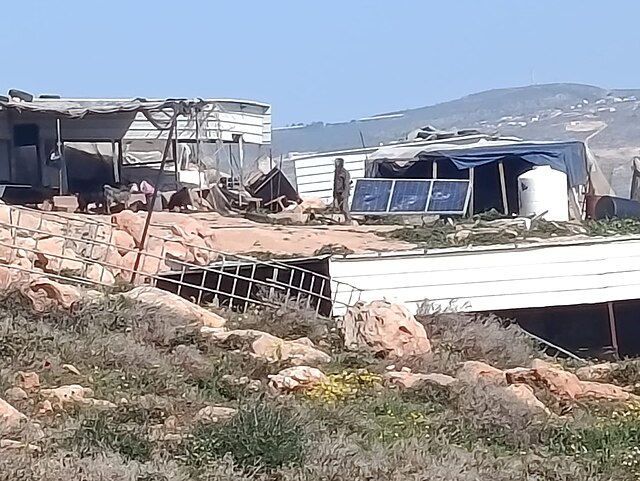
Israeli Settlers vandalizing Palestinian property, Shikara bedouin encampment east of Douma, Nablus, on March 3. (Douma Village Council/Wikimedia Commons/CC BY 4.0)
Who would win in this plan?
The people of the region, of Israel, Palestine, Lebanon, Syria, Iraq, Iran, and the rest of the world. Who would lose?
Only the backers of Greater Israel, led by Benjamin Netanyahu, Itamar Ben-Gvir, Bezalel Smotrich, and Mike Huckabee, who have brought the world to the brink of destruction.
Here are the five steps in more detail.
First: End the U.S.-Israeli Armed Aggression
Israel and the U.S. would stop their aggression and withdraw their forces. In turn, Iran would cease its retaliatory strikes. This would not be a mere ceasefire. Rather, it would be the first step of an overall peace agreement and collective security arrangement.
Second: Return to the JCPOA

IAEA Director General Rafael Mariano Grossi meeting with IAEA representatives LI Song of China, HE Reza Najafi of Iran and Mikhail Ulyanov of Russia about Iran’s nuclear program, April 24, 2025. (Dean Calma / IAEA/Flickr/CC BY 2.0)
The nuclear question would be resolved through strict monitoring by the International Atomic Energy Agency, not through bombing campaigns that merely put Iran’s enriched uranium beyond international monitoring.
The U.N. Security Council would immediately reinstate the basic framework of the 2015 Joint Comprehensive Plan of Action (JCPOA), under which Iran must strictly comply with IAEA monitoring and agreed limits on its nuclear program, while economic sanctions on Iran would be lifted.
Third: Reopen the Strait of Hormuz in an Iran-GCC Framework
The Strait of Hormuz would be quickly reopened, with safe passage jointly guaranteed by Iran and the Gulf Cooperation Council (GCC). The GCC countries would assert sovereignty over the military bases in their countries to ensure that the bases would not be used as launchpads for renewed offensive strikes against Iran. [Emphasis added: CN]
Fourth: The Two-State Solution
The two-state solution would be implemented, by admitting Palestine into the U.N. as the 194th permanent member state. This requires nothing more than the U.S. lifting its veto.
Palestinian statehood is in accord with international law and with the Arab Peace Initiative, which has been on the table since 2002. In turn, the countries in the region would establish diplomatic relations with Israel, and the U.N. Security Council would introduce peacekeepers to ensure the security of both Palestine and Israel.
Fifth: An End to Armed Belligerency
In conjunction with the two-state solution, all armed belligerency in the region would end forthwith, including the disarmament of Hamas, Hezbollah and other armed non-state actors.
In the case of Palestine, the disarmament of Hamas would underpin the authority of the Palestinian state. In the case of Lebanon, the disarmament of Hezbollah would restore Lebanon’s full sovereignty, with the Lebanese Armed Forces as the sole military authority in the country.
The disarmament would be verified by international monitors and guaranteed by the U.N. Security Council.
The key point is that the Israel-U.S. war on Iran has not occurred in a vacuum.
The Clean Break strategy, developed by Netanyahu and his American neocon backers in 1996, and implemented since then, calls for Israel to establish hegemony in the region through wars of regime change, with the U.S. as the implementing partner.
As NATO Supreme Commander Wesley Clark revealed after 9/11, the U.S. drew up plans a quarter century ago to overthrow governments in seven countries: “starting with Iraq, and then Syria, Lebanon, Libya, Somalia, Sudan and, finishing off, Iran.”
We are therefore living through the culmination of a long-standing plan by Israel and the U.S. to dominate the Arab world and West Asia, create a Greater Israel, and permanently block Palestinian statehood.
We are not optimistic about the likelihood of our plan.
The Israeli government is murderous and Trump is delusional about U.S. power.
We are perhaps already in the early days of WWIII. Yet because the stakes are so high, it’s worth laying out real solutions even if they are long shots.
We do believe, however, that the non-Western world — the part that is not vassal states to U.S. power — understands the urgency of peace and security.

Country leaders at the 17th BRICS Summit in Rio de Janeiro on July 6, 2025. (Prime Minister’s Office /Wikimedia Commons/GODL-India)
Who, then, could champion a peace plan that the U.S. and Israel will resist with every means at their disposal, until the weight of global opposition and economic catastrophe leaves them no choice but to accept it?
There is one main group, and that is the BRICS (Brazil, Russia, India, China, and South Africa) nations.
Brazil, Russia, India, China, South Africa, and the bloc’s expanded membership, which now includes the United Arab Emirates (UAE), Iran, Egypt, Ethiopia, and Indonesia, represent approximately half of the world’s population and more than 40 percent of global gross domestic product (GDP) (compared to 28 percent for the vaunted but overblown G7 countries).
The BRICS have the credibility, the economic weight, and the absence of the historical complicity in Middle East imperialism to bring the world to its senses.
The BRICS should convene an emergency summit and present a unified framework incorporating the conditions for peace and security, which in turn would be pressed at the U.N. Security Council.
There, world opinion would tell the U.S. and Israel to stop pushing the world towards catastrophe and would remind all countries to adhere to the U.N. Charter.
Jeffrey D. Sachs is a university professor and director of the Center for Sustainable Development at Columbia University, where he directed The Earth Institute from 2002 until 2016. He is also president of the U.N. Sustainable Development Solutions Network and a commissioner of the U.N. Broadband Commission for Development.
Sybil Fares is a specialist and adviser in Middle East policy and sustainable development at SDSN.

No comments:
Post a Comment