
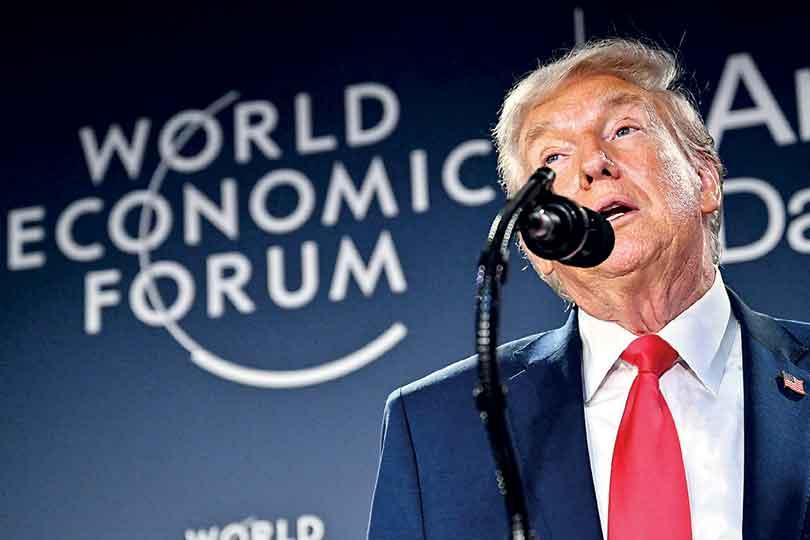
US President Donald Trump addresses business leaders at the World Economic Forum (WEF) annual meeting in Davos on Wednesday. AFP

United States President Donald Trump fits the description of the kind of world leader the Madman Theory warns about.
The theory is based on the idea of a leader who employs unpredictability as a means of conducting international relations—like Trump. When asked whether he would join Israel in a war against Iran, he said, “I may do it. I may not do it. Nobody knows what I’m going to do.”
What is predictable in Trump’s behaviour is his unpredictability.
At Davos on Wednesday, Trump backtracked on his threat to invade Greenland after warning of military action if his offers to buy the icy island were spurned. He also said he would not impose tariffs on European nations that opposed his Greenland plan. The news brought relief to European powers, yet it failed to allay fears, for he remains unpredictable and untrustworthy. The backtracking may be the outcome of a European warning to use their trade “bazooka”—the Anti-Coercion Instrument they threatened to unleash at the emergency EU leaders’ summit in Brussels yesterday.
In the United States, presidents cannot and do not act alone. The method in his madness indicates that the system—comprising, among others, the billionaire club, a.k.a. the one per cent—works with the president.
In Trump, the system found the president it wanted to aggressively promote US interests. Why aggressively? Because there is an urgency to delay China’s claim to the position of the world’s number one power. China is, for all intents and purposes, an equal power, though it is reluctant to openly challenge US hegemony. When Venezuela’s sovereignty was violated, China did not rush to the defence of its ally.
US strategists want to prove Thucydides wrong. His theory, based on the Peloponnesian Wars (431 to 404 BC) he witnessed, suggests that the number one power will not give up its position to the number two power without a fight. By taking over Venezuela’s oil and annexing new territories, the US seeks to increase its power to such a level that it may take decades more for China or any other power to catch up.
Towards this end, Trump—like the neocons’ favourite, George W. Bush, before him—embraces the system, whose primary task is to ensure the supremacy of US interests, more immorally than morally. Trump’s recently unveiled National Security Strategy, which identifies China and, to a lesser degree, Russia as security threats, reflects the Latin phrase ‘Fiat vita mea, pereat mundus’—meaning, ‘Let my life prevail, though the world perish.’
Washington’s Western allies were not unaware of US selfishness, yet they played the lackey, believing their survival was intertwined with that of the United States—or that the interdependence was symbiotic. Now they realise that this convenient approach only compromises their own security.
The threat of the US annexing the Arctic island still looms large, despite Trump’s Davos announcement that he would not use military force to take over Greenland, which he claimed the United States liberated from Nazi Germany during World War II and handed over to Denmark.
Washington’s Western allies cried foul, saying Trump’s actions threaten to scuttle the rules-based international system—a system they know very well never truly existed, and if it did, they themselves broke it with impunity to promote their national interests.
In a way, America’s Western allies deserve the stab in the back, for they, as a matter of policy, endorsed every wrong the US committed. They joined or supported Washington’s invasions and illegal wars. Together with the US, they armed and backed Israel’s genocidal campaign in the Gaza Strip. They never expressed concern over the collapse of the so‑called rules‑based world order, even when every clause and rule in international humanitarian law was violated by Israel. Hospitals were bombed, schools destroyed, and civilians massacred in their tens of thousands. Most European powers, with the exception of a handful, cheered in their tribute to Israel and the US.
Devotion to US leadership was so entrenched in the European psyche that leaders did not even mind being humiliated by Trump. They were invited to Sharm El‑Sheikh in Egypt last year for a signing ceremony to mark Trump’s peace plan for Gaza and were made to stand behind him for hours, like butlers in fine‑dining restaurants, witnessing his ego‑massaging spectacle. They feared that disobedience would invite disastrous consequences—such as additional tariffs.
As recently as early this month, when Trump kidnapped Nicolás Maduro, the democratically elected president of Venezuela, America’s European allies-out of deference to Trump-responded with guarded and circumspect condemnations that proved toothless.
European powers must now be wishing they had a powerful defence alliance independent of the United States. Had Europe emerged as both an economic and military power centre, giving rise to a multipolar world order after the Cold War’s demise, Trump would certainly have thought twice before declaring his outrageous intention to annex Greenland—an autonomous region under the sovereignty of Denmark, a founding member of NATO and, since 1973, a member of the European Union.
Now they are realising, as Canada’s Prime Minister Mark Carney said in his speech at the Davos Economic Forum on Tuesday, that middle powers must act together “because if we’re not at the table, we’re on the menu.” Too little, too late, Mr Carney. The world would have been a better place had Canada and other Western countries stood firmly for what is right and morally just, instead of becoming part of a system where international law was applied selectively—especially to shield Israel and legitimise its crimes against humanity.
In a well‑received address at Davos, delivered just before Trump’s hubris dominated the forum, Carney declared that the US-led “rules‑based international order” has not merely evolved but suffered a permanent rupture. The era of predictable cooperation, he argued, has given way to a “brutal reality” defined by great‑power rivalry and economic coercion. As the Canadian leader warned, his own country may well be the next easy target for annexation after Greenland.
After the criminal kidnapping of Nicolás Maduro, world leaders no longer dismiss Trump’s words as the harmless barks of a dog that does not bite, nor as empty threats lacking the political will or courage to implement them. His politics is schizophrenic—no one knows which avatar will manifest when and how.
The rest of the world grew anxious when Trump was reelected in 2024. As his tariff war upended the way the United States conducted business with the outside world, some opined that the world would only have to endure his shocks for four years, which would pass quickly, like an arrow in flight. Yet, as former British Prime Minister Harold Wilson famously remarked, “a week is a long time in politics.” On Wilson’s scale, with a maverick like Trump at the helm of US affairs, four years may feel like four dreaded aeons.
The United States now appears to be emerging as a new Nazi‑like state, with its own “Board of Peace”—a counter‑United Nations of sorts—designed to impose its own version of peace and justice upon the rest of the world.

No comments:
Post a Comment