Showing posts with label the United Arab Emirates. Show all posts

Thursday, December 12, 2019

UAE, a virus threatening Iraq

* By Mohammad Ghaderi

The United Arab Emirates is the name of a country that did not exist until 1971 and its geographical area was known as “the Trucial States”.
On December 2, 1971, the UAE appeared as a country on the map of the world. Today, the UAE interventions in the Arab states’ affairs and its role in creating instability is clear to everyone. 
Regarding the destructive role of the UAE, the al-Monitor newspaper wrote that after the 2011 incidents, the role of the UAE, especially in quelling popular movements, became more obvious. The UAE, along with its allies, made every efforts to prevent the success of popular movements in Arab countries.
Arab media outlets have recently released reports that reveal the UAE interference in the Iraqi domestic affairs. The Al Mayadeen news channel reported that three UAE planeloads of arms were sent to the Iraqi Kurdistan following the visit of the Kurdistan Regional Government’s officials to Abu Dhabi. 
Informed Iraqi sources told Al Mayadeen that Baghdad is not aware of the weapons that were sent to the KRG. It is not clear whether the KRG or the Syrian Democratic Forces (SDF) will use these weapons.
The sources stated that sending arms to the KRG means that the UAE is interfering in the KRG-Iraq case. If the arms were sent for the KRG, so why did not Baghdad know anything about them? Was the move intended to begin a war?
The Arabi21 News Agency revealed the role of the UAE in the protests in Iraq, reporting that as the protests began, Abu Dhabi tried to carry out its planned military coup.  
On the other hand, the Soat al-Iraq (Voice of Iraq) radio station announced the arrest of a UAE-affiliated group that sought to derail the popular protests in their own favor. The radio station emphasized that the group was directly affiliated with Tahnoun bin Zayed, the UAE national security adviser and crown prince’s brother, who was trying to resolve the issue through the Western channels. 
UAE’s expansionist policies seem to have no end in sight, and after years of suspicious support, the name of the UAE has been highlighted again in Iraq. The UAE is taking step to meet its political demands in Iraq and is seeking sedition to advance its own hostile plans. The planeloads of arms show the UAE’s intervention in security issues, raising the question of whether ISIS is linked to the UAE. What is the secret of the Iraqi antiquities stolen from a museum in Abu Dhabi?
A few days ago, the Iraqi media announced the arrest of a UAE-affiliated group, including some Lebanese individuals, who intended to influence the demonstrations in the country. 
At the same time, Asa'ib Ahl al-Haq (AAH) Secretary-General Qais Khazali told the Iraqi media that the Zionist regime and the UAE are the main actors of this great conspiracy against Iraq. The secretary-general provided the Iraqi authorities with more details about the conspiracy.
From analysts’ perspective, Iraq, like other Arab countries, has not been safe from the UAE interference. The UEA is trying to plunge Iraq into drugs and supports terrorist groups to create instability in the country. 
* Author: Mohammad Ghaderi, Tehran Times editor in chief 

Saturday, August 03, 2019

What is behind UAE's shifting policy toward Iran

Anadolu Agency gets details of secret UAE officials meeting where they mull softening of stance on regional rival Iran

Leaders of the United Arab Emirates have held a secret meeting where they discussed the need to revise their policy toward Iran, sources close to the Gulf state told Anadolu Agency.
The meeting, which followed Iran's claim of downing a U.S. drone which had entered its territory on June 20, was attended by Mohammed bin Zayed Al Nahyan, the crown prince of U.A.E., said the source who asked not to be name for fear of reprisal.
Mohammed bin Rashid al-Maktoum, vice-president of the U.A.E., slammed the existing foreign policy.
"We should completely review our foreign policy. We spend hundreds of millions of dollars every day. So, what do we earn in return?" said al-Maktoum, who also serves as U.A.E. prime minister and ruler of Dubai, the source added.
Al-Maktoum stressed the country should give up its aggressive and interventionist foreign policy "as soon as possible".
He reiterated that this costly foreign policy was reaping no benefits to the Emirates.
"What is our benefit in a regime change in Sudan or Libya? You pin hopes on the U.S. to strike Iran but [Donald] Trump called for dialogue [with Iran] even after downing of a U.S. drone.
"[...] Iran responds directly of through Houthis in Yemen, attacking the U.A.E. and Saudi Arabia. All foreign investors flee the country even if a rocket falls into U.A.E. We cannot even hold on to Asian workers."
"We have spent money for [Khalifa] Haftar. We should give up spending money and look for alternatives which should be political instead of military," he said, referring to Libya's renegade commander.

Crown Prince Al Nahyan has taken the criticism positively and has agreed on making some changes to the foreign policy, the source said.
The U.A.E. has come under fire on social media for its policies in the region. This change in foreign policy is also a step to improve its public image.
Al-Maktoum is a known opponent of U.A.E.'s interventionist policy. Dubai, which he leads, has strong commercial ties with Iran with many Iranian businesses flourishing in the luxury shopping paradise.
The U.A.E. follows Saudi Arabia's stance on Iran in the region.
The first shift in policy of the U.A.E. toward Iran was witnessed in May when the U.S. blamed Iran for an oil tanker attack in the strategic Strait of Hormuz. Sheikh Abdullah bin Zayed al-Nahyan, foreign minister of the Emirates, had said: "It is necessary to have clear evidence for the accusation against Iran."
In the following days, the U.A.E. announced to retreat troops in Yemen lowering support to the Saudi-led coalition. Also, top security officials of U.A.E. met their Iranian counterparts for a coast guard meeting in Tehran after a six-year hiatus.
The last sign of growing intimacy between the two countries was that two banks from the U.A.E. approved financial transactions with Iran, despite U.S. banking sanctions.

Sunday, June 30, 2019

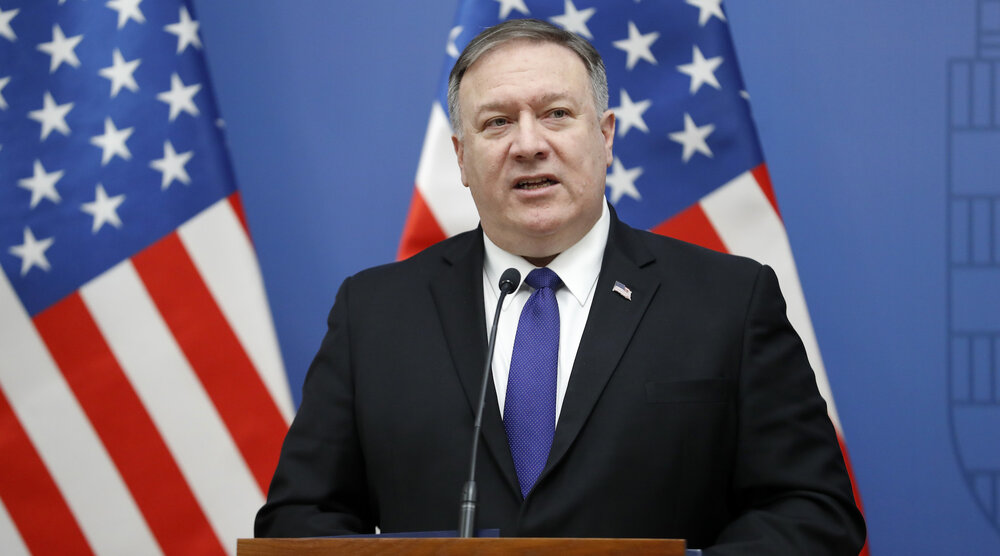
Why Pompeo is travelling to Middle East?

By Hanif Ghaffari
TEHRAN - American Secretary of States Mike Pompeo announced on Sunday that he will travel to Saudi Arabia and United Arab Emirates (UAE) to discuss the issues of western Asia. 
It seems that the intention behind this trip, like the previous trips of U.S. officials to Middle East, is to shake down Arab tycoons. In fact, Trump had recently said that Saudi Arabia must financially support U.S. actions and now Pompeo is making this trip to reap the benefits. 
In fact, with muddying the waters, U.S. is only trying to downplay his recent failures against Iran, especially after Iran downed U.S. super modern Global Hawk drone that had intruded into Iran’s airspace. 
Following the incident, Trump made a strange announcement saying that he wanted to retaliate, but he called off the attack against Iran just 10 minutes before it was to be launched. 
After this, the western media tried to start up a psychological warfare against Iran. First saying that Trump is ready to negotiate, and then repeated the false claims that they might return to nuclear deal. Amid all this tension, Trump once again sent a message to North Korea’s Supreme Leader, and now Pompeo’s trip to the Middle East is just another piece of this puzzle. 
Out of a general viewpoint, we can say that the followings are the main intentions of Pompeo with making this trip to Middle East: 
•    Announcing U.S. support for Saudi and UAE regimes to continue killing the innocent people of Yemen until they reach a big victory. 
Gaining more victories in Yemen has specially become important for Saudi-led coalition after Yemeni drones targeted Abha and Jizan airports in the south of Saudi Arabia. 
On the other hand, a rift has opened up between the two main pillars of Saudi-led coalition, Saudi Arabia and UAE because Saudi disagrees with UAE’s plans for dividing the northern and southern Yemen. 
•    Putting pressure on Arab countries to attend the Manama event where U.S. is planning to put forward the “deal of the century.” 
After massive protests of both Muslim and non-Muslims on Quds Day in different countries 
After thousands of both Muslims and non-Muslims took to the streets on Quds Day (May 31) in protest of the “deal of the century”, many countries stepped back from agreeing to this deal; which is according to many experts is a vague and unpractical plan. These events majorly hindered the project from going further. First, John Bolton, U.S. National Security Advisor tried to stop the failure of this deal by making a trip to occupied Palestine and now Pompeo is making a trip to pressure their allies among Arab countries to attend the Manama meeting as it is among the most important events arranged to facilitate the deal of the century. 
•    Fuelling Iranophobia among Arab countries.
White House has failed in carrying out many of his projects against Iran over the last two years; this has seriously undermined U.S. foreign policy; so, now, U.S. is trying to make them afraid of Iran and incite them into violent reactions. 
•    Diverting the attention out of the successful results of “active resistance” of Iranians in reaction to U.S. unilaterally leaving the nuclear agreement with Iran. 
After United Nations Security Council passed a resolution for step by step suspension of Iran’s commitment to the nuclear deal, U.S. plans for pressuring Iran into having new round negotiations were thwarted. 
Many experts believe that this would change the game in favor of Iran. So, it seems that one of Pompoe’s intentions in making this trip is to divert the public attention out of the mistakes of warmongers in White House. 
In general, Pompeo’s trip to Middle East is indeed not a sign of U.S. power and control over the region; on the contrary, it reveals U.S. failed plans and strategies in the region and especially in dealing with Iran.  
Anyway, the course of the events is showing that this trip will bring no achievement for neither U.S. nor ignorant tycoons of Middle East because Iran will never succumb to oppression and Yemen will never end its resistance against the usurpers. The deal of century has no influence over the changes in Middle East, especially now that all the evidences show that the Manama meeting is going to be a humiliating failure.  

Tuesday, November 13, 2018

The Enduring Shame: US Wars Killed 500,000 - and Counting


TEHRAN (FNA)- According to a new study by Brown University on the cost in lives of America’s Post-9/11 Wars, in Iraq, Afghanistan, and Pakistan, between 480,000 and 507,000 people were killed in the course of the three conflicts.
This includes combatant deaths and civilian deaths in fighting and war violence. Civilians make up over half of the roughly 500,000 killed, with both opposition fighters and US-backed foreign military forces each sustaining in excess of 100,000 deaths as well.

The report also notes that over 60,000 US troops were either killed or wounded in the course of the wars. This includes 6,951 US military personnel killed in Iraq and Afghanistan since 9/11. According to the Brown study, these conflicts are “inhibited by governments determined to paint a rosy picture of perfect execution and progress.”

And by these governments it means Saudi Arabia, the United Arab Emirates and a host of others who continue to wage wars on Syria and Yemen, and who purchased US arms to the tune of $192.3 billion in the year ending September 30 - a result of looser restrictions on sales coupled with high-level efforts to close deals and prolong wars of choice amid international apathy and inaction.

This terrible situation will get worse, because President Donald Trump wants to make the US, already dominant in the global weapons trade, an even bigger arms merchant to the world, despite concerns among human rights and arms control advocates. This grandiose thinking in the Middle East is putting the entire world in danger too, and it has become deeply entangled with lingering resentments from the world community.

This is often stated explicitly. At the United Nations many members say it is very obvious that it’s exceptionally important for war-party Washington to accept that the reason they lost the war of choice in Afghanistan, Iraq, Syria and Yemen is because they were wrong, and because they chose a coalition of allies who are corrupt, who are allied with terror groups, who are extremely disliked by the nations they rule or invaded, and who symbolize all of the worst failings of the United Nations and humanity. If they inflate the importance of the purported Iran meddling in their affairs it is to excuse their painful defeat. They see Iran bashing as a way to undermine efforts to end America’s endless wars and support for the tyrannical regimes.

The evidence is overwhelming that America is still playing a very harmful role, an unacceptable role in the ongoing humanitarian crisis, and that playing at war with Iran through economic warfare is Trump’s way of helping the failing terrorist groups, appeasing disappointed allies, and also an effort to try to undermine in a significant way the anti-terror alliance of Iran, Iraq, Syria, and Russia. The alliance is not, as they claim, a self-interest group relying only on its members. They are drawing support from the world community - unlike the US which is loathed and isolated, which relies on fake news and reports from terror groups and media lackeys to claim otherwise.

Let us not forget that the dire situation across the region, marked by the largest refugee crisis since the Second World War, fractured societies, proliferation of non-state actors, and unbelievable human suffering, could still be resolved through policy reversal and a surge in diplomacy for peace. In any true sense, it is America’s arms sales, misadventures, threats of new war, as well as the self-appointed roles as the warden of world order, the guarantor of other nations’ security, the shepherd of the world economy, and the custodian of the global commons, that can once again open the doors to foreign intervention and manipulation, breeding instability and sectarian bloodshed.

What is clear is that America’s one-man foreign policy and wars of choice are not the answer to the region’s never-ending woes. They only prolong the humanitarian crises for America’s regional designs and wishful thinking. This being the case, it falls upon the United Nations and the international civil society to step up their opposition to America’s wars of choice, sanctions and paranoia upon the people of Syria, Yemen and Afghanistan. They must help to put these failed states back on their feet again. It’s a responsibility for us all.

Perhaps President Trump thinks he is different. Perhaps he wants a fresh start only because his predecessors didn’t do well. Perhaps he thinks that America’s war machine and institutions are still superior in a multi-polar world. Whatever he thinks, it still doesn’t change the fact that he is doomed to repeat the same failed delusion and increasingly the same unenforceable foreign policy of his predecessors at huge humanitarian costs.