Showing posts with label quds day. Show all posts

Sunday, June 30, 2019

Why Pompeo is travelling to Middle East?

By Hanif Ghaffari
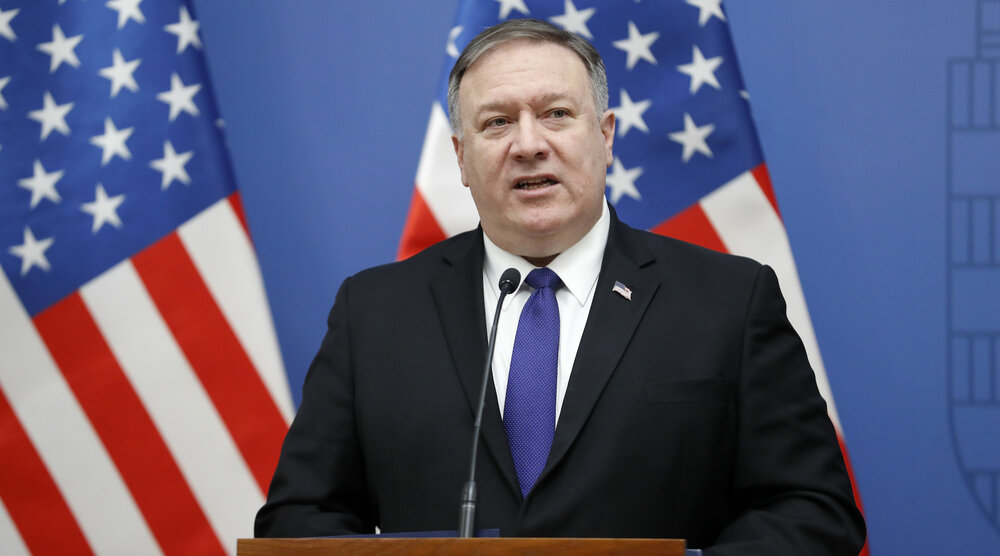
TEHRAN - American Secretary of States Mike Pompeo announced on Sunday that he will travel to Saudi Arabia and United Arab Emirates (UAE) to discuss the issues of western Asia. 
It seems that the intention behind this trip, like the previous trips of U.S. officials to Middle East, is to shake down Arab tycoons. In fact, Trump had recently said that Saudi Arabia must financially support U.S. actions and now Pompeo is making this trip to reap the benefits. 
In fact, with muddying the waters, U.S. is only trying to downplay his recent failures against Iran, especially after Iran downed U.S. super modern Global Hawk drone that had intruded into Iran’s airspace. 
Following the incident, Trump made a strange announcement saying that he wanted to retaliate, but he called off the attack against Iran just 10 minutes before it was to be launched. 
After this, the western media tried to start up a psychological warfare against Iran. First saying that Trump is ready to negotiate, and then repeated the false claims that they might return to nuclear deal. Amid all this tension, Trump once again sent a message to North Korea’s Supreme Leader, and now Pompeo’s trip to the Middle East is just another piece of this puzzle. 
Out of a general viewpoint, we can say that the followings are the main intentions of Pompeo with making this trip to Middle East: 
•    Announcing U.S. support for Saudi and UAE regimes to continue killing the innocent people of Yemen until they reach a big victory. 
Gaining more victories in Yemen has specially become important for Saudi-led coalition after Yemeni drones targeted Abha and Jizan airports in the south of Saudi Arabia. 
On the other hand, a rift has opened up between the two main pillars of Saudi-led coalition, Saudi Arabia and UAE because Saudi disagrees with UAE’s plans for dividing the northern and southern Yemen. 
•    Putting pressure on Arab countries to attend the Manama event where U.S. is planning to put forward the “deal of the century.” 
After massive protests of both Muslim and non-Muslims on Quds Day in different countries 
After thousands of both Muslims and non-Muslims took to the streets on Quds Day (May 31) in protest of the “deal of the century”, many countries stepped back from agreeing to this deal; which is according to many experts is a vague and unpractical plan. These events majorly hindered the project from going further. First, John Bolton, U.S. National Security Advisor tried to stop the failure of this deal by making a trip to occupied Palestine and now Pompeo is making a trip to pressure their allies among Arab countries to attend the Manama meeting as it is among the most important events arranged to facilitate the deal of the century. 
•    Fuelling Iranophobia among Arab countries.
White House has failed in carrying out many of his projects against Iran over the last two years; this has seriously undermined U.S. foreign policy; so, now, U.S. is trying to make them afraid of Iran and incite them into violent reactions. 
•    Diverting the attention out of the successful results of “active resistance” of Iranians in reaction to U.S. unilaterally leaving the nuclear agreement with Iran. 
After United Nations Security Council passed a resolution for step by step suspension of Iran’s commitment to the nuclear deal, U.S. plans for pressuring Iran into having new round negotiations were thwarted. 
Many experts believe that this would change the game in favor of Iran. So, it seems that one of Pompoe’s intentions in making this trip is to divert the public attention out of the mistakes of warmongers in White House. 
In general, Pompeo’s trip to Middle East is indeed not a sign of U.S. power and control over the region; on the contrary, it reveals U.S. failed plans and strategies in the region and especially in dealing with Iran.  
Anyway, the course of the events is showing that this trip will bring no achievement for neither U.S. nor ignorant tycoons of Middle East because Iran will never succumb to oppression and Yemen will never end its resistance against the usurpers. The deal of century has no influence over the changes in Middle East, especially now that all the evidences show that the Manama meeting is going to be a humiliating failure.  

Thursday, June 06, 2019

Al-Masjid al-Aqsa Under Threat

Zafar Bangash

Since US President Donald Trump illegally declared Jerusalem to be the capital of Israel and opened the US embassy there more than a year ago, tensions have escalated in the city. During the month of Ramadan, Palestinian worshippers below the age of 55 have been prevented from entering the city to pray in al-Masjid al-Aqsa. The Zionists not only have military checkpoints but a separation wall is also being erected, à la the West Bank, to prevent Palestinians from outside Jerusalem to enter the city.

The entire Haram al-Sharif that comprises al-Masjid al-Aqsa, the Dome of the Rock, and several madrasahs and zawiyahs, is under threat. Aggressive Zionist settlers have made no secret of their desire to bring down the Haram al-Sharif to build their mythical “third temple” there. While Rabbanical law expressly forbids Jews from setting foot on the holy sanctuary lest they desecrate it — and there is a board outside the Maghribiyah gate declaring this prohibition — such religious/legal rulings are no bar to the fanatical Zionist squatters.
It is not just the squatters; the Zionist regime is also pushing furiously to empty Jerusalem of its Palestinians inhabitants. Several policies are being pursued. Since Israel’s colonial occupation in 1967 of East Jerusalem that houses the holy sanctuary, Palestinian residents have not been issued permits to build or even repair their houses. Palestinians applying for a permit to build have to pay a fee of US$40,000 — an astronomical figure for most Palestinians. Even if a family manages to raise such funds, there is no guarantee that a permit would be issued. Their money is gone; it is larceny on a grand scale! Palestinians who repair their houses without a permit face Israeli bulldozers tearing them down. Adding insult to injury, the municipality charges the family for bulldozer fees. Palestinians are turned into refugees and forced to live in tents, but must pay for it.
Turning to al-Haram al-Sharif, the Jordanian Waqf that manages the Aqsa compound, reopened Babal-Rahmah, one of the accesses to al-Haram al-Sharif on February 13, 2019. The colonial Zionist regime had shut it down in 2003, alleging that the Waqf had links with Hamas and the Islamic movement.
The Zionists responded to the Waqf’s move of opening the gate by chain-locking it. This sparked a furious reaction from Palestinian worshippers; hundreds have since been arrested, including head of the Waqf Shaykh ‘Abd al-‘Azim Salhab, and his deputy. Many others have been banned from accessing the Aqsa compound. The Magistrate’s Court of Jerusalem extended the closure of the masjid for another 60 days on March 17, fueling further escalation of tensions.
Zionist extremist groups that need little prompting were emboldened by the court’s decision and the government’s moves. One of these groups is the Temple Mount Faithful, which on its website proclaims as its goal “the liberation of the Temple Mount from Arabic [Islamic] occupation.” These extremist groups have been provoking Palestinians for many years, storming the Aqsa compound in groups under the protection of Israeli soldiers, openly violating the ban on Jewish prayer on the site and constantly harassing Palestinian worshippers. They are now calling to lift the ban on Jewish prayer and even the construction of a synagogue!
These developments should cause alarm bells to ring in the capitals of the Muslim world. The pathetic Arabian rulers, far from showing any concern for the first qiblah of Muslims, are busy falling over themselves to kiss the feet of the Zionist colonizers. They have openly declared that Palestine and al-Masjid al-Aqsa are not their priorities; and that Zionist Israel is not their enemy, rather Islamic Iran is.
Under the rubric of Trump’s “deal of the century” — essentially selling out the Palestinians to make Zionist Israel supreme, another sinister plot is underway. The management of al-Haram al-Sharif is being handed over to the Saudis. They are clearly seen as even more subservient than the Jordanians who still display some modicum of self-respect. Add to that the announcement by the head of the World Muslim League that Israeli rulers will be invited to visit Saudi Arabia in 2020, one can begin to see what is afoot.
With these developments in mind, it becomes clear why the worldwide Quds Day rallies are so important. These rallies draw attention to the criminal conspiracy underway to destroy al-Masjid al-Aqsa so that Zionist control of the holy sanctuary can be made permanent.
Committed Muslims of the world, beware. There will be little to gain by crying afterward. The time for solidarity with the oppressed Palestinian people and standing up to save al-Masjid al-Aqsa is now!
Zafar Bangash is Director of the Institute of Contemporary Islamic Thought (ICIT).

Monday, September 06, 2010

The Ummah and al-Quds


There was a time when every Muslim student instinctively knew about the significance of Masjid al-Aqsa (al-Quds), the first qiblah of Muslims. It was from there that the noble Messenger (pbuh) went on his mi‘raj in the twelfth year of his prophetic mission. Jerusalem, where Masjid al-Aqsa is located (and we must be clear that the Golden Dome we see in most pictures in not Masjid al-Aqsa; that is Dome of the Rock built many years later), was liberated by the Muslims in the year 15ah (638ce) during the khilafah of ‘Umar (d). With the Muslims in charge of the body politic, Jersualem remained free except for a short interlude from 1099–1187ce when the crusaders occupied it. During the Crusades’ occupation of al-Quds, no Arabian ruler had the courage or dignity to struggle for the liberation of Masjid al-Aqsa. It took Salahuddin al-Ayubi, a Kurd, to march against the Crusaders and banish them from Jerusalem as well as liberate Masjid al-Aqsa in 1187ce. Palestine remained free for people of all religious persuasions until the modern-day British/French crusaders arrived on the scene and occupied Palestine as well as Jerusalem in 1918. The neo-crusaders knew they could not continue their occupation of the holy lands indefinitely so they planted their agents in the form of Arabian nationalist rulers in Jordan and Saudi Arabia. Their emergence facilitated the creation of Zionist Israel and its ultimate occupation of Jerusalem in the June 1967 war. The Jordanian army abandoned Jerusalem without firing a shot. This is precisely what the Hashemite kingdom of Jordan was created for: to serve Zionist-western interests in return for being allowed to remain in power.

The Zionists have sunk their claws deep into Masjid al-Aqsa undermining its foundations while the Arabian rulers continue to conspire with them against any Islamic assertion to liberate the first qiblah of Muslims. The regimes surrounding Palestine are all working in tandem with the Zionists to undermine the Islamic resistance in Palestine. The Saudis have secularized the Harams in Makkah and Madinah; it is forbidden to mention Masjid al-Aqsa or the oppression to which the people of Palestine are subjected. Muslims are told to indulge in empty rituals without raising their voices much less a finger against zulm, oppression and tyranny.

Yet not all Muslims swallow the Saudi line to remain docile. Every year, millions of Muslims participate in Quds rallies as called for by Imam Khomeini nearly 30 years ago to raise awareness about the continued Zionist occupation of Masjid al-Aqsa as well as Palestine. While such rallies scare the illegitimate Arabian rulers and their western-Zionist masters, they give hope to oppressed people everywhere. Clearly, not every Muslim is as detached from the affairs of Muslims as the Saudi-Egyptian-Jordanian and other Arabian rulers want them to be. Even as Islamic resisters in Palestine and Lebanon continue to struggle against Zionist vandalism and oppression, Muslims and other freedom-loving people elsewhere must continue to raise voices in their support.

Keeping the issue of Masjid al-Aqsa alive is a sacred duty in which every Muslim must participate to the utmost of his ability.

Tuesday, June 15, 2010

Zionist Israel: the root cause of Middle East conflict


Long before the Zionist entity was planted in the heartland of Islam, like a dagger thrust into its heart, turmoil had erupted in the Middle East. This land, once a solid bloc under Ottoman rule, was parcelled into nation-states to serve British and French colonialists’ political, economic and geostrategic interests. Saudi Arabia, Jordan, Iraq, Lebanon, and later Kuwait and the United Arab Emirates had never existed in history; they are colonial creations and serve their interests. The establishment of the Zionist entity was possible only after the creation of these non-entities: Israel’s first line of defence, in the infamous words of David Ben Gurion, Israel’s first prime minister.


In the 62 years since its creation and numerous wars later, the Zionist entity has engulfed virtually the entire Middle East into flames. Hardly any country in the region has escaped its military aggression. As an expansionist settler colonial entity, it has caused endless suffering and mayhem in the region. But unlike all earlier colonial entities, it is neither viable economically nor politically. Zionist Israel is a parasitical state that thrives on the US body. The US was not Israel’s cash cow from day one. In the first 20 years of Israel’s existence, it was dependent on European support — primarily British and French, and secondarily with money extorted from Germany for holocaust “reparations”. When the holocaust was perpetrated, there was no such entity as Israel yet hundreds of billions of dollars have been sucked by this parasitical state while the real victims of the holocaust have gotten little by way of compensation, according to Professor Norman Finkelstein, the son of holocaust survivors (The Holocaust Industry, 2000).

A glance at some statistics would help clarify Israel’s dependence. Between 1948 and 1968, Israel received $348 million in aid from the US. From 1968 to the present, Israel has received more nearly $150 billion. This figure does not include donations from Zionist Jews that funnel money to their favourite country, again hundreds of billions of dollars. While there are more than 45 million people living in absolute poverty in the US, the billions of dollars shovelled to Israel annually, is never questioned. Members of US congress dare not mention this, otherwise the Zionist lobby would make sure they do not get reelected. The Zionists are master blackmailers. Thus, for all practical purposes, the US is little more than a Zionist colony. Capitol Hill, in the word of American commentator Pat Buchanan, is “Zionist occupied territory.”

It is to the Middle East however that we must return for it is there that Zionist Israel has inflicted the greatest damage, harm and suffering. True, if Zionist Israel were wiped off the world map today, this would not mean the end of all Middle Eastern problems but it would remove a major irritant. The degree of bloodshed and suffering would decline drastically. Since 1948, every war in the Middle East has been waged either directly by Israel against its neighbours or on its behalf by the US and its allies (examples: Iraq-Iran war and the two wars against Iraq). Israel has been responsible for turning millions of Palestinians into refugees; tens of thousands of others have been murdered. The Zionists and their Western allies consider Palestinian and Muslim blood cheaper than water. From the refugee camps of southern Beirut to the slums of Ghazzah, Palestinians live in misery and deprivation. Ghazzah has become the largest open-air prison, much like a Nazi concentration camp of the Second World War.

While Israel has consistently invoked the bogey of an “existential threat” it faces from others — first the Arabian regimes, then the PLO and now Hamas, Hizbullah and Islamic Iran — it is the only nuclear-armed state in the Middle East, with 200–500 nuclear warheads. The West led by the US makes hypocritical noises about Iran’s non-existent nuclear weapons but maintains deafening silence about the Israeli arsenal. Asked by the veteran journalist Helen Thomas at his first White House press conference after becoming president to name the country in the Middle East that has nuclear weapons, Barack Obama said he did not want to “speculate”.
It is such hypocrisy and the shielding of Israel from all criticism that heightens anger against Zionist crimes in Palestine, Lebanon and elsewhere. Israel is the principal, nay the only source of conflict, war and bloodshed in the Middle East. The millions of Palestinians it has uprooted and continues to uproot from their lands, homes and farms and orchards seek an end to such crimes and redress for the injustices inflicted on them. If the world is unable or unwilling to end such barbarism, then the victims are left with no choice but to rise up and defend themselves. If such resistance causes discomfort to the Zionists or the West, so be it. Self-preservation is a basic instinct and the right of all living creatures. How can the Palestinians be deprived of this right?

Israel’s barbarism, however, carries the seeds of its own destruction. Gradually, people worldwide have woken up to the reality that Israel is not a victim but the perpetrator of horrible crimes. Despite the shrill propaganda about anti-Semitism and the holocaust, the world sees Israel through its bulldozing of Palestinian homes and the crushing of Palestinian boys after breaking their bones. Israel’s inner contradictions are catching up with it and its end is not far off.

Elimination of the racist Zionist ideology will be the first step toward bringing sanity and, therefore, peace to the Middle East.

Friday, September 18, 2009

Importance of 'Quds Day' from viewpoint of Imam Khomeini


Importance of 'Quds Day' from viewpoint of Imam Khomeini

The Islamic revolution of Iran has set a long-term pragmatic strategy in a bid to launch a justice-based peace in the region and reclaim the rights of the oppressed Palestinian nation. The strategy aims at countering almost a century-long Zionist plot that has shattered the lives of Palestinians....

The Islamic revolution of Iran has set a long-term pragmatic strategy in a bid to launch a justice-based peace in the region and reclaim the rights of the oppressed Palestinian nation.

The strategy aims at countering almost a century-long Zionist plot that has shattered the lives of Palestinians. The proposed peace strategic plan predicts the delivery of justice to the Palestinians and maintains peace in their predecessors land. This would apparently uphold a balance of power in the Middle East region and its habitants would benefit from significant stability. As a result, the people in the region would undertake serious efforts in implementing the ideals of Imam Khomeini led greater revolution that intended a truthful liberated life by snubbing any eastern or western pressure.

Given that fact, an announcement by the founder of the Islamic Republic, Imam Khomeini, to mark the International "Quds Day" could be viewed as his comprehensive strategy aimed at confronting the Zionism' conspiracies which had sought the destruction of the Palestinians and eradication of the Islamic symbols form the holy land. The Zionists' unjust schemes are not restricted to this land but they have also been pursuing an expansion policy to other Muslim lands as well. The Zionists greed policies have posed serious challenges to the regional and global security. The declaration of the last Friday from holy month of Ramadan as an "International Qods Day" served greater interest of the Muslim community and Palestinians instead of serving limited national or ethnic visions.

Victory of the Islamic Revolution and the Palestine Cause

The revolution victory in Iran made evident that acknowledgment of the Palestinians' rights and return of land to its real inhabitants was sole solution to these historical crises. As a result, the people belonging to various lifestyles, including women, children, clergymen and intellectuals kick started a coordinated movement against Zionists' bullying and bullet policy after being inspired by the experience of the mobilized struggle of the Iranian masses against the Shah-led tyrant monarch system. The Palestinians boosted their combat against the Zionism to a significant level by benefiting from Friday congregations and using mosques as bases. The involvement of above-mentioned decisive factors and people's contribution to the resistance movement highlighted the issue on the international arena.

The very first resistance movement known as the 'Great Intifada' was launched in 1987 that continued until 1991. The second resistance movement, which began in 2000, became popular as 'Aqsa Intifada'. The latter movement emerged following the fruitless so-called peace negotiation between Arabs and Israel. The struggle reflected the frustration and disappointment of the Palestinians who became disappointed of any backing by the Arab regimes that were passive to the Palestinian issue. The negligence could easily be viewed among the Arabs head of states during the summit in Jordanian capital, Oman, in 1987. There, for the first time, the Palestinian issue became of its secondary nature, instead of that they threw their weight behind Iraq in its imposed war against the Islamic republic, and opposition to Iran was placed at top of the agenda. Meanwhile, the people of Palestine who had become frustrated of the Palestinian Liberation Front (P.L.O) performance since it had abandoned the resistance against the Zionist regime, and restricted itself to engaging in unproductive political games in order to settle the issue. Another decisive factor involved in formation of second 'Intifada' was the Islam and growing hope among the people that the resistance can deliver desirable results. It was obvious that without relying on people the occurrence of the revolution would be impossible. It happened after previous political games were not able to bring about a miraculous outcome.

Therefore, Imam Khomeini guidance and leadership influenced the occupied Palestine like many other countries. The influence of the Islamic revolution became evident than any other place since the Palestinian Muslims under the Zionists' savage rule had been turned more oppressed and downtrodden than other Muslim nations. Imam's support made them learnt that the Muslim community can rise up inspiring by Islam and can gain victory again. However, according to Imam, liberation of Quds from clutches of the Zionist regime would only require some span of time.

'Intifada' resistance movement did not remain restricted to the urban areas and refugees' camps, but spread to remote villages as well. In the past, the Palestinians struggle was limited to sole social reform and has had never characteristics of a revolution. The freedom activists belonging to 'Intifada' movement believed that the rulers and power retainers could not be representatives of the young generation's inspirations. The frustration among wandering Palestinian youth reached to such an extent, as they were forced to concluding that they had nothing to loose. This was the starting point for the launch of the resistance movement. As a result, the outcome of the Imam's practical politics and its influence on Palestinian nation's movement could be seen as in following events.1

Mobilization of the public and clergymen: Widespread mobilizations of traditional and non-governmental urban movements across Iran are considered a potential power effective in bringing about great social changes in the society. Moreover, by relying on people power, Imam did not pursue the existing norms such as formation of political groupings or guerilla movements with intention of pressing his agenda ahead.. However, by benefiting ordinary existing entities of society, he made the common people aware of the struggle's objectives. In fact, the ties among the Iranian masses were not cemented through organized combative institutions, but it happened through Imam's unprecedented courageous way of perceptive communication, which was understandable for all walks of society including illiterate people. On the same pattern, the Palestinian resistance was formed at the juncture of history when decades long, non-indigenous political and diplomatic efforts had reached to a dead end in reviving the Palestinians rights, and non-religious ideologies had suffered serious blow in organizing the masses and resources of the land. For instance, by relying on masses generated movements, the Islamic Revolution proved the ever-emerging weak points and contradictions among the bullying powers. This issue became more evident when the US threw its weight behind Shah-led regime against people-oriented and the most independent revolution of the century. In the same way, 'Intifada' has played the same role in highlighting the existing theoretical and practical contradictions among the pro-Israeli systems. Such contradictions become more obvious when so-called democratic systems throw their support behind the Zionists' crimes against the people who are willing to take destiny in their own hands.

The method of combat: the awakening process in Palestinians' resistance, as an initial step, resembles to the Islamic revolution in Iran. However, some of its motives were different from the Iranian revolution. This is while the generation of young Palestinians has stepped in the political and social arena after experiencing a humiliating life under the Zionists tyrant rule.

By means of military might, and spreading propaganda among the Palestinians, Zionist regime gave impression that any change in the current state of affairs was impossible. In such circumstances when Israel campaigned hard to earn acknowledgement of its existence, and undertook serious efforts to demonstrate the occupied land as a stable on domestic and regional level, in the meantime, the Muslim combatants in Iran toppled Mohammad Reza Pahlavi-led regime that was treacherous to the Palestine's ideals. The Shah oust in Iran tuned into an important event that helped Palestinians in setting their future strategy for struggle in the occupied land. The new generation had nothing except legacy of pains and sufferings, but they were gifted with particular talent, which helped in drawing new bright horizons for the nation. Muslims' growing senility toward Quds issue, wakefulness of regional nations and Imam and revolution's support for Palestine were positive signs for the struggle. Moreover, most significant was picking up of patterns from the people struggle in Iran, which was previously considered a stable island under the US and western dominance. On the other hand, since this generation in the occupied land had suffered more pains, accordingly, they were also gifted with high-level of awareness, and were able to present a rational assessment of the circumstances by comparing the present Palestinian movements with the past. The frustrated and annoyed people in the occupied land that had been mobilized in mosques and religious centers resisted with pieces of stones against the advanced weapons, and embraced death while smile on their face. This norm of struggle played an important role in advancement of the movement despite the great losses. Even, the specialists of physiological war do not have potential to counter such type of struggle, since it transforms signals of fear and disappointment from its own court to the enemy's ground, and brings destruction to enemy with its own hand. 2

The declaration of the International 'Quds Day' by Imam Khomeini was a good tiding for reviving the Palestine struggle. A brief look at Imam's message will highlight the importance of issue regarding the topic.

In the name of Allah, the most compassionate, the most merciful

I call the world Muslims and the Islamic governments to join the Palestinians in order to segregate the Zionist regime and its supporters. I declare the last Friday from the holy month of Ramadan as International Quds day, and invite the Muslims around the globe to hold rallies in solidarity with the Palestine and in favor of their legal rights on that day. I hope that the holy day, which is religiously, coincided with the "decree days" could determine the destiny of Palestinians as well. 3

In fact, the struggle against the Zionism, a movement based on racial discrimination, is considered an essential pillar of Imam's thoughts. One of the significance points in this regard is that Imam insisted on paying attention to the International intellectuals from all lifestyles that hold common views on the issue. This aspect places the issue beyond the national and religious bindings, which would provide a suitable seedbed for the all-human contemplation on the Palestine issue and prompt unity in the Islamic society and peace among the international community. Imam emphasized that the 'Quds Day' was "an international day and would not specifically be limited to only the Qods issue." 4

Conclusion:If we have a look at the political and cultural issues of the Middle East region, particularly the Palestine issue, we find out that the Islamic revolution found its real place among the Muslims and revival movements across the world by setting an example of civilized and people-oriented struggle. Therefore, the importance of Palestine issue in Imam Words especially delivered on declaring an International Quds Day, is of worth to be contemplated.

The ever-lasting initiative by Imam in regard with declaring an International Quds Day would emphasize on an all-out opposition of the Muslim World against the existence of Israel. This day became a source of compassion and integration among the Muslim World. In this way, a significant step toward the Islamic unity was taken which leveled the grounds for a united Muslim community excluding the ethnic and national connections.

Quds Day launched a great physiological war against the Zionist regime and played a role of the most effective people-oriented pressure tool against the Zionist regime, and forced them to hold back their greed plans. The Quds Day is a big event that undermines the legitimacy of Israel. The each year mark would grab the Muslims attention toward the strategic thoughts of Imam, and would voice concerns about illegitimate nature of Israel to the world. This day also brings a relief to the believers' heart. On the other hand, the video footage of hundreds of thousands of protesters across the world would spread a physiological insecurity against the Zionist regime.

'Quds Day' has underlined the Palestine issue beyond its national aspect and has granted it with an international status. The Zionist regime has long campaigned to degrade the issue as a national conflict between Israel and Arabs. Nevertheless, a clear stance by Imam as a prominent religious and academic personality injected a fresh spirit to forgotten Islamic perspectives in struggle against Israel. Imam's guidance produced positive results, and accordingly Palestinian fighters heeded to the Islamic option instead of nationalistic or western inclinations.

1 Manouchehr Mohammadi, A comparative study between the Islamic revolution and the French and Russian revolutions, Tehran, P.163

2 Ali Akbar Velayati, "Islamic Republic of Iran and the Palestine developments" from 1979-2006

3 Sahifeh Imam, Vol.9, P.2674Sahifeh Imam, Vol.9, PP. 276-279

4 Sahifeh Imam, Vol.9, PP. 276-279