Showing posts with label Yemen’s Houthi rebels. Show all posts

Wednesday, September 11, 2019

UN Criticised For Link-Up With Saudi Prince MBS

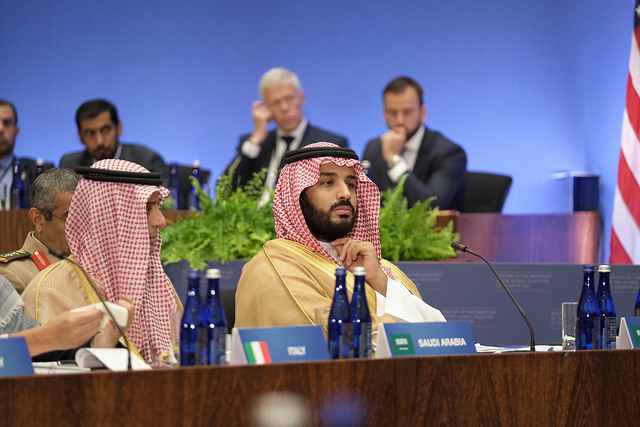
Mohammed bin Salman (State Department via Flickr)
by James Reinl
The United Nations is under growing pressure to scrap an event it is co-hosting with the private foundation of Saudi Arabia’s crown prince Mohammad bin Salman, who has been linked to the killing of journalist Jamal Khashoggi.
On Tuesday, Sunjeev Bery, director of Freedom Forward, became the latest leader of a campaign group to press the U.N. to cancel the Sept. 23 event, saying it would help repair bin Salman’s reputation over the Khashoggi murder.
The event, known as the Misk-OSGEY Youth Forum, is a partnership between the U.N.’s youth envoy, Jayathma Wickramanayake, and the Misk Foundation, a culture and education foundation chaired by bin Salman, who is better known as MBS.
“No one — especially not the U.N. — should be partnering with MBS or his personal Misk Foundation,” Bery told IPS.
“Saudi Arabia’s brutal crown prince is responsible for the deaths of thousands of Yemeni children. His thugs imprisoned leading women’s rights activists and murdered Jamal Khashoggi.”
Kenneth Roth, the director of Human Rights Watch, a campaign group, last week accused the world body of helping to “whitewash” MBS’s record; Mandeep Tiwana, from Civicus, a rights group, called the event “disturbing”.
The U.N. youth envoy’s office declined to comment on the row. U.N. spokesman Stephane Dujarric said the world body had repeatedly issued “very strong statements … calling for accountability” in Khashoggi’s killing.
The Misk-OSGEY Youth Forum will take place in New York only 10 days before the first anniversary of Khashoggi’s murder on Oct. 2 last year, when Saudi government agents killed and dismembered the journalist inside the country’s consulate in Istanbul.
The CIA later determined that MBS had personally ordered the hit. Saudi officials, who initially said Khashoggi had left the consulate alive, now say the journalist was killed in a rogue operation that did not involve MBS.
Saudi Arabia’s mission to the U.N. did not answer requests for comment from IPS.
The four-hour workshop for 300 young people at the New York Public Library will occur on the sidelines of the U.N. General Assembly and promote green themes, corporate responsibility and other aspects of the U.N.’s Sustainable Development Goal (SDG) agenda.
It will feature Alexandra Cousteau, an environmentalist and granddaughter of French explorer Jacques-Yves Cousteau; and Bart Houlahan, an entrepreneur who promotes sustainable business practices.
Other speakers include Andrew Corbett, an expert on entrepreneurship at Babson College, Paul Polman, former CEO of consumer goods firm Unilever, and Ann Rosenberg, an author and U.N. technology expert.
Dr. Reem Bint Mansour Al-Saud, a Saudi princess and an envoy to U.N. headquarters in New York, who advocates for empowering women and development in the Gulf kingdom, will also speak at the workshop.
Khashoggi, a United States-based journalist who frequently criticised the Saudi government, was killed while visiting the Saudi consulate in Istanbul, where he was collecting papers for his wedding.
U.N. expert Agnes Callamard issued a report in June that described the assassination as a “deliberate, premeditated execution,” and called for MBS and other Saudi officials to be probed.
The Misk-OSGEY Youth Forum comes after years of tensions between the U.N. and Riyadh over the war in Yemen, where Saudi Arabia is leading a military coalition against the country’s Houthi rebels.
The conflict has killed tens of thousands of people and caused led to a major humanitarian crisis.
“The crown prince and his violent government must be held accountable for their human rights crimes,” said Bery, who advocates for the U.S. to cut ties with Saudi Arabia and other authoritarian regimes.
“Instead, misguided U.N. staff are absurdly giving the crown prince a public relations platform as he attempts to wipe away the blood of so many dead Yemeni children.”
James Reinl is an independent journalist with bylines at Al Jazeera English, PRI, Foreign Policy, and elsewhere. He covers international criminal justice, U.S. foreign policy, the UN Security Council, and the Middle East. 

Thursday, May 23, 2019

Strait of Hormuz, Sabotage Attack and the Sabre-Rattling

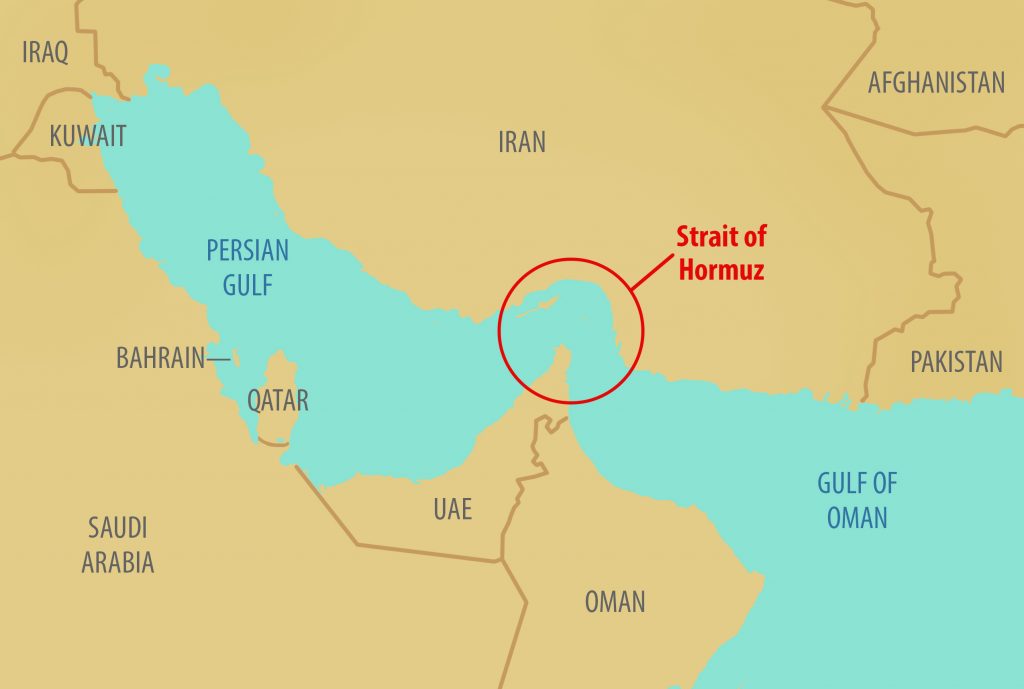
“The people of Iran should stand united in the face of this, and they will deliver a strong punch to the mouth of the American secretary of state and anyone who backs them” (Dehghanpisheh and Andrew 2018)). Almost one year back, Ismail Kowsari, the deputy commander of the Islamic Revolutionary Guards Corps (IRGC), Iran’s elite military force, responded strongly at Mike Pompeo, United States (US) secretary of state for threatening ‘the strongest sanctions in history’ on Iran. Mr. Kowsri’s harsh response was against the statement of the latter that the US would impose new penalties on Iran if the country did not make any changes in its position towards various regional and international issues, including dropping its nuclear program and pulling out of the Syrian civil war. Now the region is in an alarming situation after the sabotage attack on four oil tanks in the Strait of Hormuz on 14th May of this year. There were reports of four commercial vessels sabotaged near Fujairah emirate of the United Arab Emirates (UAE). This location is one of the world’s largest bunkering hubs lying just outside the Strait of Hormuz. Media reported that the attacks were conducted by Yemen’s Houthi rebels, supported by Iran. As West Asia is known for its political instability, regional Wars and international interventions, this attack is a warning of deepening tensions between the US, its GCC allies, and Iran could be coming to a head.
Strategic Importance of the Strait of Hormuz
Strait of Hormuz is a narrow seaway that connects the Indian Ocean with the Persian/ Arabian Gulf. Historically, the waterway has connected Persian and Arab civilisations with Pacific Asia, Indian subcontinent, and the Americas (Weitz 2018). This strategic seaway also links major crude oil producers of the West Asian countries to markets in the Asia Pacific region, West and beyond. The area also has much significance since one-third of the world’s sea-borne oil passes through it every day.
The strait is only 33 to 95 km wide throughout its length. Oman and Iran are the countries nearest to the Strait, and they share territorial rights over the strategic water body (Briney 2019). “The international shipping lane at the entrance to the Gulf is in Oman’s territorial waters, but farther up the tankers enter an area that Iran claims as within its sovereignty. Accordingly, it would be relatively easy to interrupt marine transportation to and from the Gulf” (Guzansky 2010). The widths of the chokepoint, however, is much narrower (about three km wide in each direction). “Because the waters are not deep enough for oil tankers throughout the strait’s width” (Briney 2019). Thus, the sea route makes one of the most challenging busy commercial shipping lane in the world.
In the year 2016, the waterway accounted for 30% of all sea-borne trade of crude oil and natural gas. The bulk of these natural resources comes from countries like UAE, Saudi Arabia, Iran, Iraq and Kuwait and Qatar. The U.S. Navy’s Bahrain-based Fifth Fleet, tasked to protect commercial ships is in this area (Moussa 2018). All the facts have given the Strait of Hormuz a strategically significant water body.
Context of the Sabotage Attack
According to media reports and statements made by officials of the UAE and Saudi governments, there were four oil tankers targeted in and around the Strait of Hormuz. When two of the sabotaged oil tankers belong to Saudi, another one belonged to the UAE. The fourth one belongs to the Thome Group, a Norwegian company. Importantly the first three ships belonging to the arch-rival of Iran and the most reliable allies of the US in West Asia. It is also important to note that tensions between the US and Iran had risen since last year when Donald Trump withdrew from the Iran nuclear deal or the Joint Comprehensive Plan of Action (JCPOA) signed in 2015.
The Iranian government had warned about the closing of the Strait many times since then, especially in the context of potential sanctions that could be levied upon Iranian oil exports. President Donald Trump has given countries until November 4, 2018, to stop importing petroleum from Iran. These attempts were part of a new campaign of pressure and confrontation against Iran, a staunch enemy of the US and its close allies (Chang 2019). Of course, verbal confrontation tension between the two was already heightened after the designation of the IRGC as a terrorist organisation, by the US government, withdrawal from the JCPOA, and the imposition of new sanctions on the Islamic Republic. Adding fuel to this, at the beginning of May 2019, the US sent the USS Abraham Lincoln, the aircraft carrier, and B-52 bombers to the Gulf (Freer 2019).
As an impact of these series of confrontation and pressure from each part, Iran’s oil exports have fallen significantly. Additionally, the US also warned at five of Iran’s biggest remaining customers, especially India and China, to stop purchasing Iranian oil. The move to deploy aircraft carriers strike group is an attempt to cut Iranian oil exports to zero in response to an ‘unspecified’ threat.
Responses of Major Actors
Neither the UAE nor the Saudi government assigned blamed any country publicly. But there were reports that the US officials suspect that Iran and its proxies are behind the attack. “worrisome and dreadful” is the statement made by Iran’s foreign ministry after the incidents and asking for an investigation. Al Jazeera reported that the Qatar government is attempting to defuse the tensions between the regional powers by holding talks in Tehran (Freer 2019).
Conclusion
The Strait of Hormuz is one of the busiest commercial sea routes especially for oil trade in the world. This route is vital in linking oil producing countries in the Arabian/ Persian Gulf region to markets in Europe, Asia, North America and other regions. Iran has been threatening to close the Strait at different occasions whenever the country was in trouble and international pressure. Since the Iran- Iraq War in the 1980s, it has attempted to interrupt the strategically vital waterway. But the sabotage attack in the second week of May 2019 on four oil vessels and two oil pipelines at the strategic shipping lane has further escalated the existing tension in the region. The attack can have dire consequences on the international political economy. It can lead to the decline in the shipping of oil from the Arab/ Persian Gulf region that will be resulted in the price hike. Energy security and the economy of major Asian economies like India, Japan, China, and South Korea will be most affected. Any interruption in this waterway can affect the oil producers in the Gulf region, including Iran. Because, they rely on this passage for commerce; to export oil and natural gas and import food products. Anyhow, the regional cold war and the threat from Iranian authority to close the waterway has created an alarming situation in the region. There is possibility for a close encounters between Iran and its regional enemies like Saudi Arabia and UAE. In this potential War, the former may get the support of Houthis from Yemen and Hezbollah from Lebanon, and the latter will get help from the U.S. Anyhow another war will be a catastrophe to the entire region of West Asia and international economy.
References
Briney, Amanda (2019), “Strait of Hormuz”, ThoughtCo, April 10, [Online: web] Accessed 17 May 2019, URL: https://www.thoughtco.com/strait-of-hormuz-1435398
Chang, Edward (2019), “The Real Iran Military Threat: Close the Strait of Hormuz (Watch Oil Prices Jump): Could this happen?”, The National Interest, May 16.
Dehghanpisheh, Babak, Andrew Heavens (2018), “Commander says Iran’s people will punch U.S. Secretary of State in the mouth”, Huffpost, May 22.
Freer, Courtney (2019), “Gulf Uncertainty Reigns amid Iran-US showdown”, Aljazeera, 16 May.
Guzansky, Yoel  (2010), “The Straits of Hormuz: Strategic Importance in Volatile Times”, The Institute for National Security Studies (INSS) Insight No. 204, September 3, [Online: web] Accessed 18 May 2019, URL: https://www.inss.org.il/publication/the-straits-of-hormuz-strategic-importance-in-volatile-times/
Moussa, Ziad (2018), “Strait of Hormuz: Its strategic importance for sea-borne oil (Lebanon) -, By The East, July 6, [Online: web] Accessed 18 May 2019, URL: https://www.bytheeast.com/2018/07/06/strait-of-hormuz-its-strategic-importance-for-sea-borne-oil/
Weitz, Rockford (2018), “Why is the Strait of Hormuz important?”, The Conversation, July 9,  [Online: web] Accessed 18 May 2019, URL: https://theconversation.com/why-is-the-strait-of-hormuz-important-99496
Dr. Lirar Pulikkalakath is Assistant Professor at the School of International Relations and Politics, Mahatma Gandhi University, Kerala, India.