Showing posts with label Shahnameh. Show all posts

Tuesday, August 20, 2019

Ferdowsi in world literature


Tehran (ISNA) – Persian literature has not been only limited to a particular region, but a great part of the world literature which helps us to understand the ancient history of the world.


One of the most important Iranian literary works is Shahnameh and an outstanding work in Persian culture and language. Shahnameh “The Book of Kings” is a long epic poem written by the Persian poet Ferdowsi between c. 977 and 1010 CE and is the national epic. Consisting of some 50,000 "distiches" or couplets (two-line verses), Shahnameh is the world's longest epic poem written by a single poet.
This literary masterpiece included mythical, legendary and, historical past of the Persian Empire from the creation of the world until the Arab conquest of Iran. Shahnameh as a great work in the area of culture and civilization represent the strengths and uniqueness of this Persian work gave inspiration to other nations and was translated several times into other languages which represent the strengths and uniqueness of this Persian work.
Professor of Comparative Literature in Imam Reza University of Mashhad, Dr. Maryam Kouhestani in an interview with ISNA talked about Abolqasem Ferdowsi Tusi (329 AH – 416 AH, in Tous Khorasan), not of his biographical information, but the linguistic structure and the cultural-historical context of Shahnameh. She said, “We found that he had observed ancients Poems and writings sufficiently so this was a prelude to compose Shahnameh. He was familiar with Arabic poetry, as well as Pahlavi language”.
Here is the full text of Dr. Maryam Kouhestani in the interview with ISNA:
Ferdowsi started writing the Shahnameh about 370 AH and completed it in the year of 384 AH. This edition was the first version of the Shahnameh, and Ferdowsi tried to complete it for nearly 20 years and donated Shahnameh to Sultan Mahmoud in the year 394 AH on Ferdowsi's 65st birthday. This phase was the beginning of the second edition of the Shahnameh and was completed in the year 400 AH on Ferdowsi's 71st birthday.

Shahnameh introduced as one of the 100 major literary masterpieces of the world

In the bibliography of Iraj Afshar, Shahnameh was translated to 225 times and nearly 27 languages by the 1355 year, and in 1886 Shahnameh introduced as one of the 100 major literary masterpieces of the world. In Iran, May 25 is celebrated as Ferdowsi Day. Every year on this special day the ceremonies of Ferdowsi and Shahnameh hold at universities and research institutions.
Shahnameh was first introduced to English readers by Sir William Jones (1746-94), who in his many essays on Oriental poetry compared Ferdowsi to Homer, his claim that it was through reading the Shahnameh, he found the family of the Indo-European languages. He translated some parts of the Shahnameh into English, French, and Latin, and drew up a plan for a play based on the story of Rostam and Sohrab.
The first significant translation of Ferdowsi’s epic was prepared by Joseph Champion in Calcutta in 1785.
In France, Louis M. Langles, the first French Orientalist, was the pioneering translator  who  set  out  to  turn  episodes  of  the  Shahnameh  into  French  in  1778.
James Atkinson (1780-1852) translated the story of Rostam and Sohrab in verse and prose which is the first fully independent English version of Shahnameh, but not in the form of an epic narrative. His work “The Shahnameh of Persian Poet-Firdausi” was influenced by Romanticism and a free translation of Shahnameh.
One year after the publication of Rostam and Sohrab by Atkinson, Stephen Weston (1830-1747) published privately in London a small volume with excerpts from the Shahnameh.
Another 19th-century translation of Shahnameh was by Samuel Robinson (1794-1884). On 24 December 1819, he read a paper on Ferdowsi on the Literary and Philosophical Society of Manchester, which in turn published Robinson’s paper in its Memoirs of the year 1819.
In 1810, Von Wallenburg began to translate some pieces of poems from the Shahnameh but his work remained incomplete because of his death.
Ampére published paper about Shahnameh in two worlds and compered Shahnameh with   Nibelungenlied (German), “the Iliad and the Odyssey” by (Homer), and “the Mahabharata, and Ramayana” by a Hindi author.
The first truly completed translation of the Shahnameh was prepared by the brothers Arthur George and Edmond Warner. They translated it in the form of blank verse, an epic style of poem in English to be closed to the original one. The brothers worked on the original copy which was in Persian but in some cases were not able to translate the aesthetic feature and metaphorical expressions as the original one, however, they worked hard, the result was not a successful one.
In 1907, Alexander Rogers translated “The Shahnameh of Fardusi”, a very free translation. This rendition of the critical events of the epic was published in 551 pages.
Jules Moul was German and received his doctorate in philosophy from the University of Tübingen. He taught Persian at the Eastern Languages School, and was a student of Sylvester Düssy, and in 1826 the French government gave him the translation of the Shahnameh.
The translation of "Jules Moul" is still the most eminent translation and a complete version of Shahnameh. He translated from the original copy in Persian language. Moul spent 28 years to translation Shahnameh into French. This translation of Shahnameh was published in French in seven major volumes from 1838 to 1878 in Paris. This work affected European literature in the 19th century and many poets and writers, including Victor Hugo, François Edouard Joachim Coppée, Jules Lemaître, Maurice Barrès, and Max Müller were influenced by it.
Helen Zimmern (1846-1934) translated Shahnameh in English from the French version – Moul’s translation of Shahnameh. She translated some of the major stories of Shahnameh in prose and in the form of short story rather than an epic narrative.
In 1859, Victor Hugo wrote “the legend of the Ages” under the influence of the themes of the Shahnameh.
Barbier de Meynard completed the translation of the Shahnameh after Jules Moul  death.
Adolf Avrial wrote a book on comparing women of Shahnameh and European women.
Abel Bunar (Contemporary French poet) wrote a book "Iranian Shahriar" in 1908.
Joseph Ernest Renan (French expert) in his book introduced Shahnameh as the great documentary genius and creative power of the Aryan race.
François Edouard Joachim Coppée (French poet and novelist) praised Ferdowsi.
Sir John Malcolm commends Rostam and Sohrab in his book “The History of Iran”.
The British philosopher, Bertrand Russell believed that the Shahnameh of Ferdowsi is in the same level of the Greek Homer.
Hasan Abedi, the professor of Persian language in India and known as the father of Persian father, eulogized Shahnameh.
Rasul Rahim in his paper noted that 12 books and 50 research papers on Shahnameh and Ferdowsi published in Afghanistan.
Shahnameh is also known in Pakistan, Poland, Tajikistan, Uzbekistan, Azerbaijan, Turkmenistan, Georgia, Kazakhstan and Kyrgyzstan.
Dick Davis, a British poet who is a professor of Persian literature at Ohio State University. Davis earned a Master's Degree from the University of Cambridge where he was introduced to Persian literature. In 1970, he moved to Iran and became sick during his trip, an Iranian girl nursing him through the illness. They were married after his recovery. He lived in Iran for eight years and taught Persian literature at Tehran University. Davis has PhD. in Medieval Persian Literature and has written many books, most of which are related to Persian literature. Dick Davis has translated over twenty literary works and several literary works from Italian and Farsi and has a poetry book. Dick Davis in 1992 published a lucid and eloquent version of the story of Syavash in blank verse, which is the best poetic translation of an episode from the Shahnameh.
His translation of almost the entire “Shahnameh” is a distinguished literary work which won the “National Endowment for the Humanities” award. Washington Post has also named it the “Book of the Year” in the year 2006.
The first edition in three separate volumes is illustrated with reproductions of Persian miniature paintings from different manuscripts; each volume has its own introduction. The first volume covers the epic’s beginning, comprising about a fourth of the complete Shahname. The second volume concentrates on the theme of father-son relationships. The third volume is devoted to the history of Iran from Alexander the Great until the end of the Sasanian dynasty. The second edition (2006) provides the complete text of his translation.
His translations of Farsi about Ferdowsi include the following:
The Legend of Seyavash
The lion and the throne
Fathers and Sons
Sunset of Empire
The Shahnameh: the Persian Book of Kings
One of the most fascinating stories in Ferdowsi’s Shahnameh is the tragic tale of Rostam and Sohrab; where in the son (Sohrab) is anonymously killed by his father (Rostam). Among the many translations throughout history, there is an exceedingly celebrated versed English version which was composed by the British poet Matthew Arnold and published in 1853. In a letter to his friend John Duke Coleridge, Arnold dedicated “Rustum and Sohrab”, his best poem, stating that: “I have grown fond of this poem, not for the beauty of my own rendition, but for the grandeur of its plot and the beauty of the emotions expressed in it.” Arnold’s primary source and motivation in composing “Sohrab and Rustum” was an article written by the celebrated French critic Sainte-Beuveon Julius on Mohl’s translation of Shahnameh.
While reading a note concerning Iran’s history composed by Sir John Malcolm, Arnold came across the tale [of Sohrab and Rostam], and was determined to versify it, but was ultimately discouraged of the task as a complete version of the tale was not available to him. Arnold also voiced his regret for not having seen a complete translation of Ferdowsi’s epic. Arnold related almost everything Sainte-Beuve had cited from Shahnameh, which made his work at times extremely close to the Persian original.
Matthew Arnold’s verse epic Sohrab and Rustum is not a verse by verse translation of Ferdowsi’s Shahnameh, but rather a liberal rendition inspired by that tale.  Arnold’s persistence in imitating Homer, most notably his use of epic simile, has given the poem its grand style. Therefore, upon reading Arnold’s “Sohrab and Rustum”, a Persian reader unacquainted with this literary style will be confused, and might even come to the wrong assumption that portions of another text have mistakenly found their way into this poem. This is because these similes are peculiar to Greek epics, especially The Iliad, whose beauty would appeal to western readers who are familiar with the style.

Sunday, August 18, 2019

The Longest Poem Ever Written: Shahnameh – The Epic Book of Kings

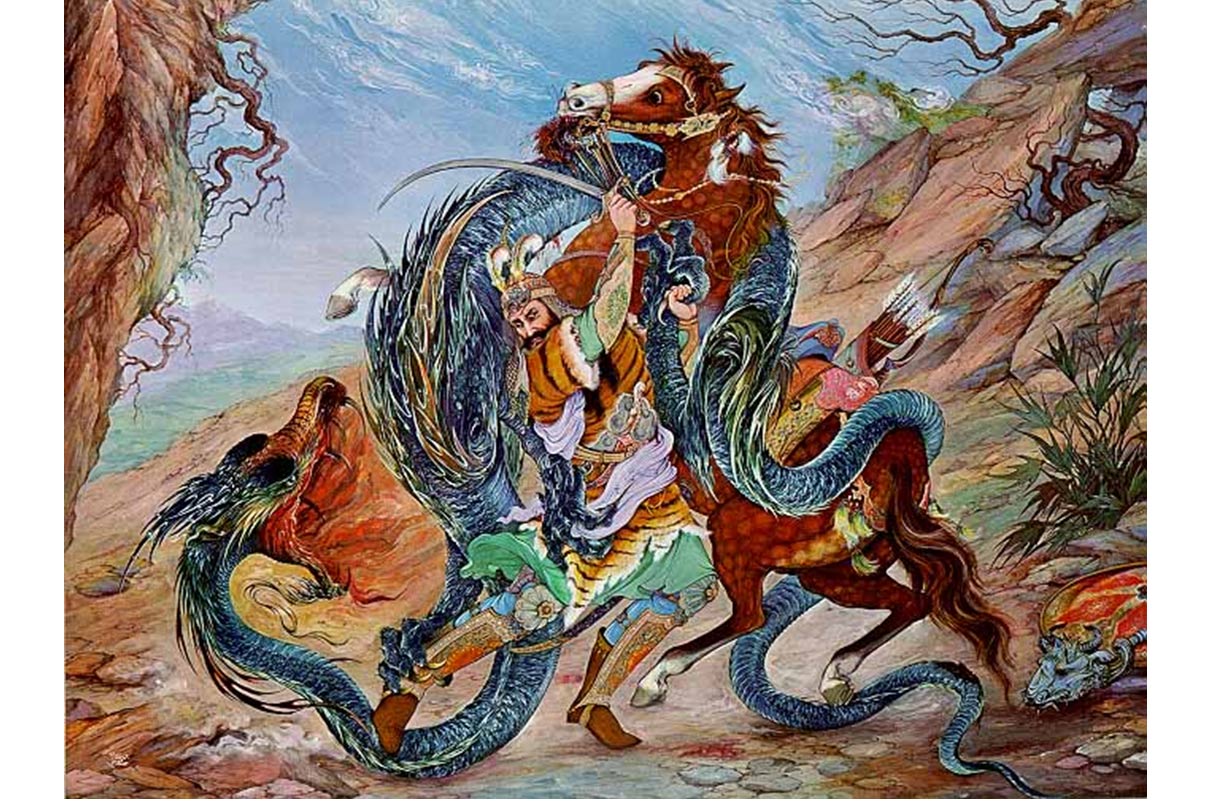
Rostam the hero fighting the Dragon in the Seven Quests of Rostam. Iranian miniature illustration from Shahnameh
In 977 AD, a Persian poet named Ferdowsi began on a grandiose poetic journey that would take him 33 years to complete. He used ancient Persian tales which had been told from generation to generation for several millennia as the source for writing his poems about epic kings and heroes and about mythical creatures and adventures. This resulted in the creation of the epic which in Persian is called Shahnameh or translated The Book of Kings, the longest poem ever written in history. Ferdowsi's great aim was to revive the ancient Persian culture, mythology and language after the invasion of the Islamic Caliphate of the Arabs.

The Life of Ferdowsi


Ferdowsi was born in 935 AD in the city of Tus located in the modern day province called Khorasan in northeastern Iran. At this time, the Samanid dynasty had restored native Persian rule on Iranian territories as the second post-Islamic Persian empire after the eastern parts of the Islamic Caliphate had been liberated from the Arabs in 861 AD. Ferdowsi came from a line of wealthy noble families which generation after generation inherited the title dehqan. The dehqans were among the social top class and were the leaders of communities and owners of land. By the time Persians were violently forced to become Muslims after the invasions, the dehqans converted to Islam not for following Islam itself, but mainly for using their social authority for preserving the ancient Zoroastrian culture of Persia. For centuries, the dehqans were the preservers of the traditional customs, culture and literature of ancient Persia and hence acted as fundamental factors for the survival of Iranian identity. Dehqans were often able to afford the best education which resulted in Ferdowsi gaining considerable knowledge in literature. He was closely tied to the ancient Persian culture and studied ancient scripts which inspired his poetry.
In the year 977 AD, a shift in power had been initiated in Persia with the end of the Samanid dynasty and the beginning of the Ghaznavid dynasty. Ferdowsi became a poet of the Ghaznavid royal court and due to the exquisite and superb quality of the poems that he wrote, the king entitled him Ferdowsi. This name derives from the Persian word pardisi or fardisi which means from paradise . With the new title given to him by the king, he began writing Shahnameh which would become the greatest poetic journey of his life and one of the greatest works of poetry in the world.
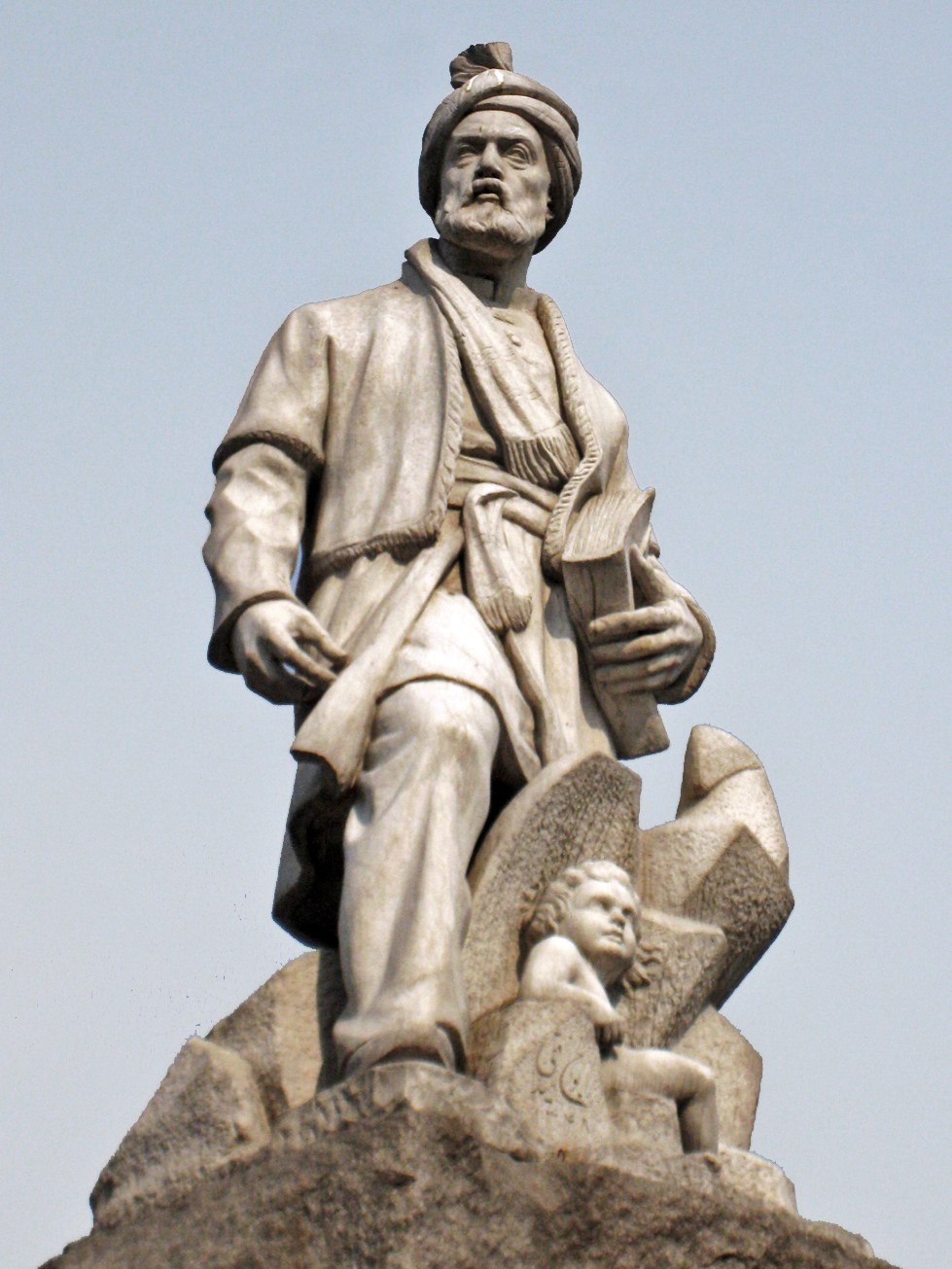
Statue of Ferdowsi in Tehran, Iran
Statue of Ferdowsi in Tehran, Iran ( http://toos051.persiangig.com/new_folder/Ferdowsi_Statue.jpg)

Shahnameh – The Epic


Prior to writing Shahnameh, Ferdowsi collected literary material from ancient sources such as from the middle Persian Pahlavi work named Khodaynameh, which translates to Book of God in English. The documentation of this ancient work was ordered by the Sassanid king Anushiravan and was based on historical facts documented by Zoroastrian priests as well as legendary accounts of mythical eras written in Avesta, the holy book of the Zoroastrian religion . Some ancient sources has stated that the Persian literary tradition of recording royal events and mythical stories has existed at least from the time of the Achaemenid era in the 6th century B.C, although the stories are thousands of years older and have been transferred verbally for generations. Many of the stories are very similar to ancient Indo-Iranian/Aryan stories, indicating the close connection of Persians to their Aryan heritage.

Ferdowsi divided the timeline of Shahnameh into three major periods; the mythical era , the heroic era and the historical era . A very brief description of each era follows:        
The mythical era comprises of poems about the creation of the world and of the first man named Keyumars who became the first king. Keyumars's grandson Hushang discovered fire and established the yearly fire festival Sadeh. Jamshid the shepherd, who became a great king in the favor of God named Ahura Mazda, ruled the lands with prosperity and struck down the evil demons named deev. Jamshid also established the Persian New Year Nowruz meaning New Day which is celebrated on 20 March every year. The child of the devil Ahriman, the evil serpent man Zahhak, killed Jamshid and became the new king. Ahriman kissed Zahhak's shoulders and out of his shoulders, two snakes grew out. Zahhak tried to cut off the snakes but they always grew out again, he was cursed. The snakes required to be fed with fresh brains of young boys every day. Zahhak therefore fulfilled their requests in fear of being killed by the snakes. This led to the uprising of the blacksmith Kaveh who refused to sacrifice his last son. Kaveh started the uprising and made a banner out of his leather apron by putting it on top of a spearhead. With the help of the people and a prince named Fereydun who eventually became king, they captured Zahhak and chained him to mount Damavand in northern Iran, the highest volcano in all of Asia and the highest peak in the Middle East. There are stories about king Fereydun and his three sons Salm, Tur and the youngest Iraj. They inherited the three corners of the world after their father died and Iraj inherited the empire of Persia. This resulted in jealousy of the two older brothers towards their younger brother Iraj and stories about epic wars between the brothers are told. Iraj was killed by Tur and Iraj’s grandson Manuchehr became the king of Persia to avenge his grandfather's death

Zahhak bound on mount Damavand. Baysungur's Shahnama, 1430.
Zahhak bound on mount Damavand. Baysungur's Shahnama, 1430. ( Wikimedia Commons )
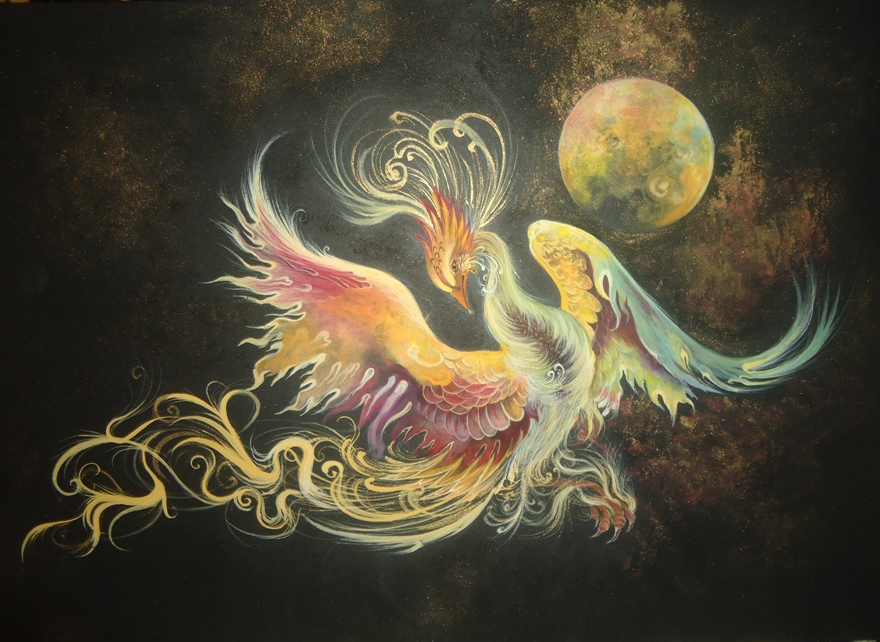
The heroic era comprises of poems about legendary love stories, epic heroes and battles. A man named Sam, who was the fellow companion of king Manuchehr, became the father of a child who he named Zal. Zal was born albino with white hair and pale skin. Manuchehr thought the child was demonic and Zal was therefore rejected as an infant and put on top of mount Damavand to die. Luckily, the loving and wise mythical bird Simorgh who nested in the mountain, found Zal and nourished him. Simorgh had experienced three ancient world destructions from which she harbored the knowledge of all ages. When Zal had grown up, he left the custody of Simorgh. Simorgh gave him three golden feathers from her wing which Zal could burn in a sacred fire whenever he needed help from Simorgh. Zal met his love, princess Rudabeh and she fell in love with Zal's unique features, charisma and wisdom. They eventually married and Rudabeh gave birth to a boy who they named Rostam. Rostam grew up to become the greatest hero of Persia. He went on seven adventures called the Seven Quests of Rostam, where he together with his loyal and strong horse Rakhsh fought battles with the White demon, The beautiful Sorceress, the Dragon, the Lion and various kings. Rostam found his love, princess Tahmineh and they became parents to a boy named Sohrab. Rostam gave Sohrab a bracelet as a gift when he was an infant before leaving him and Tahmineh. Sohrab grew up without ever seeing Rostam until several years later when the armies of Rostam and Sohrab met in a battle. Father and son did not know each other until Rostam fatally wounded Sohrab in a duel. It was then, while Sohrab was dying in his arms, that Rostam noticed the bracelet around Sohrab's neck. Rostam then tragically realized that he had killed his own son. The legendary love story is also told about Bijan, the son of a famous knight from Persia and Manijeh, the princess of an empire called Turan in modern day Central Asia, which mythologically was the greatest enemy of Persia. This love story ultimately resulted in an epic war between the two empires.
Iranian miniature painting of the mythical bird Simorgh
Iranian miniature painting of the mythical bird Simorgh ( http://nadiaartgallery.com/wp-content/uploads/2013/07/simorgh.jpg)
The historical era comprises of historical accounts starting from the dynasty of the Parthian kings after Iranian territories had been freed from Greek and Macedonian rulers. A lot of the focus is put on the succeeding dynasty of the Sassanid emperors and the stories regarding this dynasty are exquisitely told. Shahnameh ends with the Islamic Arab conquest of Persia in 651 AD. Ferdowsi poetically described this event as a major disaster over what he calls the arrival of “the army of darkness”.

The Legacy of Ferdowsi


After 33 years at the age of 71, Ferdowsi finished the writing of Shahnameh on 8 March 1010 AD and in 1020 AD, Ferdowsi died at the age of 82. He was buried in his birth place Tus. Shahnameh contains 62 stories, 990 chapters and 60 000 rhyming couplets which makes it the longest poem in the history of literature, a work seven times longer than the Illiad of Homer. Ferdowsi wrote his work entirely in classical Persian which is still spoken today by Iranians and people related to the Iranian culture in countries once part of Greater Iran. It was a linguistic renaissance considering that the Persian language was officially banned in Persia by the Arab rulers for almost 200 years. Today, Shahnameh is a common book in Iranian households and it is the national epic of the Persian speaking world. The epic stories of this masterpiece influenced the literature of Asia for centuries and the stories are enthusiastically told to this day. The philosophical message of Shahnameh is that since the world is transient and everyone is merely a passerby, one is wise enough to avoid cruelty, lying and other evil deeds. Instead one should strive for justice, truth and order which brings happiness, ease and honor. Ferdowsi put lifelong dedication and sacrificed a lot to complete his work. Ferdowsi's writing style is that of a superb poet's. His epic language is rich, moving and lavish so that it truly enchants the reader. He is remembered as the greatest of the Persian poets who with the power of the pen rescued and revived the Persian language, culture and heritage.
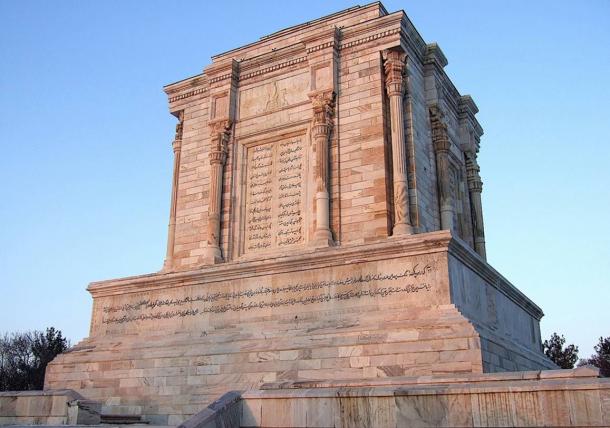
Ferdowsi's tomb in Tus, Iran
Ferdowsi's tomb in Tus, Iran ( Wikimedia Commons )
Below are the words of Sohrab spoken to Rostam as he did not know he was dying in the arms of his father. From Shahnameh - The Persian Book of Kings, translated by Dick Davis:
I brought this on myself, this is from me,
And Fate has merely handed you the key
To my brief life, not you but heaven's vault –
Which raised me and then killed me – is at fault.
Love for my father led me here to die.
My mother gave me signs to know him by,
And you could be a fish within the sea,
Or pitch black, lost in night's obscurity,
Or be a star in heaven's endless space,
Or vanish from the earth and leave no trace,
But still my father, when he knows I'm dead,
Will bring down condign vengeance on your head.
One from this noble land will take this sign
To Rostam's hands, and tell him it was mine,
And say I sought him always, far and wide,
And that at last, in seeking him, I died.

Saturday, August 03, 2019

Why Many Iranians Visit Tombs of Poets?

Rahman Mehraby

If you travel to Iran, you will certainly be amazed by the number of people who visit the tombs of Iranian poets. You see how they respect and show love for the ones buried in these places. You find out the passion and affection in their manners and treatment of the tombs. Based on what I’ve heard from the international travelers for years, this is some rare scene in the other parts of the world.

Iranian Poets in Schooling System

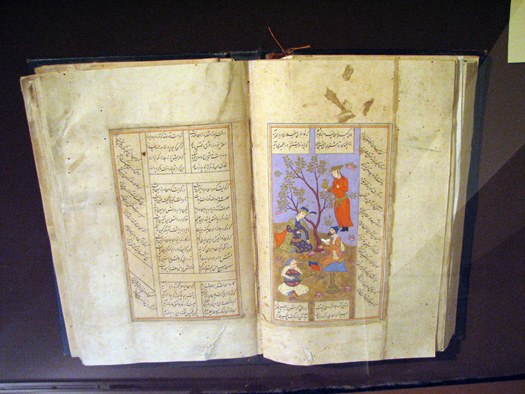
Persian Poems Book, Persian Poetry
A book of Persian poems with miniature paintings
As children, Iranian students begin to learn poems and even memorize them in the early years of primary schools. They get familiar with the rhythm and rhyme as well as the different styles of poetry. They learn about the famous Iranian poets. Persian literature is full of distinguished styles. Many of the textbooks they study are written in Middle Persian, the language used in Iran some 1400 years ago. Although the language has gone through lots of changes, it’s still understandable.
During high school, students study more complicated Persian literature and particularly poetry. This continues in the universities regardless of what you study.

Poems in Everyday Life

A lot of Persian expressions are in form of poems. Persian poems are very rich in subjects like love, modesty, wisdom, appreciation of creation, nature, and so on. Therefore, there are several occasions occurring every day in which one remembers some Persian sayings. For centuries, those who knew such expressions and used them in certain situations were considered the educated ones. In some other cases, one may even recite some lines of a poem.
There’s no Iranian home without Persian poetry books. People continue reading poems outside the schooling system too. Before the time of equinox and the coming of the New Year (Nowruz), during Yalda night (the ceremonies for the longest night of the year – Dec 20th), and many other occasions, Iranians read poems.
Iranian traditional music is so full of classical Iranian poems. Some Iranian poets are well known for their musical poems. Some of them have got a powerful soothing effect. Some make you very happy and some are deeply sad and full of emotions. In various states of heart, Iranians can listen to various types of music.
Tombs of Famous Iranian Poets
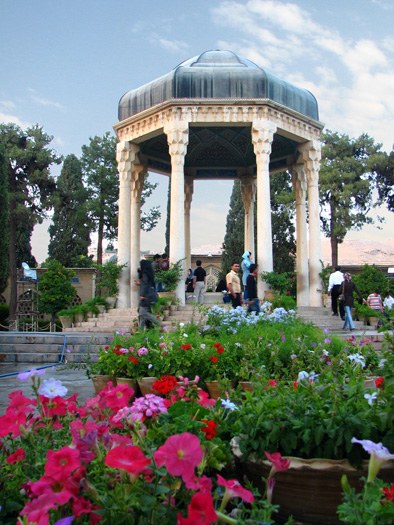
Tomb of Hafez decorated with flowers
The eloquent Persian language is used in journalism too. Sometimes the headlines, as well as the news articles you read, are embellished with poems, expressions, and references to particular poems. Some of these poems have got a work in them which are, by themselves, a reference to another story or group of people with a particular mindset and belief, etc. Therefore, understanding Iranian poems, music, stories, news articles, etc could be quite complicated, but not very much for a nation who is brought up with it.

Iranian World Class Poets

I can say Iran has offered some of the most famous poets to the world literature. They represent a nation with a profound culture and thoughtful ideas.
Ferdowsy is the Iranian poet of 1000 years ago. He composed the most famous Iranian poetry book called Shahnameh. This was an unparalleled effort to save the Persian language at the time when Arab invaders had forced Iranians not to speak, write or compose anything in Persian. His epic works set nationalistic feelings ablaze in Iranians hearts.
Omar Khayyam was a well-known mathematician and poets who lived some 900 years ago. His short poems are full of maxims about life and joy.
Saadi was a man of traveling living some 800 years ago. He had studied in Nezamieh University, Baghdad. He returned to his homeland toward the end of his life and soon gained large popularity due to his lovable poems highly appreciated by the people contemporary to his time. His famous poem has decorated the UN building as below:
Human beings are members of a whole,
In creation of one essence and soul.
If one member is afflicted with pain,
Other members uneasy will remain.
If you have no sympathy for human pain,
The name of human you cannot retain.
Rumi was the unique Iranian poet of 700 years ago. His rhythmic poems describe Iranian traditional systems of music. His words of wisdom, spiritual and love poems are still quoted by Persian speaking people. His book became the bestselling book of the late 20th century in the US and his poems’ recordings made their way to the Billboard’s top 20 list.
Hafez was the master of Persian ghazals and still is after 700 years. The figurative language he’s used was an escape way under the rule of Mongols in Iran. His description of love and beautiful language of spiritual values are uniquely adorable.
In addition to such famous poets, there are a large number of other poets who are quite well-liked by Iranians although non-Iranians may have not heard of them.

Visiting Ritual of Iranian Poets

Rituals at the Tombs of Iranian Poets
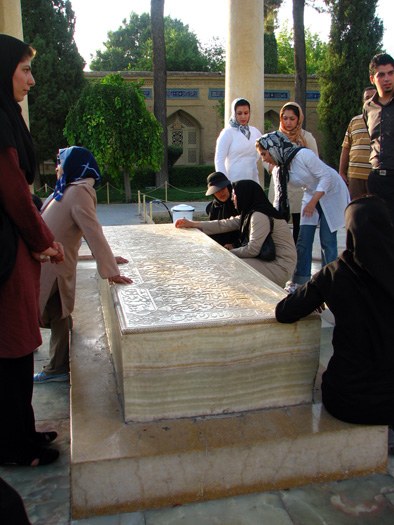
People showing their affection at a poet’s tomb
When Iranian go to the tombs of poets, they treat them like a lost beloved family member. They put flowers on their tombstones. Sometimes, they wash the tomb with rosewater. They sit down and pray for the dead poet. They talk to them and ask them to talk back with them. They bring the poet’s book with them to read or recite some of their poems to stay connected with them.
Such tombs are inside beautiful gardens, not among other graves in a cemetery. The decoration of the settings around it and the monument built for them are parts of the whole honor dedicated to them.
The reputation of Iranian Poets among Foreigners
Every year, there are several commemorative ceremonies and conferences for the above poets and others in Iran. Many people specialized in studying these poets’ works come together to discuss various dimensions of their characters and works. There are universal days allocated to such poets and non-Iranians understand the importance of such men of wisdom in the development of human knowledge.
Therefore, when you visit Iran, make sure you have a deeper look at the settings in which Iranians go to such tombs and grasp the feelings and appreciation to such gems at Persian literature.

Thursday, May 16, 2019

Ferdowsi, reviver of Farsi language

25th of Ordibehesht in the Iranian calendar (May 15) is the day of commemoration of the great Iranian poet Ferdowsi. On this occasion we have prepared a special feature.
Iranians are very much indebted to Ferdowsi as he preserved Farsi language from annihilation and gave it an independent identity. Abulqasem Ferdowsi, who lived more than a millennium ago, made strenuous effort to keep this sweet language in the face of other languages and did his best to use as many Farsi words as possible in his magnum opus, Shahnameh (the Book of King).  
But, despite the influence of Arabic language in Iran and the compilation of many books in this language by Iranians, why didn't Arabic become the official language in Iran? History bears witness that Iranians have preserved and spread the Farsi language with the effort of their thinkers. The move began with Ya'qub Laith, the founder of Saffarid dynasty. Rudaki, Daqiqi and Onsori laid the foundation for expansion of Farsi and culminated with Ferdowsi and his everlasting masterpiece, Shahnameh.
The vast Iranian territory over the course of history has experienced a lot of ups and downs. To highlight the genuine Iranian culture, Ferdowsi revived the ethnic heroes and ancient Iranian civilization, and managed to revive the sense of defending the country in many people.
Ferdowsi should be considered as one of the Iranian national heroes, a great poet who breathed a new life in the body of Farsi language, and according to Dr. Abolfazl Khatibi, "through the past experience and Ferdowsi's great endeavour, Farsi language was stabilized, and by writing Shahnameh, he succeeded to preserve Farsi language against the influence of foreign words and keep the syntax and norms of Farsi language from the harm of anomalies. Hence, Farsi language owes its development to Ferdowsi's Shahnameh and that is why the name of Ferdowsi is interlinked to the durability of the Farsi language." The author of the most valid version of Ferdowsi's Shahnameh, Dr. Khaleqi Motlaq believes that: "Part of our nationality is indebted to the Farsi language, and Farsi language is largely owing to the Shahnameh of Ferdowsi."
Ferdowsi's magnum opus Shahnameh is one of the most important and richest treasures of Farsi language in terms of containing literary terms and expressions and it is undoubtedly the largest container of Farsi vocabulary. It is the first book that keeps real and beautiful Farsi vocabulary. By accepting the huge bulk of these words in his breast, Ferdowsi was successful to provide this precious gem to the future generations. Farsi language is the basis of unity and consistency of various ethnicities of Iran. Ferdowsi's Shahnameh has bolstered the pillars of Farsi language so sturdily that there is no place for forgetting this language in history. Therefore, it is considered that Shahnameh is one of the foundations of the Iranian ethnic unity.
Years should pass to clarify the real significance of Ferdowsi's work and his magnificent work should find the status it deserves in the history of Iran. Ferdowsi's epic masterpiece is a work that has preserved the past culture and identity of Iranians to the present.
Shahnameh is the book of Iranian myths. If Ferdowsi had not written Shahnameh, today we wouldn't have had access to many of these myths. Moreover, the book of ancient Farsi stories. It is the book of ancient customs and traditions of our ancestors. Ferdowsi worked ceaselessly for thirty years to finish the Shahnameh. Shahnameh is an illustrated calendar of the Iranian epic, history and culture. British Professor Charles Melville maintains that, "The great achievement of Ferdowsi was to preserve the history of Iranians including the history of the era of the empire and the peak of its glory. But the main point is that he wrote it in Farsi, the language of Iranians. This task of Ferdowsi is part of the great concept of being Iranian, being aware of his identity. This is a point which in my opinion has been manifested by Ferdowsi more than others."
Researchers are of the opinion that one of the reasons for the significance of Ferdowsi's Shahnameh is the role that the great poet has played with his great book in the culture and destiny of a nation. Dr. Khaleqi Motlaq believes that there is no book in Farsi literature and even in the world literature that, like the Shahnameh of Ferdowsi, to play such an effective role and influential status in the destiny and culture of a nation.
Researcher, Mohammad Ali Islami Nodushen, believes that Ferdowsi's Shahnameh is the only book in the world literature that has changed the destiny of a nation. He said, "Shahnameh changed the fate of Iran, and had it not been created, we would have been a different country! If Shahnameh had not been written, what happened in some countries like Egypt, Syria and Jordan, would have been repeated for Iran. Survival of the history and culture of Iran and Farsi language is deeply indebted to Ferdowsi and his magnum opus Shahnameh."
Ferdowsi cannot be called only a poet and writer of myths because, behind these lofty poems and with the rich and sweet Farsi language, he was effective in rebuilding a nation. Thus, in the imagination of Ferdowsi, it was not just Iranian myths that would find life in his poems, but it was the Iranians who got shape and grew up. Therefore, Shahnameh is part of the Iranian identity, and every Iranian needs a Shahnameh to identify himself and his old culture.
Iran in its history has been the land of the poems and hymns and has created the greatest literary masterpieces of the world. The poems of the great Iranian poets like Hafez, Sa'adi, Nezami, Sanai, Attar and Mowlana, and others are full of lessons not for Iranians but for the whole mankind. But Ferdowsi's great masterpiece Shahnameh is considered as the mirror of the ancient Iranian culture and identity.
Some scholars have tried to introduce Ferdowsi in a way as if he had been an extremely nationalist figure with no religious bond; while he was a Muslim with deep belief in the Prophet of Islam and his progeny. Leader of the Islamic Revolution, Ayatollah Khamenei, once said, "I consider Ferdowsi as a sagacious man." 
Shahnameh is important not only for the Iranians, but also for the world, because it addresses the essence of humanity. Shahnameh has mentioned the main human point and it is the conflict between truth and falsehood, good and evil, light and darkness, loyalty and treason. The core of Ferdowsi's Shahnameh is wisdom and victory of good over evil.
Shahnameh is a treasure of wisdom. It teaches the lesson of humanity, morality and virtue. Freedom and non-submission to oppression are the basic virtues of all the heroes of Shahnameh.

Artists, experts receive Ferdowsi Medals


Persian language scholar Seyyed Fat’hollah Mojtabai (2nd L) accepts a Ferdowsi Medal at the University of Ferdowsi in Mashhad on May 14, 2019.  (Photoshahr/Hossein Shariat)
TEHRAN – Russian graphic designer Sergey Feofanov, Iranian experts Seyyed Fat’hollah Mojtabai and Sajjad Aidanlu, and a performer of naqqali, Mostafa Saeidi, were honored with Ferdowsi Medals during a ceremony in Mashhad on Tuesday.
The University of Ferdowsi was the main organizer of the ceremony attended by Cinema Organization of Iran director Hossein Entezami and a number of art and cultural figures.
Feofanov is a senior stage and graphic designer. He has also created paintings and sculptures inspired by the Shahnameh, the epic masterpiece of the Persian poet Ferdowsi.
Mojtabai has so far written and published over 200 books and articles in Persian and English in Iran and out of Iran.
Aidanlu has also published books and articles on the Shahnameh.
Saeidi is a naqqal or a performer of naqqali, a style of storytelling dedicated to Shahnameh epic stories. He performs at teahouses across Lorestan Province.
In his brief speech, Entezami said that disregard of the Shahnameh might imperil the identity of the Persian language.
“If there was no Ferdowsi, Iranians would not have any myths, and returning to this epic spirit manifested in the Shahnameh is necessary indeed,” he remarked.
“We need to pay due attention to the Shahnameh while producing our cultural products, to help them remain eternal,” he added.
The honoring ceremony was part of an international conference, which opened in Mashhad on Monday to discuss connections between the Shahnameh and the Silk Road. The conference came to end on Wednesday with a celebration of Ferdowsi Day at the tomb of Ferdowsi in the northeastern Iranian town of Tus.

Tuesday, May 14, 2019

Conference on Shahnameh, Silk Road opens in Mashhad

A poster for the international conference on
the Shahnameh and the Silk Road.
TEHRAN – An international conference linking together the Shahnameh, the epic masterpiece of the Persian poet Ferdowsi, and the Silk Road opened in the northeastern Iranian city of Mashhad on Monday.
A number of Iranian and foreign experts on the Shahnameh are attending the conference. 
“The lands the Shahnameh talks about are where the route of the Silk Road connects East and West,” director of the conference Mohammad-Jafar Yahaqi has said during a press conference.
He noted that scholars have demonstrated little regard for international issues in the Shahnameh, and expressed his hope that the conference would bring the thoughts of Ferdowsi and the Shahnameh to the attention of the scholars across the world.
A number of articles submitted to the secretariat of the conference will be published in a book after the conference concludes.
The three-day conference will end with a celebration of Ferdowsi Day on Wednesday at the tomb of Ferdowsi in the northeastern Iranian town of Tus. 

Thursday, April 04, 2019

Shahnameh; historical document of Iranian history, culture


123502.jpg
Tehran (ISNA) – Shahnameh has been a historical document of Iranian history and culture in the few past centuries and it bounds to culture and people beliefs.
Student of the epic literature of Ferdowsi University of Mashhad, Mohammad Bayani said in an interview with ISNA, “Shahnameh has another aspect of epic and heroic, Shahnameh has been a historical document of Iranian history and culture in the few past centuries, and the view of epic genre and a certain weight of poetry cannot be clearly seen in the historic epic treasures. It is clear that when a book like Shahnameh finds such a situation, how much it can be bound to culture and people beliefs”.
Here is the full text of Mohammad Bayani’s interview with ISNA:
The main point of familiarity with Shahnameh and mainly Persian language among Western scholars started in India. When the country was occupied by the British government, the British and West met with the precious treasure of the Persian literature, especially the Shahnameh, and they began their research.

Shahnameh is the world's greatest epic relic in terms of volume

Shahnameh is not the only Iranian epic book. But we have the first place in the world in the epic text volume, and our epic treasure is more than any countries in the world. The Shahnameh is the greatest epic book of the world in terms of volume. Another great epic book is "Borzu-Nameh" which some of its copies have more than 38,000 distiches. If we put all these epic texts together, we might say that we have as much epic text in the world.
The main idea of Shahnameh is based on Zoroastrian thought, and it has multi aspects; the first aspect is a good speech, good deeds and good mentality, these are the Zarathustra slogan, which can be clearly found in any story of Shahnameh. Another aspect is the battle between good and evil.
One of the characteristics of Zoroastrian thought is duality: one part of the soul is the place of evil and another part is for goodness.
Demon as the creator of evil beings and Ahura Mazda as the creator of goodness referred to as dualism. These two sides are always fighting with each other, but ultimately, the victory belongs to the Ahura Mazdas positive forces. We can see the effect of this thought in the realm of Shahnameh and under the title of Iran and Turan.
The point of difference in Shahnameh and other great epics of Iran is the struggle between good and evil by reliance on wisdom.
“Afrasiab” is a symbol of the devil and the king of Iran, "Rustam" and his troops are the symbol of goodness. This is clearly seen in the epic book and the consequence of this collision is one of the most significant aspects of the Shahnameh.
Moral themes emphasized in Shahnameh, such as the battle of evil and good or the emphasis on rationality cannot be found in other epics of the world and the main characteristic of the Shahnameh cannot clearly found in other epic texts.
Ferdowsi made moral deductions from any stories in of Shahnameh and convinces people.  After every long story or every important event, he conveys a moral point and this is a continuation of the ancient Iranian culture, especially in the Sassanid era, which is the culmination of this kind of literature, that’s named Didactic literature.
During the Sassanid period, Ferdowsi has narrated that in the Sassanid kings court, especially Anooshirvan, all the walls and clothes, ring, belts, utensils, and so on have been written with pleasurable and moral words, and what we can see today on some clothes and t-shirts are the poems which is reminded of the Sasanian tradition.
One of the traditions in Shahnameh is that Ferdowsi constantly gives advice to the audience and always says, be cautious to stay in the right side.
This is the product of the great personality of Ferdowsi who is truly wise, the wise person is the one who is intellectual and speak just by morality, and his actions are based on thinking, and what he has done or said is based on moral acceptance.
Invitation to wisdom and savant can also be understood from the effects of the Ferdowsi era, since Nasser Khosrow, who stayed almost near Ferdowsi, emphasizes goodness and wisdom has been rooted in the personality of Ferdowsi.
But what we can clearly found in epics treasure of other countries are more likely rely on fighting, rebelliousness, championship, defeat and assault. It happened occasionally among the stories, that the creator of the book praises the gladiators who have done a good job.
For example, the British national epic "the Beowulf" narrates a story that Beowulf has gone to the battle with Granger's mother, and Unferth, the Danish hero, gives his sword to Beowulf to take advantage of Granger's mother. But the given sword was not affected in the battle and finally he destroyed the opponent without the given sword.
Beowulf returns his sword after the fight. He thanks him and says that your sword has been very useful. Then the creator refers to being "Beowulf" with morality and introduces him as a symbol of moral approach. Thus, such a thing is rarely found in other epics, and it’s not as vivid as what we can clearly found in Shahnameh.
The West has been discussing more of its epic than us and this approach is an attractive and appealing aspect.
One of the contemporary scholars of Shahnameh is Dick Davis. He says in the introduction of Epic and Sedition, “I taught English literature in Iran in the 1970s, when I returned to England, some students presented me with a nine-part book of Shahnameh”.
After reading the book, he was fascinated, and his study path was completely based on Shahnameh. He has done his doctoral thesis on the Persian literature - which is the same book - focused on Shahnameh. He also translated the entire Shahnameh into English poetry. Most English translations have returned the summary of Shahnameh's stories in English.
The reason is the high volume of the poems of Shahnameh, which is about 50,000 distich and it is very difficult to restore the whole of it in English with all the details, and the life of the person may not be responsive. But Dick Davis tried to keep the text intact in the heart of the Shahnameh.
The most famous English translations are made by “Warner Borders” and “Helen Zimren”, and "Dick Davis" is the latest and best translation of the Shahnameh.
Shahnameh stories are also translated into German, Polish and French. Hegel has some ideas about the Shahnameh, which shows the antiquity of translation of Shahnameh into German and the spread of Shahnameh beyond the borders of Iran. The Polish translation has not yet been fully edited and only part of it has been printed. Joule Mol is a well-known French interpreter of the Shahnameh who translated it into his own language.
Among the prominent non-Iranian scholars in the area of Shahnameh and Iran's mythology, we can mention the American woman, Olga Davidson, and Anna Krasnaulskaya, Poland. Also, Danish scholar Arthur Christine Sen has done interesting research on mythology and history of Iran and Shahnameh, and his works, written about 100 years ago, still have scientific credence. One of the most important researches in the German language is Theodore Noldek, who first used the composition of "The National Epic of Iran," and translated by the great Alavi and Saeed Nafisi.
We can extract New tips and point from the heart of Shahnameh. For example, in Shahnameh, Sam, an Iranian champion after being born to his son Zal, considers him as a devil because of his whiteness and his hair, leaving him on the mountain to feed the birds, but he has been found by Simorgh and this ancient bird show mercy to the child and nourishes him. Sam later regretted his killing and returned Zal to his city and countryside. This story can be one of the best examples to promote anti-racist ideas because it emphasizes the lack of superiority of skin colour.

Ferdowsi as the most important factor in preserving the Persian language

It's been said that Ferdowsi saved the Persian language from the downfall. If we want to know only Ferdowsi as a factor in preserving the Persian language, it does not seem very good. But, of course, he should be regarded as one of the most important factors in keeping the language alive. In his Shahnameh, he used very little no Persian words and it clearly showed that he has done it deliberately. Because he was very fond of the Persian language and the culture of his ancestors, and if he didn't write this book, the document would not be proud. That is why the lack of alien words in Shahnameh can be attributed to Ferdowsi's intention.
End Item