Showing posts with label Persian literature and poetry. Show all posts

Saturday, December 07, 2019

Shahnameh Centre for Persian Studies

Shahnameh Centre for Persian Studies


On Saturday, May 24th, Global philanthropist Bita Daryabari and speakers from around the globe gathered to celebrate the official opening of the Shahnama Centre for Persian Studies at Pembroke College in Cambridge, England.  (Pembroke College is a constituent college of the University of Cambridge, England.) 


The $2 million (US) endowment by Daryabari ensured the creation of the Centre, which aims to encourage research on Persian literature, history and art.


The Centre grew out of the Cambridge Shahnama Project founded in 1999 by Professor Charles Melville and originally funded by the British Academy.


It has already accumulated an extensive library with the publications dedicated to Persian literary and visual culture, particularly related to the study of the Shahnama texts and their illustrated manuscripts, which are now kept in the museums and libraries all over the world.


The new Centre’s director is Dr. Firuza Abdullaeva who joined the project in 2001 being a Professor of Persian at St. Petersburg University.


The Shahnama Centre for Persian Studies has grown out of the Cambridge Shahnama Project (currently 1 Fitzwilliam Street, Cambridge CB2 1QH), and represents the fulfilment of one of the original aims of that project, to promote Persian studies in Cambridge and the UK more generally.


While work on the Shahnama Project and completion of the database will continue to be the main focus of the Centre’s activity, a number of new initiatives are planned that broaden the scope of its research, emphasising the continuing importance of the Shahnama and its world today, and promoting Persian studies more widely through a programme of conferences, lectures and outreach events.


The Centre is acquiring an excellent library of books and other publications, both printed and digital, on Persian and Islamic art as well as works devoted specifically to the Shahnama, currently being catalogued with the help of Ms Peyvand Firouzeh and soon to be put online, and welcomes visiting scholars to come and make use of these and other resources available.


Saturday, September 14, 2019

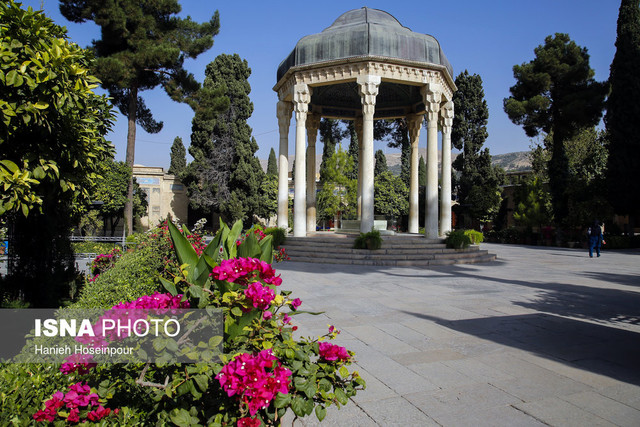
Hafez’s impact on literature, culture of Western society


۲۰ مهر، روز بزرگداشت «حافظ»

Tehran (ISNA) – Khwajeh Shams al-Din Muhammad Hafez Shirazi was a Persian mystic and poet who was born in the city of Shiraz in 1310.
 Most of his poems are Ghazal (which the subject includes both love and religious beliefs or mysticism) and his elocution is similar to Khajawi Kermani.
 He was one of the most influential poets of his time. In the eighteenth and nineteenth centuries, his poems were translated into European languages, and his name somehow reached Western literary circles. Hafez national commemoration day is October 21.
Professor of Comparative Literature in Imam Reza University of Mashhad, Dr. Maryam Kouhestani in an interview with ISNA talked about, the poetic style of Hafez which is concentrated on three issues of love, mysticism and panegyric. The most important characteristic of the Hafez’s style is the dispersion of the subject and the independence of the verses which is still discussed by the Hafez scholars.
There is no doubt about the influence of the Qur'anon Hafez thought and belief. In the field of form and structure, the most important feature of Hafez's poems, the independence of the verses, are most influenced by the Qur'anic Āyahs (verses). This is the characteristic of the Hafez revolution in the verses. The realm of meaning, Hafez; is in the position of a thoughtful poet whose poetry represents his worldview, merged the ancient and Islamic culture of Iran with religion, theology, philosophy, and mysticism.
Johann Wolfgang von Goethe (1749-1832), the most renowned poet of German literature was deeply interested in Eastern literature and above all, Hafez poems which increasingly awakened his interest in Persian literature. The first impulse of Goethe in imitating Hafez was a framework to compose romantic poems but later the mystical aspects of Hafez poems attracted him. The influence of Hafez Ghazaliat (the collection of his poems/ghazals) on Goethe was so profound that he composed his collection of poems in order to imitate Hafez and named it the -“West-Eastern Divan”-. By imitation of Hafez, Goethe called his collection of poems -“the Divan”- and named this collection, which consists of twelve sections, with Persian names. He titled the sections of his book in the following order:  the Singer (Moganni Nameh), Hafiz (Hafis Nameh), Love (Uschk Nameh), Reflection (Tefkir Nameh), Ill Humour (Rendsch Nameh), Maxims (Hikmet Nameh), Timur (Timur Nameh), Zuleika (Suleika Nameh), Cupbearer (Saki Nameh), Parables (Mathal Nameh), Parsees (Parsi Nameh), and Paradise (Chuld Nameh. Goethe also tried to rhythme, meter and rhyme of the Hafez’s poetic style. He praises Hafez for his broad-mindedness and intellectuality.
The remarkable point that impresses the reader of the West-Eastern Divan is that Hafez is not a Persian-speaking poet for Goethe; he represents great human beings throughout the ages. The important feature of his work is combination of Eastern culture with Western structure and the cohesion of them in his book.
Ralph Waldo Emerson (1803-1882), a great American philosopher and poet was also fascinated by Saadi and Hafiz among Iranian poets. Emerson started to know Hafez thought reading Goethe's West-Eastern Divan. For Emerson, Hafez became a perfect poet whom he called a “poet for poets”. He spent fourteen years reading Hafez poems. To recognize the spirit of Hafez's poetry in English literture, Emerson first translated "Sagittarius" into English and called it "From Hafiz's Persian Poetry". He was the founder of Transcendentalism, a philosophical movement which was based on spirituality and intellectualism at the time. He was vastly under the auspices of the Hafez‘s notions. Emerson was the primary practitioner of the movement, which existed loosely in Massachusetts in the early 1800s before becoming an organized group in the 1830s.

France and Hafez

William Jones was the first Englishman who translated some of Hafez's gazals into English. He also translated thirteen gazals of Hafez into French.
The inspiration of Eastern culture was so strong that many French poets were impressed by Eastern literature. Among them Victor Hugo (1802-1885) was profoundly affected by Persian poets especially Saadi, Hafez and Ferdowsi. Hugo was much inspired by Hafez poems through reading the West-Eastern Divan by Goethe. He composed his “Les Orientales” by inspiration of Saadi and Hafez’s notions. In the preface of this book, Hugo highly colored several poems of Hafez and Saadi.
Jean Lahore (1840-1909) was one of the French symbolist poets who knew Hafez through translations and was inspired by Hafez in his collection of poems entitled "Pandar".
Andre Gide (1869-1951 was acquainted with Hafez through Goethe. In the preface to of his famous book, “The Fruits of the Earth”, he brought a line of Hafez poem.
Armand Renaud (1836-1895) was very inspired by Hafez. He composed a set of twelve poems under the name of “Les Nuits persanes”. In the preface to his collection, Renaud noted his interest in Eastern culture and literature and entitled one of the twelve sets as “Iranian Night”.
Theophile Gauthier (1811-1872), the founder of the Parnassianism was also fascinated by Hafez, He began the preface of his famous Divan, "Enamels and Engravings" with a fascinating poem about Hafez that shows his enchantment of Hafez’s poems.
The French poet, painter and musician, Tristan Klingsor (1874-1966) was fascinated by Hafez and sang a love song to him.

England and Hafez

William Jones (1746-1794), the English Orientalist was the first translator of some of Hafez's gazals into English. Although Jones's translation of Hafez's poems were very eloquent and praised by many literary critics; he had deviated from the principle ideas of the poems in his translation, which has the taste and the style of English poetry.
John Richardson (1740-1795), was the editor of the first Persian-Arabic-English dictionary. He was a member of the East India Company, who was fascinated by Eastern literature and worked as a periodical writer and editor. In 1774, he translated a number of Hafez's gazals. Like Jones, he was not faithful in the the rhetorical figures of the poems and transferred Hafez's the notions through his own understanding of the poems and mingled them with the taste and style of English poetry.
Henry Wilberforce Clarke in 1891 translated the Divan of Hafez into English prose. The translation was accompanied by extensive notes, a clear biography of the Hafez, and detailed notes explaining practically some lines of the poems. His translation was hard to understand and had with many ambiguous figures.
One of Hafez's best translations was made by a lady named Gertrade Lowthian Bell in 1898. In her translation, she focused on the mystical and social aspects of Hafez's poems; therefore, it is a known as one of the best translation which seems to be close to the original version of Hafez Divan.
John Payne (1842-1916), an English poet and translator. He was best known for his translation of “Diwan Hafez” and ‘The Arabian Nights”. He translated the entire Divan of Hafez into verse in 1901. He also translated the quatrains of Omar Khayyam. Payne once said that Hafez, Dante and Shakespeare were the three greatest poets of the world. 

Thursday, May 16, 2019

Ferdowsi, reviver of Farsi language

25th of Ordibehesht in the Iranian calendar (May 15) is the day of commemoration of the great Iranian poet Ferdowsi. On this occasion we have prepared a special feature.
Iranians are very much indebted to Ferdowsi as he preserved Farsi language from annihilation and gave it an independent identity. Abulqasem Ferdowsi, who lived more than a millennium ago, made strenuous effort to keep this sweet language in the face of other languages and did his best to use as many Farsi words as possible in his magnum opus, Shahnameh (the Book of King).  
But, despite the influence of Arabic language in Iran and the compilation of many books in this language by Iranians, why didn't Arabic become the official language in Iran? History bears witness that Iranians have preserved and spread the Farsi language with the effort of their thinkers. The move began with Ya'qub Laith, the founder of Saffarid dynasty. Rudaki, Daqiqi and Onsori laid the foundation for expansion of Farsi and culminated with Ferdowsi and his everlasting masterpiece, Shahnameh.
The vast Iranian territory over the course of history has experienced a lot of ups and downs. To highlight the genuine Iranian culture, Ferdowsi revived the ethnic heroes and ancient Iranian civilization, and managed to revive the sense of defending the country in many people.
Ferdowsi should be considered as one of the Iranian national heroes, a great poet who breathed a new life in the body of Farsi language, and according to Dr. Abolfazl Khatibi, "through the past experience and Ferdowsi's great endeavour, Farsi language was stabilized, and by writing Shahnameh, he succeeded to preserve Farsi language against the influence of foreign words and keep the syntax and norms of Farsi language from the harm of anomalies. Hence, Farsi language owes its development to Ferdowsi's Shahnameh and that is why the name of Ferdowsi is interlinked to the durability of the Farsi language." The author of the most valid version of Ferdowsi's Shahnameh, Dr. Khaleqi Motlaq believes that: "Part of our nationality is indebted to the Farsi language, and Farsi language is largely owing to the Shahnameh of Ferdowsi."
Ferdowsi's magnum opus Shahnameh is one of the most important and richest treasures of Farsi language in terms of containing literary terms and expressions and it is undoubtedly the largest container of Farsi vocabulary. It is the first book that keeps real and beautiful Farsi vocabulary. By accepting the huge bulk of these words in his breast, Ferdowsi was successful to provide this precious gem to the future generations. Farsi language is the basis of unity and consistency of various ethnicities of Iran. Ferdowsi's Shahnameh has bolstered the pillars of Farsi language so sturdily that there is no place for forgetting this language in history. Therefore, it is considered that Shahnameh is one of the foundations of the Iranian ethnic unity.
Years should pass to clarify the real significance of Ferdowsi's work and his magnificent work should find the status it deserves in the history of Iran. Ferdowsi's epic masterpiece is a work that has preserved the past culture and identity of Iranians to the present.
Shahnameh is the book of Iranian myths. If Ferdowsi had not written Shahnameh, today we wouldn't have had access to many of these myths. Moreover, the book of ancient Farsi stories. It is the book of ancient customs and traditions of our ancestors. Ferdowsi worked ceaselessly for thirty years to finish the Shahnameh. Shahnameh is an illustrated calendar of the Iranian epic, history and culture. British Professor Charles Melville maintains that, "The great achievement of Ferdowsi was to preserve the history of Iranians including the history of the era of the empire and the peak of its glory. But the main point is that he wrote it in Farsi, the language of Iranians. This task of Ferdowsi is part of the great concept of being Iranian, being aware of his identity. This is a point which in my opinion has been manifested by Ferdowsi more than others."
Researchers are of the opinion that one of the reasons for the significance of Ferdowsi's Shahnameh is the role that the great poet has played with his great book in the culture and destiny of a nation. Dr. Khaleqi Motlaq believes that there is no book in Farsi literature and even in the world literature that, like the Shahnameh of Ferdowsi, to play such an effective role and influential status in the destiny and culture of a nation.
Researcher, Mohammad Ali Islami Nodushen, believes that Ferdowsi's Shahnameh is the only book in the world literature that has changed the destiny of a nation. He said, "Shahnameh changed the fate of Iran, and had it not been created, we would have been a different country! If Shahnameh had not been written, what happened in some countries like Egypt, Syria and Jordan, would have been repeated for Iran. Survival of the history and culture of Iran and Farsi language is deeply indebted to Ferdowsi and his magnum opus Shahnameh."
Ferdowsi cannot be called only a poet and writer of myths because, behind these lofty poems and with the rich and sweet Farsi language, he was effective in rebuilding a nation. Thus, in the imagination of Ferdowsi, it was not just Iranian myths that would find life in his poems, but it was the Iranians who got shape and grew up. Therefore, Shahnameh is part of the Iranian identity, and every Iranian needs a Shahnameh to identify himself and his old culture.
Iran in its history has been the land of the poems and hymns and has created the greatest literary masterpieces of the world. The poems of the great Iranian poets like Hafez, Sa'adi, Nezami, Sanai, Attar and Mowlana, and others are full of lessons not for Iranians but for the whole mankind. But Ferdowsi's great masterpiece Shahnameh is considered as the mirror of the ancient Iranian culture and identity.
Some scholars have tried to introduce Ferdowsi in a way as if he had been an extremely nationalist figure with no religious bond; while he was a Muslim with deep belief in the Prophet of Islam and his progeny. Leader of the Islamic Revolution, Ayatollah Khamenei, once said, "I consider Ferdowsi as a sagacious man." 
Shahnameh is important not only for the Iranians, but also for the world, because it addresses the essence of humanity. Shahnameh has mentioned the main human point and it is the conflict between truth and falsehood, good and evil, light and darkness, loyalty and treason. The core of Ferdowsi's Shahnameh is wisdom and victory of good over evil.
Shahnameh is a treasure of wisdom. It teaches the lesson of humanity, morality and virtue. Freedom and non-submission to oppression are the basic virtues of all the heroes of Shahnameh.

Thursday, August 09, 2018

Diplomat: Popularization of Persian literature a response to Islamophobia


Popularizing Persian literature and poetry overseas is a reasonable response to those who portray an unreal image of Islam and Muslims in the world, said Iran's ambassador to Bosnia-Herzegovina.
Mahmoud Heidari was speaking in a meeting at the Iranian embassy in Sarajevo with a Bosnian author who wrote a book about the school of thought of famous Iranian poet Jalāl ad-Dīn Mohammad Rūmī, IRNA wrote.

Rumi was a 13th-century Persian Muslim poet, jurist, Islamic scholar and theologian whose influence transcends national borders and ethnic divisions. His poems have been widely translated into many of the world's languages and transposed into various formats.
The book, titled 'Molaviyeh; Treasury of Wisdom', was written by Elvir Music, a Persian language and literature professor and instructor of Hafez-reading programs in Bosnia.

During his meeting with the Bosnian author, the Iranian diplomat said promoting Persian literature would also help develop cultural relations between Iran and Bosnia.
Relations between Iran and Bosnia and Herzegovina are not limited to political and economic ties, said Heidari, adding that intellectual connections between scientists, poets and scholars of the two countries have always existed.
He underlined that publishing of the Music's book about Rumi is an opportunity for Bosnians to get re-introduced with the theosophy and thoughts of great Iranian poets and theologists.
Heidari added that extremism and excommunication will not emerge in a society where people exemplify Rumi, Sa'di and Hafez (three prominent Iranian poets).
Meanwhile, Music thanked Iran's embassy in Sarajevo and Avicenna Science and Research Institute for publishing his book and for the support extended to him by the two entities.
He also briefed the Iranian ambassador on actions taken to popularize Persian and Iranian

literature and culture in Bosnia-Herzegovina.


Turning to the prominence of Persian language and literature in the Balkans, Music added that 32 Bosnian poets have epitomized Iranian poets and also wrote a number of poems in Persian.
He said that the book of Bosnian poets who have created works in Persian will be authored soon and the publishing of that book can be a prominent step toward familiarizing the young Bosnian generation with the thoughts of great Bosnian writers who are inspired originally by Persian literature and theology.
The Bosnian Persian language and literature professor said in order to further encourage Bosnian people to read poems of the ancient Iranian poets, certain sessions are being held in the cities of Tuzla and Sarajevo to recite poems by Rumi and Hafez. The sessions are highly welcomed by the public, he added.
'Moulaviyeh; Treasury of Wisdom', is written by Music, prefaced by Ambassador Heidari and published by Avicenna Science and Research Institute.