Showing posts with label Mowlana Jalaluddin Rumi. Show all posts

Tuesday, August 06, 2019

'Rumi's Secret' offers an expanded view of the 13th-century poet and mystic

Millions of readers in America and around the world know the name Rumi is synonymous with love poetry, but they don’t know much about the life of the beloved 13th-century Persian poet and Sufi mystic. The new biography Rumi’s Secret, by Brad Gooch – the bestselling author of biographies about Flannery O’Conner and Frank O’Hara – provides important insights yet also raises questions.
As Gooch explains in the prologue, which flows with the ease of good fiction, the idea of Rumi’s secret came from a conversation Gooch had with a merchant named Sebastian in Aleppo, Syria, in 2011. Sebastian compared Rumi to the American Walt Whitman – another poet 
revered for the universality of his writing – who “never tells his secret!” 
Gooch follows that fascinating statement with one of his own: “Rumi did have secrets – personal, poetic, and theological – that he was always both revealing and concealing.”
Some of the poet’s smaller secrets are revealed in the book’s first section, which opens with Rumi, at five years old, seeing angels. His father, an esteemed Muslim preacher and teacher, explained that the beings had come to bring him favor and invisible gifts.
When Rumi – whose given name was Mohammad – was six, his family began a 2,500-mile trek from their home in Vakhsh (in present-day Tajikistan) that would take years to complete. Along the way, they followed the Silk Road to Bagdad and to Mecca – which all Muslims are required to visit at least once in their lifetime. They also spent time in several cities as Rumi’s father sought opportunities to teach and safety from ongoing political upheavals and invading Mongols.
In every locale, the precocious Rumi – whose father sometimes called him Jalaloddin, meaning splendor of the faith – absorbed the sights and sounds, which would one day color his poetry, as in these lines: “Speak Persian, though Arabic is more beautiful/ Love speaks a hundred different languages.” He also developed a deep understanding of the longings and losses people experience during tumultuous times.
The family finally settled in Konya, where Rumi, now married and a father,would spend most of his adult life, after furthering his studies in Aleppo and Damascus. In Konya, he became renowned for his teaching and preaching and was called Mowlana – “our master” – and, eventually, Rumi, which is derived from “Rum” or “Rome” – meaning Byzantium.
Yet as subsequent sections show, the Rumi we know today might never have emerged if not for three profound friendships. The first and most impactful was with Shams of Tabriz, a mystic who came to Konya after decades of traveling and spiritual seeking.
Shortly after the two met, they went into seclusion, where Shams urged Rumi to stop reading other writers (including his father), to be honest and heartfelt, rather than refined, and to reject the trappings of his prestigious career and demanding religious life. Instead, Shams encouraged Rumi to use music, sung poetry, and whirling to “literally spin loose of language and logic, while opening and warming his heart.”
Rumi viewed Shams as a teacher who could help him overcome his pride, as evidenced in these lines: 
You speak for God, you see the Truth,
You save the world from drowning in an ocean of fire.
A king beyond compare, your majesty is eternal
You lead the soul away from harmful desires
Shams, always a controversial figure, also taught Rumi about the pain of separation by abruptly leaving the city, in part to test Rumi’s loyalty. The first time Shams left – for Aleppo, 400 miles away – Rumi responded by writing poetry ghazals (which would become his favorite poetic form) to channel his feelings and demonstrate the creativity Shams had nurtured. The second time Shams disappeared, Rumi spent months searching for his friend, who was presumed dead.
The acceptance of that loss forever changed Rumi, who became known for his quiet acts of kindness, humility, and willingness to speak with anyone. His writing deepened and flourished.
Rumi had two other cherished friends: a goldsmith named Salah, who had studied with Rumi’s tutor from childhood, and Hosam, one of Rumi’s loyal followers. Both served as muse and spiritual axis, but with different functions. Where Salah was like a calm mirror, helping Rumi find peace, Hosan was a conduit and scribe for Rumi’s long poem "Masnavi," which is quoted throughout the book.
According to Gooch, there is no evidence that these relationships were romantic. Yet because of the way he portrays them – with movie-like intensity and drama – he creates enough ambiguity to leave readers wondering, especially about Shams. Some may also question the validity of conversations and details shared hundreds of years after the fact, despite Gooch’s thorough references.
The book is important, however, because it illustrates how each man helped the poet learn about love (both human and divine), the process of giving up the self to make room for something purer and higher, and transcendence. The work also shows how the poet came to realize the logic and importance of a religion of the heart, which is described in these lines: “The mosque inside the hearts of holy men/ Is a place of worship for everyone. God is there."
That idea resonates with contemporary audiences. Yet as Gooch explains in the afterword, it, like many of Rumi’s practices – such as whirling and elevating a human being to the level of God or the Prophet Mohammad – were controversial in his day. Rumi’s “veil of secrecy was a virtue and an artistic style in the broader culture of the time.”
That veil is equally effective in our tell-tale age because Rumi’s “aesthetic of secrets” as Gooch calls it, broadens and deepens his writing. For example, Rumi saw both Shams and God as the light of the sun, “and in speaking of the beloved he was also speaking of the unspeakable, or approaching the unspeakable, as the essence of God is love.” 

Saturday, August 03, 2019

Why Many Iranians Visit Tombs of Poets?

Rahman Mehraby

If you travel to Iran, you will certainly be amazed by the number of people who visit the tombs of Iranian poets. You see how they respect and show love for the ones buried in these places. You find out the passion and affection in their manners and treatment of the tombs. Based on what I’ve heard from the international travelers for years, this is some rare scene in the other parts of the world.

Iranian Poets in Schooling System

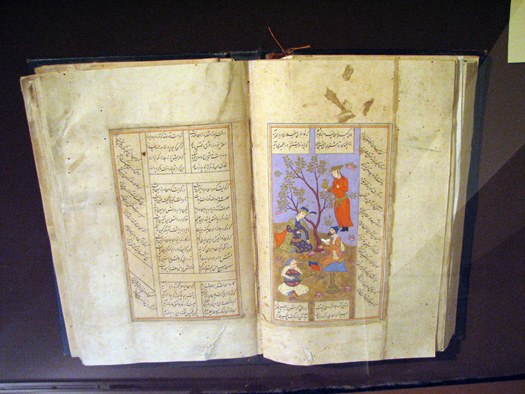
Persian Poems Book, Persian Poetry
A book of Persian poems with miniature paintings
As children, Iranian students begin to learn poems and even memorize them in the early years of primary schools. They get familiar with the rhythm and rhyme as well as the different styles of poetry. They learn about the famous Iranian poets. Persian literature is full of distinguished styles. Many of the textbooks they study are written in Middle Persian, the language used in Iran some 1400 years ago. Although the language has gone through lots of changes, it’s still understandable.
During high school, students study more complicated Persian literature and particularly poetry. This continues in the universities regardless of what you study.

Poems in Everyday Life

A lot of Persian expressions are in form of poems. Persian poems are very rich in subjects like love, modesty, wisdom, appreciation of creation, nature, and so on. Therefore, there are several occasions occurring every day in which one remembers some Persian sayings. For centuries, those who knew such expressions and used them in certain situations were considered the educated ones. In some other cases, one may even recite some lines of a poem.
There’s no Iranian home without Persian poetry books. People continue reading poems outside the schooling system too. Before the time of equinox and the coming of the New Year (Nowruz), during Yalda night (the ceremonies for the longest night of the year – Dec 20th), and many other occasions, Iranians read poems.
Iranian traditional music is so full of classical Iranian poems. Some Iranian poets are well known for their musical poems. Some of them have got a powerful soothing effect. Some make you very happy and some are deeply sad and full of emotions. In various states of heart, Iranians can listen to various types of music.
Tombs of Famous Iranian Poets
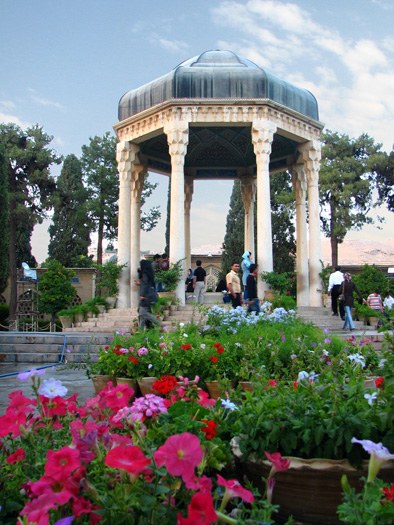
Tomb of Hafez decorated with flowers
The eloquent Persian language is used in journalism too. Sometimes the headlines, as well as the news articles you read, are embellished with poems, expressions, and references to particular poems. Some of these poems have got a work in them which are, by themselves, a reference to another story or group of people with a particular mindset and belief, etc. Therefore, understanding Iranian poems, music, stories, news articles, etc could be quite complicated, but not very much for a nation who is brought up with it.

Iranian World Class Poets

I can say Iran has offered some of the most famous poets to the world literature. They represent a nation with a profound culture and thoughtful ideas.
Ferdowsy is the Iranian poet of 1000 years ago. He composed the most famous Iranian poetry book called Shahnameh. This was an unparalleled effort to save the Persian language at the time when Arab invaders had forced Iranians not to speak, write or compose anything in Persian. His epic works set nationalistic feelings ablaze in Iranians hearts.
Omar Khayyam was a well-known mathematician and poets who lived some 900 years ago. His short poems are full of maxims about life and joy.
Saadi was a man of traveling living some 800 years ago. He had studied in Nezamieh University, Baghdad. He returned to his homeland toward the end of his life and soon gained large popularity due to his lovable poems highly appreciated by the people contemporary to his time. His famous poem has decorated the UN building as below:
Human beings are members of a whole,
In creation of one essence and soul.
If one member is afflicted with pain,
Other members uneasy will remain.
If you have no sympathy for human pain,
The name of human you cannot retain.
Rumi was the unique Iranian poet of 700 years ago. His rhythmic poems describe Iranian traditional systems of music. His words of wisdom, spiritual and love poems are still quoted by Persian speaking people. His book became the bestselling book of the late 20th century in the US and his poems’ recordings made their way to the Billboard’s top 20 list.
Hafez was the master of Persian ghazals and still is after 700 years. The figurative language he’s used was an escape way under the rule of Mongols in Iran. His description of love and beautiful language of spiritual values are uniquely adorable.
In addition to such famous poets, there are a large number of other poets who are quite well-liked by Iranians although non-Iranians may have not heard of them.

Visiting Ritual of Iranian Poets

Rituals at the Tombs of Iranian Poets
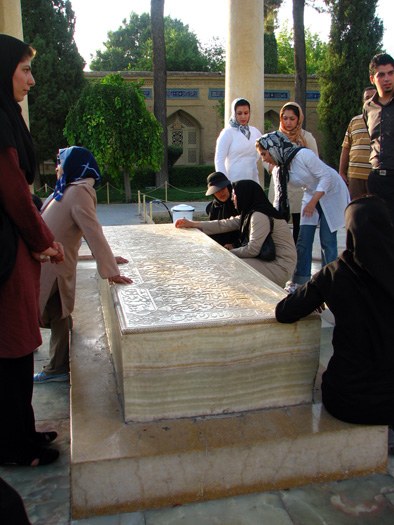
People showing their affection at a poet’s tomb
When Iranian go to the tombs of poets, they treat them like a lost beloved family member. They put flowers on their tombstones. Sometimes, they wash the tomb with rosewater. They sit down and pray for the dead poet. They talk to them and ask them to talk back with them. They bring the poet’s book with them to read or recite some of their poems to stay connected with them.
Such tombs are inside beautiful gardens, not among other graves in a cemetery. The decoration of the settings around it and the monument built for them are parts of the whole honor dedicated to them.
The reputation of Iranian Poets among Foreigners
Every year, there are several commemorative ceremonies and conferences for the above poets and others in Iran. Many people specialized in studying these poets’ works come together to discuss various dimensions of their characters and works. There are universal days allocated to such poets and non-Iranians understand the importance of such men of wisdom in the development of human knowledge.
Therefore, when you visit Iran, make sure you have a deeper look at the settings in which Iranians go to such tombs and grasp the feelings and appreciation to such gems at Persian literature.

Thursday, March 28, 2019

Spring in Farsi Literature (1)

In this episode, we are going to touch upon some of the poems of the Iranian poets on spring. Stay tuned.
Mowlana Jalaluddin Rumi is an acclaimed Iranian poet who has composed poems on spring in different parts of his poetries.
Sprinkle water on the way as the beloved is coming,
Give tidings to the garden, the spring scent is coming.
Open the way for the friend, to that full moon,
As his luminous face is radiating generously.
The garden is thriving; the apple of our eyes is coming,
Grief is departing, the moon is coming.
The garden is greeting; the cypress is standing up,
The meadow is going on foot; the blossom is coming on mount.
A great development is taking place as we are hearing the sound of the steps of a traveler who is known to us. It is the sound of the wings of swallows and the sprouting of life in the nature. The traveler is spring. Nowruz has always inspired the Iranian poets to portray their perception of this beautiful season with their words. Some poets, like Manuchehri, Onsori and Rudaki have just described the beauties of spring. Thus their poetry sounds like a colorful painting.
Spring arrived and brought freshness,
And the earth is ornate with the splendor of spring.
As the cloud of early spring rained,
Thousands of tulips sprouted out of the stone.
Some poets like Hafez, Mowlana, Sa’adi and Khayyam have used spring as an excuse to express their thoughts. Spring in the poems of Hafez is a different picture compared with other poets. Hafez’s soul is mixed with the delicacies and beauties of spring. The start of spring and flourishing of the nature is the gushing forth of unknown phenomena inside him.
From the residence of the friend comes the breeze of Nowruz,
Calling this breeze for help, would kindle your heart’s light.
 Go to the plain to dust grief from your lap,
Come to the garden to learn lyrics from the nightingale.
For Hafez, spring is intertwined with true and eternal love. Upon the arrival of spring, the scent of beauty is blown in the poetry of Hafez and he remembers God as the Creator and Center of the entire being. He uses similes and metaphor to emphasize the transience of the world.
The flower is welcome as there is nothing better than that,
As there is nothing in your hand except the goblet.
Take the time of happiness and find the pearl,
As the shell won’t yield pearl constantly.
 Khayyam in his poems likens the life to spring and recommends us to make the best use of the life as it is transient just like spring.
O cupbearer, the flower and the meadow are very happy,
Enjoy them as they will wither just in a moment.
Get up and pick a flower just to see that,
The flower has fallen on the soil and the meadow is dry.
Sa’adi, the renowned poet, describes Nowruz and spring as a reference to the order ruling the world and the creator of the world. Then, he concludes that these bounties should be appreciated through gratitude toward God.  
There is no man who does not love spring,
It is dry wood not a plant that does not sprout on Nowruz.
Mowlana looks at spring in a different way in his poems. He speaks of the spring of soul instead of the spring of nature. Indeed, he considers the spring of soul as the main spirit which inspires the spring of nature.
The spring of souls has arrived, dance oh fresh twig,
As Joseph has stepped in, dance oh Egypt and sugar.
Mowlana’s look at the universe is a spiritual one and spring is no exception for him. He considers spring as a gift from the heavens for the spirit of humans and other creatures. He describes spring as a sign of man’s spiritual journey which will end in communion with the real Beloved.
Spring arrived, spring arrived, and it greets the drunks,
From that messenger of the good, it brings greetings for the drunks.
Come to the eternal flower garden; ascend to the roof, as the cupbearer,
Has brought a message from the Hidden House for the drunks.
The topic of learning from spring and making use of the life was not confined to the classical poets and many of the contemporary poets have also broached on this topic. Parvin Etesami, the noted Iranian poetess of the 20th century, has pointed to the issue several times. She has emphasized the fact that the life is transient as spring. She says:
The pansy withered at dawn and the gardener said,
It has not withered and hidden its face in due time.
It answered that, ‘We were very transient’,
As the flower that flourished soon and withered soon.
Now I am broken and at night I will be dust,
You yourself will trample on me in the garden at dawn.