India’s Hindu nationalists and the Israeli right have a remarkable mutual affinity. Binyamin Netanyahu welcomed Narendra Modi to Israel in 2017 with these words: “Prime Minister Modi, we have been waiting for you for a long time, almost 70 years … We view you as a kindred spirit.”
The two premiers, both battling for re-election in spring 2019, share a warm rapport, and regularly refer to each other on Twitter as “my friend Narendra” and “my friend Bibi.”
The Modi-Bibi bonhomie rests on much more than personal chemistry, or even the Israeli military-industrial complex’s significant role in servicing Indian needs. It is rooted in the profound admiration of generations of Hindu nationalists for Zionism and its product, Israel, whose model of nation-state they seek to emulate in India.
Indian secularists often claim that the Hindu nationalists intend to turn India into a Hindu version of Pakistan. This is not wrong. Just as Pakistan founder Muhammad Ali Jinnah’s politics fused religion, nation and state, so does “Hindutva”, the political ideology of Hindu nationalism born in the 1920s.
But the Pakistan analogy is limited. For more than 60 years, Pakistan has been a state dominated by the military. India is a highly evolved democracy. It has always been inconceivable that an equivalent of Zia-ul Haq, the Islamist military dictator who ruled Pakistan from 1977 to 1988, could appear in India and “Hinduise” the state. The intent of Hindu nationalism to remake India therefore needs to be pursued, and accomplished, in a way compatible with a democratic polity.
The prototype exists of a form of state which is simultaneously democratic and supremacist: Israel. Israel was a self-described “Jewish and democratic state” until July 2018, when the right-wing majority in its parliament narrowly won a vote to further tighten Israel’s identity to “the nation-state of the Jewish people, which respects the rights of all its citizens”. The revision reflects the ascendancy of hardliners and extremists in Israeli politics.
Affinity for Zionism and Israel
Successive generations of Hindu nationalists – from Vinayak Damodar Savarkar (1883-1966), who coined and elaborated the Hindutva concept, to Modi today – have professed a deep affinity for Israel. Savarkar wrotein the 1920s: “If the Zionists’ dreams are ever realised – if Palestine becomes a Jewish state – it will gladden us almost as much as our Jewish friends.”
In late 1947, Savarkar was very upset when the Indian delegate in the UN General Assembly argued for a binational Arab-Jewish state in Palestine and voted against the proposal to partition Palestine into a larger Jewish state and a smaller Arab state.
Madhav Sadashiv Golwalkar (1906-73), who steered the Hindu nationalist movement in post-independence India as the chief of the volunteer organisation Rashtriya Swayamsevak Sangh (RSS), wrote in the late 1930s that the Zionist movement exemplified his own “five unities” framing of Indian nationhood: “The Jews had maintained their race, religion, culture and language, and all they wanted was their natural territory to complete their nationality.”
Ethnic democracy as the shared ideal
It is Jewish Israeli scholars who have explicated the paradigm of “ethnic democracy”, using the case of their own country. One such scholar, Sammy Smooha defined ethnic democracy as “an alternative non-civic form of democratic state that is identified with and subservient to a single ethnic nation.” He said this is “best exemplified by Israel”, which is “based on Jewish and Zionist hegemony and the structural subordination of the Arab minority” – who are currently 20% of the population of the Jewish state. Propelling this is an ideology, Smooha says, that “makes a crucial distinction between members and non-members of the ethnic nation”. Non-members are seen as undesirable and threatening – as agents of biological dilution, demographic swamping, cultural degeneration, security risks, and even as a fifth column for enemy states.
This is the typical Hindu nationalist perspective on India’s Muslims who, at just under 15% of the population, are India’s largest religious minority.
The distinction made between members and non-members of the nation underlies a very controversial amendment to India’s citizenship laws that has been strongly pushed by Modi’s Bharatiya Janata Party (BJP) government since 2016. The proposed legislation would confer Indian citizenship on members of designated religious minorities (Hindus, Sikhs, Christians, Buddhists, Jains, Zoroastrians) from three Muslim-majority countries in India’s neighbourhood – Bangladesh, Pakistan and Afghanistan – who have settled in India without legal status.
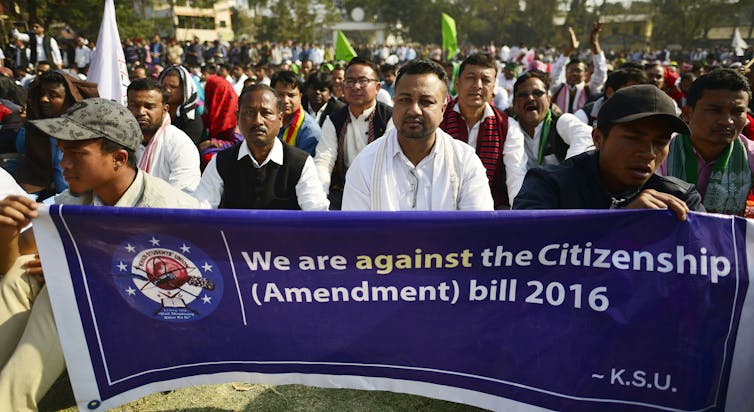
A protest in Assam against India’s citizenship bill in late January 2019. EPA
So, Hindus and other non-Muslims from these countries would have a fast track to Indian citizenship, the argument being that they are victims of religious persecution. The proposed law is, in a more limited scope, analogous to the Israeli policy of promoting migration of Jews from across the world to Israel. It sends an unmistakable signal of who are preferred as citizens and who are viewed as undesirables.
India as a clone of Israel?
Ethnic democracies do not totally exclude or disenfranchise the citizens viewed as undesirables. Israeli Arabs are entitled to cultural and religious rights. Arabic is officially recognised (though the July 2018 revision asserted the primacy of Hebrew), and usually around 10% of the Knesset’s members are Israeli Arabs. Still, a range of formal and informal policies ensure that the Arab community mostly remains ghettoised in deprived enclaves, relegated to what is in effect second-class citizenship.
Israel is not the only example of an ethnic democracy. There is Sri Lanka, where the post-colonial state was captured by majoritarian Sinhala-Buddhist nationalism from 1956 onward. There is Croatia, since 2013 a member-state of the European Union. It proclaimed independence in 1991 as: “The national state of the Croatian people, and a state of other nations and minorities who are its citizens.”
What ethnic democracies do is to create a de facto but very real hierarchy of citizenship, in which some are full, first-class citizens and others are second class – at best. The current Hindu nationalist movement is remarkably faithful to the ideological creed laid down by its pioneers Savarkar and Golwalkar eight decades ago. In 1938, Savarkar declared that “the Hindus are the Nation in India and the Moslem minority a community” just as “the Turks are the Nation in Turkey and the Arab or the Armenian minority a community.” Golwalkar wrote in 1938: “The non-Hindu people of Hindustan … may stay in the country, wholly subordinated to the Hindu nation.”
The type of “democratic” state exemplified by Israel – and not Pakistan – is the model the Hindu nationalist movement, led by its core RSS organisation, aspires to establish in an Indian variant. But will its vision prevail? It’s far from certain that a 1.3 billion-strong country, defined culturally by multiple identities and politically by cross-cutting cleavages, can be turned into a giant-sized version of Israel, Croatia, or Sri Lanka.