Showing posts with label Savak. Show all posts

Wednesday, December 18, 2019

CIA-Mossad backed MEK resembles ISIS in many ways: analyst

Mohammad Reza Pahlavi, and the leader of the MEK, Masoud Rajavi, formed cults of personality around themselves. Many people are attracted to cults, some of whom are willing to engage in deadly violence for the sake of being a member. One can see this type of behavior among members of Daesh.
Yuram Abdullah Weiler is a former engineer educated in mathematics turned writer and political critic who has written over 130 articles on Islam, social justice, economics, and politics focusing mainly on the Middle East and U.S. policies.  His works have been largley published across the globe. In addition, he has frequently appeared as a guest commentator on Press TV, Al Etejah, and Alalam. A dissenting voice from the “Belly of the Beast”, he currently lives in Las Cruces, New Mexico, USA. In an exclusive interview with Khamenei.ir, Mr. Abdullah elaborates on the U.S.- West support for the notorious MEK terrorist organization. The following is the full text of the interview:
The MEK terrorists assassinated the Iranian President and PM of the time - Muhammad Ali Rajai and Javad Bahonar - on August 30th; how do you evaluate the West and the U.S.’s support effective in the execution of such crimes?

The United States has a long history of state-sponsored terrorism against Iran beginning in 1953 with the CIA-engineered coup of the legitimate government of Iran by covert action.  This was followed by 25 years of rule by the U.S.-supported dictator, Mohammed Reza Pahlavi, whose brutal security force, the SAVAK, was responsible for the death and torture of thousands of Iranians.  U.S. policy since the time of the victory of the Islamic Revolution in February 1979 has been one of recapturing the country that former President Jimmy Carter “lost” on his watch. 

U.S. state-sponsored terrorism directed against Iran has included support of terrorist organizations such as Jundullah based in Pakistan, assassination of senior Iranian nuclear scientists by agents of the terrorist organization Mujahedin-e Khalq (also known by acronyms MeK, MKO, PMOI), a draconian regimen of economic sanctions, and launching proxy wars against Iranian allies such as Syria.  Just as the U.S. used the Afghan mujahedin to fight a proxy war against the Soviet Union in Afghanistan, the U.S. is now using the MKO in conjunction with Mossad to fight a covert war against the government of the Islamic Republic of Iran.  

The relationship of the U.S. and the MKO certainly dates back to the Islamic Revolution, but prior to 1975, when the MKO split into Islamic and Marxist factions and was under severe repression from the shah, it is doubtful that the organization was receiving any support from Washington.  However, there is evidence that the CIA was attempting to infiltrate the MKO by recruiting the first president of Iran, Abol Hassan Bani Sadr, while he was still in Paris in January 1979 when CIA agent Vernon Cassin offered him $5,000 a month to act as a “consultant” for a U.S. company. 

What is certain is that MKO leader Masoud Rajavi, along with twenty members of his organization, paid a visit to Ayatollah Hussein Ali Montazeri on 25 October 1978 in Evin Prison seeking a leading role for the MKO in the post-revolutionary government.  Rajavi explicitly told Montazeri to pass a message to Imam Khomeini in Paris that the MKO would be the only group capable of administering Iran.  Suspiciously enough, on 30 October, Montazeri was released and was “debriefed” by SAVAK chief general Nasser Moqaddam.  It is certainly possible that this was an initial vetting of Rajavi and the MKO by Washington for being an acceptable “Iranian opposition.”

In the days following the 15 June 1981 impeachment of Abol Hassan Bani Sadr, the MKO called for massive demonstrations against the nascent Islamic government of Iran compelling security officials to initiate a crackdown on the group. On June 28, the MKO launched a series of lethal terrorist attacks in an attempt to topple the government beginning with the bombing of the headquarters of the Islamic Republic Party during a meeting of party leaders, killing Ayatollah Mohammed Beheshti along with four cabinet ministers, twenty-seven members of the Majlis and several other government officials for a total of 72 fatalities.   On August 30 just after 2:30 p.m., another bomb planted by an MKO operative, most likely Masoud Kashmiri, detonated killing President Mohammed Ali Rajai and Prime Minister Mohammad Javad Bahonar.

In the aftermath of the attempted overthrow of the government in June 1981 by the MKO that had Bani Sadr’s support, he and MKO leader Masoud Rajavi, whose second wife was Bani Sadr’s daughter, along with other leaders of the organization, fled Iran for Paris on July 29 where they established the National Council of Resistance (NCR). After being evicted from France in 1986, Rajavi relocated the MKO to Iraq, where, receiving asylum and financial support from Iraqi dictator Saddam, he formed the National Liberation Army (NLA), the military wing of the MKO, with himself as commander in chief.  The NLA used Iraq as a base to launch multiple attacks across the border into Iran. In June and July 1988, the NLA participated in a joint invasion into Iran with Iraqi forces, which used chemical weapons against Iranians. 

By 1988 during the Sacred Defense, the MKO had become a U.S. asset as evidenced by National Council of Resistance of Iran (NCRI) mouthpiece Alireza Jafarzadeh’s admission that, by that time, the MKO possessed hundreds of millions of dollars’ worth of tanks, armored personnel carriers and field guns.   The claim that such a huge cache of heavy weaponry was acquired from cross-border raids into Iran simply does not ring true.  Other evidence of U.S. involvement in the 30 August bombing can be gleaned from the fact that Bani Sadr and Rajavi were whisked out of Iran in a Boeing 707 military tanker piloted by Colonel Behzad Moezzi, who was in the cockpit of the shah’s plane when he fled from Iran to Aswan, Egypt on 16 January 1979.

Since then, the U.S. has even trained members of the MKO at the U.S. Department of Energy Nevada Security Site under the auspices of the Joint Operations Special Command between 2005 and 2008.  Additionally, senior U.S. officials have confirmed that the MKO, working through the Zionist spy organization, Mossad, has been responsible for carrying out the assassinations since 2007 of five top Iranian scientists: Mostafa Ahamdi Roshan on Jan. 11, 2012; Darioush Rezaei-Nejad on July 23, 2011; Majid Shahriari on November 29, 2010; Massoud Ali-Mohammadi on January 12, 2010; and, Ardeshir Hosseinpour on January 15, 2007.


Why did MKO terrorists kill both officials as well as ordinary Iranian citizens?

During that reign of terror in 1981, the MKO targeted Friday prayer leaders, including those in Tabriz, Kerman, Shiraz and Yazd, as well as minor government officials, members of the Revolutionary Guard, prison wardens and even ordinary citizens.  Such random violence fits well with the definition of terrorism used by the United States Department of Defense (DoD):
“The calculated use of unlawful violence or threat of unlawful violence to inculcate fear; intended to coerce or to intimidate governments or societies in the pursuit of goals that are generally political, religious, or ideological.”

While I am by no means qualified to voice an opinion on the psychology of terrorism, I would point out that the terrorist engages in violent activities under an assumption that this will cause a political change.  However—and I believe the MKO is a good example of this—political change can, in turn, precipitate terrorism.  While MKO members apparently did contribute to the victory of the Islamic Revolution in Iran, nevertheless following the victory of the Islamic Revolution, because of unfulfilled aspirations of leadership in the new government, ideological disagreement with the direction set by Imam Khomeini and other factors, the MKO mutated into a terrorist organization, and turned viciously against the fledgling Islamic government voted upon by the people of Iran.


Shahid Rajai was severely tortured on the hands of SAVAK and then martyred by MKO in a bomb explosion. What is the common enmity of the thugs of the shah and MKO with Iranian revolutionaries like Shahid Rajai?

To discuss the enmity, one would have to delve into the psychological factors motivating individuals to join with others and resort to extreme violence, whether deemed as terrorist or state-mandated, in order to achieve political goals.  To study such factors scientifically remains a near impossibility, since few legitimate researchers have direct access to terrorist groups over long periods of time to gather data for analysis.  Certainly there is no single causative factor, such as mental illness or low childhood self-esteem that causes the embrace of enmity.

Beyond the psychological factors, the thugs of the shah and the MKO appear to have shared a common goal of suppressing the desire of the Iranian people to have an Islamic form of governance.  The common denominator seems to be the use of extreme violence for the imposition of a political goal.  In the case of the shah, it was the perpetuation of his U.S.-supported regime, and in the case of the MKO, it was instituting an authoritarian Marxist regime.

From another aspect, one can say that the former shah, Mohammad Reza, and the leader of the MKO, Masoud Rajavi, both formed cults of personality around themselves.    Both used media to surround themselves with an idealized, mystical aura, and both pursued and promoted radical ideologies:  the shah with his “White Revolution” of westernization and marginalization of Islam, and Rajavi, with his obsession with toppling the legitimate Islamic government of Iran and assuming the leadership role himself.  Many people are attracted to cults, some of whom are willing to engage in deadly violence for the sake of being a member.  One can see this type of behavior among members of  Daesh.


How do you analyze all the fuss MKO is making these days by meeting with the dictators of certain countries?

On 9 July 2016, former Saudi intelligence chief and former Saudi ambassador to Britain and the United States Prince Turki al-Faisal Al Saud spoke for 30 minutes before a crowd in Paris, France gathered for the annual conference of the MKO.  This is not totally surprising, for there has been a long list of U.S. politicians, including Newt Gingrich, the former speaker of the House, Bill Richardson, a former New Mexico governor and U.N. ambassador under Bill Clinton, and former Vermont governor Howard Dean, have spoken to and received handsome fees from the MKO.  These fees, in the neighborhood of $25,000 each, may have been funded by Saudi Arabia, so covert support of the MKO may not be a recent development.

In contrast, al-Faisal’s overtly inflammatory rhetoric against Ayatollah Khomeini however was indeed shocking.  Crudely stating that Iran was infected with a “Khomeini cancer,” al-Faisal, openly called for regime change by declaring, “I, too, want the downfall of the regime.”  The rhetoric directly threatening the Islamic Republic of Iran may have been for its support of the legitimate government in Syria, Lebanese Hezbollah, and for its support of Houthi resistance fighters in Yemen.  At a minimum, al-Faisal’s announcement certainly chills any further incentive for Tehran to deice diplomatic relations with Riyadh.

The U.S. the Israeli entity and the Saudis appear to have convergent interests in destabilizing Iran with the ultimate goal of toppling the Islamic government and installing a pro-western client regime.  Certainly U.S. and Saudi support for terrorist organizations to fight their proxy wars is nothing new and the symbiotic relationship dates back to the 1980s, when Washington and Riyadh partnered to fund the Afghan mujahedin, which later morphed into the terrorist group al-Qa’idah.

As far as Mahmoud Abbas’ meeting with Maryam Razavi three weeks after al-Faisal’s disclosure, it is not clear what the aging American puppet hoped to accomplish.  As a largely irrelevant figure in the fight for the rights of the oppressed Palestinian people, Abbas may have simply desired to show himself as associating with an opponent of Iran, which is a requirement to remain in the good graces of the U.S. and the Israeli entity.  On the other hand, the Abbas-MKO meeting may signal the reestablishment of a Fatah-MKO coalition, which fought together against Iran during the 1980-1988 Iraq-imposed (and U.S.-backed) war.

Thursday, July 25, 2019

London Defends The Shreds Of Its Empire Against Iran

Written by Thierry MEYSSAN

At the end of the Second World War, the United Kingdom balked at the idea of abandoning its Empire. It created independent central banks everywhere in order to continue to plunder its ex-colonies once they became independent, and companies poised to grab half of the national wealth.
The Shah’s Prime Minister, Mohammad Mossadegh, could not accept that London should confiscate his country’s oil and steal 50% of its profits via the Anglo-Iranian Oil Company (AIOC). He therefore nationalised the company. But the AIOC was the property of the British Ministry for the Marine, and London feared that this example may spread to all of the third world.
Seen from the West, Iran is a dangerous competitor.
Defending his Empire, His Majesty’s Prime Minister, Winston Churchill, convinced his US partner, President Dwight D. Eisenhower, to overthrow Mossadegh. This was Joint Operation AJAX, implemented by MI6 and the CIA and directed by Kermit Roosevelt and Herbert N. Schwarzkopf. The former was the grandson of President Theodor Roosevelt, who colonised Latin America, and the latter was the father of General Norman Schwartzkopf, who directed the Gulf War against Saddam Hussein.
Then the Anglo-US bloc set up General Fazlollah Zahedi as Prime Minister, and created a cruel political police, the SAVAK, by recycling ex-Nazi Gestapo criminals. The Iranian people paid a bloody tribute for its desire for true independence.
Operation AJAX was a success for the Anglo-US. It supplied the model for false revolutions aimed at changing recalcitrant régimes, but above all, it set back the liberation of colonised people by 35 ans.
When the same USA overthrew Shah Reza Pahlevi, who was preparing a world increases in oil prices via the OPEC, they thought they were making a smart choice by organising his succession with France – the return of Imam Rouhollah Khomeini. But the cow-boys never attained the same levels of subtlety as their English mentors. BOOM! Iran once more became the champion of the anti-imperialist struggle, as it had been before the Islamic régime.
This is the conflict which is resurfacing today. As in the time of Mossadegh, Iranian oil production collapsed under the weight of Western threats. The Royal Navy seized an Iranian oil tanker (the Rose Mary in July 1952, and Grace 1 at Gibraltar in 2019). As always, the British pretend that the Law is on their side, but in fact they have only their arrogance. In Mossadegh’s time, they accused Iran of exporting oil which had been stolen from them (because they refused nationalisation), and today, claim that Iran is violating European sanctions (although these specific sanctions themselves violate international Law).
If the conflict should favour the British, it would set back the liberation of the colonised people by many decades. If, however, it should favour the Iranians, it would open the door to a transformed world.
Stena ImperoThere is the possibility of a third way. While London and Washington were allies in 1952, they progressively became rivals, and in 1957, the United States grabbed part of the British Empire during the Suez crisis. At that time, Washington participated in the British negotiations with Gamal Abdel Nasser. It saw the rapprochement of France to the English and the Israëlis, but did not act until they launched their irreparable expedition. Today, the United States maintains its distance from the United Kingdom, and could benefit from a false move by London to « save peace » by ousting it from the Gulf. British advisors are present in Saudi Arabia, in Bahreïn, the Emirates, Oman and Qatar.
Washington is pursuing two objectives facing Iran. The first is to destroy its State structures, as it did in Afghanistan, Iraq and Libya, and attempted to do in Syria. This is the Rumsfeld/Cebrowski strategy . The second aims to control the export of Iranian hydrocarbons in order to regulate the world market. This is the Trump/Pompeo strategy. The dialectic concerning the nuclear programme is no more than cheap grandstanding which everybody knows to be phantasmagorical.
It could be that, tangled up in a Brexit that arrived too late and has become impossible to manage, Whitehall may insist on defending the shreds of its Empire. The collapse of Theresa May’s government makes it susceptible to give in to any crazy adventure.

Sunday, February 03, 2019

Four Decades Ago: US Fueled “Most Repressive Regime in the World”

42 years ago, an article published by The Daily Iowan, “US Imperialism and the Shah,” lamented United States-sponsored terrorism against the Iranian people, which was nearing the breaking point. The author, a second-year law student who later became an attorney named Robin B. Potter, who at the time, was a member of the US-based Revolutionary Student Brigade (RSB), explained how the relentlessly brutal dictator, the Shah, acting as a puppet for US government interests, allowed the US economy to reap the harvests of Iran’s oil, while the people of Iran suffered under a torturous, totalitarian leader. Subjected to constant scrutiny, individuals and groups who opposed the Shah’s tyrannical rule drew the attention of the Shah’s secret police, known as SAVAK. They were used to torture political opponents and dissidents while imprisoning more than 100,000 Iranian citizens.

Iranian students attending college in the US in 1977 – the group named “Daneshjouian Irani”- in a letter to the editor carried by The Daily Iowan, wrote, “The CIA created the SAVAK in Iran in 1956 and over the last 25 years has created and controlled the most repressive regime in the world.”

At the same time that the SAVAK wreaked havoc on the free-thinking Iranian population, corporate US business interests, with the CIA’s backing, maintained 30,000 “advisers” in Iran in 1977 and provided millions of dollars in military arms and hardware. I suspect that many young people today in the US have no idea what a jagged, violent and deceitful path US politicians chose to follow in order to either harness Iran’s financial revenues, or seek its total destruction. Most do not know that the US instructed Saddam Hussein, another US puppet, to invade and occupy Iran in the Iran-Iraq War, which left 300,000 Iranian people dead, and they probably don’t know that the US Navy once blasted an Iranian airliner filled with hundreds of people out of the sky and then adamantly refused to accept guilt or accountability for the murderous act.

These are the events that shaped present-day relations between the United States and Iran today. Yes, Iran took many Americans hostage during the infamous “Hostage Crisis” in 1979, but it is also a fact that all were released alive. Still, the chagrin the Americans felt over that incident would be the reason for more unapologetic reprisals. Once US politicians lost the ability to profit from Iran, the country was immediately placed on America’s hit list.

Former US President Dwight D. Eisenhower famously revealed the truth when he said, “Lord knows what we’d do without Iranian oil.” Well Dwight, Americans would have had to live more humbly, they would have needed to drive economy cars like the rest of the world, instead of 6,000 pound beasts twenty feet long with engines often in excess of four liters. Americans would have had to listen to former US President Jimmy Carter when he told the nation on public television that they were living beyond their means; this even before credit card mania overtook Americans, causing them to all become like hamsters in a wheel, unable to get off, constantly worrying about paying off their growing debts.

In “US Imperialism and the Shah,” Potter wrote that the US government, “permits the SAVAK to spy openly on Iranian students and dissidents living in this country. Besides installing the ruthless dictator, the United States has assisted the Shah in building a complete intelligence network for the purpose of monitoring the Persian Gulf movements of foreign powers like the Soviet Union in the area, as well as to police his opposition.”

The same things gripping the state of the world in 2018, were well underway more than three decades ago. The article and attitude among progressive Americans at that time was that, “…the same investments, the same companies and moneybags who have their fingers in the Iranian economy and profit by the oppressive nature of its social system.”

Interestingly, at the time of the article, South Africa was still under full apartheid oppression and Black Africans were considered second-rate citizens as the Palestinians and African migrants are to the Israelis today. It’s as though they just keep trading positions instead of learning from mistakes. Greed, racial and religious superiority absolutely dominate the politics of the US and other oppressive regimes.

The article referenced here is republished on the Website, MohammadMossadegh.com. Mossadegh of course was Iran’s western educated democratically elected Prime Minister, who the US removed from power in a coup d’etat in 1953. Why? Because Mossadegh could read the writing on the wall and after many years of western governments and their corporate allies absolutely ripping Iran off over oil prices, he decided to nationalize oil and oust the Anglo Iranian Oil Company, today known as British Petroleum. This led the British to collaborate with the newly formed US CIA and overthrow Iran’s government, in order to install the Shah.

In fact The Economist reported 8 March, 1975, that the Shah was so oppressive, that he made an announcement about three principles that all Iranians must believe in: those were the monarchy, the constitution, and the Shah’s “white revolution.” He said those who accepted the principles he insisted upon, had to join the Shah’s new party. Those who refused to accept those tenets, the Shah said, should, “leave the country or go to jail.”

That is what the US government did to the Iranian people by forcibly removing their elected leader and installing the Shah. The US has been at odds with Iran since 1979 and while the US remains constantly engaged in unilateral overseas military engagements that claim many lives and brew endless controversy, Iran has not attacked a nation outside of its borders for hundreds of years.

Saturday, February 02, 2019

Islamic Iran: 40 Years of Valiant Resistance

The last surviving beacon for the world’s oppressed and disadvantaged

Zafar Bangash
Even if we ignore all its other achievements — and there are many — the very survival of the Islamic Republic of Iran, 40 years after the victory of the Islamic Revolution is a remarkable achievement. This has occurred despite unremitting hostility, sabotage, and aggression from a vast array of internal and external enemies that have spared no effort to destroy the Islamic Republic and the Islamic system of governance. Of this, the people of Iran led by muttaqi and self-sacrificing leadership can be truly proud.
Faced with similar or even less serious challenges, any other state or polity would have collapsed long ago. Not so the Islamic Republic. Instead, the people and leadership of Iran have made enormous sacrifices to maintain their independence and dignity standing up to virtually the entire world. It is not easy; an entrenched unjust global order whose tentacles have spread into all international institutions does not cede control easily. Similarly, with minor exceptions, most countries are also beholden to the predatory powers to serve their own narrow interests. Rule of law and principles of justice are meaningless expressions uttered from international platforms to camouflage the barbaric practices of the imperialists and Zionists and their puppets worldwide.
Maintaining one’s independence, especially based on Islamic principles, and standing up for truth and justice require enormous sacrifices. This is what Islamic Iran has done for 40 years. It has done more: the Islamic Republic has taken great strides in many vital fields despite facing seemingly insurmountable challenges.
For instance, on January 15, Iran launched two satellites into space using its indigenous technology. It has improved its missile systems for self-defence. Islamic Iran leads the Muslim world in scientific research and its scientists have published peer-reviewed articles in leading scientific journals. On the geostrategic level, Iran is now the preeminent power in the region. It has achieved all this despite 40 years of illegal sanctions imposed by the international thug and bully — the US — and its henchmen and puppets in the world.
To consider how far Iran has progressed, let us look at the history of the Islamic Revolution. In 1978–1979, the year of the revolution, the world was divided into two distinct camps. The Western camp was led by the US (First World) while the former Soviet Union led the eastern camp (Second World). The victors of the Second World War had imposed this global order following the disastrous war that resulted in 60 million deaths. For the vast majority of people in the world, this global order has been an unmitigated disaster but since it serves and continues to serve the predators’ interests, it has remained entrenched.
The Second World War, fought primarily in Europe (although the US dropped two atomic bombs on Japan, a non-European state, resulting in millions of deaths), left various colonial powers greatly weakened. Britain, France, Germany, Belgium, the Netherlands, Italy, and Portugal among others were no longer able to keep control of their colonial possessions in Asia and Africa. That even such two-bit European players as Belgium and the Netherlands, little larger than city-states, had colonial possessions is reflective of how weak the rest of the world had become.
For the colonized people of Asia and Africa, the Second World War turned out to be a blessing in disguise. With the weakening of the European colonial powers, people in Asia and Africa gained independence but it was nominal. The newly emerging states were also left with little choice but to join one or the other bloc for sheer survival. The two blocs were like vast prisons from where escape was virtually impossible. Countries existed as vassals of one or the “superpower.” True, there was the so-called non-aligned movement but this was little more than a label of convenience.
When the Islamic Revolution started, Iran was completely under US control. It is interesting to note that even as signs of discontent against the Shah’s regime were becoming visible, the US continued to support him. On a visit to Tehran, then US President Jimmy Carter described the Shah’s regime as an “island of stability.” At a state banquet on December 31, 1977, Carter toasting the Shah said, “Iran, because of the great leadership of the Shah, is an island of stability in one of the more troubled areas of the world. This is a great tribute to you, Your Majesty, and to your leadership and to the respect and the admiration and love which your people give you” (emphasis added). Anyone with even a rudimentary knowledge of the state of affairs in Iran would have found these words totally detached from reality. Within a year, Carter’s “island of stability” had been swept away by the tidal wave of the Islamic Revolution.
In praising the Shah, Carter was merely confirming that he was a loyal puppet and the US would keep him in power. The CIA had a huge presence in Iran. The Shah’s notorious secret service Savak was everywhere. It had such a vast network that people did not trust even their close relatives. Tens of thousands of people were imprisoned and tortured mercilessly.
In such an oppressive environment, the thought of success of the Islamic Revolution appeared remote. After all, the West had neutralized not only Christianity but it thought Islam too had been reduced to the same level: a set of rituals for individual salvation without intruding into the realm of state and politics. The West’s assumption was not entirely wrong; it was based on the sorry condition of Muslim states. Pakistan (officially called an “Islamic Republic”) and Saudi Arabia (claiming to be “governed by the Qur’an and the Prophet’s Sunnah”) offered ready examples.
What the Western policymakers and think-tankers had ignored vis-à-vis Iran was that the movement led by Imam Khomeini was entirely indigenous and rooted in purely Islamic principles. It was not contaminated by Western political thought or influenced by its ideas that bred an inferiority complex in non-Western people. There was also widespread belief among the educated elite in newly independent states that they could only survive if they belonged to one or the other camp.
This is where Imam Khomeini broke new ground. He did more: he overcame the inertia in Shi‘i political thought that had for centuries held the view that injustices in the world would end only with the appearance of Imam Mahdi (a). Imam Khomeini posited that Muslims, especially the ‘ulama’ must abandon their quietism and struggle to prepare the ground for Imam Mahdi’s arrival.
Long before Imam Khomeini came back to Iran to lead the new Islamic Republic, he was already committed to the realization that the world could only be misled by the prevailing superpowers and their ideologies, as they were running their programs of institutional injustice counter to the system and values Allah had chosen for humanity. And he broadly communicated his views, not only to the emergent revolutionaries in Iran, but to anyone else who would listen in the Muslim world and beyond. Apparently, enough of the people in power were listening, for none of their proxies in the Muslim world permitted the Imam to migrate there, forcing him to go to France until his final and triumphant return home.
In a series of lectures both in Iran and then in exile in Iraq, the Imam enlightened the people to take charge of their Islamic responsibilities. Titled Hukumat-e Islami (Islamic Government), these lectures were later published in English under the title, Islam and Revolution: Writings and Declarations of Imam Khomeini, edited and annotated by Professor Hamid Algar, the leading authority on Iran. In these lectures, the Imam outlined his reasons for the necessity of establishing the Islamic government and the rule of walayah al-faqih (rule of the jurist consult). Muslims sincere about understanding the nature, purpose, and ethos of the Islamic Revolution should study this book carefully.
Once the protests started in Qom in January 1978, they spread to other cities heralding the birth of the Islamic Revolution. It quickly gained momentum despite the regime’s brutal crackdown. Shooting unarmed protesters was the time tested method to crush dissent but the protests remained peaceful throughout the year until succeeding in February 1979. Referred to as Deh-e Fajr (“Ten Days of Dawn”), it takes its name from the Qur’anic ayat, “Wa-al-fajr, wa-layalin ‘ashr” (89:1–2).
Despite the regime’s indescribable brutality, the people’s resolve remained firm. This was primarily because of the Imam’s charismatic personality, leadership qualities, and foresight. At every critical juncture, the Imam provided guidance that proved invaluable. On January 16, 1979, the Shah fled the country leaving behind a puppet regime whose authority was confined to his office. Soon thereafter, the Imam arrived in Tehran from Paris and went straight to the Behesht-e Zahra Cemetery to pay homage to the tens of thousands of martyrs of the Revolution (most estimates put the number of people killed by the regime’s forces at 80,000 including women and children!). In his address to the massive crowd, he mentioned that the Shah’s so-called modernization had given us a graveyard full of martyrs.
With the Imam back in Iran, remnants of the regime began to crumble. The first ten days of February proved crucial. The Imam appointed a new government ignoring the regime left behind by the Shah. On the morning of February 11, that regime also crumbled. The revolution had finally succeeded in overthrowing one of the most oppressive regimes in contemporary history.
At this point, it may be pertinent to define the Islamic revolution. The late Dr. Kalim Siddiqui, one of the leading experts on the Islamic Revolution, defined it thus,
The Islamic revolution is that state of a society in which:
1. all the Muslims of an area become mobilized to the point where their collective will and effort becomes irresistible and undefeatable;
2. the Muslim society acquires a leadership that is positively committed to the civilizational goals of Islam and has no class or other interests of its own;
3. the energies thus released are capable of restructuring the society at all levels internally; and,
4. the social order acquires the confidence and the ability to deal with the external world on its own terms” (Zafar Bangash, editor, In Pursuit of the Power of Islam: Major Writings of Kalim Siddiqui, London, 1996; p.136).
True, there are some Muslims, perhaps many that are still not fully aware of or appreciate the importance of the Islamic Revolution. This is largely the result of relentless anti-Iran and anti-Islam Western propaganda beamed at the behest of their corporate or political masters. There are, however, other reasons as well for some Muslims’ antipathy toward the Islamic Revolution.
Part of this has to do with long-entrenched sectarian prejudices that are constantly highlighted by illegitimate regimes to divert attention from their own failures. Unfortunately, most Muslims’ understanding of Islam is quite superficial; they are generally unaware of the Qur’anic message or the Prophetic Sunnah and Sirah. The overwhelming majority of Muslims, even Arabic speaking ones, are woefully unaware of what Allah (swt) says in the noble Qur’an. This is both the result of the decline of Muslims as well as the secularization of Islam.
A state becomes Islamic when the legal system of Islam is implemented in that society as a natural outgrowth of its moral commitment to Allah (swt), His command, and His counsel. Only, then is it able to deal with its enemies on its own terms, not those dictated by others. Further, the Islamic executive, leadership, and temporal command instrument, otherwise called the state, is an essential requirement for establishing Islam in society, as exemplified by the noble Messenger (pbuh) when he migrated from Makkah to the prototypical Islamic State of Madinah.
Even those Muslims who understand the necessity of the Islamic state insist that unless it conforms to their peculiar fiqhi understanding, then the state is not Islamic. This is what has prevented some “Sunni” Muslims from appreciating the significance of the Islamic Revolution in Iran. They simply dismiss it as “Shi‘i,” as if Shi‘is are somehow not Muslims (nastaghfir-allah).
It may also be appropriate to mention the role of Crescent International in support of the Islamic Revolution. Throughout the year of the Revolution and since its success, the West’s poisonous propaganda has been unrelenting. Every attempt has been made to distort its reality and to create doubts in the minds of people, especially Muslims. This was to be expected since the West had lost a favorite client.
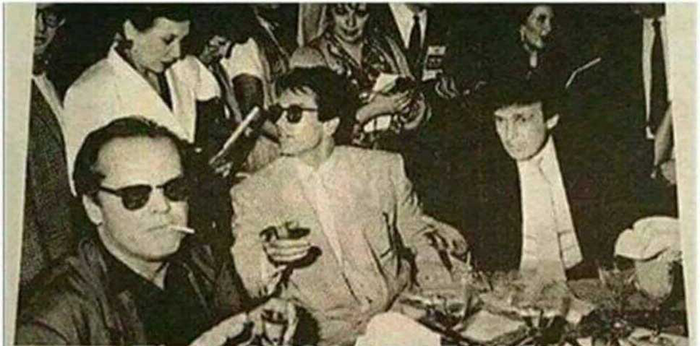
The current US President Donald Trump (right), then age 38, visiting Tehran along with US actors, Jack Nicholson (left) and Warren Beatty in 1978. Trump was planning to open a casino (one of the reasons he has close ties to today’s casino king, arch-Zionist Sheldon Adelson) and nightclub in the north of Iran, but his plans were scuttled because of the instability leading up to the culmination of the Revolution, which would occur the following year. One need not guess over Trump’s decades-old vendetta against Islamic Iran as it prevented him from expanding his criminal business empire (read that, his mob empire) in areas that would have been free and clear of US taxation. Not only did the new Islamic leadership reject his “business” initiatives in the country, but it took a principled stand against the predatory and rapacious practices of the American business elite, which was used to being accommodated with all sorts of luxuries and prostitutes during the proxy reign of the Shah.
Further, Islamic Iran had openly challenged the oppressive exploitative global order and defeated it in one geographical area. Left unchecked and unchallenged, its influence would spread. Despite massive anti-Iran and anti-Islam propaganda and sabotage, Islamic Iran has made enormous strides. Its influence has spread both at the intellectual as well as political and geostrategic levels. We in the Crescent International can claim some credit for acting as a bridge between Islamic Iran and the wider Muslim Ummah, indeed the rest of the world or that part of it where people are not totally blinded by Western propaganda.
It must also be mentioned that the resilience to survive these serious challenges came from one source: the Iranian leadership and people’s reliance on Allah (swt) and Allah alone. This is called the power of Islam. It needs elaboration. Every system is based on certain ideas, suppositions about human nature, and values (sometimes, these values are morals, while in other instances, material considerations). The former Soviet Union and its satellites were based on Marxist ideology. The West has pursued capitalism. Muslims have the Islamic system of governance but only one country — Iran — has truly adopted it in contemporary history.
Communism has long been abandoned while capitalism is on its deathbed because it has deepened global inequalities both within and between societies. This has resulted in immense suffering everywhere. The world is a deeply troubled place today.
If we focus on the Muslim East (aka the Middle East), the picture is not only dismal it is deeply problematic. There is hardly a country that is free of turmoil, degradation, and dysfunction, whether internally generated or externally imposed. Most regimes are also totally subservient to the imperialists and Zionists and exist at their mercy. Islamic Iran, on the other hand, despite four decades of illegitimate Western sanctions, has not only weathered these challenges but has emerged much stronger.
Others states, such as Iraq, that were subjected to similar sanctions, have suffered grievously, resulting in mass poverty, starvation, and the death of hundreds of thousands of people. In Iran’s case, far from bringing it to its knees, the leadership has used sanctions as an opportunity to develop a resistance economy, as repeatedly stressed by the Rahbar, Imam Seyyed Ali Khamenei. True, not every segment of the government machinery has followed this advice thereby resulting in problems for ordinary people. These, however, pale into insignificance compared to the very serious problems even some Western countries — France, Britain, and the US — are facing. The neo-liberal world is now in terminal decline, and in all cases, the problem is its obeisance to capitalism — a system that thrives on wealth inequality and class indignation. The US is on the run in the Muslim East. Can the Zionist regime be very far behind?
It also needs emphasizing that the Islamic Republic is not a perfect model of an Islamic state. There are good and not so good people in the government and state machinery. What is indisputable is that the overall ethos is Islamic and that the establishment is totally committed to and sincere about Islamic values and principles. The Rahbar is a modicum of wisdom and taqwa; he has been a truly worthy successor of Imam Khomeini.
Under his leadership, the resistance front has emerged stronger and is able to successfully challenge the oppressive powers. This is just as evident in Syria as it is in Yemen and now increasingly in Palestine. The days of imperialist and Zionist hegemony are over. Their nervousness is evident from the shrill propaganda they indulge in against Islamic Iran these days. Their client regimes are also destined to the dung heap of history, sooner rather than later, insha’allah.
 

Zafar Bangash