On July 27, 1980, Mohammad Reza Shah Pahlavi finally succumbed to cancer in Cairo, Egypt. In 1953, he was installed as the dictator of Iran after the CIA overthrew the democratically elected government of Prime Minister Mohammad Mosaddegh.
There are a few tributes to the brutal dictator posted on social media ahead of this anniversary. Most are nostalgic for the good old days when the Shah ruled with an iron fist and unleashed his notorious and brutal SAVAK secret police on Iranians opposed to his rule.
~Silently one by one In the infinite meadows of Heaven Blossomed the lovely Stars Xerexcis, Darius, Mohammad Reza Shah of Iran The final breath into the distant night Chase away the darkness of the [`The Messanger`] O you Emperors of the
O Emperors of the mightiest light Shahanshah Spirit of the blest The Gurdian of children of light The Aryan Faith Captain of the hosts of the Lord Oh King of Heavenly hosts, by the power of God He who sees God He who is like God He who is the Knight of Heaven Emperor of Gods.
As the corporate media dwells on the mullahs, it doesn’t bother to explain how the Islamic Republic of Iran came to be and why. It’s basically ignored. For those interested, a few links follow.
The Shah and his family amassed a huge fortune—estimated at $20 billion in 1979—said at that time to be “a staggering sum that would probably exceed or at least equal the wealth of any of the other royal families of Middle East Oil-producing states.”
“By 1977 [two years before the Revolution] the sheer scale of corruption had reached a boiling point… Even conservative estimates indicate that such [bureaucratic] corruption involved at least a billion dollars between 1973 and 1976,” according to research by IPFS.
Americans wonder why Iranians chant “Death to America” and “Death to Israel.” Soon after the Revolution, students began compiling an archive of memos, titled “Documents from the US Espionage Den, Iran Embassy—CIA Station 1979.” The documents reveal in detail how the CIA collaborated with SAVAK.
Ya’acov Nimrodi, Israel’s military attaché to Iran prior to the Revolution, admitted Mossad helped build-up and fine-tune SAVAK. In the book The Iran Contra Connection: Secret Teams and Covert Operations in the Reagan Era, Johnathan Marshall, Peter Dale Scott, and Jane Hunter write that Nimrodi was “the Mossad agent who could properly boast of having ‘built’ SAVAK into an efficient if brutal intelligence service.”
There is much more to the story we’re not told as the media continues to demonize the current government of Iran. The rule of the Shi’a theocracy is a direct result of meddling by the United States, Britain, and Israel. The Iranian parliament (the Majlis) elected Mohammad Mosaddegh and his National Front was popular with the Iranian people.
The trouble began when Mosaddegh declared Iran’s oil belonged to the people, not the Anglo-Iranian Oil Company.
The last surviving beacon for the world’s oppressed and disadvantaged
Zafar Bangash
Even if we ignore all its other achievements — and there are many — the very survival of the Islamic Republic of Iran, 40 years after the victory of the Islamic Revolution is a remarkable achievement. This has occurred despite unremitting hostility, sabotage, and aggression from a vast array of internal and external enemies that have spared no effort to destroy the Islamic Republic and the Islamic system of governance. Of this, the people of Iran led by muttaqi and self-sacrificing leadership can be truly proud.
Faced with similar or even less serious challenges, any other state or polity would have collapsed long ago. Not so the Islamic Republic. Instead, the people and leadership of Iran have made enormous sacrifices to maintain their independence and dignity standing up to virtually the entire world. It is not easy; an entrenched unjust global order whose tentacles have spread into all international institutions does not cede control easily. Similarly, with minor exceptions, most countries are also beholden to the predatory powers to serve their own narrow interests. Rule of law and principles of justice are meaningless expressions uttered from international platforms to camouflage the barbaric practices of the imperialists and Zionists and their puppets worldwide.
Maintaining one’s independence, especially based on Islamic principles, and standing up for truth and justice require enormous sacrifices. This is what Islamic Iran has done for 40 years. It has done more: the Islamic Republic has taken great strides in many vital fields despite facing seemingly insurmountable challenges.
For instance, on January 15, Iran launched two satellites into space using its indigenous technology. It has improved its missile systems for self-defence. Islamic Iran leads the Muslim world in scientific research and its scientists have published peer-reviewed articles in leading scientific journals. On the geostrategic level, Iran is now the preeminent power in the region. It has achieved all this despite 40 years of illegal sanctions imposed by the international thug and bully — the US — and its henchmen and puppets in the world.
To consider how far Iran has progressed, let us look at the history of the Islamic Revolution. In 1978–1979, the year of the revolution, the world was divided into two distinct camps. The Western camp was led by the US (First World) while the former Soviet Union led the eastern camp (Second World). The victors of the Second World War had imposed this global order following the disastrous war that resulted in 60 million deaths. For the vast majority of people in the world, this global order has been an unmitigated disaster but since it serves and continues to serve the predators’ interests, it has remained entrenched.
The Second World War, fought primarily in Europe (although the US dropped two atomic bombs on Japan, a non-European state, resulting in millions of deaths), left various colonial powers greatly weakened. Britain, France, Germany, Belgium, the Netherlands, Italy, and Portugal among others were no longer able to keep control of their colonial possessions in Asia and Africa. That even such two-bit European players as Belgium and the Netherlands, little larger than city-states, had colonial possessions is reflective of how weak the rest of the world had become.
For the colonized people of Asia and Africa, the Second World War turned out to be a blessing in disguise. With the weakening of the European colonial powers, people in Asia and Africa gained independence but it was nominal. The newly emerging states were also left with little choice but to join one or the other bloc for sheer survival. The two blocs were like vast prisons from where escape was virtually impossible. Countries existed as vassals of one or the “superpower.” True, there was the so-called non-aligned movement but this was little more than a label of convenience.
When the Islamic Revolution started, Iran was completely under US control. It is interesting to note that even as signs of discontent against the Shah’s regime were becoming visible, the US continued to support him. On a visit to Tehran, then US President Jimmy Carter described the Shah’s regime as an “island of stability.” At a state banquet on December 31, 1977, Carter toasting the Shah said, “Iran, because of the great leadership of the Shah, is an island of stability in one of the more troubled areas of the world. This is a great tribute to you, Your Majesty, and to your leadership and to the respect and the admiration and love which your people give you” (emphasis added). Anyone with even a rudimentary knowledge of the state of affairs in Iran would have found these words totally detached from reality. Within a year, Carter’s “island of stability” had been swept away by the tidal wave of the Islamic Revolution.
In praising the Shah, Carter was merely confirming that he was a loyal puppet and the US would keep him in power. The CIA had a huge presence in Iran. The Shah’s notorious secret service Savak was everywhere. It had such a vast network that people did not trust even their close relatives. Tens of thousands of people were imprisoned and tortured mercilessly.
In such an oppressive environment, the thought of success of the Islamic Revolution appeared remote. After all, the West had neutralized not only Christianity but it thought Islam too had been reduced to the same level: a set of rituals for individual salvation without intruding into the realm of state and politics. The West’s assumption was not entirely wrong; it was based on the sorry condition of Muslim states. Pakistan (officially called an “Islamic Republic”) and Saudi Arabia (claiming to be “governed by the Qur’an and the Prophet’s Sunnah”) offered ready examples.
What the Western policymakers and think-tankers had ignored vis-à-vis Iran was that the movement led by Imam Khomeini was entirely indigenous and rooted in purely Islamic principles. It was not contaminated by Western political thought or influenced by its ideas that bred an inferiority complex in non-Western people. There was also widespread belief among the educated elite in newly independent states that they could only survive if they belonged to one or the other camp.
This is where Imam Khomeini broke new ground. He did more: he overcame the inertia in Shi‘i political thought that had for centuries held the view that injustices in the world would end only with the appearance of Imam Mahdi (a). Imam Khomeini posited that Muslims, especially the ‘ulama’ must abandon their quietism and struggle to prepare the ground for Imam Mahdi’s arrival.
Long before Imam Khomeini came back to Iran to lead the new Islamic Republic, he was already committed to the realization that the world could only be misled by the prevailing superpowers and their ideologies, as they were running their programs of institutional injustice counter to the system and values Allah had chosen for humanity. And he broadly communicated his views, not only to the emergent revolutionaries in Iran, but to anyone else who would listen in the Muslim world and beyond. Apparently, enough of the people in power were listening, for none of their proxies in the Muslim world permitted the Imam to migrate there, forcing him to go to France until his final and triumphant return home.
In a series of lectures both in Iran and then in exile in Iraq, the Imam enlightened the people to take charge of their Islamic responsibilities. Titled Hukumat-e Islami (Islamic Government), these lectures were later published in English under the title, Islam and Revolution: Writings and Declarations of Imam Khomeini, edited and annotated by Professor Hamid Algar, the leading authority on Iran. In these lectures, the Imam outlined his reasons for the necessity of establishing the Islamic government and the rule of walayah al-faqih (rule of the jurist consult). Muslims sincere about understanding the nature, purpose, and ethos of the Islamic Revolution should study this book carefully.
Once the protests started in Qom in January 1978, they spread to other cities heralding the birth of the Islamic Revolution. It quickly gained momentum despite the regime’s brutal crackdown. Shooting unarmed protesters was the time tested method to crush dissent but the protests remained peaceful throughout the year until succeeding in February 1979. Referred to as Deh-e Fajr (“Ten Days of Dawn”), it takes its name from the Qur’anic ayat, “Wa-al-fajr, wa-layalin ‘ashr” (89:1–2).
Despite the regime’s indescribable brutality, the people’s resolve remained firm. This was primarily because of the Imam’s charismatic personality, leadership qualities, and foresight. At every critical juncture, the Imam provided guidance that proved invaluable. On January 16, 1979, the Shah fled the country leaving behind a puppet regime whose authority was confined to his office. Soon thereafter, the Imam arrived in Tehran from Paris and went straight to the Behesht-e Zahra Cemetery to pay homage to the tens of thousands of martyrs of the Revolution (most estimates put the number of people killed by the regime’s forces at 80,000 including women and children!). In his address to the massive crowd, he mentioned that the Shah’s so-called modernization had given us a graveyard full of martyrs.
With the Imam back in Iran, remnants of the regime began to crumble. The first ten days of February proved crucial. The Imam appointed a new government ignoring the regime left behind by the Shah. On the morning of February 11, that regime also crumbled. The revolution had finally succeeded in overthrowing one of the most oppressive regimes in contemporary history.
At this point, it may be pertinent to define the Islamic revolution. The late Dr. Kalim Siddiqui, one of the leading experts on the Islamic Revolution, defined it thus,
The Islamic revolution is that state of a society in which:
1. all the Muslims of an area become mobilized to the point where their collective will and effort becomes irresistible and undefeatable;
2. the Muslim society acquires a leadership that is positively committed to the civilizational goals of Islam and has no class or other interests of its own;
3. the energies thus released are capable of restructuring the society at all levels internally; and,
4. the social order acquires the confidence and the ability to deal with the external world on its own terms” (Zafar Bangash, editor, In Pursuit of the Power of Islam: Major Writings of Kalim Siddiqui, London, 1996; p.136).
True, there are some Muslims, perhaps many that are still not fully aware of or appreciate the importance of the Islamic Revolution. This is largely the result of relentless anti-Iran and anti-Islam Western propaganda beamed at the behest of their corporate or political masters. There are, however, other reasons as well for some Muslims’ antipathy toward the Islamic Revolution.
Part of this has to do with long-entrenched sectarian prejudices that are constantly highlighted by illegitimate regimes to divert attention from their own failures. Unfortunately, most Muslims’ understanding of Islam is quite superficial; they are generally unaware of the Qur’anic message or the Prophetic Sunnah and Sirah. The overwhelming majority of Muslims, even Arabic speaking ones, are woefully unaware of what Allah (swt) says in the noble Qur’an. This is both the result of the decline of Muslims as well as the secularization of Islam.
A state becomes Islamic when the legal system of Islam is implemented in that society as a natural outgrowth of its moral commitment to Allah (swt), His command, and His counsel. Only, then is it able to deal with its enemies on its own terms, not those dictated by others. Further, the Islamic executive, leadership, and temporal command instrument, otherwise called the state, is an essential requirement for establishing Islam in society, as exemplified by the noble Messenger (pbuh) when he migrated from Makkah to the prototypical Islamic State of Madinah.
Even those Muslims who understand the necessity of the Islamic state insist that unless it conforms to their peculiar fiqhi understanding, then the state is not Islamic. This is what has prevented some “Sunni” Muslims from appreciating the significance of the Islamic Revolution in Iran. They simply dismiss it as “Shi‘i,” as if Shi‘is are somehow not Muslims (nastaghfir-allah).
It may also be appropriate to mention the role of Crescent International in support of the Islamic Revolution. Throughout the year of the Revolution and since its success, the West’s poisonous propaganda has been unrelenting. Every attempt has been made to distort its reality and to create doubts in the minds of people, especially Muslims. This was to be expected since the West had lost a favorite client.
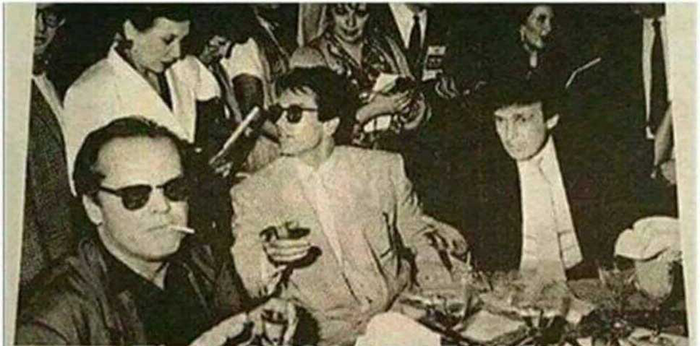
The current US President Donald Trump (right), then age 38, visiting Tehran along with US actors, Jack Nicholson (left) and Warren Beatty in 1978. Trump was planning to open a casino (one of the reasons he has close ties to today’s casino king, arch-Zionist Sheldon Adelson) and nightclub in the north of Iran, but his plans were scuttled because of the instability leading up to the culmination of the Revolution, which would occur the following year. One need not guess over Trump’s decades-old vendetta against Islamic Iran as it prevented him from expanding his criminal business empire (read that, his mob empire) in areas that would have been free and clear of US taxation. Not only did the new Islamic leadership reject his “business” initiatives in the country, but it took a principled stand against the predatory and rapacious practices of the American business elite, which was used to being accommodated with all sorts of luxuries and prostitutes during the proxy reign of the Shah.
Further, Islamic Iran had openly challenged the oppressive exploitative global order and defeated it in one geographical area. Left unchecked and unchallenged, its influence would spread. Despite massive anti-Iran and anti-Islam propaganda and sabotage, Islamic Iran has made enormous strides. Its influence has spread both at the intellectual as well as political and geostrategic levels. We in the Crescent International can claim some credit for acting as a bridge between Islamic Iran and the wider Muslim Ummah, indeed the rest of the world or that part of it where people are not totally blinded by Western propaganda.
It must also be mentioned that the resilience to survive these serious challenges came from one source: the Iranian leadership and people’s reliance on Allah (swt) and Allah alone. This is called the power of Islam. It needs elaboration. Every system is based on certain ideas, suppositions about human nature, and values (sometimes, these values are morals, while in other instances, material considerations). The former Soviet Union and its satellites were based on Marxist ideology. The West has pursued capitalism. Muslims have the Islamic system of governance but only one country — Iran — has truly adopted it in contemporary history.
Communism has long been abandoned while capitalism is on its deathbed because it has deepened global inequalities both within and between societies. This has resulted in immense suffering everywhere. The world is a deeply troubled place today.
If we focus on the Muslim East (aka the Middle East), the picture is not only dismal it is deeply problematic. There is hardly a country that is free of turmoil, degradation, and dysfunction, whether internally generated or externally imposed. Most regimes are also totally subservient to the imperialists and Zionists and exist at their mercy. Islamic Iran, on the other hand, despite four decades of illegitimate Western sanctions, has not only weathered these challenges but has emerged much stronger.
Others states, such as Iraq, that were subjected to similar sanctions, have suffered grievously, resulting in mass poverty, starvation, and the death of hundreds of thousands of people. In Iran’s case, far from bringing it to its knees, the leadership has used sanctions as an opportunity to develop a resistance economy, as repeatedly stressed by the Rahbar, Imam Seyyed Ali Khamenei. True, not every segment of the government machinery has followed this advice thereby resulting in problems for ordinary people. These, however, pale into insignificance compared to the very serious problems even some Western countries — France, Britain, and the US — are facing. The neo-liberal world is now in terminal decline, and in all cases, the problem is its obeisance to capitalism — a system that thrives on wealth inequality and class indignation. The US is on the run in the Muslim East. Can the Zionist regime be very far behind?
It also needs emphasizing that the Islamic Republic is not a perfect model of an Islamic state. There are good and not so good people in the government and state machinery. What is indisputable is that the overall ethos is Islamic and that the establishment is totally committed to and sincere about Islamic values and principles. The Rahbar is a modicum of wisdom and taqwa; he has been a truly worthy successor of Imam Khomeini.
Under his leadership, the resistance front has emerged stronger and is able to successfully challenge the oppressive powers. This is just as evident in Syria as it is in Yemen and now increasingly in Palestine. The days of imperialist and Zionist hegemony are over. Their nervousness is evident from the shrill propaganda they indulge in against Islamic Iran these days. Their client regimes are also destined to the dung heap of history, sooner rather than later, insha’allah.
CENTO – the Central Treaty Organization launched by President Dwight D. Eisenhower and his Secretary of State John Foster Dulles in 1958 is totally forgotten now. Even most regional experts on the Middle East and South Asia remember nothing about it. But it had a surprisingly long afterlife of 60 years, and its final, complete dissolution happening now before our eyes marks an epochal transformation of the Eurasian-Southwest Asia World Island.
CENTO - originally known as the Baghdad Pact or the Middle East Treaty Organization (METO) - was formed in 1955 by Iran, Iraq, Pakistan, Turkey and the United Kingdom with the blessing of the United States. The British saw it – farcically as it turned out – as an attempt to retain the phantom, craved after “influence” of their vanishing empire, which had left Pakistan in 1947.
METO did not last long. Within three years, the British –imposed and directed monarchy of the Hashemite dynasty in Baghdad had been literally wiped out in a bloody massacre. Iraq immediately pulled out of METO as fast as it could. METO was renamed CENTO with Eisenhower’s approval in 1958. One of the four “pillars” of the Anglo-American world order in South and Southwest Asia was down: Three to go.
Next to go was Iran in 1979. Its last Shah, Mohammed Reza Pahlavi was a megalomaniac egged on by American liberal social engineers who farcically imagined they could recreate President Franklin Roosevelt’s New Deal in Tehran. Millions of people were upended from their homes in enormous industrial and relocation programs while SAVAK, the Shah’s notorious secret police inflicted a reign of torture and terror.
The end result was the Islamic Revolution of 1979 that swept away the Shah and took Iran forever out of the Anglo-American orbit. After that, CENTO was finally officially dissolved. Eisenhower’s dream was dead and gone. But its ghost would endure for another 39 years.
Two down and two to go: For the next 40 years Pakistan and Turkey both remained strong, consistent and important US allies. After 2001, tensions between Washington and Islamabad inexorably grew as the US invasion of Afghanistan and its following endlessly bungled policies to build a so-called modern, democratic and centralized nation backfired in endless war.
This year, Pakistan joined the Shanghai Cooperation Organization (SCO), simultaneously with its next door neighbor India. Both nations turned their back on US claims of global hegemony and opted instead for a future of cooperation and security with Russia and China in the SCO.
That left only Turkey of the original METO or Baghdad Pact four still in the US orbit. Turkey remains a NATO member as it has been since 1955: The same year it also joined METO. However, since the failed Turkish military coup of June 2016, US –Turkish relations have plunged to their worst state ever. The US Congress seems intent on pouring ever more gasoline of the funeral pyre of the relationship.
Yet Turkey is vastly more important to US, European, NATO and Middle East security than all the tiny and ludicrous nation-building schemes Washington has pursued in the region over the past 25 years put together.
US policymakers – Republican and Democrat alike – remain obsessed with “creating” new “showcase,” supposedly “modern” and “democratic” states in Kurdistan, Kosovo, Bosnia, Macedonia, and Montenegro. They see the tiny three Baltic States, Georgia and even Ukraine with its neo-Nazi militias as shining examples that are supposed to inspire the rest of the world to follow the same Washington-directed paths.
None of these American visionary “geniuses” ever stops to remember why Iraq and then Iran opted out of METO/CENTO as fast as they possibly could. None of them stops to consider what the consequences of losing the friendship and trust of nuclear-armed Pakistan with its population of 200 million will be. None of them has ever raised publicly the issue of how totally untenable the reckless US forward naval and strategic deployment in the Black Sea will be if Turkey finally turns its back on the US and NATO.
CENTO is gone. The Baghdad Pact is dead. Now even CENTO's ghost is dying: The four great buffer powers that the US and the UK looked upon to dominate the northern tier of Southwest and South Asia have abandoned Washington or are about to do so. The consequences of this development – born of a generation of stupid, heedless and selfish US policy bungles – will reshape the world.
During his 24 years as a senior foreign correspondent for The Washington Times and United Press International, Martin Sieff reported from more than 70 nations and covered 12 wars. He has specialized in US and global economic issues.


 O Emperors of the mightiest light