Showing posts with label Over throw of Mohammad Mossadegh. Show all posts

Thursday, June 27, 2019

As Conflict With Iran Escalates, Path To Peace Can Be Found

 Co-Written by Kevin Zeese and Margaret Flowers
The recent escalation of conflict between the United States and Iran threatens another US military quagmire that would create crisis and chaos in Iran, the region and perhaps globally as well as costing the US trillions of dollars. The US needs to change course — a deeply wrong course it has been on regarding Iran since the 1950s, escalating since Iran declared its independence in their 1979 Revolution. There is a path out of this situation, but it requires leadership from President Trump, which will only come if the people of the United States mobilize to demand it.
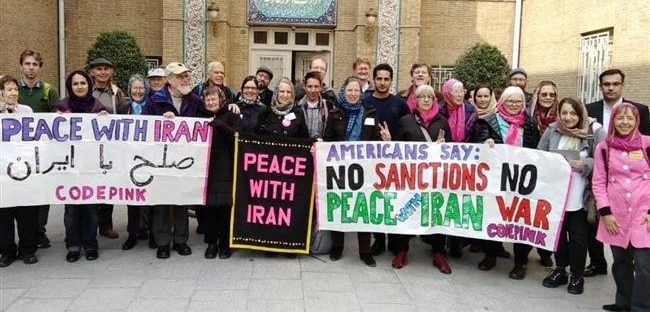
Peace Delegation to Iran at the Iranian Foreign Ministry, February 2019. Photograph from CODE PINK.
The Trump Story Of Last Minute Decision Not To Attack Iran, Doubted
The story repeated in the corporate media, including the New York Times, Washington, Post, CNN, ABC News, and others is that President Trump called off a military attack on Iran at the last moment because he was told that 150 Iranians could be killed. It is evident this was the story being pushed by the White House. Initially, the story was that Trump stopped the bombing with ten minutes to spare, while the planes were already in the air. On Sunday, the story changed to Trump was asked for a decision by the Pentagon a half hour before the attack and said ‘no’ to the attack because he was told about civilian casualties.
This story is being doubted by many. Even on FOX News, two of its leading broadcasters, Shepard Smith and Chris Wallace, said Trump’s story of stopping the attack at the last moment, “does not hold water” and “something is wrong here.” They talked with former military officials and said it was highly unlikely that the president would not have been told of the likely casualties from the possible military scenarios.
Did President Trump really think the US could drop bombs on Iran and not kill people? Trump broke the record for bombs dropped in Afghanistan when in 2018 he dropped more than 5,200 bombs. The UN found that in 2019, the US and its allies were responsible for the majority of civilian deaths in Afghanistan. In 2017, President Trump loosened the rules on drone strikes causing a significant escalation in drone strikes. The US and its allies dropped more than 20,000 bombs in 2017 in Syria, reducing cities to literal rubble. With this record, how can anyone believe Trump was worried about a potential 150 deaths in Iran?
And, bombs are not the only way President Trump kills people. Economic coercive measures (aka sanctions) in Venezuela put in place by President Trump in August 2017 have resulted in 40,000 deaths. In Iran, Trump has escalated sanctions to choke the economy and create hardship for the Iranian people. Sanctions are as deadly as war but are worse because people find them to be more palatable than bombs.
If it was not a concern for the death of civilians, why did Trump not bomb Iran in response to the drone being shot down?
Iranian Surface to Air Missile Defense System on display in 2012 at an Iranian military parade. By Ata Kenare for AFP-Getty Images
Iran Shows it can Defend Itself Against a US Military Attack
One concern about the destruction of the US drone is whether it was over Iranian airspace when it was destroyed. Iran maintains that it was in their airspace. The US claims it was in international air space, but the US lacks credibility when it makes such claims. Perhaps one reason Trump has not acted is he knows Iran was within its rights.
Iran reports that they did not shoot down the drone until after giving several warnings to the United States.  Major General Hossein Salami of the Revolutionary Guard said, “The downing of the US drone had an explicit, decisive and clear message that defenders of the Islamic Iran’s borders will show decisive and knockout reactions to aggression against this territory by any alien.”
According to Reuters, Amirali Hajizadeh, the head of the Revolutionary Guard’s aerospace division, said that a manned US Boeing P-8 Poseidon surveillance plane was also in Iranian airspace at the same time as the drone. Iran decided not to shoot it down because there were 35 people on board. Hajizadeh said, the US “plane also entered our airspace and we could have shot it down, but we did not.”
Reuters also reported that Iran received a message from the United States through Oman that a military strike was imminent and that Trump was against any war with Iran but wanted to talk to Iran about various issues. Iran responded: “We made it clear that the leader is against any talks, but the message will be conveyed to him to make a decision … However, we told the Omani official that any attack against Iran will have regional and international consequences.”
Iran shot down the drone with a Surface to Air Missile that was an Iranian-produced defense system. This illustrates that a military conflict with the Islamic Republic would be very challenging for the United States. The Center for Strategic and International Studies reports that Iran has the largest and most diverse missile arsenal in the Middle East. Tehran views missile defense as vital against Washington’s aggression. The missile attack on the US drone shows Iran has aerial defense capability.
Military Times reports how difficult war with Iran would be writing, “Iranian coastal defenses would likely render the entire Persian Gulf off-limits to U.S. Navy warships. Iran’s advanced surface-to-air missile defenses would be a significant threat to U.S. pilots. And Iran’s arsenal of ballistic missiles and cruise missiles put U.S military installations across the U.S. Central Command region at risk. The cost in U.S. casualties could be high.”
The big problem for the United States is it simply does not have the military power to keep the Strait of Hormuz  open, 30% of the world’s oil supply transits the Persian Gulf and the Strait of Hormuz. Chairman of the Chiefs of Staff of the Iranian Armed Forces, Major General Mohammad Baqeri, stated reality clearly: “If the Islamic Republic of Iran were determined to prevent export of oil from the Persian Gulf, that determination would be realized in full and announced in public, in view of the power of the country and its Armed Forces.”
Pepe Escobar explains the Iranian border of the Persian Gulf is lined up with anti-ship missiles and Iran’s ballistic missiles are capable of hitting “carriers in the sea” with precision. He explains that blocking the Strait would dramatically increase oil prices and detonate “the $1.2 quadrillion derivatives market; and that would collapse the world banking system, crushing the world’s $80 trillion GDP and causing an unprecedented depression.”
Iran’s allies in Lebanon, Syria, Iraq, Yemen, and Afghanistan are ready for joint operations in response to a US military war against Iran.  According to Eliajah J.Magnier, they are prepared and on alert at the highest level. Joint operations will begin from the moment they are necessary. According to sources, Iran’s allies will open fire against already agreed on objectives in an organized, orchestrated, synchronized and graduated response, anticipating a war that may last many months. The US will face war on many fronts very quickly.
The US lacks international support for a military attack on Iran. Russia, China, the European Union, and other major powers have called for de-escalation. A military attack on Iran would lead to a quagmire that could take a decade or more and end in defeat for the United States, destruction in Iran and chaos in the region. The US has spent more than $7 trillion since the beginning of the Iraq War and Iran is larger in geography and population as well as having a better militarily. The United States cannot afford another $7+ trillion dollar war for another decade. It would be an economic and military disaster that would further isolate the United States.
Peace Delegation to Iran visits the Tehran Peace Museum 2019. Photograph from Popular Resistance.
Iran in Context and a Path Out of the US-Created Debacle
In our conversation on the Clearing the FOG podcast, which will air Monday, June 24, conflict resolution expert, Patrick Hiller, explained how sometimes to resolve a conflict, the conflict must be heightened. The US conflict with Iran is escalating in dangerous ways where perhaps both sides can see that the path to war will produce no winners and could be the greatest foreign policy error in US history.
President Trump can be the hero as the US heads into 2020 presidential elections but it will require him to stop listening to National Security Advisor, John Bolton and Secretary of State, Mike Pompeo, who both want war with Iran. Their advice is the opposite of President Trump’s criticism of war during his last campaign. They have teamed up to undermine Trump’s negotiations with North Korea, prevent the withdrawal of US troops from Syria, led him into a failed coup in Venezuela and now to the brink of war with Iran. Trump would be wise to replace both Bolton and Pompeo.
The idiocy of Pompeo was shown this week when he claimed Iran’s actions “should be understood in the context of 40 years of unprovoked aggression.” Is Pompeo really that ignorant of history?
Popular Resistance has often reported on the US overthrow of the democratically-elected government of  Prime Minister Mohammed Mossadegh in August 1953. The CIA has confirmed its role in this coup as has the US State Department. This coup ended Iran’s brief experience with a secular democracy. If that democracy had been allowed to flourish, the story of the Middle East would have been very different than the war, chaos and brutal governments we have seen since that time. Mossadegh was followed by the US puppet, the Shah, who brutally ruled the country until the Iranian Revolution of 1979.
After the Iranian Revolution, the US encouraged and supported the eight-year Iraq War against Iran with money, naval assistance, and weapons. The US provided Iraq with the ingredients for chemical weapons as well as intelligence on where to use them. More than one million people were killed and more than 80,000 were injured by chemical weapons in the war.
The US also killed 290 Iranians, including 66 children, when a US missile shot down a commercial Iranian airliner in July 1988. The US has never apologized for this mass killing of civilians. The US has imposed aggressive economic sanctions against Iran since they declared their independence and has consistently escalated those sanctions in an attempt to destroy their economy. And, the US has spent millions of dollars to build opposition inside Iran to the Iranian government as well as working with the opposition, MEK,  secretly trained by the US military, which is branded a terrorist group by Iran (and used to be designated a terrorist group by the US).
The US has imposed economic sanctions since 1980 when the US broke diplomatic relations with Iran. President Carter put in place sanctions including freezing $12 billion in Iranian assets and banning imports of Iranian oil. The economic war and the illegal unilateral coercive measures have been escalated by every president, including by President Trump when he violated the carefully negotiated nuclear agreement. Iran’s Foreign Minister Zarif painstakingly negotiated the 2015 Iran Nuclear Deal between China, France, Russia, the UK, Germany, and the European Union for more than a decade. Instead of abiding by the agreement, the US violated it and escalated sanctions against Iran.
The US is also fomenting rebellion. The Trump administration has been seeking regime change through various actions including violence. Trump created a Mission Center in the CIA focused on regime change in Iran and spends millions of dollars to encourage opposition in Iran, working to manipulate protests to support a US agenda.
The path out of this mess is for President Trump to lead. He needs to acknowledge this history and the mistakes of his advisors, Bolton and Pompeo, rejoin the nuclear agreement, abide by it by lifting the illegal US sanctions and promise to abide by international law.  It will take positive actions by the United States to make up for decades of aggressive abuses against Iran to bring Iran to the table of diplomacy.
If these steps are taken, a positive relationship based on mutual respect can be developed between the US and Iran. It is the job of the peace movement and all those who seek stability and justice in the world to work toward this outcome.

Join Us For The People’s Mobilization Against The US War Machine

The US War Machine Must Be Stopped, And Only We Can Stop It. That’s Why We Are Organizing The People’s Mobilization To Stop The US War Machine, A Series Of Actions In New York City From September 20 To 23 While The United Nations General Assembly Meets. Sign Up Here.
Kevin Zeese and Margaret Flowers are directors of Popular Resistance where this article originally published

Thursday, May 16, 2019

Attacking Iran Would Mean Global Disaster

On Monday, 13 May 2019, the New York Times posted an article with the title “White House Reviews Military Plams Against Iran. in Echoes of Iraq War”. Besides the aircraft carrier and other naval forces already sent to the Persian Gulf, plans include sending as many as 120,000 US troops to the region. There is a great danger that an attack on Iran might be sparked by a Gulf-of-Tonkin-like false flag incident involving Saudi oil ships.
Why is this threat especially worrying? Such a war would completely destabilize the already-unstable Middle East. In Pakistan, the unpopularity of the US-Israel alliance, as well as the memory of numerous  atrocities, might lead to the overthrow of Pakistan’s less-than-stable government. Israel’s response might be a preemptive attack on Pakistan’s nuclear installations. Russia and China might also be drawn into the conflict. There would be a grave danger of escalation into a full-scale nuclear war.
Iran is a peaceful nation but has often been attacked
Iran has an ancient and beautiful civilization, which dates back to 7,000 BC, when the city of Susa was founded. Some of the earliest writing that we know of, dating from from approximately 3,000 BC, was used by the Elamite civilization near to Susa. Today’s Iranians are highly intelligent and cultured, and famous for their hospitality, generosity and kindness to strangers. Over the centuries, Iranians have made many contributions to science, art and literature, and for hundreds of years they have not attacked any of their neighbors. Nevertheless, for the last 90 years, they have been the victims of foreign attacks and interventions, most of which have been closely related to Iran’s oil and gas resources. The first of these took place in the period 1921-1925, when a British-sponsored coup overthrew the Qajar dynasty and replaced it by Reza Shah.
Reza Shah (1878-1944) started his career as Reza Khan, an army officer. Because of his high intelligence he quickly rose to become commander of the Tabriz Brigade of the Persian Cossacks. In 1921, General Edmond Ironside, who commanded a British force of 6,000 men fighting against the Bolsheviks in northern Persia, masterminded a coup (financed by Britain) in which Reza Khan lead 15,000 Cossacks towards the capital. He overthrew the government, and became minister of war. The British government backed this coup because it believed that a strong leader was needed in Iran to resist the Bolsheviks. In 1923, Reza Khan overthrew the Qajar Dynasty, and in 1925 he was crowned as Reza Shah, adopting the name Pahlavi.
Reza Shah believed that he had a mission to modernize Iran, in much the same way that Kamil Ata Turk had modernized Turkey. During his 16 years of rule in Iran, many roads were built, the Trans-Iranian Railway was constructed, many Iranians were sent to study in the West, the University of
Tehran was opened, and the first steps towards industrialization were taken. However, Reza Shah’s methods were sometimes very harsh.
In 1941, while Germany invaded Russia, Iran remained neutral, perhaps leaning a little towards the side of Germany. However, Reza Shah was suffciently critical of Hitler to offer safety in Iran to refugees from the Nazis. Fearing that the Germans would gain control of the Abadan oil  fields, and
wishing to use the Trans-Iranian Railway to bring supplies to Russia, Britain invaded Iran from the south on August 25, 1941. Simultaneously, a Russian force invaded the country from the north. Reza Shah appealed to Roosevelt for help, citing Iran’s neutrality, but to no avail. On September 17, 1941, he was forced into exile, and replaced by his son, Crown Prince Mohammed Reza Pahlavi. Both Britain and Russia promised to withdraw from Iran as soon as the war was over. During the remainder of World War II, although the new Shah was nominally the ruler of Iran, the country was governed by the allied occupation forces.
Reza Shah, had a strong sense of mission, and felt that it was his duty to modernize Iran. He passed on this sense of mission to his son, the young Shah Mohammed Reza Pahlavi . The painful problem of poverty was everywhere apparent, and both Reza Shah and his son saw modernization of Iran
as the only way to end poverty.
In 1951, Mohammad Mosaddegh became Prime Minister of Iran through democratic elections. He was from a highly-placed family and could trace his ancestry back to the shahs of the Qajar dynasty. Among the many reforms made by Mosaddegh was the nationalization of the Anglo-Iranian Oil
Company’s possessions in Iran. Because of this, the AIOC (which later became British Petroleum), persuaded the British government to sponsor a secret coup that would overthrow Mosaddegh. The British asked US President Eisenhower and the CIA to join M16 in carrying out the coup, claiming
that Mosaddegh represented a communist threat (a ludicrous argument, considering Mosaddegh’s aristocratic background). Eisenhower agreed to help Britain in carrying out the coup, and it took place in 1953. The Shah thus obtained complete power over Iran.
The goal of modernizing Iran and ending poverty was adopted as an almost-sacred mission by the young Shah, Mohammed Reza Pahlavi, and it was the motive behind his White Revolution in 1963, when much of the land belonging to the feudal landowners and the crown was distributed to landless villagers. However, the White Revolution angered both the traditional landowning class and the clergy, and it created fierce opposition. In dealing with this opposition, the Shahs methods were very harsh, just as his fathers had been. Because of alienation produced by his harsh methods, and because of the growing power of his opponents, Shah Mohammed Reza Pahlavi was
overthrown in the Iranian Revolution of 1979. The revolution of 1979 was to some extent caused by the British-American coup of 1953.
One can also say that the westernization, at which both Shah Reza and his son aimed,  produced an anti-western reaction among the conservative elements of Iranian society. Iran was “falling between two stools”, on the one hand western culture and on the other hand the country’s traditional culture. It seemed to be halfway between, belonging to neither. Finally in 1979 the Islamic clergy triumphed and Iran chose tradition.
Meanwhile, in 1963 the US had secretly backed a military coup in Iraq that brought Saddam Hussein’s Ba’ath Party to power.  In 1979, when the western-backed Shah of Iran was overthrown, the United States regarded the fundamentalist Shi’ite regime that replaced him as a threat to supplies of oil from Saudi Arabia. Washington saw Saddam’s Iraq as a bulwark against the Shi’ite government of Iran that was thought to be threatening oil supplies from pro-American states such as Kuwait and Saudi Arabia.
In 1980, encouraged to do so by the fact that Iran had lost its US backing, Saddam Hussein’s government attacked Iran. This was the start of a extremely bloody and destructive war that lasted for eight years, inflicting almost a million casualties on the two nations. Iraq used both mustard gas and the nerve gases Tabun and Sarin against Iran, in violation of the Geneva Protocol.
The present attacks on Iran by Israel and the United States, both actual and threatened, have some similarity to the war against Iraq which was launched by the United States in 2003. In 2003, the attack was nominally motivated by the threat that nuclear weapons would be developed, but the
real motive had more to do with a desire to control and exploit the petroleum resources of Iraq, and with Israel’s extreme nervousness at having a powerful and somewhat hostile neighbor. Similarly, hegemony over the huge oil and gas reserves of Iran can be seen as one the main reasons why the United States is presently demonizing Iran, and this is combined with Israel’s almost paranoid fear of a large and powerful Iran. Looking back on the “successful” 1953 coup against Mosaddegh, Israel and the United States perhaps feel that sanctions, threats, murders and other pressures can cause a regime change that will bring a more compliant government to power in Iran – a government that will accept US hegemony. But aggressive rhetoric, threats and provocations can escalate into full-scale war.
I do not wish to say that Iran’s present government is without serious faults. However, any use of violence against Iran would be both insane and criminal. Why insane? Because the present economy of the US and the world cannot support another large-scale conflict; because the Middle East is already a deeply troubled region; and because it is impossible to predict the extent of a war which, if once started, might develop into World War III, given the fact that Iran is closely allied with both Russia and China. Why criminal? Because such violence would violate both the UN Charter and the Nuremberg Principles. There is no hope at all for the future unless we work for a peaceful world, governed by international law, rather than a fearful world where brutal power holds sway.
References
  1. Sir Percy Sykes, A History of Persia – 2nd edition, MacMillan, (1921).
  2. Paula K. Byers, Reza Shah Pahlavi, Encyclopedia of World Biography
    (1998).
  3. Roger Hoffman, The Origins of the Iranian Revolution, International
    A airs 56/4, 673-7, (Autumn 1980).
  4. Daniel Yergin, The Prize: The Epic Quest for Oil, Money and Power,
    Simon and Schuster, (1991).
  5. Sampson, The Seven Sisters: The Great Oil Companies of the World
    and How They Were Made, Hodder and Staughton, London, (1988).
  6. James Risen, Secrets of History: The C.I.A. in Iran, The New York
    Times, April 16, (2000).
  7. Mark Gasiorowski and Malcolm Byrne, Mohammad Mosaddegh and the
    1953 Coup in Iran, National Security Archive, June 22, (2004).
  8. Roosevelt, Countercoup: The Struggle for the Control of Iran, McGraw-
    Hill, New York, (1979).
  9. Abrahamian, Iran Between Two Revolutions, Princeton University
    Press, Princeton, (1982).
  10. T. Klare, Resource Wars: The New Landscape of Global Conflict, Owl Books reprint edition, New York, (2002).
  11. M. Blair, The Control of Oil, Random House, New York, (1976).
John Scales Avery is a theoretical chemist at the University of Copenhagen. He is noted for his books and research publications in quantum chemistry, thermodynamics, evolution, and history of science. His 2003 book Information Theory and Evolution set forth the view that the phenomenon of life, including its origin, evolution, as well as human cultural evolution, has its background situated in the fields of thermodynamics, statistical mechanics, and information theory. Since 1990 he has been the Chairman of the Danish National Group of Pugwash Conferences on Science and World Affairs. Between 2004 and 2015 he also served as Chairman of the Danish Peace Academy. He founded the Journal of Bioenergetics and Biomembranes, and was for many years its Managing Editor. He also served as Technical Advisor to the World Health Organization, Regional Office for Europe (19881997).

Sunday, February 03, 2019

Four Decades Ago: US Fueled “Most Repressive Regime in the World”

42 years ago, an article published by The Daily Iowan, “US Imperialism and the Shah,” lamented United States-sponsored terrorism against the Iranian people, which was nearing the breaking point. The author, a second-year law student who later became an attorney named Robin B. Potter, who at the time, was a member of the US-based Revolutionary Student Brigade (RSB), explained how the relentlessly brutal dictator, the Shah, acting as a puppet for US government interests, allowed the US economy to reap the harvests of Iran’s oil, while the people of Iran suffered under a torturous, totalitarian leader. Subjected to constant scrutiny, individuals and groups who opposed the Shah’s tyrannical rule drew the attention of the Shah’s secret police, known as SAVAK. They were used to torture political opponents and dissidents while imprisoning more than 100,000 Iranian citizens.

Iranian students attending college in the US in 1977 – the group named “Daneshjouian Irani”- in a letter to the editor carried by The Daily Iowan, wrote, “The CIA created the SAVAK in Iran in 1956 and over the last 25 years has created and controlled the most repressive regime in the world.”

At the same time that the SAVAK wreaked havoc on the free-thinking Iranian population, corporate US business interests, with the CIA’s backing, maintained 30,000 “advisers” in Iran in 1977 and provided millions of dollars in military arms and hardware. I suspect that many young people today in the US have no idea what a jagged, violent and deceitful path US politicians chose to follow in order to either harness Iran’s financial revenues, or seek its total destruction. Most do not know that the US instructed Saddam Hussein, another US puppet, to invade and occupy Iran in the Iran-Iraq War, which left 300,000 Iranian people dead, and they probably don’t know that the US Navy once blasted an Iranian airliner filled with hundreds of people out of the sky and then adamantly refused to accept guilt or accountability for the murderous act.

These are the events that shaped present-day relations between the United States and Iran today. Yes, Iran took many Americans hostage during the infamous “Hostage Crisis” in 1979, but it is also a fact that all were released alive. Still, the chagrin the Americans felt over that incident would be the reason for more unapologetic reprisals. Once US politicians lost the ability to profit from Iran, the country was immediately placed on America’s hit list.

Former US President Dwight D. Eisenhower famously revealed the truth when he said, “Lord knows what we’d do without Iranian oil.” Well Dwight, Americans would have had to live more humbly, they would have needed to drive economy cars like the rest of the world, instead of 6,000 pound beasts twenty feet long with engines often in excess of four liters. Americans would have had to listen to former US President Jimmy Carter when he told the nation on public television that they were living beyond their means; this even before credit card mania overtook Americans, causing them to all become like hamsters in a wheel, unable to get off, constantly worrying about paying off their growing debts.

In “US Imperialism and the Shah,” Potter wrote that the US government, “permits the SAVAK to spy openly on Iranian students and dissidents living in this country. Besides installing the ruthless dictator, the United States has assisted the Shah in building a complete intelligence network for the purpose of monitoring the Persian Gulf movements of foreign powers like the Soviet Union in the area, as well as to police his opposition.”

The same things gripping the state of the world in 2018, were well underway more than three decades ago. The article and attitude among progressive Americans at that time was that, “…the same investments, the same companies and moneybags who have their fingers in the Iranian economy and profit by the oppressive nature of its social system.”

Interestingly, at the time of the article, South Africa was still under full apartheid oppression and Black Africans were considered second-rate citizens as the Palestinians and African migrants are to the Israelis today. It’s as though they just keep trading positions instead of learning from mistakes. Greed, racial and religious superiority absolutely dominate the politics of the US and other oppressive regimes.

The article referenced here is republished on the Website, MohammadMossadegh.com. Mossadegh of course was Iran’s western educated democratically elected Prime Minister, who the US removed from power in a coup d’etat in 1953. Why? Because Mossadegh could read the writing on the wall and after many years of western governments and their corporate allies absolutely ripping Iran off over oil prices, he decided to nationalize oil and oust the Anglo Iranian Oil Company, today known as British Petroleum. This led the British to collaborate with the newly formed US CIA and overthrow Iran’s government, in order to install the Shah.

In fact The Economist reported 8 March, 1975, that the Shah was so oppressive, that he made an announcement about three principles that all Iranians must believe in: those were the monarchy, the constitution, and the Shah’s “white revolution.” He said those who accepted the principles he insisted upon, had to join the Shah’s new party. Those who refused to accept those tenets, the Shah said, should, “leave the country or go to jail.”

That is what the US government did to the Iranian people by forcibly removing their elected leader and installing the Shah. The US has been at odds with Iran since 1979 and while the US remains constantly engaged in unilateral overseas military engagements that claim many lives and brew endless controversy, Iran has not attacked a nation outside of its borders for hundreds of years.

Sunday, August 19, 2018

1953 coup plotters still fearful of Iran


Today marks the 1953 coup in Iran. 65 has passed since that date. Among Iranians it is known in as the 28 Mordad coup d'état.


On that day the streets of Tehran became the scene of violence and chaos by hooligans in support of Mohammad Reza Pahlavi. The violence was engineered by Britain and with the help of U.S. dollars. Finally, the democratically elected government of Mohammad Mosaddeq was toppled.
The coup was plotted to take avenge for the nationalization of oil in Iran on August 19, 1951. The nationalization of oil became possible through unity among nationalists and religionists.
The British, who saw unity among different groups of society as the main hurdle to their plundering of Iran, tried to create division among religionists and nationalists on the date the nationalization of oil was declared. They did so in order to create the ground for the return of Phalavi to power on August 19, 1953.
The coup was the highlight of suppression and despotism and the plundering of national resources until the victory of the Islamic Revolution in February 1979.


There are many stories about the role of Britain and the U.S. in the coup. However, Kermit Roosevelt, the chief of the CIA's Near East and Africa division who was director of the coup, said in an interview that it was the first secret operation against a foreign government which had been engineered at the end of the Truman administration.
These revelations show that due to political, geopolitical and economic reasons, foreigners have always had a covetous eye on Iran and that such moves have not been limited to the post-1979 revolution.


Needless to say that regardless of who has been in power in Washington or London, the U.S. and Britain have not yet abandoned their evil intentions toward Iranians, a nation that many experts say has civilizational superiority.
These moves show that the leaders of liberal democracy, from Dwight D. Eisenhower to Donald Trump, have been fearful of Iran no matter the nationalists have been ruling this country or proponents of Islamic republicanism.  

Saturday, February 17, 2018

Three Decades Ago: US Fueled “Most Repressive Regime in the World”


31 years ago today, an article published by The Daily Iowan, “US Imperialism and the Shah,” lamented United States-sponsored terrorism against the Iranian people, which was nearing the breaking point. The author, a second-year law student who later became an attorney named Robin B. Potter, who at the time, was a member of the US-based Revolutionary Student Brigade (RSB), explained how the relentlessly brutal dictator, the Shah, acting as a puppet for US government interests, allowed the US economy to reap the harvests of Iran’s oil, while the people of Iran suffered under a torturous, totalitarian leader. Subjected to constant scrutiny, individuals and groups who opposed the Shah’s tyrannical rule drew the attention of the Shah’s secret police, known as SAVAK. They were used to torture political opponents and dissidents while imprisoning more than 100,000 Iranian citizens.

Iranian students attending college in the US in 1977 – the group named “Daneshjouian Irani”- in a letter to the editor carried by The Daily Iowan, wrote, “The CIA created the SAVAK in Iran in 1956 and over the last 25 years has created and controlled the most repressive regime in the world.”

At the same time that the SAVAK wreaked havoc on the free-thinking Iranian population, corporate US business interests, with the CIA’s backing, maintained 30,000 “advisers” in Iran in 1977 and provided millions of dollars in military arms and hardware. I suspect that many young people today in the US have no idea what a jagged, violent and deceitful path US politicians chose to follow in order to either harness Iran’s financial revenues, or seek its total destruction. Most do not know that the US instructed Saddam Hussein, another US puppet, to invade and occupy Iran in the Iran-Iraq War, which left 300,000 Iranian people dead, and they probably don’t know that the US Navy once blasted an Iranian airliner filled with hundreds of people out of the sky and then adamantly refused to accept guilt or accountability for the murderous act.

These are the events that shaped present-day relations between the United States and Iran today. Yes, Iran took many Americans hostage during the infamous “Hostage Crisis” in 1979, but it is also a fact that all were released alive. Still, the chagrin the Americans felt over that incident would be the reason for more unapologetic reprisals. Once US politicians lost the ability to profit from Iran, the country was immediately placed on America’s hit list.

Former US President Dwight D. Eisenhower famously revealed the truth when he said, “Lord knows what we’d do without Iranian oil.” Well Dwight, Americans would have had to live more humbly, they would have needed to drive economy cars like the rest of the world, instead of 6,000 pound beasts twenty feet long with engines often in excess of four liters. Americans would have had to listen to former US President Jimmy Carter when he told the nation on public television that they were living beyond their means; this even before credit card mania overtook Americans, causing them to all become like hamsters in a wheel, unable to get off, constantly worrying about paying off their growing debts.

In “US Imperialism and the Shah,” Potter wrote that the US government, “permits the SAVAK to spy openly on Iranian students and dissidents living in this country. Besides installing the ruthless dictator, the United States has assisted the Shah in building a complete intelligence network for the purpose of monitoring the Persian Gulf movements of foreign powers like the Soviet Union in the area, as well as to police his opposition.”

The same things gripping the state of the world in 2018, were well underway more than three decades ago. The article and attitude among progressive Americans at that time was that, “…the same investments, the same companies and moneybags who have their fingers in the Iranian economy and profit by the oppressive nature of its social system.”

Interestingly, at the time of the article, South Africa was still under full apartheid oppression and Black Africans were considered second-rate citizens as the Palestinians and African migrants are to the Israelis today. It’s as though they just keep trading positions instead of learning from mistakes. Greed, racial and religious superiority absolutely dominate the politics of the US and other oppressive regimes.

The article referenced here is republished on the Website, MohammadMossadegh.com. Mossadegh of course was Iran’s western educated democratically elected Prime Minister, who the US removed from power in a coup d’etat in 1953. Why? Because Mossadegh could read the writing on the wall and after many years of western governments and their corporate allies absolutely ripping Iran off over oil prices, he decided to nationalize oil and oust the Anglo Iranian Oil Company, today known as British Petroleum. This led the British to collaborate with the newly formed US CIA and overthrow Iran’s government, in order to install the Shah.

In fact The Economist reported 8 March, 1975, that the Shah was so oppressive, that he made an announcement about three principles that all Iranians must believe in: those were the monarchy, the constitution, and the Shah’s “white revolution.” He said those who accepted the principles he insisted upon, had to join the Shah’s new party. Those who refused to accept those tenets, the Shah said, should, “leave the country or go to jail.”

That is what the US government did to the Iranian people by forcibly removing their elected leader and installing the Shah. The US has been at odds with Iran since 1979 and while the US remains constantly engaged in unilateral overseas military engagements that claim many lives and brew endless controversy, Iran has not attacked a nation outside of its borders for hundreds of years.