Showing posts with label Reza Khan. Show all posts

Wednesday, December 18, 2019

Britain's Major Plunder of Iranian Oil in 1903

The British government of Clement Attlee labeled the sales of Iran’s nationalized oil as ‘theft’ and all who may get involved in the transaction of Iranian oil would be prosecuted under ‘international law’.
By Sadegh Abbasi*
The first illegal concession to explore, obtain, and market oil, natural gas, asphalt, and ozocerite was given to William Knox D’Arcy and became known as D’Arcy concession. This concession was gained through bribes to those Iranian officials who were the signatory of the deal(1). Since the illegal D’arcy Concession was reached, Britain agreed to pay %16 of the net oil profits(2). But Britain has always been committed in falsifying its books for calculation of the Iranian share of the profits(3). The sum received through taxation from APOC by the British government was higher than the share of Iranians(4). The public opposition to this illegal concession mounted to the Constitutional Revolution of Iran and establishment of Majlis in 1906 so people can take royal decisions under the balance of a parliament.
William Knox D’Arcy
William Knox D’Arcy
 
British government came into possession of %51 of the shares of APOC and thus became directly involved in the oil concession(5). As oil was a better fuel than coal(6) for the British fleet, and as it was gained through plundering of Iranian resources ended up to be cheaper for the British Navy. Britain were receiving reports that Germans are building all-oil battleships and thought that it is necessary to have such battleships to match the speed and power of the German fleet(7). 

British government bought oil at a considerable discount from APOC and by adding the taxation it received from the company, oil price was actually close to zero for the this country. Therefore, British government immediately converted to oil fuel. British government began to throw its support behind APOC with indirect financial assistance and political backing in 1909. Thanks to the cheap Iranian oil, British Navy became mightier during the two World Wars and in their colonial conquests in the face of its rivals. Oil soon became a strategic asset for political dominance of Britain over the whole world as Britain was at the time in possession of the biggest refinery in world; Abadan Refinery in Iran.
Abadan refinery; the biggest refinery at the time

During World War I all efforts were made by Britain to secure the continuous flow of oil from Iran. But Germans managed to launch an attack on Iranian pipelines through their proxies in Iran and achieved to make an interruption in the oil flow. As Abadan Refinery had a critical importance for winning the war, the British army were sent to Iran to maintain a total control over southern Iran in a total breach of International conventions. Even the British went further by claiming that Iran was responsible for this attack and as a result cut the falsified royalties that used to be paid to Iran until the damage caused by this attack was being settled. 

In order to gain a much tighter control on Iran politically and economically, the British preceded to have the 1919 Agreement being signed. But at this time, they were faced with a democratic institution called Majlis(8). According to the 1906 Iranian Constitution (article XIV), Parliamentary approval was necessary for every agreement to make it binding and operative but thanks to British illegal actions and bribery they managed to strike a deal with the Iranian government and the king and managed to circumvent the ratification by the Parliament(9). To get the Agreement, the British started to bribe the Qajar princes, Prime Minister and the king(10). They even started to exert their influence on the Iranian Parliament by dictating the candidates who were favorable to them(11), to prevent any opposition from the Parliament. 

300,000 pounds were paid to the Iranian press to support the 1919 Agreement which was very unpopular among the Iranian public.(12) There was a growing opposition from the Iranian public about the 1919 agreement(13) and the bribery that was used to get the signs under this agreement. Modarres, a Shia clergy and the speaker of Parliament was a proponent of political Islam and the main figure of opposition against the Anglo-Persian Agreement. Modarres was an able and strong popular politician with an impeccable constitutionalist and anti-imperialist record, and had excellent connections within the political establishment as well as among the Ulema, the bazaar and ordinary people. But finally the Agreement was signed in August 1919 in total negligence of Iranian public opinion.

It caused the second Jangali campaign in Gilan by Kuchek Khan who was encouraged also by Modarres.(14) This campaign was driven back by the British Norperforce (North Persia Force)(15). Khiyabani, another opposition figure to the 1919 Agreement, launched his successful revolt in Tabriz in the beginning of April 1920, when the draft agreement reached Tehran. But this uprising was finally suppressed and Khiyabani was killed. These opposition events were examples among so many other movements that occurred across the country and were formed in reaction to the 1919 Agreement and were all suppressed in the end.

Following the 1919 Anglo-Iranian Treaty, Britain's position was so powerful that the Council of Peace in Paris was disturbed that the secret treaty would make Persia (later renamed by Reza Khan to Iran) a British protectorate(16). A point that was shared by all political spectrum in Iran(17). Due to domestic and international mounting pressures, this Agreement was suspended and then annulled by Parliament in February 1921(18). But all these events did not stop Iran’s oil being extracted by the British over another illegal agreement called Amitage-Smith which was also not ratified by Majlis. All these agreements excluded the northern area of Iran for exploration. Despite this fact, British government who controlled APOC founded a new subsidiary called North Persian Oil Company. Aware of the double cause for discontent among the Iranian public, the British staged their first coup in Iran in 1921 and brought a repressive dictator named Reza Khan who was famous for his brutal character. 
(Reza Khan visiting Abadan Refinery, 1930. (By courtesy of BP Archives

The flow of oil was secured by Reza Khan and all who were discontent were killed, imprisoned or exiled and the terms under D’Arcy Concession continued to be viable for the British government. Under 1901 agreement, Iran was to receive only %16 of the share from the net oil profits which actually never took place. From 1901 to 1919 this share amounted to Zero and in 1920-29 period, Iran received only about 5 percent of the net profit(19). Even now Iran has a highly oil-reliant economy, and considering this it becomes obvious what it means to receive the meager sum of £ 300,000 a year from the APOC (AIOC under Reza Khan) as a contribution to the Iranian GDP.
The British company never permitted its books to be audited so as to show the Iranian side that they are paying what has been promised which soon became a source of outrage among the Iranian public and culminated in a temporary cancelation of the D’Arcy Concession by Reza Shah.
Reza Shah who came to power with a British-backed coup did not seek to terminate the British monopoly on the Iranian oil but was urged by the public opinion of the time to do something about it. So he renegotiated the terms of the previous concession to create more transparency in payment of the royalties but instead extended the D’Arcy Concession up to 1993, which was initially set to expire in 1961. Nevertheless, AIOC continued to falsify its accounts. As by 1950, Iran received only 8 percent of the total oil exports.

Iranian workers' condition at Anglo-Persian Oil Company

By the time when the Iranian parliament voted to nationalize oil on 15 march 1951, almost all political views were against the monopoly of the British over the Iranian oil. In London, the Labour government of Clement Attlee was shocked by this decision: “It labeled the Iranian nationalists ‘ungratefuls,’ ‘paranoiacs,’ ‘thieves’ and ‘unreliable,’ to cite a few of epithets wielded by British ministers and diplomats at the time. Labour’s obdurate and reactionary attitude was quite paradoxical for a government that made ‘nationalization’ a pillar of its political program and was undertaking several operations of that kind in Great Britain.”(20) Attlee nationalized one fifth of the British government(21) but considered nationalization to be forbidden in Iran.

The Abadan Refinery and its oil became subject of a cruel sanction by Attlee’s cabinet who labeled the sales of Iran’s oil as ‘theft’ and all who may get involved in the transaction of Iranian oil would be prosecuted under ‘international law’. Consequently, Iran’s oil production rate plummeted from 650,000 barrels per day in 1951 to only 20,000 bpd in 1953. The flow of cheap oil was being threatened in the midst of Cold War and the Korean War. Under Churchill this policy was reinforced as he viewed Mossadeq as a reckless demagogue intent on the theft of ‘British property’(22).  Iranian property was even considered as British property! Meanwhile the U.S. which took the path of its close ally Britain has already became reliant on Iranian oil as the latter had become the main U.S. supplier of oil during its Korean war. So these two countries with the collaboration of one another finally staged the 1953 coup against the democratically elected government of Mohammad Mosaddegh in Iran to guarantee cheap oil flow under the pro-Nazi government of General Zahedi who was installed by them after the coup. It was under Zahedi that Anglo-Iranian Oil Company renamed its name to be able to return to Iran.
.Anglo-Iranian Oil Company being renamed to British Petroleum(BP). The same company which is reponsible for Gulf of Mexico oil spill in 2010

The nationalization of oil did not truly take place up until the popular uprising of Iranian nation in 1979 and the sole revolution that brought democracy and independence that was unprecedented in Iranian history.

*Sadegh Abbasi is a Junior M.A. student at Tehran University. As a student in history he has also worked as a contributor to different Iranian news agencies.


________________
1. Daniel Yergin (2011). The Prize: The Epic Quest for Oil, Money & Power. Simon and Schuster. p. 121. https://books.google.com/books?id=WiUTwBTux2oC&pg=PA121&lpg
2. Ibid
3. Boghoziyan, Albert. One for Us, Six for Britons!: William Knox D'Arcy in History of Iran. 28 May 2015. Web. 25 Oct. 2015. http://www.iranreview.org/content/Documents/One-for-Us-Six-for-Britons-.htm
4. Mohaddes, K. and M.H. Pesaran (2013), One hundred years of oil income and the Iranian economy: a curse or blessing, Cambridge Working Papers in Economics 1302, Faculty of Economics, University of Cambridge. http://www.econ.cam.ac.uk/people/cto/km418/100_Iranian_Oil.pdf
5. ibid
6. For technical superiority of oil over coal in navies see: David C. Evans; Mark R. Peattie (30 October 2012). Kaigun: Strategy, Tactics, and Technology in the Imperial Japanese Navy 1887-1941. Seaforth Publishing. p. 158. https://books.google.com/books?id=iSDOAwAAQBAJ&pg=PA158&lpg and Roy Nersesian (18 December 2014). Energy for the 21st Century: A Comprehensive Guide to Conventional and Alternative Sources. Routledge. p. 139. https://books.google.de/books?id=bFDfBQAAQBAJ&pg=PA139&lpg
7. Manfred Weissenbacher (2009). Sources of Power: How Energy Forges Human History. ABC-CLIO. p. 373. https://books.google.de/books?id=dcYHzuFLZP0C&pg=PA373&lpg
8. Iranian Parliament
9.  Encyclopedia of Iranica. ANGLO-PERSIAN AGREEMENT OF 1919. Retrieved October 25, 2015. 
http://www.iranicaonline.org/articles/anglo-persian-agreement-1919
10. Cyrus Ghani; Sīrūs Ghanī (2000). Iran and the Rise of the Reza Shah: From Qajar Collapse to Pahlavi Power. I.B.Tauris. p. 55. https://books.google.de/books?id=VGZItY9kL0AC&pg=PA55&lpg
11. Ibid. pp. 53
12. Touraj Daryaee (19 January 2012). The Oxford Handbook of Iranian History. Oxford University Press. p. 343. https://books.google.de/books?id=KjQ_AwAAQBAJ&pg=PA343&lpg
13. Ghani, (5 September 2013). Iran & The West. Taylor & Francis. p. 368. https://books.google.de/books?id=Xdy3AAAAQBAJ&pg=PT368&lpg
14. Ervand Abrahamian (1993). Khomeinism: Essays on the Islamic Republic. University of California Press. p. 101. https://books.google.de/books?id=iQgS6ZRg9gQC&pg=PA101&lpg
15. Touraj Atabaki (4 September 2006). Iran and the First World War: Battleground of the Great Powers. I.B.Tauris. p. 97 https://books.google.de/books?id=M3adD9kNH1gC&pg=PA97&lpg
16. Associated Press, 28 August 1919
17. Homa Katouzian (2012). Iranian History and Politics: The Dialectic of State and Society. Routledge. p. 165. https://books.google.de/books?id=MYT2mo92KowC&pg=PT165&lpg
18. Ibid
19. Op. Cit. Mohaddes and Pesaran (2013) http://www.econ.cam.ac.uk/people/cto/km418/100_Iranian_Oil.pdf
20. Leonardo Maugeri (2006). The Age of Oil: The Mythology, History, and Future of the World's Most Controversial Resource. Greenwood Publishing Group. p. 66. https://books.google.com/books?id=JWmx5uKA6gIC&pg=PA66&lpg
21. https://www.gov.uk/government/history/past-prime-ministers/clement-attlee
22. Jim Newton (4 October 2011). Eisenhower: The White House Years. Knopf Doubleday Publishing Group. p. 103. https://books.google.de/books?id=bbH1QYXxtMcC&pg=PA103&lpg

Thursday, May 16, 2019

Attacking Iran Would Mean Global Disaster

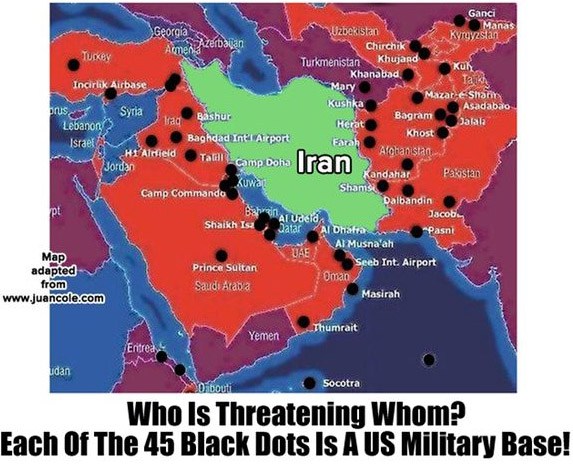
On Monday, 13 May 2019, the New York Times posted an article with the title “White House Reviews Military Plams Against Iran. in Echoes of Iraq War”. Besides the aircraft carrier and other naval forces already sent to the Persian Gulf, plans include sending as many as 120,000 US troops to the region. There is a great danger that an attack on Iran might be sparked by a Gulf-of-Tonkin-like false flag incident involving Saudi oil ships.
Why is this threat especially worrying? Such a war would completely destabilize the already-unstable Middle East. In Pakistan, the unpopularity of the US-Israel alliance, as well as the memory of numerous  atrocities, might lead to the overthrow of Pakistan’s less-than-stable government. Israel’s response might be a preemptive attack on Pakistan’s nuclear installations. Russia and China might also be drawn into the conflict. There would be a grave danger of escalation into a full-scale nuclear war.
Iran is a peaceful nation but has often been attacked
Iran has an ancient and beautiful civilization, which dates back to 7,000 BC, when the city of Susa was founded. Some of the earliest writing that we know of, dating from from approximately 3,000 BC, was used by the Elamite civilization near to Susa. Today’s Iranians are highly intelligent and cultured, and famous for their hospitality, generosity and kindness to strangers. Over the centuries, Iranians have made many contributions to science, art and literature, and for hundreds of years they have not attacked any of their neighbors. Nevertheless, for the last 90 years, they have been the victims of foreign attacks and interventions, most of which have been closely related to Iran’s oil and gas resources. The first of these took place in the period 1921-1925, when a British-sponsored coup overthrew the Qajar dynasty and replaced it by Reza Shah.
Reza Shah (1878-1944) started his career as Reza Khan, an army officer. Because of his high intelligence he quickly rose to become commander of the Tabriz Brigade of the Persian Cossacks. In 1921, General Edmond Ironside, who commanded a British force of 6,000 men fighting against the Bolsheviks in northern Persia, masterminded a coup (financed by Britain) in which Reza Khan lead 15,000 Cossacks towards the capital. He overthrew the government, and became minister of war. The British government backed this coup because it believed that a strong leader was needed in Iran to resist the Bolsheviks. In 1923, Reza Khan overthrew the Qajar Dynasty, and in 1925 he was crowned as Reza Shah, adopting the name Pahlavi.
Reza Shah believed that he had a mission to modernize Iran, in much the same way that Kamil Ata Turk had modernized Turkey. During his 16 years of rule in Iran, many roads were built, the Trans-Iranian Railway was constructed, many Iranians were sent to study in the West, the University of
Tehran was opened, and the first steps towards industrialization were taken. However, Reza Shah’s methods were sometimes very harsh.
In 1941, while Germany invaded Russia, Iran remained neutral, perhaps leaning a little towards the side of Germany. However, Reza Shah was suffciently critical of Hitler to offer safety in Iran to refugees from the Nazis. Fearing that the Germans would gain control of the Abadan oil  fields, and
wishing to use the Trans-Iranian Railway to bring supplies to Russia, Britain invaded Iran from the south on August 25, 1941. Simultaneously, a Russian force invaded the country from the north. Reza Shah appealed to Roosevelt for help, citing Iran’s neutrality, but to no avail. On September 17, 1941, he was forced into exile, and replaced by his son, Crown Prince Mohammed Reza Pahlavi. Both Britain and Russia promised to withdraw from Iran as soon as the war was over. During the remainder of World War II, although the new Shah was nominally the ruler of Iran, the country was governed by the allied occupation forces.
Reza Shah, had a strong sense of mission, and felt that it was his duty to modernize Iran. He passed on this sense of mission to his son, the young Shah Mohammed Reza Pahlavi . The painful problem of poverty was everywhere apparent, and both Reza Shah and his son saw modernization of Iran
as the only way to end poverty.
In 1951, Mohammad Mosaddegh became Prime Minister of Iran through democratic elections. He was from a highly-placed family and could trace his ancestry back to the shahs of the Qajar dynasty. Among the many reforms made by Mosaddegh was the nationalization of the Anglo-Iranian Oil
Company’s possessions in Iran. Because of this, the AIOC (which later became British Petroleum), persuaded the British government to sponsor a secret coup that would overthrow Mosaddegh. The British asked US President Eisenhower and the CIA to join M16 in carrying out the coup, claiming
that Mosaddegh represented a communist threat (a ludicrous argument, considering Mosaddegh’s aristocratic background). Eisenhower agreed to help Britain in carrying out the coup, and it took place in 1953. The Shah thus obtained complete power over Iran.
The goal of modernizing Iran and ending poverty was adopted as an almost-sacred mission by the young Shah, Mohammed Reza Pahlavi, and it was the motive behind his White Revolution in 1963, when much of the land belonging to the feudal landowners and the crown was distributed to landless villagers. However, the White Revolution angered both the traditional landowning class and the clergy, and it created fierce opposition. In dealing with this opposition, the Shahs methods were very harsh, just as his fathers had been. Because of alienation produced by his harsh methods, and because of the growing power of his opponents, Shah Mohammed Reza Pahlavi was
overthrown in the Iranian Revolution of 1979. The revolution of 1979 was to some extent caused by the British-American coup of 1953.
One can also say that the westernization, at which both Shah Reza and his son aimed,  produced an anti-western reaction among the conservative elements of Iranian society. Iran was “falling between two stools”, on the one hand western culture and on the other hand the country’s traditional culture. It seemed to be halfway between, belonging to neither. Finally in 1979 the Islamic clergy triumphed and Iran chose tradition.
Meanwhile, in 1963 the US had secretly backed a military coup in Iraq that brought Saddam Hussein’s Ba’ath Party to power.  In 1979, when the western-backed Shah of Iran was overthrown, the United States regarded the fundamentalist Shi’ite regime that replaced him as a threat to supplies of oil from Saudi Arabia. Washington saw Saddam’s Iraq as a bulwark against the Shi’ite government of Iran that was thought to be threatening oil supplies from pro-American states such as Kuwait and Saudi Arabia.
In 1980, encouraged to do so by the fact that Iran had lost its US backing, Saddam Hussein’s government attacked Iran. This was the start of a extremely bloody and destructive war that lasted for eight years, inflicting almost a million casualties on the two nations. Iraq used both mustard gas and the nerve gases Tabun and Sarin against Iran, in violation of the Geneva Protocol.
The present attacks on Iran by Israel and the United States, both actual and threatened, have some similarity to the war against Iraq which was launched by the United States in 2003. In 2003, the attack was nominally motivated by the threat that nuclear weapons would be developed, but the
real motive had more to do with a desire to control and exploit the petroleum resources of Iraq, and with Israel’s extreme nervousness at having a powerful and somewhat hostile neighbor. Similarly, hegemony over the huge oil and gas reserves of Iran can be seen as one the main reasons why the United States is presently demonizing Iran, and this is combined with Israel’s almost paranoid fear of a large and powerful Iran. Looking back on the “successful” 1953 coup against Mosaddegh, Israel and the United States perhaps feel that sanctions, threats, murders and other pressures can cause a regime change that will bring a more compliant government to power in Iran – a government that will accept US hegemony. But aggressive rhetoric, threats and provocations can escalate into full-scale war.
I do not wish to say that Iran’s present government is without serious faults. However, any use of violence against Iran would be both insane and criminal. Why insane? Because the present economy of the US and the world cannot support another large-scale conflict; because the Middle East is already a deeply troubled region; and because it is impossible to predict the extent of a war which, if once started, might develop into World War III, given the fact that Iran is closely allied with both Russia and China. Why criminal? Because such violence would violate both the UN Charter and the Nuremberg Principles. There is no hope at all for the future unless we work for a peaceful world, governed by international law, rather than a fearful world where brutal power holds sway.
References
  1. Sir Percy Sykes, A History of Persia – 2nd edition, MacMillan, (1921).
  2. Paula K. Byers, Reza Shah Pahlavi, Encyclopedia of World Biography
    (1998).
  3. Roger Hoffman, The Origins of the Iranian Revolution, International
    A airs 56/4, 673-7, (Autumn 1980).
  4. Daniel Yergin, The Prize: The Epic Quest for Oil, Money and Power,
    Simon and Schuster, (1991).
  5. Sampson, The Seven Sisters: The Great Oil Companies of the World
    and How They Were Made, Hodder and Staughton, London, (1988).
  6. James Risen, Secrets of History: The C.I.A. in Iran, The New York
    Times, April 16, (2000).
  7. Mark Gasiorowski and Malcolm Byrne, Mohammad Mosaddegh and the
    1953 Coup in Iran, National Security Archive, June 22, (2004).
  8. Roosevelt, Countercoup: The Struggle for the Control of Iran, McGraw-
    Hill, New York, (1979).
  9. Abrahamian, Iran Between Two Revolutions, Princeton University
    Press, Princeton, (1982).
  10. T. Klare, Resource Wars: The New Landscape of Global Conflict, Owl Books reprint edition, New York, (2002).
  11. M. Blair, The Control of Oil, Random House, New York, (1976).
John Scales Avery is a theoretical chemist at the University of Copenhagen. He is noted for his books and research publications in quantum chemistry, thermodynamics, evolution, and history of science. His 2003 book Information Theory and Evolution set forth the view that the phenomenon of life, including its origin, evolution, as well as human cultural evolution, has its background situated in the fields of thermodynamics, statistical mechanics, and information theory. Since 1990 he has been the Chairman of the Danish National Group of Pugwash Conferences on Science and World Affairs. Between 2004 and 2015 he also served as Chairman of the Danish Peace Academy. He founded the Journal of Bioenergetics and Biomembranes, and was for many years its Managing Editor. He also served as Technical Advisor to the World Health Organization, Regional Office for Europe (19881997).

Sunday, December 02, 2018

Ayatollah Modarres, Martyr of Struggle against Despotism and Colonialism

Throughout the history of Iran, religious scholars have played the greatest role in the grassroots struggles in the way of freedom and justice.
Many of these scholars have sacrificed their life in this way. This has awakened the people and accelerated their struggle against despotism and colonialism. No doubt, one of the most prominent scholars, who fought domestic dictatorial regime and the foreign colonialism, was Ayatollah Seyyed Hassan Modarres. He was the scholar who bravely and strongly stood against the oppression of foreign regimes and their domestic agents so that he lost his life in this way.
Seyyed Hassan Modarres was born in 1870 in a village near Ardestan, a city in Isfahan province. His had a poor but religiously devoted family. Modarres started his studies with his father and continued them at the seminary of Isfahan. After 13 years, he attained the status of Ejtihad; but he left for holy Najaf in Iraq to continue his studies beside the sacred shrine of Imam Ali (AS). He attended the courses of eminent ulema of Najaf for 7 years. One of these brilliant masters of Islamic sciences was Grand Ayatollah Seyyed Hassan Shirazi, famous for his fatwa against the British colonial bill to confiscate Iran’s tobacco industry. Thus, Ayatollah Modarres returned to Isfahan at the age of 35 as an outstanding scholar and a precious Mujtahid. This was simultaneous with the developments in the aftermath of Constitutional Movement in Iran. From the very beginning, Modarres announced his support for the movement along some of the other ulema to curtail the dictatorship of the illiterate agent of British regime, Reza Khan Mir Panj.
Ayatollah Modarres had learnt this from Islamic teachings which emphasize on political and social issues. A Muslim has social responsibilities and his duties are not limited to individual acts of worship. The practice and behavior of the Prophet and his infallible successors show that they were never indifferent to the fate of the society. Great ulema, too, have always tried to solve the problems of people. But the colonial powers, especially Britain, have incessantly propagated that religion is separate from politics as they found that if Muslims interfere in political affairs of their countries, foreign-backed governments would be ousted and the path for pillaging the resources and reserves of Islamic nations would be blocked. Ayatollah Modarres, sensing the great danger of separation of religion and politics, said, “Our politics is the same as our religiosity; and out religiosity is the same as our politics.”
Ayatollah Modarres enters the arena of politics as a wakeful and conscious religious scholar. According to the Constitution of that era, 5 jurisprudents should supervise the laws of parliament to be compliant with Islamic criteria. Ayatollah Seyyed Hassan Modarres was one of these jurisprudents. Thus, in 1909, he came to Tehran and in his first speech at the parliament called everyone to unity and cooperation to achieve the goals of Constitutional movement and serving the people. But the parliament was closed down due to the Russian intervention and the stake of return of despotism. Ayatollah Modarres, used the opportunity to organize the affairs of religious seminaries and the students of these seminaries in a bid to train conscious and insightful ulema for the future of the country. Moreover, his house became the place of commutation of people and resolving their problems. The high number of votes of the people of Mashhad for Ayatollah Modarres in various rounds of the parliament, despite rigging by the government, indicated his high position among the people. Modarres was the real defender of the people’s rights inside and outside the parliament; hence he was the target of assassination attempts several times. Another factor which endeared him among masses was his simple way of living and compliance with the low strata of society. His astuteness and lack of dependence on material attachments made him a very brave combatant against oppression and colonialism.
Seeking independence and vehement opposition against colonialism were among the obvious traits of Ayatollah Modarres. Being aware of the international developments and the history of crimes of colonialists, he believed that no colonial government had the right to meddle in the internal affairs of Iran or any other country. During the First World War, the Iranian government declared neutrality which enraged the Russians and the British. The armies of these two governments occupied vase swathes of Iran’s soil in the north and the south of the country and massacred many people. In those days, with the endeavours of Ayatollah Modarres, many religious and national dignitaries got the impetus to form National Defence Committee so that they might prevent further calamities in the country. However, this move failed due to the advancement of the invading forces and Modarres went to Turkey for two years.
Ayatollah Modarres decisively opposed the 1919 agreement which was imposed by the Britain on the gullible premier, Vosuq-ul Dowla. According to the agreement, the affairs and resources of the country would entirely be at the British control. Nevertheless, severe oppositions of the ulema and the awareness of people forced the client government to rescind the execution of the unilateral agreement. After the failure of this plot, the British hatched another plot to bolster their influence in Iran. On February 1921, the staged a coup with the commandment of their stooge, Reza Khan. He was an illiterate, violent and excessively dictatorial person and at first had been appointed to the post of minister of war. Ayatollah Modarres was soon aware of the British stratagem and courageously contested the despotic and oppressive measures of Reza Khan.
When Reza Khan proclaimed the motto of changing the system of government from Constitutional to presidency, Ayatollah Modarres realized that that Britain desired to concentrate power in Reza Khan’s hand under the guise of presidency. Ayatollah Modarres embarked on enlightening the ulema and people about the real purpose of the British so that Reza Khan was forced to retreat from the scheme of formation of so-called presidential system. Shortly after, he called for dismantling the Qajarid dynasty and coming to power of Pahlavi rule which meant his own kingship.
The religious and national leaders, led by Ayatollah Modarres, were severely opposed to this anti-Constitutional bill; but Reza Khan imposed himself as Shah through the British support. In the 6th parliamentary elections, which were supervised by Reza Khan, a lot of pro-government candidates entered the parliament through rigging; but Ayatollah Modarres succeeded in garnering the highest number of votes and enter the parliament from Tehran constituency. Modarres continued his struggles against the dictatorial regime of Reza Khan more strongly. He was several times beaten by the hired agents of the regime and a few times been the target of assassination attempt which he escaped bravely. Once the illiterate British-installed Shah, Reza Khan, who was hysteric with the inexhaustible struggles of Ayatollah Modarres, asked him, “Why don’t you let go of me? What do you want of me?” Ayatollah Modarres answered him very tersely but bravely, “I want you not to be there as ruler.”
Elsewhere, he had said, “If you see that I express my opinion freely on many secrets and utter any truth fearlessly, is because I have nothing and don’t want anything from anyone.”
He also stressed, “God hasn’t given me two things: fear and greed. Anyone who is compliant with national interests and religious affairs I am with him; or else I will be opposed to him.”
The intensive criticisms of Ayatollah Modarres caused Reza Khan to lose his patience and announce in the next round of parliamentary elections that he hadn’t gained a single vote. But this great scholar said ironically, “Why don’t you announce even one vote that I had voted for myself?”
This time Reza Khan was scared of Ayatollah Modarres’s charismatic influence and love among people. Therefore, he ordered him to be exiled to Khaaf in the east of the country and seven years later on December 1, 1937, he ordered his agents to martyr this great combatant and brilliant scholar.
Imam Khomeini described the great character of Ayatollah Modarres in this way, “Our great martyr, Modarres, for whom epithets are deficient and small, was a bright star on the forehead of the country which had been dark due to the oppression and injustice of Reza Shah; and no one can understand the value of this lofty personality unless he had experienced that period. Our nation is indebted to his services and sacrifices.”

Sunday, August 19, 2018

The Gambler Plays His Last Card, But the Die is Already Cast Against the US

By: S. Nawabzadeh


Today, on the 19th of August in 1953, in the aftermath of World War 2, when the West Asian region was still grappling with the twilight of colonialism, the US, as the new superpower, was lured into oil-rich Iran by the wily British to overthrow the democratically-elected but weak and indecisive government of Prime Minister Dr. Mohammad Mosaddeq that had alienated itself from the Muslim masses by its wrong attitude towards the popular leader, Ayatollah Seyyed Abu’l-Qasim Kashani – in addition to misplaced trust in the yet-to-be discovered untrustworthy Uncle Sam.
Operation Ajax was a thus cakewalk, and all it required of Washington to bring back to Tehran the fugitive British-installed Mohammad Reza Pahlavi for use as a handy milk cow was to distribute a fistful of dollars amongst thugs and mercenary military officers.

Today 65 years later – 40 years after the US was kicked out from Iran by the people’s grassroots movement led by that Sage of Age, Imam Khomeini (RA) – the bloodied and bruised US, faced with humiliating defeats on all fronts in the region by states and masses inspired by the Islamic Republic of Iran and alarmed at the prospects of losing to the wheel of history the two remaining milk cows (Saudi Arabia and UAE), is making a futile bid to stay in the region.


And what a fantasy it has come up with! To firm up the drooping hearts of the tribal and tyrannical British created regimes in Riyadh and Abu Dhabi, which will collapse the moment the US is kicked out from the region, it has set up a so-called Iran Action Group at the State Department in Washington for what it calls the rolling back of Iranian influence and if possible change of government in Tehran – the first results of which is the hundred-million dollars doled out by the Saudis as initial payment for funding and arming thousands of terrorists flourishing in northeastern Syria under the illegal presence of the US.
If wishes were horses the dotard Donald Trump would be the emperor of Planet Earth, with the gangster Mike Pompeo and the mustachioed bozo John Bolton among his bejeweled courtiers, literally gulping billions of barrels of crude oil and inhaling trillions of cubic meters of natural gas of the ‘jewel’ in the American crown – the reconquered Iran run by the terrorist MKO clique and subservient to the regional satrap, Israel.
Dreams, however, are nothing more than dreams. Neither we are living in the Iran of 1953 when Mohammad Reza was re-installed with a "yes sir, I am at your service” salute to his new masters, the Americans, nor in the Iran of 1925 when the British conveniently replaced the Qajarid dynasty with an illiterate soldier of obscure origin named Reza Khan, and then the moment he erred in thinking he was an independent sovereign, they caught him by the scruff of his neck and threw him on the island of Mauritius to die in exile in Johannesburg, South Africa.


Islamic Iran, with its popular religious system of government led by the farsighted Ayatollah Seyyed Ali Khamenei and supported by scores of millions of masses, is an impregnable fortress whose outposts in the region are so powerful that no amount of Saudi money or the American and Zionist weaponry can overpower them in Lebanon, Yemen, Syria and elsewhere.

So what to do? With the change of government in Tehran out of question, let’s take a big gamble as they do in the casinos of Las Vegas for a make-up and break-up bid through bluster, through sanctions on paper that never work, through threats to the free world to stop trade with Iran that never materialize, through appeal to a few misled elements to indulge in vandalism that quickly backfires, and through tweets to browbeat some faint-hearted officials to enter into talks that will never take place in view of the Leader’s absolute banning of such worthless negotiations.

Thus, in order to lift the sagging spirits of the rootless but rich regimes in the Persian Gulf which are ready to pay the last of their petro-dollar to the US for survival, Syria could be the ideal place for more mischief and more blood, since stability in the Levant means is a nightmare for the illegal Zionist entity, whose days seem to be numbered. 

As the Syrian Ministry of Foreign Affairs and Expatriates told SANA yesterday the Saudi aid to the "criminal US-led coalition” comes in defiance of UN Security Council resolutions, and a bid "to fragmentize the region and impose Zionist hegemony on all countries.”

In the words of Mohammed Ali al-Houthi of the Revolutionary Command Council of Yemen, Saudi Arabia’s latest multi-million dollar gift to the US for revitalizing Takfiri and other terrorists in Syria, is "admission of Riyadh’s defeat in the face of the Islamic Republic of Iran”.

To be more precise, the Wahhabi regime in Riyadh afraid of sending its soldiers to graves in Syria, is ready to dole out many millions or perhaps billions of dollars to the US to recruit mercenaries to try to keep that country in turmoil, since there is no hope of victory against forces trained by the Islamic Republic of Iran.

The US is aware of ground realities. Thus, in order to milk the reactionary Arab cows to the last drop of milk, is indulging in propaganda against Tehran through such worthless bodies as the so-called Iran Action Group, while resorting to every dirty trick up its sleeve to avert the inevitable end of Israel by entrenching itself in Syria through Arab money and Arab terrorists, without deploying fighting force of its own that will end in body bags coming home.