Showing posts with label Occupied West Bank. Show all posts

Friday, September 20, 2019

Apartheid Made Official: Deal of the Century is a Ploy and Annexation is the New Reality

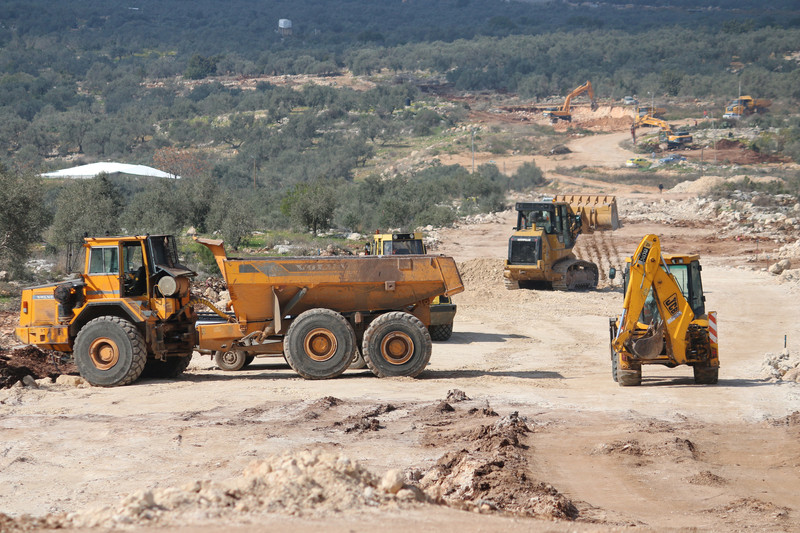
Israeli bulldozers work on a new Israeli settler road, in Nabi Elias village, in the occupied West Bank, on 6 February. Some 700 olive trees were uprooted from private Palestinian land to build the road. Ahmad Al-Bazz ActiveStills
Israeli Prime Minister Benjamin Netanyahu is moving quickly to alter the political reality in Palestine, and facing little or no resistance.
On September 10, Netanyahu declared his intentions to annex swathes of Palestinian land adjacent to the Jordan River, an area that covers 2,400 square kilometers, or nearly a third of the Occupied West Bank. That region, which extends from Bisan in the north to Jericho in the south, is considered to be Palestine’s food basket, as it accounts for an estimated 60 percent of vegetables that are produced in the West Bank.
While Israel has already colonized nearly 88 percent of the entire Palestinian Ghoor (or Jordan Valley), dividing it between illegal agricultural settlements and military zones, it was always assumed that the militarily occupied region will be included within the border of a future Palestinian state.
Netanyahu’s announcement has been linked to Israel’s general elections of September 17. The Israeli leader is desperate, as he is facing “unprecedented alliances” that are all closing in to unseat him from his political throne. But this cannot be all. Not even power-hungry Netanyahu would alter the political and territorial landscape of Israel and Palestine indefinitely in exchange for a few votes.
Indeed, talks of annexation have been afoot for years and have long preceded the September elections, or the previous ones in April.
A sense of euphoria has been felt among Israel’s rightwing officials since the advent of Donald Trump to the White House. The excitement was not directly linked to Trump but to his Middle East team, like-minded pro-Israel US officials whose support for Israel is predicated on more than personal interests, but religious and ideological beliefs as well.
White House senior adviser, Jared Kushner, selected his team very carefully: Jason Greenblatt as special envoy for Middle East peace, David Friedman as United States Ambassador to Israel, and layers of other second-tier officials whose mission was never aimed at resolving conflict or brokering peace, but supervising a process in which Israel finalizes its colonization of Palestine unhindered.
Kushner’s master stroke is epitomized in the way he presented his objectives as part of a political process, later named “Deal of the Century”.
In all fairness, Kushner’s team hardly labored, or even pretended to be, peacemakers, especially as they oversaw the US recognition of Jerusalem as Israel’s capital and of the occupied Golan Heights as Israeli territories. Indeed, none of these officials tried to hide their true motives. Just examine statements made by the just-resigned Greenblatt where he refused to name illegal Jewish settlements as such, but as “neighborhoods and cities”; and Friedman’s outright support for the annexation of parts of the Occupied West Bank, and much more.
The US political discourse seemed in complete alignment with that of Israel’s right-wing parties. When right-wing extremist politicians, the likes of Naftali Bennett and Ayelet Shaked, began floating the idea of annexing most or all of the Occupied West Bank, they no longer sounded like marginal and opportunistic voices vying for attention. They were at the center of Israeli politics, knowing full well that Washington no longer had a problem with Israel’s unilateral action.
It could be argued, then, that Netanyahu was merely catching up, as the center of gravity within his right-wing coalition was slipping away to younger, more daring politicians. In fact, Israel, as a whole, was changing. With the Labor Party becoming almost entirely irrelevant, the Center’s political ideology moved further to the right, simply because supporting an independent Palestinian state in Israel has become a form of political suicide.
Therefore, Netanyahu’s call for the annexation of Palestinian land east of the Jordan River must not be understood in isolation and only within the limited context of the Israeli elections. Israel is now set to annex large parts of the West Bank that it deems strategic. This is most likely to include all illegal settlement blocks and the Jordan Valley as well.
In fact, Netanyahu said on September 11 that he was ready to annex the Jordan Valley region even before the election date, but was blocked by the Attorney General’s office. Netanyahu would not have taken such a decision if it represented a political risk or if it faced a pushback from Washington. It is, then, sadly, a matter of time.
Suspiciously absent in all of this are the Palestinian Authority (PA), the Arab League, the European Union and, of course, the United Nations and its many outlets and courts. Aside from a few shy statements – like that of the spokesperson of the UN, Stéphane Dujarric, decrying that “unilateral actions are not helpful in the peace process” – Israeli leaders are facing little or no hindrance whatsoever as they finalize their complete colonization of all Palestinian land.
Unable to stage any kind of meaningful resistance against Israel, the Palestinian leadership is so pathetically insisting on utilizing old terminologies. The official Palestinian response to Netanyahu’s annexation pledge, as communicated by Prime Minister Mohammed Shtayyeh, came only to underscore the PA’s political bankruptcy.
“Netanyahu is the chief destroyer of the peace process,” Shtayyeh said, warning that annexing parts of the West Bank would have negative consequences.
For his part, the PA leader Mahmoud Abbas resorted, once more, to empty threats. Abbas said in a statement, “All agreements and their resulting obligations would end if the Israeli side annexes the Jordan Valley, the northern Dead Sea, and any part of the Palestinian territories occupied in 1967.”
Neither Abbas nor Shtayyeh seem troubled by the fact that a “peace process” does not exist, and that Israel has already violated all agreements.
While the PA is desperately hanging on to any reason to justify its continued existence, Netanyahu, with the full support of Washington, is moving forward in annexing the West Bank, thus making apartheid an official and undisputed reality.
The Palestinian leadership must understand that the nature of the conflict is now changing. Conventional methods and empty statements will not slow down the Israeli push for annexation nor Tel Aviv’s determination to expand its apartheid to all of Palestine. If Palestinians continue to ignore this reality altogether, Israel will continue to single-handedly shape the destiny of Palestine and its people.
Ramzy Baroud  is a journalist, author and editor of The Palestine Chronicle. His last book is ‘The Last Earth: A Palestinian Story’, and his forthcoming book is ‘These Chains Will Be Broken: Palestinian Stories of Struggle and Defiance in Israeli Prisons’. Baroud has a Ph.D. in Palestine Studies from the University of Exeter and is a non-resident research fellow at the Center for Islam and Global Affairs (CIGA) at Zaim University in Istanbul.

Saturday, June 29, 2019

The Day After: What if Israel Annexes the West Bank?


Photograph Source: Mr. Kate – CC BY-SA 3.0
Calls for the annexation of the Occupied West Bank are gaining momentum in both Tel Aviv and Washington. But Israel and its American allies should be careful what they wish for. Annexing the Occupied Palestinian Territories will only reinforce the current rethink of the Palestinian strategy, as opposed to solving Israel’s self-induced problems.
Encouraged by the Donald Trump administration’s decision to move the US Embassy from Tel Aviv to Jerusalem, Israeli government officials feel that the time for annexing the entirety of the West Bank is now.
In fact, “there is no better time than now” was the exact phrase used by former Israeli Justice Minister, Ayelet Shaked, as she promoted annexation at a recent New York conference.
Certainly, it is election season in Israel again, as Israeli Prime Minister, Benjamin Netanyahu, failed to form a government following the last elections in April. So much saber-rattling happens during such political campaigns, as candidates talk tough in the name of ‘security’, fighting terrorism, and so on.
But Shaked’s comments cannot be dismissed as fleeting election kerfuffle. They represent so much more, if understood within the larger political context.
Indeed, since Trump’s advent to the White House, Israel has never – and I mean, never – had it so easy. It is as if the rightwing government’s most radical agenda became a wish list for Israel’s allies in Washington. This list includes the US recognition of Israel’s illegal annexation of Occupied Palestinian East Jerusalem, of the Occupied Syrian Golan Heights, and the dismissal of the Palestinian refugees’ right of return altogether.
But that is not all. Statements made by influential US officials indicate initial interest in the outright annexation of the Occupied West Bank or, at least, large parts of it. The latest of such calls was made by US ambassador to Israel, David Friedman.
“Israel has the right to retain some … of the West Bank,” Friedman said in an interview, cited in the New York Times on June 8.
Friedman is deeply involved in the so-called ‘Deal of the Century’, a political gambit championed mostly by Trump’s top advisor and son-in-law, Jared Kushner. The apparent idea behind this ‘deal’ is to dismiss the core demands of the Palestinians, while reassuring Israel regarding its quest for demographic majority and ‘security’ concerns.
Other US officials behind Washington’s efforts on behalf of Israel include US Special Envoy to the Middle East, Jason Greenblatt, and former US Ambassador to the UN, Nicki Haley. In a recent interview with the Israeli rightwing newspaper, Israel Hayom, Haley said that the Israeli government “should not be worried” regarding the yet-to-be fully revealed details of the ‘Deal of the Century.’
Knowing Haley’s love-affair with – and brazen defense of – Israel at the United Nations, it should not be too difficult to fathom the subtle and obvious meaning of her words.
This is why Shaked’s call for the annexation of the West Bank cannot be dismissed as typical election season talk.
But can Israel annex the West Bank?
Practically speaking, yes, it can. True, it would be a flagrant violation of international law, but such a notion has never irked Israel, nor stopped it from annexing Palestinian or Arab territories. For example, it occupied East Jerusalem and the Golan Heights in 1980 and 1981 respectively.
Moreover, the political mood in Israel is increasingly receptive to such a step. A poll conducted by the Israeli newspaper, Haaretz, last March revealed that 42% of Israelis back West Bank annexation. This number is expected to rise in the following months as Israel continues to move to the right.
It is also important to note that several steps have already been taken in that direction, including the Israeli Knesset’s (parliament) decision to apply the same civil laws to illegal Jewish settlers in the West Bank as to those living in Israel.
But that is where Israel faces its greatest dilemma.
According to a joint poll conducted by Tel Aviv University and the Palestinian Center for Policy and Survey Research in August 2018, over 50% of Palestinians realize that a so-called two-state solution is no longer tenable. Moreover, a growing number of Palestinians also believe that co-existence in a single state, where Israeli Jews and Palestinian Arabs (Muslims and Christians, alike) live side by side, is the only possible formula for a better future.
The dichotomy for Israeli officials, who are keen on maintaining Jewish demographic majority and the marginalization of Palestinian rights, is that they no longer have good options.
First, they understand that the indefinite occupation of Palestinian territories cannot be sustained. Ongoing Palestinian resistance at home, and the rise of the Boycott, Divestment and Sanctions (BDS) Movement abroad is challenging Israel’s very political legitimacy across the world.
Second, they must also be aware of the fact that, from an Israeli Jewish leaders’ point of view, annexing the West Bank, along with millions of Palestinians, will multiply the very ‘demographic threat’ that they have been dreading for many years.
Third, the ethnic cleansing of whole Palestinian communities – the so-called ‘transfer’ option – as Israel has done upon its founding in 1948, and again, in 1967, is no longer possible. Neither will Arab countries open their borders for Israel’s convenient genocides, nor will Palestinians leave, however high the price. The fact that Gazans remained put, despite years of siege and brutal wars, is a case in point.
Political grandstanding aside, Israeli leaders understand that they are no longer in the driver’s seat and, despite their military and political advantage over Palestinians, it is becoming clear that firepower and Washington’s blind support are no longer enough to determine the future of the Palestinian people.
It is also clear that the Palestinian people are not, and never were, passive actors in their own fate. If Israel maintains its 52-year old Occupation, Palestinians will continue to resist. That resistance will not be weakened, or quelled, by any decision to annex the West Bank, in part or in full, the same way that Palestinian resistance in Jerusalem did not cease since its illegal annexation by Tel Aviv four decades ago.
Finally, the illegal annexation of the West Bank can only contribute to the irreversible awareness among Palestinians that their fight for freedom, human rights, justice and equality can be better served through a civil rights struggle within the borders of one single democratic state.
In her blind arrogance, Shaked and her rightwing ilk are only accelerating the demise of Israel as an ethnic, racist state, while opening up the stage for better possibilities than perpetual violence and apartheid.
Ramzy Baroud is a journalist, author and editor of Palestine Chronicle. His latest book is The Last Earth: A Palestinian Story (Pluto Press, London, 2018). He earned a Ph.D. in Palestine Studies from the University of Exeter and is a Non-Resident Scholar at Orfalea Center for Global and International Studies, UCSB.