Showing posts with label Khashoggi’s gruesome murder. Show all posts

Tuesday, August 06, 2019

Mohammad Bin Salman’s Waning Influence

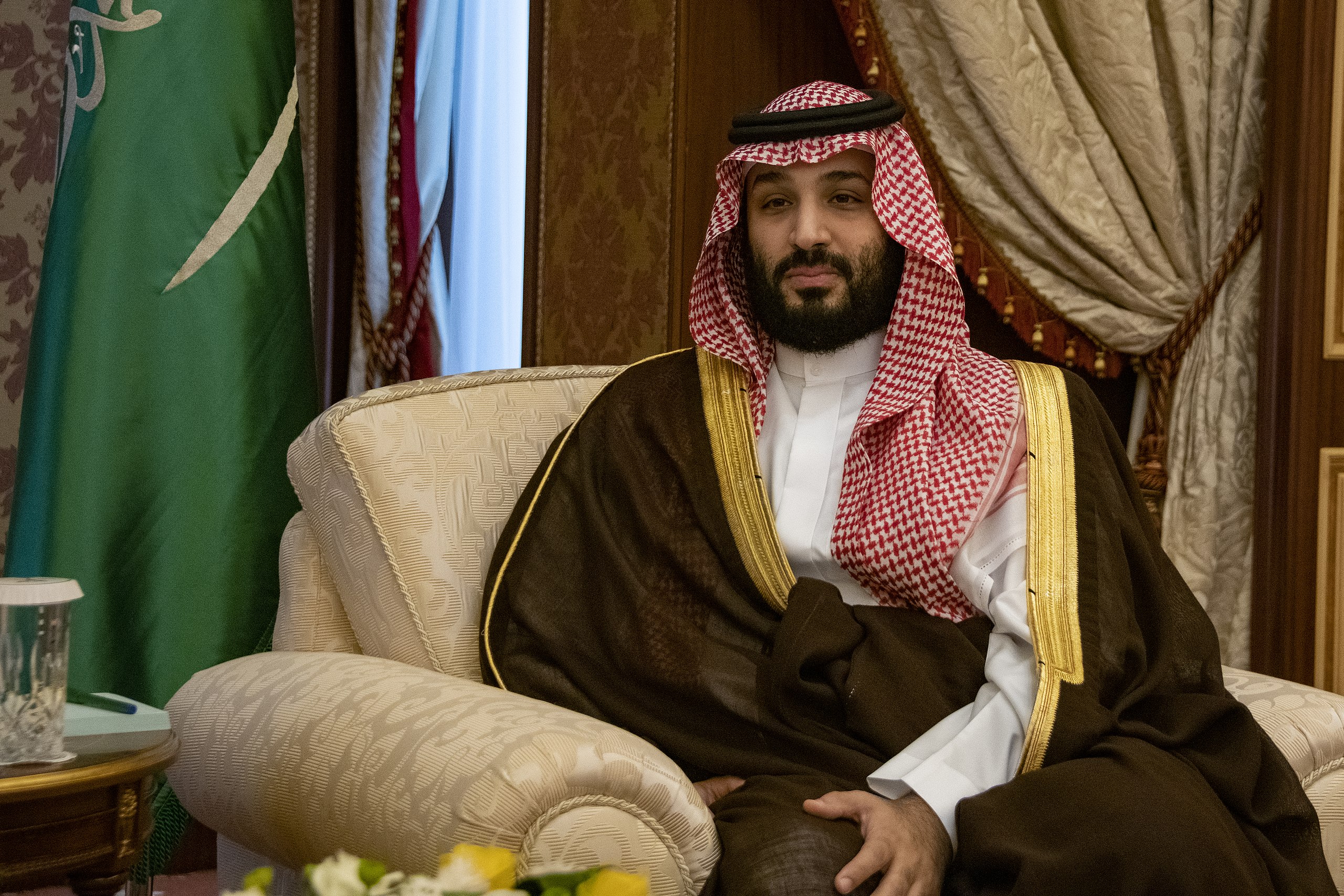
Mohammad bin Salman (U.S. State Department via Wikimedia Commons)
by Emile Nakhleh
The United Arab Emirates’ recent decision to withdraw from the Yemen war has left Saudi Crown Prince and de facto ruler Mohammad bin Salman (MbS) the sole key driver of that disastrous conflict. MbS’s friend, Abu Dhabi Crown Prince and de facto UAE leader Mohammed bin Zayed (MbZ), has left him to pick up the pieces. In the aftermath of MbZ’s action, MbS’s star seems to be dimming and his influence on the international scene is waning.
Frequent attempts by the United States Congress to halt American arms sales to Saudi Arabia and to hold MbS accountable for the murder of journalist Jamal Khashoggi have severely tarnished the Saudi leader’s reputation and standing. Although Congress has not been able to overcome President Trump’s veto and actually impede those arms deals, symbolic congressional action has long-term negative implications for MbS. Traditional American bi-partisan support for Saudi Arabia, which goes back to President Franklin Delano Roosevelt, has been reduced, because of MbS’s hubris and repression, to a personal relationship between the the Saudi autocrat and the current U.S. president and his son-in-law. 
The traditional bi-partisan support has all but faded, leaving the Saudi crown prince dependent on the goodwill and quid-pro-quo support of the Trump administration. MbS’s actions have, in effect, undermined long-term Saudi interests and whatever goodwill the kingdom used to have with the U.S. public. Once a new administration comes to Washington, demands to hold MbS accountable for his actions in Yemen and for Khashoggi’s gruesome murder will again resurface. The failure to override Trump’s veto aside, several senators have expressed negative views of the Saudi leader. The millions of dollars that MbS has spent in Washington to burnish his image have not served him well.
Israel-Palestine
The failure of Jared Kushner’s Israel-Palestine “Deal of the Century” plan at a Bahrain workshop in late June was another blow to the MbS brand. Kushner and MbS had hoped they would be able to persuade Arab leaders to attend the Bahrain event and hail Kushner’s economic plan on Palestine. But the leaders of Jordan, Egypt, Kuwait, and several other countries refused to sign on to the initiative. They argued that the economic portion of an Israel-Palestine peace deal must go hand in hand with a political component along the path of a two-state solution. As I have written previously on this blog, the Bahrain event fizzled and was reduced to a photo-op that failed to gain traction. MbS must have been stung by his inability to deliver Arab support to his friends in the White House.
If Israeli Prime Minister Benjamin Netanyahu wins next month’s national election and is able to form a government, he will be expected to cater to the extreme Israeli right. Instead of a deal with the Palestinians along the lines of Kushner’s ill-fated economic formula, Israel’s ultra-right politics would be consumed by talk about annexation of the occupied territories and a population transfer of Palestinians out of Israel. Despite his camaraderie with Kushner, MbS’s Arab credentials will be sullied. It’s ironic that the three-decade old Arab Peace Initiative, which calls for full Arab recognition of Israel in return for terminating the Israeli occupation on the basis of UN Security Council Resolutions 242 and 338, was initiated by another Saudi crown prince, MbS’s uncle Abdullah, and continues to be supported by his own father, King Salman. His special relationship with Kushner will not help him salvage his self-perceived image as a seminal Arab leader and his covert relations with Israeli intelligence and political leaders will not help him deliver Palestinian support.
If MbS truly believes in improving the lives of Palestinians, why doesn’t he join Qatar in funding economic development in the West Bank and Gaza and prove to the Palestinians that he is committed to their wellbeing? He could also initiate serious talks with the Israelis and Palestinians about the future of the two peoples “between the River and the Sea.” Otherwise, history will view him, like many other Arab leaders before him, as having fought the Palestinian cause to the last Palestinian.
Iran
The potential for restarting talks with Iran—through diplomatic efforts involving Oman and possibly the UAE—is another blow to MbS’s regional ambitions and hubris. The recent statement by U.S. Secretary of State Mike Pompeo that US forces will begin withdrawing from Afghanistan before next year’s elections could be a message to MbS about Iran. Although it’s easy to disagree with Trump on many foreign policy issues, one gets the impression from Pompeo’s announcement that Trump is not gung-ho about another war in the Middle East or a military confrontation with Iran. Tough talk toward Iran doesn’t mean that war is imminent.
The Wall Street Journal reported this week that an Emirati delegation went to Iran to discuss maritime security in that part of the Persian Gulf. The UAE, especially Dubai, is keen on keeping commercial shipping routes secure and on convincing international trade partners that it is safe to conduct commerce with the Arab states of the Persian Gulf.
Of course, peacefully resolving regional political tensions with Iran is the best guarantee for safe commerce in the Persian Gulf. Dubai, the most commercially driven emirate within the UAE, has traded with Iran for decades. Dubai also has a significant Shia minority and a relatively large number of successful businessmen of Iranian origins. It also has a history of prioritizing business above all. During the heyday of the Arab boycott of Israel, when blacklisted items like Coca-Cola and Ford cars could not be traded in the Arab world because of the boycott, one could always find them at the Dubai port. Mohammed bin Zayed’s animus toward Iran notwithstanding, in the modern history of Dubai commerce always trumps politics.
If the Wall Street Journal report is accurate, perhaps this is the message that the UAE delegation is taking to Tehran. Keeping the complexity and interconnectivity of regional issues in mind, it’s possible to imagine that the UAE peace delegation would expand its maritime security agenda to include Yemen, the nuclear deal, sanctions, and other thorny issues. Such talks could become more comprehensive if Oman and Kuwait join them. If the talks result in some sort of quiet rapprochement between Tehran and Washington, they could be the prelude to a new deal in which nuclear discussions would be a major component. If the Trump administration supports de-escalation and continues to give sanction waivers to major Iranian trade partners, it should become clear to MbS that Trump is not seeking a war with Iran.
If Washington and Tehran begin a serious conversation about the nuclear deal and the sanctions, then MbS’s regional wars and hostile machinations toward Iran and Shia Islam would have failed. His isolation would continue, and history would judge him as yet another failing corrupt, repressive Arab autocrat. His grand design for the region would be no more than a chimera, and his money-powered ambition to be a kingmaker on the world scene would evaporate.
Repression
In recent months, many U.S. senators have publicly admonished MbS for his repressive human rights record. The growing number of dissidents being executed in Saudi Arabia and Bahrain—where the Saudis have tremendous sway—has tarnished MbS’s reputation and standing. These executions are primarily sectarian in nature, directed against Shia citizens of both countries, and are generally based on illegal arrests, torture, coerced confessions, and sham trials. The Bahraini regime relies on Saudi military support as a tool in repressing their Shia majority.
With the recent announcement that U.S. troops are being sent back to Saudi Arabia, MbS will begin to feel the heat from the kingdom’s Wahhabi-Salafi religious flank. The religious opposition to the presence of “infidel” troops in the “Land of the Two Holy Mosques” in 1991 fueled Osama bin Laden’s terror campaign against the Saudi regime and the United States.
After the U.S.-led international coalition evicted Iraqi leader Saddam Hussein from Kuwait in 1991 and U.S. troops stayed on in Saudi Arabia, religious activists decried the presence of these troops on the basis of a hadith attributed to the Prophet Muhammad. Regardless of the authenticity of this hadith, radical Wahhabis believe that Muhammad said on his deathbed that only one religion shall exist in Arabia. Non-Muslim “infidel” troops, according to this view, should be expelled from the kingdom. In the early 1990s, this became the rallying cry for Bin Laden and al-Qaeda. This radical mantra could re-emerge as a terrible nightmare for MbS around which his opponents would coalesce.
In the aftermath of the UAE withdrawal from Yemen, MbS will be forced to re-examine the grand design he devised for himself and for the region. The design, which has been fueled by his economic largesse and perceived support from the Trump White House, is fading. Will MbS internalize the ensuing failure and act on it before it’s too late?
avatar

EMILE NAKHLEH

Dr. Emile Nakhleh was a Senior Intelligence Service officer and Director of the Political Islam Strategic Analysis Program at the Central Intelligence Agency. He is a member of the Council on Foreign Relations, a Research Professor and Director of the Global and National Security Policy Institute at the University of New Mexico, and the author of A Necessary Engagement: Reinventing America’s Relations with the Muslim World and Bahrain: Political Development in a Modernizing State. He has written extensively on Middle East politics, political Islam, radical Sunni ideologies, and terrorism. His recent writings on terrorism and contemporary regional politics are posted on LobeLog.com (https://lobelog.com/author/emile-nakhleh/). Dr. Nakhleh received his BA from St. John’s University (MN), the MA from Georgetown University, and the Ph.D. from the American University. He and his wife live in Albuquerque, New Mexico.

Saturday, December 01, 2018

Erdogan, Bin Salman, and the Medieval Kingdom

Turkish president seizes opportunity to raise his profile in the Muslim East

By Yusuf Dhia-Allah


Jamal Khashoggi may be dead but his murder story refuses to die. The episode continues to have strong reverberations two months after his brutal murder in the Saudi consulate in Istanbul on October 2. It has led to political upheaval inside the medieval kingdom where questions have been raised about King Salman’s rule. He suffers from dementia resulting in all major decisions being left to his impulsive and ignorant son, and anointed successor, Muhammad bin Salman (MbS). The latter is in trouble because many believe he is directly implicated in Khashoggi’s gruesome murder.
The return from self-imposed exile of Prince Ahmad bin ‘Abd al-‘Aziz, the younger brother of the king, has added further grist to rumor mills. Prince Ahmad is the youngest of the Sudayri brothers and is, therefore, considered of a higher breed than the other surviving sons of ‘Abd al-‘Aziz Al Saud. Reports also say that he returned to the kingdom after receiving assurances from Britain and the US for his safety. Both his pedigree and the assurances now make him virtually untouchable. If Bin Salman were to try anything nasty against his uncle Prince Ahmad, what he did against his cousins a year ago, he would almost certainly lose his job. MbS may still do so, even as he has become a liability for his imperial masters.
Bin Salman’s position has been severely undermined following Khashoggi’s murder and the clumsy manner in which it was handled. Every explanation merely compounded the Saudis’ dilemma. Turkish President Recep Tayip Erdogan has skillfully manipulated the gruesome murder to twist the knife each time the Saudis tried to wriggle out of the mess. It made them look even worse.
Commonly referred to as the “clown” prince, Bin Salman has become so toxic that many media outlets in the US and Britain no longer want to touch him. Gone are the fawning editorials about a “reforming prince”; they now refer to him as “Mr. Bone Saw” (MBS). This is a reference to the bone saw that the death squad from Saudi Arabia had used to dismember Khashoggi’s body at the consulate.
Saudi reputation, especially in the Muslim world, has also suffered greatly. It was not very high to begin with but the Khashoggi saga has ripped the mask off completely. Bin Salman bears principal responsibility for this. Since his father became king in January 2015, Bin Salman has been in charge of virtually all decision-making in the Kingdom. He has acted as his father’s gatekeeper (in charge of the court); he is in charge of the country’s economic policy as well as of Aramco, the Saudi oil company. He is also the Kingdom’s defence minister who launched the disastrous war on Yemen in March 2015 that is still raging. The war has caused more than 56,000 deaths and millions of people including children are on the verge of starvation.
The intemperate Bin Salman has taken on Iran in a futile attempt to undermine the Islamic Republic; he took on Qatar — another futile policy that has yielded little — and he even arrested the Lebanese Prime Minister Sa‘d Hariri in November 2017 forcing him to announce his resignation on Saudi television! Bin Salman got egg on his face when French President Emmanuel Macron intervened securing Hariri’s release from house arrest in the Kingdom, and his return to Beirut where he withdrew his resignation.

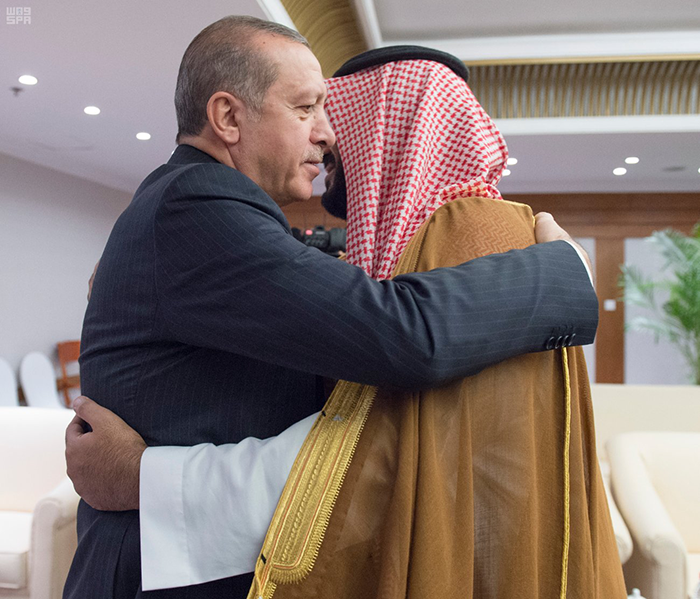
Back when they were on the same page with regard to overthrowing Bashar al-Asad’s government in Syria, then Deputy Crown Prince Muhammad bin Salman (MbS) met with Turkish President Erdogan to discuss developments in the region, and to keep pliable Turkish investments in the Kingdom, ahead of a G20 summit in the Chinese coastal city of Hangzhou, 9-4-2016. How things turn on a dime: today, it is all about the art of the leak. President Erdogan has been strategically leaking damning information on the Khashoggi murder, exposing all Saudi attempts to exonerate MbS as fabrications designed to immunize a ruthless killer. With the way the clever Turkish executive has played his hand, all roads are leading back to MbS. Compared to the green clown prince of Arabia, Erdogan is a seasoned political veteran who will never let a crisis (or a tragedy), served up on a silver platter, that he can manipulate for political ascendancy slip through his fingers.
The Saudis’ real challenge now comes from Turkey, hitherto seen as an ally. Last August, when US President Donald Trump imposed sanctions on Turkey for its refusal to release the CIA agent Andrew Brunson operating under the cover of a priest, the Saudis also joined in. Ankara had accused Brunson, together with the US-based Turkish cleric Fethullah Gulen of being involved in the failed coup attempt of July 2016 against Erdogan. In return for Brunson’s release, Turkey wanted Gulen extradited, a demand Washington rejected (but just as CI is going to press this week, Washington floated the trial balloon that Gulen could be extradited to Turkey if Erdogan agreed to hush up the Khashoggi affair going forward).
Instead, Trump imposed sanctions on Turkey as well as tariffs on Turkish goods. Ankara retaliated by imposing its own sanctions but the consequences for Turkey were much more severe causing its currency to plunge. The Turkish lira lost more than 40% of its value. It was, however, Saudi treachery that the Turks found most disturbing.
To understand the severity of Saudi action, we need to know what was involved. Saudi Arabia had invested some $10 billion in Turkey in 2011 in return for Ankara joining the assault on Libya and Syria. Until that point Turkey had refused. Libya with a small population was a soft target. Libyan ruler Mu’ammar al-Qadhdhafi was easily ousted from power and then publicly lynched in October 2011. Syria proved to be a much more difficult case. There are several reasons for this, but suffice it to say that the grand conspiracy against Syria has failed.
Realizing its folly in Syria, Turkey started to cozy up to Russia and Iran, much to the chagrin of Saudi Arabia. Just when Trump imposed sanctions and tariffs on Turkey, the Saudis also withdrew their money from the country. This further undermined the fragile Turkish economy.
Khashoggi’s murder provided Erdogan the perfect opportunity to get even with the Saudis. He has them right where he wants them. The wily Turk has played his cards well, drawing rings around the uncouth Bedouins. He has released damaging information about the Saudis at critical junctures making them look really clumsy and outright villains. They are!
So the question that must be asked is: what does Erdogan want? Embarrassing the Saudis is not enough; this will soon die down. He seems to have a much bigger game plan in mind at Saudi expense. Current speculation is that he wants a substantial sum of money from the Saudis to bury the incriminating evidence in his possession. Knowing Erdogan’s ambitions, this, too, is a small price.
His goal seems to be to displace the Saudis and become the unquestioned leader of the “Sunni” world. Hitherto, the Saudis pretended to hold that banner because Makkah and Madinah are in Saudi Arabia. Many Muslims in their innocence have extended the sanctity of the two holy cities to the Bani Saud clan as well. Their terrible conduct has finally exposed them as a bunch of criminals. Even their massive war crimes in Yemen did not affect the Saudis’ reputation as much as what the murder of Khashoggi has done.
His murder has changed the situation for two reasons. First, Erdogan is pursuing the matter vigorously; second, the Washington Post where Khashoggi wrote a regular column is not letting go. The Post has strong connections to the American deep state including the CIA and Khashoggi was their man even if not an American citizen. How dare the Saudis cross that red line? A price must be paid for that; the buck — or the camel — stops at Bin Salman’s tent.
Developments inside the Kingdom suggest that Bin Salman’s position is becoming increasingly precarious. With the return of Prince Ahmad, internal disagreements that Bin Salman had crushed with an iron fist are again getting louder. His opponents — and there are many — sense Bin Salman’s vulnerability. This is an opportunity they do not wish to miss. They put it in stark terms: either the kingdom or Bin Salman.
Many are banking on Prince Ahmad to lead the charge. Even if he does not, some senior princes are now openly questioning Bin Salman’s enormous powers. They argue that his continued high profile role puts at risk the very survival of Bani Saud’s rule. This is one argument for which neither the aged king nor his ambitious son has an answer.
So the question is: will it be Bin Salman or the Kingdom? The way things are moving it appears likely that with or without Bin Salman, the Kingdom is doomed.