
By Mohamed El Mokhtar
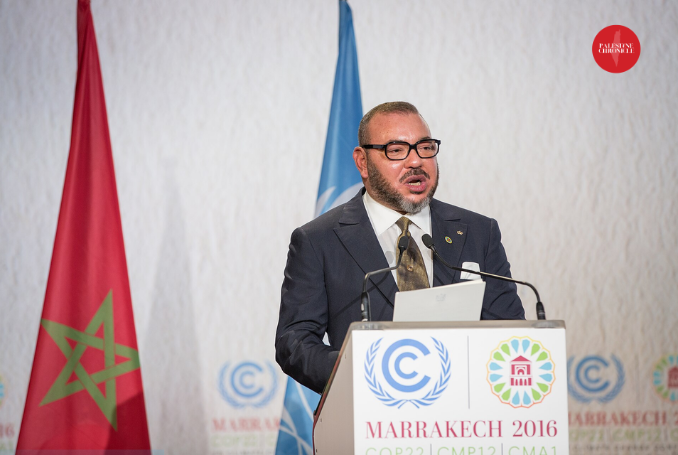 King of Morocco Mohammed VI. (Photo: UN Climate Change, via Wikimedia Commons)
When a power makes its own duration the apparent condition of national existence, it no longer needs to convince: it suffices to maintain confusion.
Behind the image of a stable, modern, and sovereign kingdom lies a system built on dependency, diplomatic duplicity, and the preservation of power. The Moroccan mirage consists precisely in this gap between the official narrative and a reality where proclaimed sovereignty often masks strategic servitude.
All politics is ultimately judged by what it conceals of what it promises. For six decades, Morocco has elevated this to an art: silence draped in words, a monarchy that speaks of independence while cultivating dependency, that celebrates sovereignty while ceaselessly negotiating the external conditions of its survival. It invokes the Ummah, then forgets it; exalts Jerusalem in its diplomatic orations, yet deepens its alliances with those who trample it. Arab in language, it becomes, in the time of genocide, the standard-bearer of Zionism in its sub-region. Not through error but through deliberate choice. By design.
This system obeys a single principle: its own duration. To this perpetuation, everything is subordinate — collective memory, solemn commitments, historical loyalties, and even the very idea of political freedom. The throne does not defend a nation: it administers a continuity, a vassal state.
Observers marvel at the apparent contradictions. They cease to be so once one abandons the notion that the nation is the true subject of this policy. The priority is not the national interest but the preservation of the system. What seemed incoherent becomes remarkably coherent.
The permanence of power is the key that opens all doors. It rests not solely on force, which wears down regimes as much as it protects them. Durable systems prefer another method: they organize a society in which their existence appears as the natural condition of all stability. They seek less to convince than to render the alternative unthinkable. Classical dictatorships govern through fear. Patrimonial regimes govern through habit. They eventually produce a confusion in which the country’s destiny blends with that of its rulers. The citizen no longer distinguishes the nation from the state, the state from the regime, the regime from the dynasty. All converges. This confusion is the foundation of their longevity.
In this perspective, principles cease to be obligations; they become resources. Sovereignty is no longer a limit; it becomes a language of adherence. Arab solidarity is no longer a fidelity; it becomes a rhetoric mobilized according to circumstances. Religious references no longer derive their value from their moral content but from their capacity to strengthen the system’s legitimacy. Political language changes function: it no longer describes reality, it organizes it. Words no longer tell the truth; they produce stability.
The affair of Ceuta offers the most complete mirror of this. How can one conceive that a police state, capable of monitoring its cities, infiltrating social movements, and locking down public space, should suddenly become blind before thousands of migrants converging on the Spanish enclaves? It is not. The security apparatus instrumentalizes human distress; it turns men into projectiles, women into low-intensity hostages, and the Palestinian cause into a bargaining chip with Washington. Principles, lives, loyalties have no value beyond the use the palace can make of them.
Signals from the Trump entourage in favor of a new “Green March” on Ceuta and Melilla were meant to pressure Pedro Sánchez’s Spain, guilty in their eyes of not sufficiently adjusting its position on Gaza. In this game, Rabat is neither the master nor the ultimate beneficiary: it is the available instrument, the regional auxiliary brandished against a European government that has become cumbersome. Giorgia Meloni’s alarmed reaction confirms that this affair exceeds the framework of a simple border dispute: migratory flows are a lever for destabilizing European balances.
This duplicity is not a departure from the principle; it is the principle itself. The Arab summit in Casablanca, in 1965, bears the indelible mark: its deliberations were reportedly transmitted to Israeli services before the 1967 war. The normalization of 2020 follows the same logic: Rabat traded the Palestinian cause for American recognition of Moroccan sovereignty over Western Sahara. Since then, military, security, and academic cooperation with Israel has continued to deepen, while Gaza collapsed.
The same docility can be read in its relationship with Western capitals. Pitiless toward its citizens, even its closest collaborators who sometimes endure its slaps, the regime, or more precisely the king, proves conciliatory with its protectors. It imprisons for a word, monitors for a suspicion, represses for a gathering, but aligns with Washington, Paris, or Brussels as soon as dynastic preservation demands it.
On the domestic front, the strategy has varied, the objective has remained. Hassan II weakened the historical left, one of the most prestigious in the Arab world, by fragmenting its influence. Mohammed VI integrates political Islam into an institutional framework where it can govern without holding sovereign power. One neutralizes through confrontation; the other through absorption. In both cases, the opposition ceases to be an alternative and becomes an adjustment variable of the system.
Normalization with Israel was carried out in defiance of popular sentiment. The recent revolt of Generation Z reflects a fed-upness fueled by the inequity of resource distribution and the insolent opulence of elites. Comparing Morocco to Egypt or Tunisia leads nowhere: a country is measured against its potential, not against the mediocrity of its neighbors. Yet this potential, the regime does not place at the service of the greatest number. It prefers diversion: the Sahara issue, elevated to a sacred cause, serves to occupy minds so that one forgets unemployment, the silencing of freedoms, and the lack of prospects for a suffocating youth.
This political logic finds its natural extension in the economy. Morocco has attracted investment, but remains a land of offshoring par excellence rather than a hub of innovation. It assembles more than it conceives. The strategic segments of value chains, research, and cutting-edge technologies remain elsewhere. Factories create jobs, but it has found no industrial sovereignty.
This economy produces an uneven modernity. Automotive, aeronautics, textiles, finance, insurance, real estate, agribusiness have progressed, but the transfer of know-how has remained limited. Engineering schools have adapted to local and international markets; technical education and vocational training remain insufficient. The result is a dual Morocco: that of urban, mostly French-speaking elites connected to global networks, and that of a youth condemned to precariousness, chronic unemployment, and dreaming only of exile.
The economy is more diversified than several neighbors, including rentier Algeria, but this diversification benefits a restricted circle. Major industrial groups revolve around interests tied to power. Opening up has not redistributed the dividends of growth; it has consolidated dominant positions. Concentrated prosperity contrasts with generalized precariousness. The women porters of the Spanish enclaves, the little maids in households, the barely disguised prostitution in urban centers are its daily faces.
Signs of this fracture are visible at every turn. Children wander the streets, engaging in begging or inhalation — that whiff of glue that serves as escape, before returning to plead under the indifferent gaze of the authorities. In rural areas, precarious housing — sheet metal, tarps, crumbling mud-brick — reminds us that modernity often stops at the gates of metropolises. Entire families live without electricity or running water, a few miles from the industrial zones where they assemble for Europe.
Recent earthquakes have brutally reminded us of this fracture: on one side, the metropolises where investments and infrastructure are concentrated; on the other, a rural world marked by isolation and unequal access to essential services. Illiteracy, particularly among women, remains one of the most visible symptoms of this unfinished modernization.
This logic is reflected in the composition of the ruling elites, where renewal concerns faces more than ideas. The same sociology of power reproduces itself from generation to generation, privileging loyalty over merit.
The result is a modernization whose appearance impresses more than its depth. Infrastructure changes quickly; power relations, much less so. Concrete progresses faster than institutions, industrial zones faster than the diffusion of knowledge, macroeconomic indicators faster than social emancipation. Growth consolidates existing structures more than it transforms them.
This regime does not betray by accident: it betrays by method. It has made duplicity a survival technique, alignment a diplomacy, and inner silence a national virtue. It invokes the Ummah to mobilize emotions, then acts against its interests when a tutelary power demands it. It exalts independence while placing its security, its armament, its economy, and its international legitimacy under external guarantee.
The true loyalty of this system goes neither to Palestine, nor to Arab unity, nor even to the Moroccan people. It goes to its own perpetuation. Everything can be sacrificed to this continuity: memory, principles, alliances, the poor, migrants, and even the very idea of political freedom. The kingdom does not defend a nation: it administers a dependency.
When a power makes its own duration the apparent condition of national existence, it no longer needs to convince: it suffices to maintain confusion. The true Moroccan mirage does not consist merely in proclaiming one thing and practicing another. It is deeper: making believe that the continuity of the regime merges with that of the nation, that stability is impossible without the permanence of those who govern, that any questioning of the system amounts to a questioning of the country itself. It is in this confusion that the mirage resides.
– Mohamed El Mokhtar Sidi Haiba is a social and political analyst, whose research interest is focused on African and Middle Eastern Affairs. He contributed this article to The Palestine Chronicle.

No comments:
Post a Comment