Showing posts with label Iranian Art and Culture. Show all posts

Sunday, September 29, 2019

Nasir-ol-Molk Mosque, stunning whirling colors

TEHRAN, (MNA) – One of the most beautiful and photographed pieces of architecture in southern Iran, is Nasir-ol-Molk Mosque. It is one of the tourist attractions of Iran’s historic city of Shiraz which is known for its colorful lights that are formed by stained glass windows.
Shiraz is one of the most beautiful cities in south of Iran, where many tourists visit it every year. It is one of the oldest cities of ancient Persia and is known as the city of poets, literature, flowers and gardens. It is one of the main tourism sites in Iran and its cultural heritage is of global importance. Due to many historical, cultural, religious and natural attractions, Shiraz has always attracted many tourists. One of these magnificent places is Nasir-ol-molk Mosque.
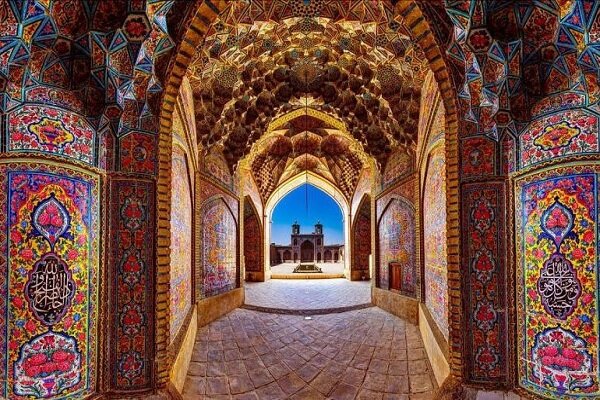
Nasir-ol-molk Mosque is one the tourist attractions of Shiraz which was built during the Qajar dynasty at the end of the 19th century. It is one of the most unique and different mosques in Iran. The mosque is famous for its colored glasses and its tiles are unique in their kind.
This mosque is called by many different names. Mostly known as the “Pink Mosque” because its tiles are beautifully decorated with a pre-eminently pinkish rose color, it is also called the “Mosque of colors,” the “Rainbow Mosque” or the “Kaleidoscope Mosque”.
It is located in a region in the southern part of Lotf Ali Khan Zand Street. The mosque was built by order of Mirza Hasan Ali Nasir ol Molk, a Qajar ruler. Mohammad Hasan-e-Memar, an Iranian architect, and Mohammad Reza KashiSaz were two designers of this mosque. The construction of this elegant mosque was finished after 12 years.
It is 2890 square meters and considered as one of the most valuable mosques in Iran in terms of construction, especially tiling and muqarnas (a form of ornamented vaulting in Islamic architecture). It has two shabestan (an underground space that can be usually found in traditional architecture of mosques, houses, and schools in ancient Iran which were usually used during summers) in east and west.  
The eastern Shabestan has seven columns that are located in the middle of the space and are in a row. The most amazing part of the mosque is the western Shabestan. There are twelve columns which are placed in two rows of six. Seven arches are located between the two pillars, and at the end, there is an attractive tiled altar. The floor of the altar is made of marble and its surface is lower than the floor of the Shabestan. The western Shabestan has seven wooden doors with colored glasses that open to the courtyard.
With dazzling stained glass, thousands of painted tiles on the ceiling and Persian rugs covering the floor, this place of worship is a gorgeous rainbow of color in every direction, like stepping into a kaleidoscope.
There is an open courtyard with a rectangular pool in the center of the mosque, surrounded by flowers. The building’s facade features dozens of Islamic arches, adding to the beauty of the light show from the stained glass.
Despite other mosques, Nasir-ol-molk Mosque has no dome, which indicates that this religious building was quite personal and not used by the public. The tiling of this mosque is unique and the use of pink color is one of the features of the mosque which is not usual in any other Iranian mosques.
In autumn and winter, when the sunlight shines through the colorful glasses, and reflexes it on blue mosaics, make a dazzling view inside this mosque which making this mosque outstandingly aesthetic among other mosques of Iran.
Recently, Nasir-ol-molk Mosque has been lighted at nights as well; the light passes through the colored glasses and spreads into the yard and all over the mosque.
Nasir-ol-molk Mosque is still used for worship. It was registered in Iran's National Heritage on February 1955 under the registration number of 369.
The best time to visit Nasir-ol-molk Mosque is early in the morning before 9 a.m when the hall and its Persian carpets are illuminated with a kaleidoscope of patterned flecks of light.  

Wednesday, September 18, 2019

Chehel Sotoun; a blend of prominent Persian garden, glorious palace

TEHRAN, (MNA) – Located next to Naqsh-e Jahan Square and Chahar Bagh, Chehel Sotoun Palace is considered as one of the tourist attractions of Isfahan, Iran.
The attractive Safavid architecture and world heritage sites have made Isfahan province a popular destination for both Iranian and international tourists.
Isfahan is Iran's most beautiful city, where it boasts the highest level of Islamic and Iranian architecture and, as a living museum; shows the culture and tradition of the Iranian people.
The artistic and historical city of Isfahan has over 22,000 historical sites and monuments, of which 850 are nationally registered and four have been designated by UNESCO as World Heritage Sites, namely Naqsh-e Jahan Square, Imam Mosque and Chehel Sotoun Palace.
Chehel Sotoun Palace is renowned for its unique paintings and mirrors and has once been the place of hosting greats from all over the world.
The palace dates back to Safavid Era in 1588, was established during the reign of Shah Abbas I, the first king of Safavid Empire, in the midst of a vast and lush garden. It was a small palace in the middle of a large garden and to be used for the Shah's resting. The immense halls of this palace used to be the selected places for official feasts of the country.
After his reign, Chehel Sotoun Palace was enlarged and inaugurated by Shah Abbas II for receptions and amusements.  Some porches, paintings, ornaments and various parts were added at the behest of Shah Abbas II, making it a glorious palace for the Safavid kings.
It was selected as the official venue for the usual political ceremonies and reception of other kings and officials.
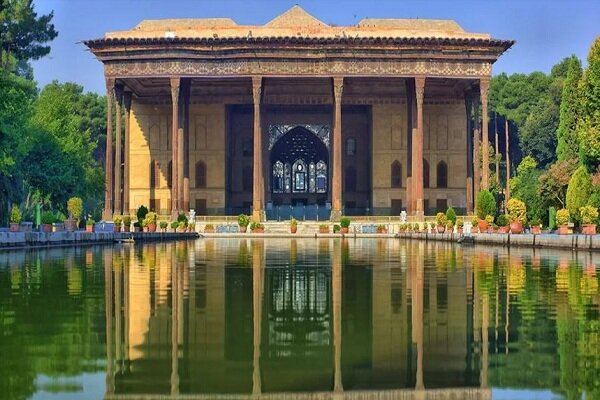
The land of Chehel Sotoun Palace is 67000 square meters. The architecture of this palace is a blend of Iranian, Chinese and European arts and consists of a main porch on the east part of the palace. The 20 slender, ribbed wooden pillars of the palace rise to a superb wooden ceiling with crossbeams and exquisite inlay work.
The name, meaning "Forty Columns" in Persian, was inspired by the twenty slender wooden pillars supporting the entrance pavilion, which, when reflected in the waters of the fountain, are said to appear to be forty.
The main porch of the palace consists of two parts. The first part consists of 18 wooden pillars and 4 middle pillars on the stone lions. The second part of the palace is the Hall of Mirrors, which is on two columns and is decorated with a very wide and beautiful mirror.
The central hall of the Chehel Sotoun Palace is dedicated to guests and great figures from other countries and contains the beautiful paintings by the famous Safavid painter, Reza Abbasi. Each miniature here is depicting one certain time during Safavid dynasty.
In the paintings of the central hall which, in some cases, have been repainted in Qajar period on the previous paintings, we can see the depiction of “Shah Abbas I, Shah Abbas II and Shah Tahmasb entertaining Turkestan kings and Indian Homayoun” and “the battle of Shah Ismail and the Uzbek”. Two other illustrations one in front of the hall entrance opposite to the other depict a scene of Chaldiran Battle in shah Ismail’s period and Karnal Battle in Nader shah Afshar’s time. Dedicated to entertaining the guests and foreign ambassadors, this hall has a pretty dome with colorful corner motifs, golden and lucid details.
The doors and windows are all decorated with fretworks and cachet designs. In addition, the central hall of the palace includes some glamorous paintings on the walls that each refers to a special event on a specific period of time. All these elements are representative of the proficiency of the skillful Iranian masters and architectures.
Chehel Sotoun Palace is a great example of the royal gardens left over from the Safavid era. It was registered on UNESCO Cultural Heritage list in 2011.It is among the 9 Iranian Gardens which are collectively registered as one of the Iran’s 23 registered World Heritage Sites under the name of the Persian Garden.
The best time to visit Chehel Sotoun Palace is in spring and summer and visiting this palace will take one hour.