Showing posts with label Cultural Heritage. Show all posts

Saturday, November 30, 2019

Iran takes part in 3rd Ministerial Meeting of Ancient Civilization Forum

Iran takes part in 3rd Ministerial Meeting of Ancient Civilization Forum

TEHRAN, (MNA) – The Third Ministerial Meeting of Ancient Civilization Forum was opened in Chinese capital Beijing on Fri. with the participation of the Islamic Republic of Iran.
As headed by the Chinese Tourism Minister, the Third Ministerial Meeting of Ancient Civilization Forum was held in Beijing International Hotel in the presence of tourism ministers of nine countries including People’s Republic of China, Islamic Republic of Iran, India, Iraq, Egypt, Armenia, Italy, Bolivia, Peru and Greece.
In this forum, tourism ministers of Tajikistan and Mexico attended as observer countries and Iran’s Minister of Cultural Heritage, Tourism and Handicrafts Ali-Asghar Moonesan delivered speech.
For her part, Narin Kachatourian Armenia’s Deputy Minister of Tourism, Science, Culture, and Sports considered Islamic Republic of Iran as one of the target tourism countries and added, “holding a joint tourism forum with Iran last year in 2018 has provided an opportunity for closer ties between the two countries.”
While appreciating rich Iranian culture and civilization, she emphasized the need for the developing and strengthening cooperation with the Islamic Republic of Iran.
Chinese National Curator Wang also said that civilizations of Persia, India and Greece en route the ‘Silk Road’ have many similarities and commonalities.
The Silk Road has not been merely for the economic transactions, rather, this Road has created political interactions, he emphasized.
Iranian Minister of Cultural Heritage, Tourism and Handicrafts Ali-Asghar Moonesan arrived in Beijing, China on Thu. at the head of the high-ranking delegation.

Sunday, September 29, 2019

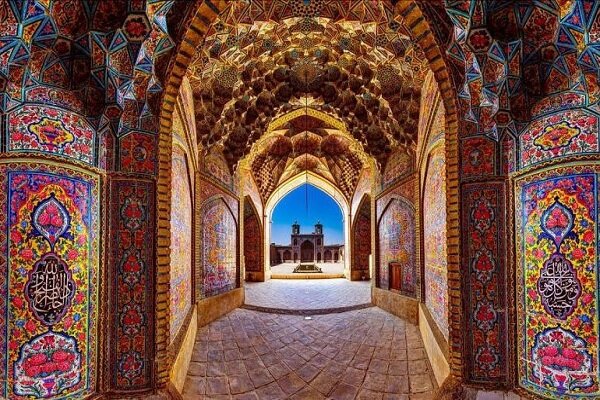
Nasir-ol-Molk Mosque, stunning whirling colors

TEHRAN, (MNA) – One of the most beautiful and photographed pieces of architecture in southern Iran, is Nasir-ol-Molk Mosque. It is one of the tourist attractions of Iran’s historic city of Shiraz which is known for its colorful lights that are formed by stained glass windows.
Shiraz is one of the most beautiful cities in south of Iran, where many tourists visit it every year. It is one of the oldest cities of ancient Persia and is known as the city of poets, literature, flowers and gardens. It is one of the main tourism sites in Iran and its cultural heritage is of global importance. Due to many historical, cultural, religious and natural attractions, Shiraz has always attracted many tourists. One of these magnificent places is Nasir-ol-molk Mosque.
Nasir-ol-molk Mosque is one the tourist attractions of Shiraz which was built during the Qajar dynasty at the end of the 19th century. It is one of the most unique and different mosques in Iran. The mosque is famous for its colored glasses and its tiles are unique in their kind.
This mosque is called by many different names. Mostly known as the “Pink Mosque” because its tiles are beautifully decorated with a pre-eminently pinkish rose color, it is also called the “Mosque of colors,” the “Rainbow Mosque” or the “Kaleidoscope Mosque”.
It is located in a region in the southern part of Lotf Ali Khan Zand Street. The mosque was built by order of Mirza Hasan Ali Nasir ol Molk, a Qajar ruler. Mohammad Hasan-e-Memar, an Iranian architect, and Mohammad Reza KashiSaz were two designers of this mosque. The construction of this elegant mosque was finished after 12 years.
It is 2890 square meters and considered as one of the most valuable mosques in Iran in terms of construction, especially tiling and muqarnas (a form of ornamented vaulting in Islamic architecture). It has two shabestan (an underground space that can be usually found in traditional architecture of mosques, houses, and schools in ancient Iran which were usually used during summers) in east and west.  
The eastern Shabestan has seven columns that are located in the middle of the space and are in a row. The most amazing part of the mosque is the western Shabestan. There are twelve columns which are placed in two rows of six. Seven arches are located between the two pillars, and at the end, there is an attractive tiled altar. The floor of the altar is made of marble and its surface is lower than the floor of the Shabestan. The western Shabestan has seven wooden doors with colored glasses that open to the courtyard.
With dazzling stained glass, thousands of painted tiles on the ceiling and Persian rugs covering the floor, this place of worship is a gorgeous rainbow of color in every direction, like stepping into a kaleidoscope.
There is an open courtyard with a rectangular pool in the center of the mosque, surrounded by flowers. The building’s facade features dozens of Islamic arches, adding to the beauty of the light show from the stained glass.
Despite other mosques, Nasir-ol-molk Mosque has no dome, which indicates that this religious building was quite personal and not used by the public. The tiling of this mosque is unique and the use of pink color is one of the features of the mosque which is not usual in any other Iranian mosques.
In autumn and winter, when the sunlight shines through the colorful glasses, and reflexes it on blue mosaics, make a dazzling view inside this mosque which making this mosque outstandingly aesthetic among other mosques of Iran.
Recently, Nasir-ol-molk Mosque has been lighted at nights as well; the light passes through the colored glasses and spreads into the yard and all over the mosque.
Nasir-ol-molk Mosque is still used for worship. It was registered in Iran's National Heritage on February 1955 under the registration number of 369.
The best time to visit Nasir-ol-molk Mosque is early in the morning before 9 a.m when the hall and its Persian carpets are illuminated with a kaleidoscope of patterned flecks of light.  

Monday, August 12, 2019

Difficult but worthwhile ascent

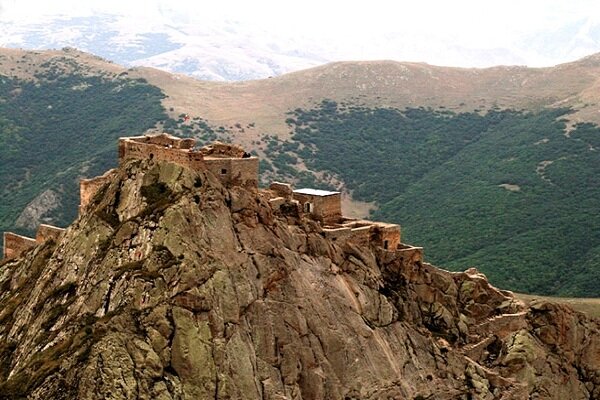
TEHRAN, Aug. 11 (MNA) – One of the mysterious places in Iran which its location made it impossible army of thousands men to pass, is Babak Fort. It sits attractively on a steep-sided mountain in north-western Iran.
Babak Fort, also known as the Immortal Castle or Republic Castle, in East Azarbaijan Province is located on top of a mountain with 2600 meter height in the Arasbaran forests, 6 km southwest of Kalibar City in northwestern Iran. It is known as the most glorious stone castle of Iran.
It is a magnificent and beautiful monument that was the stronghold of Babak Khoramdin, a patriot and militant leader against invaders.
Babak Khoramdin was one of the Iranian commanders of Azarbaijan and main Persian revolutionary leaders of the Iranian Khoramdinan, which was a local freedom movement fighting the Abbasid Caliphate. He persisted against Abbasid for 22 years and gave his life for it. 
The fort is one of the greatest examples of Iranian architecture. It consists of several stone towers and lodging areas stretched in an area of nearly ten thousand square meters, attributed to the Sassanid-era (224–651).
Babak Fort has a multi-story structure in which the main hall has been surrounded by seven rooms all of them ends up in the hall. It was constructed in two floors and has only one entrance gate. There exists a narrow passage about 100 meters high to reach the main fort before the entrance. This passage was under control of guardians in the past in order to check all traffic. There were towers in two sides of the entrance which were the headquarters of guards. The entrance was the only way to enter the fort because of the security issues.
On the eastern side of the fort, there are some reservoirs next to the rooms. The mortar was the materials which were used in building of reservoirs in order to prevent the rain and snow water penetration. In rainy and snowy seasons the tank become full of water that they use it in summer.
Most of the western part is now destroyed, but it seems that it was the place where the troops were guarding and monitoring everything. Staircase is the only way to reach the upper floors; it is located in the northwestern side of the fort. The roof of this reservoirs has been established by barrel and rib vault. 
The Babak Fort has been refurbished many times over the years, but its complete restoration is not easy given its geographical location and conditions. Much of the fort's walls have collapsed, and its current appearance is very different from past.
It was recorded in list of national, cultural and historical opuses in 1966 and has been repaired by The Cultural Heritage Organization of Iran.
Iranian archeologists have found many coins and potteries belonging to 13th century in Babak Fort. The objects and tools obtained from the Babak Fortress are carved and glazed potteries that are belonged to early seventh century A.H.
Given that Babak Fort is in a mountainous area, the best time to visit this glorious castle is from April to early June and also from September to October. Access to fort is challenging and involves one to two hours difficult uphill walk. The hike is not recommended for the infirm, elderly or those afraid of heights.
If you are interested in ancient Iranian history, continue your adventure up the Babak Fort on your journey to East Azerbaijan province.

Saturday, August 03, 2019

The Art of Crafting and Playing with Kamancheh


Rahman Mehraby

The art of crafting and playing with Kamancheh by an Iranian Musician

Kamancheh is one of the musical instruments with a long history in the East. Although the track record of this instrument can be found in other countries as well, due to its original place of creation, UNESCO has inscribed the art of crafting and playing with Kamancheh as an intangible cultural heritage of Iranians.
In pre-Islam Iran, musicians used to play an instrument that was very similar to Kamancheh. It had a large resonating box and a neck. Today it’s a popular instrument in Baluchistan province.
Also in Lorestan province, artists have played Kamancheh since long time ago. In the past, this instrument used to have only three strings. The box was covered with deer’s skin. Famous Iranians such as Faraby and Masoud Sa’ad Salman have written extensively in their books about Iranian musical instruments like Kamancheh.
Other countries that used to play Kamancheh in the past are India, Malaysia, Indonesia, Kenya, Burma, Nepal and some Arab countries. Today artists play this instrument in India and Turkey as well, but Kamancheh is considered a traditional Iranian musical instrument. Even in other countries, people know it with the same name.
Musicians tune Kamancheh differently for various Iranian music systems. However, it is of different types depending on what sort of sound you expect it to produce.

Different Types of Kamancheh

Iranian Kamancheh is one of the different Iranian musical instruments with a particular sound similar to the violin, but sharper than that. It produces a sound that is quite pleasant. Famous Iranian musicians and singers have created beautiful songs with Kamancheh during the history of Iranian music. No doubt, many Iranians have listened to numerous such songs played with this instrument and have sweet memories with them.
The sound produced by Iranian Kamancheh is of various types. What differentiates the sound of this instrument can be the type of wood used for making the box, the thickness of the box at different parts, the size of the box, the materials used for the strings and the way neck is attached to the box.

Different Parts of Iranian Kamancheh


The Art of Crafting and Playing w & Piecesith Kamancheh - Parts
Iranian Kamancheh Parts

The art of crafting and playing with Kamancheh requires you to gain a more detailed acquaintance with this instrument first. So, we need to explore all its parts. Here is a list:
• Resonating box
• Skin
• Bridge (kharak)
• Neck
• Headstock (sarpanjeh)
• Tuning pegs (gushy)
• Nut (sheytanak)
• Tailpiece (simgir)
• String
From the structural point of view, this instrument has got a resonating box and a neck with a set of strings extended from the top of the neck to the box. One needs another piece to play the instrument and it’s the bow. To produce a sound, the musician moves the bow back and forth onto a Kamancheh’s strings.
The main part of the instrument is its resonating box. It usually consists of a spherical or oval shape with a small flat base. This box is made of wood and could be built either in one piece or several pieces for various instrument types. Depending on which type of Kamancheh a craftsman makes, they can design it with longer or shorter diameters. They make the best instruments out of walnut wood.
Craftsmen make the top surface of Kamancheh’s resonating box by goat or deerskin. Certainly, different skins produce different sounds. In fact, the art of crafting and playing with Kamancheh is best demonstrated when all such details are observed and put into practice.
The bridge is a small but strong piece attached to the top of the skin. It has a rectangular cuboid shape with top groves creating equal distance for the strings in an oblique way. This makes the first string shorter and the last one longer than others.
The neck of Iranian Kamancheh is made of one piece. Iranian craftsmen make the neck and box in particular size and proportions known as the Iranian standard for Kamancheh. As a result, if such sizes and proportions aren’t observed when crafting the instruments, the desired sound cannot be expected from it when it is made.
The headstock is attached to the top of the Kamancheh’s neck. It lengthens the neck of the instrument and provides a space for the tuning pegs to be installed there.
Iranian Kamancheh has got four tuning pegs attached to either side of the top part of the neck. The strings are harnessed by these pegs to the top of the instrument.
The nut is a narrow grooved object installed between headstock and neck. Kamancheh strings are laid inside these grooves to be tied to the pegs.
The tailpiece is installed at the farthest part of the resonating box. It’s made of wood or metal to fix the lower end of the strings to the instrument.
Strings are the next important part of Kamancheh. In some old instruments, there were only two strings on the necks, which are three in some modern Kamanchehs crafted these days. They are fixed at the top of the neck and extended all the way to the upper surface of the box.

How to Play Iranian Kamancheh


Iranian Kamancheh can easily compete for violin in terms of sound quality. Most of the musicians enjoy the pleasing sound of this instrument. Depending on which string is played or which direction the bow moves on the strings, different sounds could be produced.

As the art of crafting and playing with Kamancheh is the topic, we should explain how one plays this instrument:
A Kamancheh player should sit on a chair and put the resonating box on the ground or on his knee. Then, he should slide the bow’s hairs onto the strings while simultaneously moving his other hand’s fingers on the strings tuning the sound.
It takes particular skill and musical expertise to play Iranian Kamancheh. Such a player is required to pay attention to musical notes, songs’ tunes and produced melodies while playing. Before starting to play this instrument, the musician should tune the instrument. To produce bass or treble sound with Kamancheh requires a particular skill, which comes with time.
In general, the art of crafting and playing with Kamancheh has been an old tradition among Iranians, a cultural heritage and still popular among Iranian artists. There are several traditional Iranian music festivals held in Iran every year in which this instrument is played and one can enjoy the artists’ live performance there. A trip to Iran without getting acquainted with Iranian music is incomplete.

Tuesday, February 26, 2019

Darak, where the desert meets the sea

TEHRAN, Feb. 23 (MNA) – The coastal village of ‘Darak’ can be found in the southernmost tip of Iran, on Mokran's shores, stretching along the Sea of Oman. It is one of the most stunningly pristine beaches in the country.
The village is a potential touristic site, which enjoys all three types of the cliff, sandy and coral beaches in the vicinity.
Darak or ‘Darag’ in the local language means settling along the sea. It is where the burning sands nestle in the arms of the free waters.
In the coastline, the waters of the Gulf of Oman and the Indian Ocean collide. The perceived coastlines of the sands and palm trees create wonderful scenes.
Location
The village forms a part of Zarabad County in the borders of Konarak. It is 19km from Johlou, the capital city of Zarabad. From the east, Darak is linked to the coastal village of Jod, and from the west it borders Poshti Village. Mountains embrace the village from the north and the sea from the south.
Abandoning the usual tourist routes, one could take an unknown route to venture into Sistan and Baluchestan. Trotting along the mild path, we will reach its sandy shore that offers a unique spectacle.
This village is located between two important southern port cities: Chabahar and Bandar Abbas.
he sand hills, shores, corals, rocks, mountains and surrounding forests, and the unspoiled and domesticated nature can all be seen in the same place.
Thanks to the efforts of the indigenous people and officials, this village has kept its purity and beauty. Interestingly, it does not appear on Iranian maps and you have to look in English maps, or look for the term "Darak Coast" in English or Darak Beach to geolocate.
Tourist sites and entertainment
Darak has a pristine shoreline. It is known for its extraordinary beaches. However, fortunately or unfortunately, its tourist potential has never been exploited and no tourist development has been realized. It is a site for those who are looking for the authenticity and charm of this unspoiled coastline.
The sand dunes and the extended coast are a good combination for cycling enthusiasts. Roads in this region are also suitable for motorized leisure activities, including off-road.
Along the Chabahar road in the village of Darak are temporary signs indicating access to one of the most beautiful coasts of Iran. This road is itself a tourist attraction by the landscapes that it presents to the eyes, but also by the sporty driving that it requires - it is thus preferable to take this road with a car adapted to all types of ground.
The most obvious recreation at the seaside is swimming. The place is also very good for all kinds of water activities, from surfing to diving. But again, no development has been done and it must become equipped.
Picnics, photography and hiking
The village, in itself, is worth seeing. Do not hesitate on the way to stop for a picnic under the shade of a palm tree. Hiking trails abound and compete with the coastal path. The hikes are made in forests and palm groves up to the sky, always with a view of the coast of sand and coral. The sunsets are also of unique beauty.
Best season to travel
The province of Sistan and Baluchestan is one of the hottest provinces of Iran. It rarely rains there, let alone in the years of drought. Nevertheless, the Darak village enjoys a spring climate most of the year. It is due to the refreshing winds that come from the Indian Ocean.
The best time to visit Darak is spring, from early to mid-season. After that, the heat of summer may reduce the pleasure of this trip. Summer remains a season to avoid due to high temperatures.
The beginning of autumn is still warm in the province, but the monsoon winds allow Chabahar and the littoral zones to benefit from a little more freshness. It is quite possible to go there in the fall, although it is better to wait until the second half of the season. Winter is also a good season to visit the village of Darak.
Inhabitants of Darak
The inhabitants of Darak belong to the Balouch ethnicity and speak Baluchi. Men's clothing consists of shalwar kameez. It consists of very baggy pants. The kameez is also loose, which traditionally is long with long sleeves. The Balochi shalwar kameez is similar to the styles worn in Afghanistan. 
The female Balochi suit consists of the head scarf, long dress and a shalwar. Balochi women wear loose dresses which are embroidered in colorful designs that are particularly renowned for the finesse of their embroidery.
The inhabitants of Darak mainly do fishing, but they also practice agriculture as a secondary activity. The kindness of these people is proverbial. It is common that visitors and travelers are invited to enjoy delicious local dishes, seasoned with traditional spices, where the ancestral culinary know-how of the women of the village is tasted. According to the latest censuses, Darak is populated by less than 500 people, making up over a hundred households.
Therapeutic virtues of Darak coastal dunes
One of the interesting aspects of the coast of Darak village is the existence of white sand hills that, according to locals, have healing properties for muscular and bone pains. In order to cure these pains, they lie on the sand early in the morning, when the sun shines high in the sky.
Darak is a rather green place, and one wonders how the palms grew on this hot desert coast. This is another oddity of the village: this place nestled near the sea and located in a hot and dry area has fresh water, just a few tens of meters from the sea. fresh water exists less than two meters deep.
This water is the origin of the forest and the variety of tropical species existing there. The inhabitants use fresh water to cultivate and harvest watermelon, corn, palm trees, etc. Side by side with these fruits, you will also see different species of acacia nilotica and fig trees pagodas.
Acacia nilotica (the red gum) is a species native to East Africa and the Indian subcontinent of the family Fabaceae, which also grows in Tchabahar in southern Iran. This tree has therapeutic virtues.
The fig tree of the pagodas is a tree belonging to the genus Ficus religiosa of the Moraceae family. It is a sacred tree according to Hinduism and Buddhism.