Showing posts with label Handicrafts and Tourism. Show all posts

Saturday, November 30, 2019

Iran takes part in 3rd Ministerial Meeting of Ancient Civilization Forum

Iran takes part in 3rd Ministerial Meeting of Ancient Civilization Forum

TEHRAN, (MNA) – The Third Ministerial Meeting of Ancient Civilization Forum was opened in Chinese capital Beijing on Fri. with the participation of the Islamic Republic of Iran.
As headed by the Chinese Tourism Minister, the Third Ministerial Meeting of Ancient Civilization Forum was held in Beijing International Hotel in the presence of tourism ministers of nine countries including People’s Republic of China, Islamic Republic of Iran, India, Iraq, Egypt, Armenia, Italy, Bolivia, Peru and Greece.
In this forum, tourism ministers of Tajikistan and Mexico attended as observer countries and Iran’s Minister of Cultural Heritage, Tourism and Handicrafts Ali-Asghar Moonesan delivered speech.
For her part, Narin Kachatourian Armenia’s Deputy Minister of Tourism, Science, Culture, and Sports considered Islamic Republic of Iran as one of the target tourism countries and added, “holding a joint tourism forum with Iran last year in 2018 has provided an opportunity for closer ties between the two countries.”
While appreciating rich Iranian culture and civilization, she emphasized the need for the developing and strengthening cooperation with the Islamic Republic of Iran.
Chinese National Curator Wang also said that civilizations of Persia, India and Greece en route the ‘Silk Road’ have many similarities and commonalities.
The Silk Road has not been merely for the economic transactions, rather, this Road has created political interactions, he emphasized.
Iranian Minister of Cultural Heritage, Tourism and Handicrafts Ali-Asghar Moonesan arrived in Beijing, China on Thu. at the head of the high-ranking delegation.

Sunday, September 29, 2019

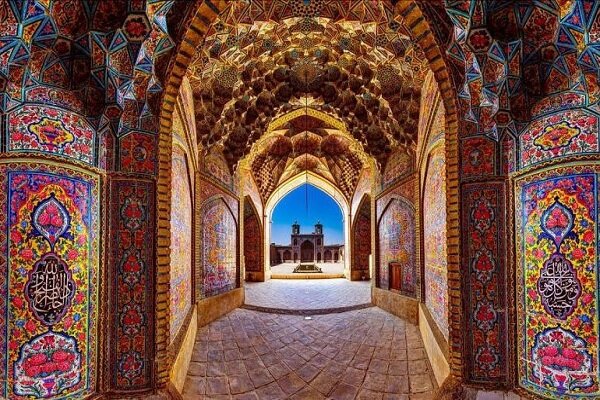
Nasir-ol-Molk Mosque, stunning whirling colors

TEHRAN, (MNA) – One of the most beautiful and photographed pieces of architecture in southern Iran, is Nasir-ol-Molk Mosque. It is one of the tourist attractions of Iran’s historic city of Shiraz which is known for its colorful lights that are formed by stained glass windows.
Shiraz is one of the most beautiful cities in south of Iran, where many tourists visit it every year. It is one of the oldest cities of ancient Persia and is known as the city of poets, literature, flowers and gardens. It is one of the main tourism sites in Iran and its cultural heritage is of global importance. Due to many historical, cultural, religious and natural attractions, Shiraz has always attracted many tourists. One of these magnificent places is Nasir-ol-molk Mosque.
Nasir-ol-molk Mosque is one the tourist attractions of Shiraz which was built during the Qajar dynasty at the end of the 19th century. It is one of the most unique and different mosques in Iran. The mosque is famous for its colored glasses and its tiles are unique in their kind.
This mosque is called by many different names. Mostly known as the “Pink Mosque” because its tiles are beautifully decorated with a pre-eminently pinkish rose color, it is also called the “Mosque of colors,” the “Rainbow Mosque” or the “Kaleidoscope Mosque”.
It is located in a region in the southern part of Lotf Ali Khan Zand Street. The mosque was built by order of Mirza Hasan Ali Nasir ol Molk, a Qajar ruler. Mohammad Hasan-e-Memar, an Iranian architect, and Mohammad Reza KashiSaz were two designers of this mosque. The construction of this elegant mosque was finished after 12 years.
It is 2890 square meters and considered as one of the most valuable mosques in Iran in terms of construction, especially tiling and muqarnas (a form of ornamented vaulting in Islamic architecture). It has two shabestan (an underground space that can be usually found in traditional architecture of mosques, houses, and schools in ancient Iran which were usually used during summers) in east and west.  
The eastern Shabestan has seven columns that are located in the middle of the space and are in a row. The most amazing part of the mosque is the western Shabestan. There are twelve columns which are placed in two rows of six. Seven arches are located between the two pillars, and at the end, there is an attractive tiled altar. The floor of the altar is made of marble and its surface is lower than the floor of the Shabestan. The western Shabestan has seven wooden doors with colored glasses that open to the courtyard.
With dazzling stained glass, thousands of painted tiles on the ceiling and Persian rugs covering the floor, this place of worship is a gorgeous rainbow of color in every direction, like stepping into a kaleidoscope.
There is an open courtyard with a rectangular pool in the center of the mosque, surrounded by flowers. The building’s facade features dozens of Islamic arches, adding to the beauty of the light show from the stained glass.
Despite other mosques, Nasir-ol-molk Mosque has no dome, which indicates that this religious building was quite personal and not used by the public. The tiling of this mosque is unique and the use of pink color is one of the features of the mosque which is not usual in any other Iranian mosques.
In autumn and winter, when the sunlight shines through the colorful glasses, and reflexes it on blue mosaics, make a dazzling view inside this mosque which making this mosque outstandingly aesthetic among other mosques of Iran.
Recently, Nasir-ol-molk Mosque has been lighted at nights as well; the light passes through the colored glasses and spreads into the yard and all over the mosque.
Nasir-ol-molk Mosque is still used for worship. It was registered in Iran's National Heritage on February 1955 under the registration number of 369.
The best time to visit Nasir-ol-molk Mosque is early in the morning before 9 a.m when the hall and its Persian carpets are illuminated with a kaleidoscope of patterned flecks of light.  

Monday, August 12, 2019

Difficult but worthwhile ascent

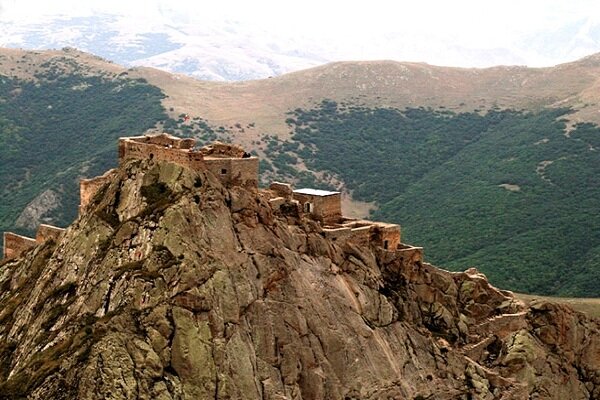
TEHRAN, Aug. 11 (MNA) – One of the mysterious places in Iran which its location made it impossible army of thousands men to pass, is Babak Fort. It sits attractively on a steep-sided mountain in north-western Iran.
Babak Fort, also known as the Immortal Castle or Republic Castle, in East Azarbaijan Province is located on top of a mountain with 2600 meter height in the Arasbaran forests, 6 km southwest of Kalibar City in northwestern Iran. It is known as the most glorious stone castle of Iran.
It is a magnificent and beautiful monument that was the stronghold of Babak Khoramdin, a patriot and militant leader against invaders.
Babak Khoramdin was one of the Iranian commanders of Azarbaijan and main Persian revolutionary leaders of the Iranian Khoramdinan, which was a local freedom movement fighting the Abbasid Caliphate. He persisted against Abbasid for 22 years and gave his life for it. 
The fort is one of the greatest examples of Iranian architecture. It consists of several stone towers and lodging areas stretched in an area of nearly ten thousand square meters, attributed to the Sassanid-era (224–651).
Babak Fort has a multi-story structure in which the main hall has been surrounded by seven rooms all of them ends up in the hall. It was constructed in two floors and has only one entrance gate. There exists a narrow passage about 100 meters high to reach the main fort before the entrance. This passage was under control of guardians in the past in order to check all traffic. There were towers in two sides of the entrance which were the headquarters of guards. The entrance was the only way to enter the fort because of the security issues.
On the eastern side of the fort, there are some reservoirs next to the rooms. The mortar was the materials which were used in building of reservoirs in order to prevent the rain and snow water penetration. In rainy and snowy seasons the tank become full of water that they use it in summer.
Most of the western part is now destroyed, but it seems that it was the place where the troops were guarding and monitoring everything. Staircase is the only way to reach the upper floors; it is located in the northwestern side of the fort. The roof of this reservoirs has been established by barrel and rib vault. 
The Babak Fort has been refurbished many times over the years, but its complete restoration is not easy given its geographical location and conditions. Much of the fort's walls have collapsed, and its current appearance is very different from past.
It was recorded in list of national, cultural and historical opuses in 1966 and has been repaired by The Cultural Heritage Organization of Iran.
Iranian archeologists have found many coins and potteries belonging to 13th century in Babak Fort. The objects and tools obtained from the Babak Fortress are carved and glazed potteries that are belonged to early seventh century A.H.
Given that Babak Fort is in a mountainous area, the best time to visit this glorious castle is from April to early June and also from September to October. Access to fort is challenging and involves one to two hours difficult uphill walk. The hike is not recommended for the infirm, elderly or those afraid of heights.
If you are interested in ancient Iranian history, continue your adventure up the Babak Fort on your journey to East Azerbaijan province.