Showing posts with label Eli Clifton. Show all posts

Thursday, December 05, 2019

The Jewish Billionaire Behind A New Christian Anti-Iran Group

by Eli Clifton
Yesterday, a new organization’s “promoted” (read: sponsored) tweet popped up on my timeline. It came from The Philos Project, a group dedicated to promoting “Christian engagement in the Middle East.” The tweet read: “Iran is known to sponsor #terrorism. Iran wants a nuclear bomb. What could possible go wrong? #StopIran.” A quick glance at the website reveals a heavy emphasis on rehashing fear-mongering clichés about Iran’s nuclear ambitions.
A column published the day before Netanyahu’s speech before Congress by the group’s executive director, Robert Nicholson, warned that “Iran wants to take over the Middle East” because “they remember empire – and they want it back.” And “Iranian leaders see themselves as bringing about the end of history” because “Iran is prepared to kill and maim its way across the Middle East in order to achieve military hegemony over its foes.”
Even odder, Dan Senor, former chief spokesman for the ill-fated Coalition Provisional Authority (CPA) in Iraq, sits on the group’s board. Since leaving government, Senor, in addition to making money at Paul Singer’s Elliott Management hedge fund firm, has focused a lot on Israel advocacy through writing and promoting his book, “Start-Up Nation: The Story of Israel’s Economic Miracle” and co-founding (along with Bill Kristol) the Foreign Policy Initiative, the lineal descendant of the Project for a New American Century (PNAC), which did so much to promote the Iraq invasion (and indirectly to create the CPA).
So who is behind The Philos Project? It isn’t registered as a legal entity of any sort in New York State. Someone must be paying the bills, but who? The domain name, which was registered last May, offers the first clue. A woman named “Michele Packman” is listed as the “registrant name.”
Googling her name reveals that Packman is the director of operations and human resources at Singer’s family office. A little more research reveals that the Paul E. Singer Foundation is described as a “core funder “ of the Philos Project on the website of the Jewish Funders Network International Conference, an event scheduled to be held later this month in Tel Aviv.
Singer, a director at the Republican Jewish Coalition, is a huge donor to various groups that promote a hawkish line on Iran policy. Between 2008 and 2011, he contributed $3.6 million to the Foundation for Defense of Democracies, a hard-line neoconservative think tank whose scholars have variously advocated for “crippling sanctions,” “economic warfare,” and bombing Iran. The hedge fund mogul has also supported the American Enterprise Institute, a think tank whose scholars, including Richard Perle and Danielle Pletka, led the charge into Iraq and have been no less aggressive in regard to Iran. In addition, Singer has supported the Jewish Institute for National Security Affairs—he was listed in the group’s “Chairman’s Circle” as recently as 2012. The group’s current director, Michael Makovsky, recently compared President Obama to Neville Chamberlain. Singer has also served on the board of Commentary magazine, the publication that has more-or-less defined hard-line neoconservative orthodoxy since the late 1960s.
The Philos Project might be a clever example of astroturfing, attempting to portray itself as speaking for persecuted Christians while simultaneously promoting the aggressively pro-Israel agenda of a Jewish billionaire. If that was the intent, Singer and his employees should have been more careful in covering their tracks. If nothing else, the Philos Project stands as an object lesson in the eagerness with which neoconservatives try to create the perception that their views are shared by a vast, diverse constituency, which in this case is warning Christians about the imperial designs of Iran and the dangers of a nuclear deal between it and the P5+1.

avatar

ELI CLIFTON

Eli Clifton reports on money in politics and US foreign policy. He is a co-founder of the Quincy Institute for Responsible Statecraft. Eli previously reported for the American Independent News Network, ThinkProgress, and Inter Press Service.

Friday, June 28, 2019

Trump Has A $259 Million Reason To Bomb Iran

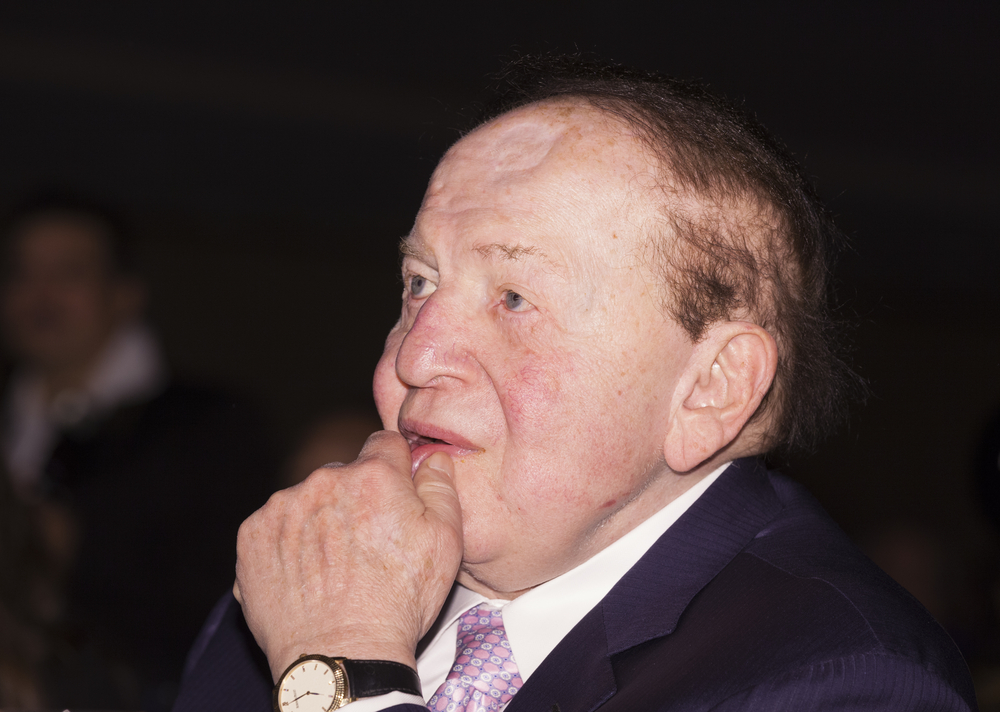
Sheldon Adelson (lev radin via Shutterstock)
On Thursday, the United States came perilously close to a military confrontation with Iran after it downed a U.S. drone that may or may not have entered the country’s air space. President Donald Trump reportedly ordered a retaliatory military strike on Iran but called it off, according to Trump’s own tweets on Friday morning, because a general told him that “150 people” might die in the strike.
Much analysis of Trump’s slide toward war with Iran has focused on his hawkish national security adviser, John Bolton, who, reportedly requested options from the Pentagon to deploy as many as 120,000 troops to the Middle East and hit Iran with 500 missiles per day. Bolton is the loudest voice inside the White House pushing for a military escalation to the administration’s “maximum pressure” strategy.
Secretary of State Mike Pompeo, for his part, is staking out the position that the 2001 Authorization for Use of Military Force allows the administration to take military action against Iran without congressional approval, an unusual and broadly criticized interpretation of congressional oversight.
Yet, there’s another omnipresent influence on Trump: $259 million given by some of the GOP’s top supporters to boost his campaign in 2016 and support Republican congressional and senate campaigns in 2016 and 2018.
Those funds  came from Sheldon and Miriam Adelson, Paul Singer and Bernard Marcus, donors who have made no secret, both through public statements and funding think tanks that support military action against Iran, of their desire for the United States to destroy the Islamic Republic.
Adelson, who alongside his wife Miriam are the biggest donors to Trump and the GOP, contributed $205 million to Republicans in the past two political cycles and reportedly sent $35 million to the Future 45 Super PAC that supported Trump’s presidential bid. His role as the biggest funder of Republican House and Senate campaigns makes him a vital ally for Trump—who relied on Adelson’s campaign donations to maintain a Republican majority in the Senate and curb Republican losses in the House in the 2018 midterm election—and any Republican seeking national office.
Adelson publicly suggested using nuclear weapons against Iran and pushed for Trump to replace then-national security adviser H.R. McMaster with Bolton, partly due to the former’s perceived unwillingness to take a harder line on Iran. In 2017, the Zionist Organization of America, which receives much of its funding from the Adelsons, led a public campaign against McMaster, accusing him of being “opposed to President Trump’s basic policy positions on Israel, Iran, and Islamist terror.”
In 2015, Trump mocked his primary opponent, Sen. Marco Rubio (R-FL), for seeking Adelson’s financial support, warning that Adelson expects a degree of control over candidates in exchange for campaign contributions. Trump tweeted:
Sheldon Adelson is looking to give big dollars to Rubio because he feels he can mold him into his perfect little puppet. I agree!
And Adelson isn’t alone.
Billionaire Home Depot co-founder Bernard Marcus is the second largest contributor to Trump’s campaign, providing $7 million. He also champions John Bolton, contributing $530,000 to John Bolton’s super PAC over its lifetime. And he’s a major contributor to GOP campaigns, contributing over $13 million to Trump’s presidential campaign and GOP congressional campaigns in 2016 and nearly $8 million to GOP midterm efforts in 2018.
Marcus, like Adelson, makes no qualms about his views on Iran, which he characterized as “the devil” in a 2015 Fox Business interview.
Unlike Adelson and Marcus, hedge fund billionaire Paul Singer was a “never Trump” conservative until Trump won the election. Then he donated $1 million to Trump’s inauguration. Singer is far more careful with his words than Marcus and Singer, but his money supports some of the most hawkish think tank experts and politicians in Washington.
Singer, alongside Marcus and Adelson, has contributed generously to the hawkish Foundation for Defense of Democracies, whose experts have spent the past decade regularly promoting policies to pressure Iran economically and militarily, including most recently Trump’s “maximum pressure” approach.
According to donor rolls of FDD’s biggest supporters by the end of 2011, a year that saw a sharp rise in tensions and rumors of war by Israel against Iran, Adelson contributed $1.5 million, Paul Singer contributed $3.6 million, and Bernard Marcus, who sits on FDD’s board, contributed $10.7 million.
(FDD says that Adelson is no longer a contributor, but Marcus continues to give generously, contributing $3.63 million in 2017, over a quarter of FDD’s contributions that year.)
Employees of Singer’s firm, Elliott Management, were the second largest source of funds for the 2014 candidacy of the Senate’s most outspoken Iran hawk, Sen. Tom Cotton (R-AR), who urged Trump to conduct a “retaliatory strike” against Iran for purportedly attacking two commercial tankers last week.
Singer donated $26 million to Republicans in the 2016 election and $6.4 million to the GOP’s midterm campaigns.
The billionaire Iran hawks—the Adelsons, Singer, and Marcus—made combined donations of over $259 million to GOP politicians in the past two cycles, making them some of the Republican Party’s most important donors. That quarter-billion-dollars doesn’t include contributions to dark money 501c4 groups and donations to 501c3 nonprofits, such as think tanks like FDD.
News coverage of Trump’s slide toward war frames the discussion as a competition between his better instincts and a national security advisor and secretary of state who, to varying degrees, favor military action.
But the $259 million that helped elect Trump and Trump-friendly Republicans must loom large over the president.
As Trump evaluates his options with Iran and turns his attention to the 2020 election, he knows he’ll need to rely on the Adelsons, Singer, and Marcus to boost his campaign, maintain a narrow majority in the Senate, and attempt a takeback of the House.
These donors have made their policy preferences on Iran plainly known. They surely expect a return on their investment in Trump’s GOP.