Showing posts with label Abdel Fattah el-Sisi. Show all posts

Monday, November 11, 2019

Trump to Arab Protesters: I Stand With Your Rulers, Not You

by COLUM LYNCH, Foreign PolicySaudi Trump


As demonstrations erupt from Iraq to Lebanon to Egypt, the United States is sending strong signals that it no longer has any stomach for democracy promotion.
This year, the largest popular protests since the Arab Spring have gripped the Middle East and North Africa, toppling a military dictator and accused war criminals in Sudan, prompting the resignation of Lebanese Prime Minister Saad Hariri, and challenging the rule of leaders in Algeria, Egypt, Jordan, and Iraq.
During that time, the Trump administration has responded with a fairly consistent message: America no longer much cares—unless you are protesting against Iran.
While the State Department has offered measured expressions of support for protesters, critics and former U.S. officials say the White House has remained largely indifferent, raising doubts about the administration’s commitment to the demonstrators’ aspirations. For some observers, President Donald Trump’s silence represents a betrayal of America’s traditional role as an inspiration for democracy abroad. But others feel that it would be best for the protesters if the White House stays out of their business—especially since Washington has so egregiously botched democracy promotion in the Arab world before, particularly in Iraq.
“It is better if they don’t say anything,” Marwan Muasher, a former Jordanian foreign minister, told Foreign Policy.
Yet Trump has gone even further in the opposite direction than mere silence, unambiguously siding with the region’s autocratic rulers and leaving lower-level bureaucrats in his administration to deliver mild encouragement to the protesters. Asked this fall to comment on Egypt’s most violent crackdown on protesters since the Arab Spring, Trump offered unconditional support for the country’s leader, Egyptian President Abdel Fattah al-Sisi, whom he once described as “my favorite dictator.”
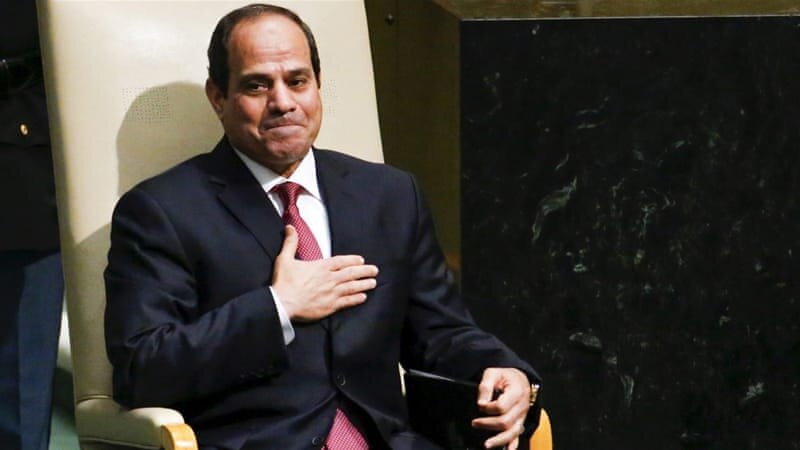
“I’m not concerned with it. Egypt has a great leader. He’s highly respected,” Trump said following a meeting with Sisi in September on the sidelines of the United Nations General Assembly. “Everybody has demonstrations.”
Trump’s apparent disregard for democratic yearnings in the Middle East may come as no surprise for a president that has questioned the legitimacy of key democratic institutions that have challenged him at home, including the courts, the press, and Congress.
“We have never had a president beaming out to the world a set of anti-democratic instincts and actions that conform so closely with the strongman playbook,” said Thomas Carothers, an expert on international democracy promotion with the Carnegie Endowment for International Peace.
Still, his public embrace of autocrats represents a sharp departure from his predecessors, who may have learned to turn up their noses and work with foreign despots but preached the virtues of democratic government in public.
“After [Abraham] Lincoln, this is the first time we’ve had a president who is not just autocratic but has dictatorial tendencies,” said Hussein Ibish, a senior resident scholar at the Arab Gulf States Institute in Washington, citing Trump’s effort to bend constitutional institutions to his will. “He has more in common with Sisi and [Turkish President Recep Tayyip] Erdogan than any of his predecessors.”
Trump’s views on promoting democracy elsewhere in the world contrast sharply with those of his predecessors, including President Barack Obama.


Thursday, October 03, 2019

Trouble for Pharaoh on the Nile

Editor

The streets of Egypt are again filled with protesters demanding the ouster of another dictator — General ‘Abd al-Fattah al-Sisi. The protests surprised many observers not least because al-Sisi is absolutely ruthless and does not hesitate slaughtering thousands of innocent civilians as he did in August 2013.
He has ruled by arresting tens of thousands of people — one estimate puts the number of political prisoners at 60,000 — and terrorizing the rest into submission. So far this seemed to work but now al-Sisi faces a challenge from an unusual quarter: Mohamed Ali, a contractor living in exile who had previously worked for the regime. Since he is not affiliated with any political party he is seen as having inside knowledge. People are more inclined to respond to his call.
Al-Sisi’s situation is worsened by the fact that military officers loyal to former army chief, General Sami ‘Anan have also voiced support for the protesters. The former army chief is in prison but given his popularity in the army, his loyalists pose a threat to al-Sisi’s rule.
Al-Sisi’s support base is the military. His claim to enjoying mass support and massive “victory” in elections is simply untenable. Every dictator in the Muslim East claims 99.9% support until protests erupt. The 99.9% simply evaporates.
Has al-Sisi reached that moment? It is difficult to say but given the dire economic straits of Egypt, he may have reached the tipping point.

Monday, September 23, 2019

Will General Abdel Fattah El-Sisi return to Egypt?

For the first time since Abdel Fattah el-Sisi came to power in Egypt, there have been wide protests against him in Cairo and other cities. The protesters have called for his dismissal due to growing corruption.
There were wide protests against el-Sisi in Alexandria, Suez, Damietta, Dakahlia and Gharbia. Images have been spread on social media showing that protesters have taken down and ripped large pictures of Abdel Fattah el-Sisi.
Dozens of people were arrested in Tahrir Square, where the Egyptian revolution flared against Husni Mubarak in 2011. Police used tear gas extensively, and security forces rush in the streets to react to smallest movement.  
The protests were formed at the request of a campaign on social media launched by Muhammad Ali, exiled businessman. Muhammad Ali who is exiled in Barcelona, Spain asked to overthrow el-Sisi. The Egyptian contractor, who exposed el-Sisi’s corruption cases, urged Egyptians to come to the streets and launch a revolution against him.
The people’s anger was aroused when Muhammad Ali posted files about the corruption of the President and the Egyptian army on social media. These files revealed that they wasted public treasury on the projects that have no benefits for Egyptian people, such as building Egyptian presidential palaces.
From the analysts’ view, the Egyptian army is accused of entering in all economic projects, and making certain companies to carry out the projects. Senior officers have also been paid by these projects, in addition to their salaries.
The supervisors believe that base on the Constitution, the Egyptian army goes beyond the observation of the parliament. It makes the army a closed and non-transparent organization that is not audited. No one knows how much funding and foreign financial assistance does it receive, how much domestic investment projects does it have, or how much it costs.
The question is that, after the protests by the Egyptians against Abdel Fattah el-Sisi, will he keep his promise and step down? He has stated repeatedly that if Egyptian people want him to leave, he would not hesitate for a moment.
 Anyway, we should wait and see how el-Sisi will deal with these protests. Will he respond them with iron fist, and call their actions a planned intrigue for destabilizing Egypt? He recently had collective and individual meetings with military and security commanders to make sure that whether there will be a harsh confrontation with opponents, or he should consider another process. He left Egypt for New York last Friday night to attend the UN General Assembly meeting.
Nobel Prize winner Tawakkol Karman referred to Abdel Fattah el-Sisi’s trip as a non-return trip, and posted on Twitter, “ousted el-Sisi will not return to Egypt and that is for sure.”