
By Ranjan Solomon
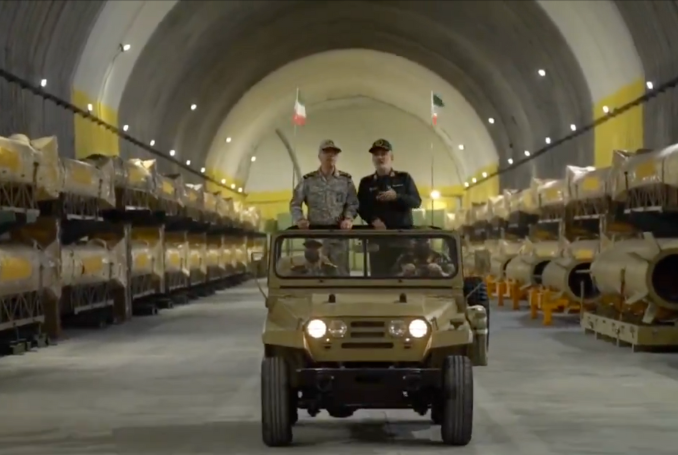 A newly unveiled underground facility operated by Iran’s IRGC. (Photo: video grab)
Ranjan Solomon examines how Western powers weaponize terrorism designations against Iran’s IRGC, revealing colonial double standards that criminalize sovereignty, resistance, and strategic autonomy.
The Islamic Revolutionary Guard Corps (IRGC) is one of the most misunderstood political-military institutions in the contemporary world. This is not because its role is opaque, but because global power has decided which forms of armed organization deserve legitimacy and which must be criminalized. In Western discourse, the IRGC is routinely presented as an inherently “terrorist” entity. Inside Iran, however, it is constitutionally mandated, nationally endorsed, and socially embedded.
This contradiction is not accidental. It exposes how the language of terrorism functions as a colonial instrument—applied selectively, enforced asymmetrically, and weaponized against states that refuse political subordination.
Countries that have designated the IRGC as a terrorist organization cite its role in suppressing protesters, providing weapons to regional allies such as Hezbollah, Hamas, and the Houthis, and allegedly plotting attacks abroad. Iran has condemned these designations as “illegal, political, and contrary to international law.” Critics argue that such measures form part of a broader “maximum pressure” strategy pursued by Western powers, one that undermines diplomacy and heightens the risk of regional instability.
As of January 2026, the IRGC has been designated a terrorist organization by the United States, Canada, Australia, and the European Union. These same powers, however, have continued to support the Israeli military during its barbaric genocide against the people of Gaza. At the same time, Israel’s intelligence agency, Mossad, has operated inside Iran as a foreign entity, while Western governments maintain a discreet and hypocritical silence.
Those who understand the language of justice versus colonial domination recognize that Iran’s branding as part of an “Axis of Terrorism” serves a strategic purpose: it criminalizes Iran’s support for liberation movements resisting Israel’s Western-backed military supremacy.
Its Formation and Rationale
The IRGC was formed in the aftermath of the 1979 Iranian Revolution, not as a rogue militia but as a parallel institution designed to protect a newly sovereign state from internal sabotage and external overthrow. Iran’s modern history explains this imperative. The 1953 CIA–MI6 coup against Prime Minister Mohammad Mossadegh—engineered to safeguard Western oil interests—left a lasting trauma in Iranian political consciousness.
The lesson was unmistakable. Electoral legitimacy offered no protection against imperial intervention.
It was in this context that the IRGC emerged, not merely as a military force but as a guardian of national independence. Its mandate is enshrined in Iran’s constitution, its leadership answers to state authority, and its legitimacy—whatever one thinks of Iran’s political system—is derived internally rather than imposed from outside. This alone places the IRGC in a fundamentally different category from non-state armed groups operating without national consent.
National Legitimacy vs. Imperial Judgment
The countries that have designated the IRGC as a terrorist organization have done so through unilateral or bloc-based political decisions. There has been no UN Security Council designation, nor has any international judicial body adjudicated such a claim. The designation rests entirely on the authority of states that also happen to wield overwhelming military, financial, and narrative power.
Here, the colonial logic becomes unmistakable. Western governments claim the authority to label another country’s official armed forces as “terrorist” while maintaining alliances with regimes whose records include occupation, apartheid, mass civilian killings, and systemic repression. Israel’s military, despite decades of illegal occupation and documented war crimes, is not designated terrorist. Saudi Arabia’s armed forces, despite their catastrophic role in Yemen, remain Western allies. The United States military itself—responsible for Iraq, Vietnam, Afghanistan, and countless covert operations—faces no such designation.
The message is clear: violence committed in defense of Western interests is framed as “security,” while violence committed in resistance to Western power is labeled “terrorism.”
The Post-Colonial Crime: Strategic Autonomy
What truly distinguishes the IRGC is not its methods—many of which mirror those employed by Western militaries—but its refusal to operate within a US-led security architecture. Iran does not host American military bases, does not align with NATO, and does not outsource its defense policy to Washington or Brussels.
The IRGC, particularly through its regional deterrence strategy, has been central to maintaining this strategic autonomy. That autonomy is intolerable to imperial systems. From Latin America to West Asia, institutions that block Western penetration are systematically delegitimized. Leaders are labeled dictators, movements are branded extremist, and militaries are declared terrorist. Sanctions follow, destabilization follows, and—when possible—regime change follows.
The IRGC fits squarely within this historical pattern. To describe these bans as “counterterrorism” is disingenuous. They function instead as political warfare, designed to criminalize diplomacy, intimidate diaspora communities, and lay the legal groundwork for future escalation.
Iranian Society and the Myth of Universal Opposition
A common Western myth is that the IRGC survives only through repression. This claim collapses under closer scrutiny. Iranian society is diverse and politically contested, yet the IRGC retains significant support, particularly among those who remember the Iran-Iraq war, years of sanctions, and repeated external threats.
For many Iranians, the Guards symbolize resistance to foreign domination rather than blind loyalty to clerical authority. This does not mean the IRGC is beyond criticism. No institution is. But critique must come from within a society, not be imposed by powers with long histories of exploitation, coups, and war.
At the same time, the IRGC has played a central role in violently suppressing domestic protests, generating internal dissent and accusations of brutality. It operates a vast business empire, with affiliates exerting significant influence over Iran’s political and economic structures. As a result, the IRGC remains a central yet deeply divisive institution—commanding loyalty from the ruling establishment while facing alleged opposition from some segments of Iranian society and international actors.
Terrorism as a Colonial Vocabulary
The modern definition of terrorism did not emerge from neutral spaces. It developed through colonial counterinsurgency doctrine, where indigenous resistance was criminalized to preserve imperial control. That legacy persists. Today’s terrorism lists are less about protecting civilians than about preserving geopolitical hierarchies.
When colonial powers label a nationally endorsed institution as terrorist, they are not issuing a legal judgment. They are issuing a political warning: obedience grants legitimacy; resistance invites criminalization. The IRGC’s designation tells us less about Iran than about the world order that seeks to discipline it.
Who Decides Legitimacy?
The central question is not whether one approves of the IRGC, but who decides legitimacy in international politics. If legitimacy flows only from Western capitals, sovereignty becomes a myth. If armed force is legal only when exercised by the empire or its allies, international law becomes a façade. And if resistance to domination is always labeled terrorism, then decolonization itself becomes a crime.
The IRGC exists because Iran’s history demanded it. It is endorsed nationally because external threats remain real. Those who ban it do so not from moral clarity, but from imperial habit.
History has taught us this much: empires do not criminalize what is weak. They criminalize those who refuse to kneel.
– Ranjan Solomon has been a long-time advocate for justice and an independent state for Palestine. He contributed this article to the Palestine Chronicle.

No comments:
Post a Comment