
By Romana Rubeo
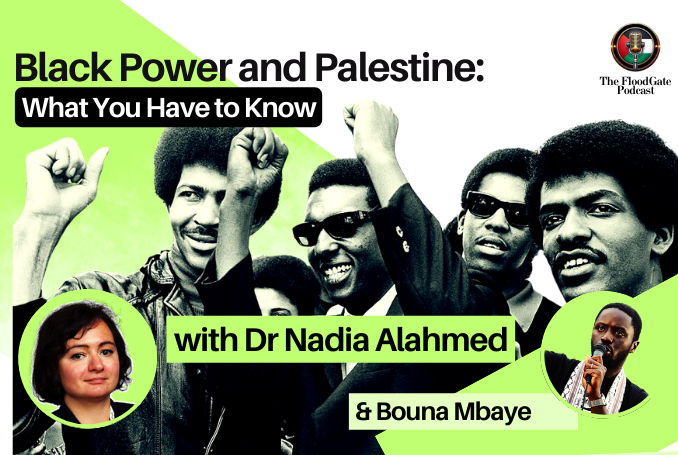 Bouna Mbaye in conversation with Dr. Nadia Alahmed for the FloodGate Podcast. (Design: Palestine Chronicle)
The relationship between Black liberation movements and the Palestinian struggle is often framed as solidarity — a political choice made in response to specific events. But in her conversation with Bouna Mbaye, Dr. Nadia Alahmed describes something deeper: a relationship that emerged independently, repeatedly, and almost inevitably, because both movements were interpreting the same global condition.
Key Takeaways
- The connection began in intellectual experience, not activism.
- 1967 transformed sympathy into political alignment.
- Ideology — not empathy — sustained solidarity.
- The apartheid framework globalized the Palestinian cause.
- The alliance continues but requires internal transformation.
Recognition through Literature
Across decades, Black radical thought and Palestinian political consciousness developed in dialogue with anti-colonial theory, literature, and lived experience. Rather than one inspiring the other, both arrived at similar conclusions about power, race, and liberation.
Long before organized activism, the relationship emerged through interpretation and personal experience.
Dr. Alahmed explains that she encountered the connection not in politics but in survival. Reading Black literature while living under occupation gave language to experiences she already understood. She recalls that “reading Black American authors really saved my life… it helped me overcome so many struggles of occupation.”
What mattered was not influence but recognition. She began to see that the narratives described the same structure of domination: “I started seeing the connections between the experiences expressed in Black American literature and Palestinian experience… I know how this feels. I know what this person is writing about.”
The relationship, therefore, began as a realization: two communities identifying the same reality through different histories.
The Turning Point of 1967
For decades, many Black intellectuals viewed Israel sympathetically. That changed when Palestinians became visible within an anti-colonial framework.
According to Dr. Alahmed, the decisive shift followed the 1967 war, when civil rights organizations publicly reframed the conflict. She describes that moment as a rupture in political history: “This can be considered a breaking point where civil rights movement turns into Black Power.”
The reaction was immediate and dramatic. A single public statement triggered political consequences across organizations, producing what she calls a reverberation “very intense and very loud” throughout Black American political life.
After that moment, Palestine was no longer an abstract international issue: it became part of a shared political struggle.
Shared Ideology
The alliance endured because it was analytical rather than emotional.
Black Power thinkers interpreted African Americans as an internally colonized population, drawing from anti-colonial theory. Palestinians were developing the same framework independently. As Dr. Alahmed explains, “Black Power is just a manifestation of the global anti-colonial African movement.”
Both movements identified themselves as dispossessed communities confronting similar structures of authority. “Here are two oppressed people relying on really similar ideological matrixes, waging a struggle for freedom and against dispossession,” she says.
Because the diagnosis was the same, the objectives were the same: “self-determination, freedom, liberation.” The relationship did not depend on sympathy; it rested on shared political analysis.
Naming Apartheid
The connection deepened when activists began comparing Israeli rule to South African apartheid.
For many African and Black intellectuals, the conclusion came quickly. Dr. Alahmed notes that the overwhelming majority of African thinkers viewed Israel as “an embodiment of a Western colonial project.”
Once articulated, the comparison reshaped the relationship. She explains that the parallels between the two systems were not peripheral but central: “the connections between Israeli apartheid and South African apartheid were at the heart of Black and Palestinian solidarity turning into a movement.”
The accusation provoked backlash, but it also internationalized Palestine by embedding it within the global anti-apartheid struggle.
A Living Alliance
Today, the relationship continues — visible in protest movements, student organizing, and political advocacy — yet Dr. Alahmed insists its survival depends on reflection as much as resistance.
She stresses mutual learning: communities must recognize that “we have a lot to learn from Palestinians… and Palestinians have a lot to learn from African liberation struggles.”
But she also emphasizes accountability. The alliance cannot exist without confronting internal prejudice. Palestinians must confront anti-Black racism, while African and diaspora communities must confront Islamophobia. Only then, she argues, can the relationship remain genuine rather than symbolic.
(The Palestine Chronicle)

– Romana Rubeo is an Italian writer and the managing editor of The Palestine Chronicle. Her articles appeared in many online newspapers and academic journals. She holds a Master’s Degree in Foreign Languages and Literature and specializes in audio-visual and journalism translation.

No comments:
Post a Comment