
By Palestine Chronicle Staff
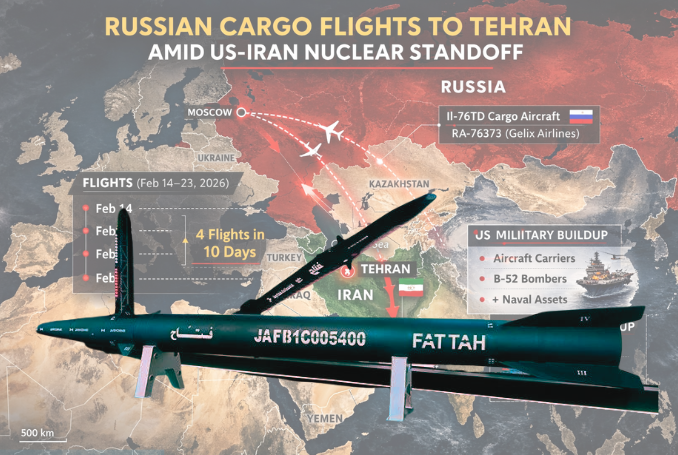 This map is for illustration purposes only. The exact flight paths of the Russian cargo aircraft have not been officially confirmed by either country. (Design: Palestine Chronicle)
Four Russian cargo flights to Tehran coincide with renewed nuclear diplomacy and escalating US military deployments in the region.
Key Developments
- A Russian Il-76TD cargo aircraft landed in Tehran four times within ten days.
- The aircraft belongs to Gelix Airlines, a Russian heavy cargo operator.
- Flights were openly visible on civilian tracking platforms.
- Iran and the US are set to resume nuclear negotiations in Geneva.
- Tehran denied reports of a “temporary agreement” with Washington.
- US President Donald Trump warned of possible military action if talks fail.
- Iraqi and Omani officials discussed efforts to prevent regional escalation.
- Iranian officials warned that any war would have broader consequences.
Russian Cargo Landings
Four flights by a Russian heavy cargo aircraft to Tehran within ten days have drawn attention amid renewed nuclear diplomacy and heightened regional tensions.
Open-source flight tracking data from Flightradar24 showed that an Il-76TD aircraft, registered RA-76373 and operated by Russia’s Gelix Airlines, landed in the Iranian capital before departing again for Russia after several hours on the ground. The aircraft conducted similar rotations on February 14, 15, and 16, with the fourth flight occurring shortly thereafter.
The Il-76TD is one of Russia’s principal strategic transport aircraft, capable of carrying tens of tons of cargo across long distances. Gelix Airlines specializes in heavy airlift operations and has previously operated in sensitive environments, including conflict-affected regions.
Neither Moscow nor Tehran has issued an official statement regarding the nature of the cargo transported during the recent flights. Civilian tracking data indicated that the aircraft did not conceal its route or disable transponder signals, remaining fully visible on public monitoring platforms throughout its journey.
The visibility of the flights has fueled questions about their timing, particularly as they occurred during a sensitive diplomatic phase between Iran and the United States.
Geneva Talks Resume
Iran and the United States are scheduled to reconvene in Geneva to resume negotiations aimed at reaching a potential nuclear agreement. The talks follow months of suspension and renewed mediation efforts, particularly by Oman.
Iranian Foreign Ministry spokesman Esmaeil Baghaei denied reports circulating in some media outlets suggesting that Tehran and Washington had reached or were close to reaching a “temporary agreement.” Speaking at a press conference in Tehran, Baghaei said Iran is currently drafting its positions for the upcoming round of talks and coordinating the timing and mechanism of submission with the Omani mediator.
He emphasized that the details of any negotiation are discussed within the negotiating room and that no agreement has been finalized. According to Baghaei, any deal must protect Iran’s national rights and interests and ensure the lifting of US sanctions.
Baghaei also reiterated that Iran’s nuclear program remains under the supervision of the UN nuclear watchdog and that no deviation toward militarization has been observed. He stated that Iran would accept an agreement that recognizes its nuclear rights under the Non-Proliferation Treaty (NPT) while addressing concerns through verifiable mechanisms.
The renewed talks come at a time when both sides are under internal and external pressure. Iranian officials have stressed the economic burden caused by sanctions, while US officials have reiterated demands related to uranium enrichment and stockpiles.
US Military Buildup
The diplomatic process is unfolding against the backdrop of a significant US military buildup in the Persian Gulf and surrounding areas.
US President Donald Trump has warned that Washington may consider military action if a “meaningful” nuclear agreement is not reached within a short timeframe. According to US statements, negotiators have been given between 10 and 15 days to secure progress.
Additional US naval assets, aircraft and air defense systems have been deployed to the region in recent weeks. Reports indicate that aircraft carriers and strategic bombers are positioned within operational range of Iran, contributing to heightened tensions.
Simultaneously, Iran’s Islamic Revolutionary Guard Corps (IRGC) has conducted military drills in the Strait of Hormuz, including missile tests and naval maneuvers. Iranian military officials have described the exercises as defensive in nature.
Deputy Foreign Minister Kazem Gharibabadi, speaking at a United Nations meeting, stated that Iran would not initiate a war but would defend its sovereignty. He warned that any military confrontation would not be confined to the immediate parties involved and would carry wider regional implications.
Iranian officials have consistently described US threats as violations of international law and the UN Charter, arguing that diplomacy must proceed without coercion.
Regional Diplomacy
Regional actors have sought to contain escalation and support dialogue.
The foreign ministers of Iraq and Oman held discussions regarding the upcoming US-Iran talks. Iraqi Foreign Minister Fuad Hussein said that both sides reaffirmed their support for dialogue and stressed the importance of ensuring the success of negotiations to avoid further instability in the region.
Oman has played a central role in facilitating indirect negotiations between Tehran and Washington. Previous rounds of talks were held in Muscat before shifting to Geneva.
The broader regional environment remains volatile. Tensions have been compounded by disputes over maritime boundaries in the Gulf and by ongoing conflicts in neighboring states.
Iran has also moved on the domestic economic front. The country’s central bank recently approved a draft law aimed at removing four zeros from the national currency, a measure that reflects ongoing economic challenges following years of sanctions and financial pressure.
Strategic Assessment
No official link has been established between the recent Russian cargo flights to Tehran and the ongoing nuclear negotiations with Washington. However, the timing has inevitably drawn scrutiny.
The flights took place amid an intensified US military buildup in the region, renewed public warnings from President Donald Trump, and the resumption of indirect diplomatic talks in Geneva. Four heavy cargo rotations within ten days constitute a notable pattern, particularly within such a compressed timeframe.
There is, at present, no publicly available evidence regarding the nature of the cargo transported, nor confirmation of whether it served military or civilian purposes. Russia and Iran maintain longstanding economic, logistical, and defense cooperation frameworks, and cargo exchanges between the two countries are not unprecedented.
Moscow has issued no official statement regarding the flights. Yet Russian-Iranian cooperation has expanded in recent years across multiple sectors, including defense coordination, energy partnerships, and strategic trade arrangements — particularly under the pressure of Western sanctions imposed on both states.
As nuclear talks resume in Geneva under Omani mediation and regional forces remain on heightened alert, the convergence of visible air traffic, military deployments, and diplomatic maneuvering underscores the dual-track dynamic currently shaping the crisis: negotiation on one hand, deterrence on the other.
For now, the flights form part of a broader geopolitical landscape defined by simultaneous diplomacy and strategic signaling. Absent formal confirmation, their precise purpose remains undisclosed — but their timing ensures they are viewed within the wider contest unfolding between Washington and Tehran.
(AJA, Anadolu, Al Mayadeen, Flightradar24, Iranian Media, US Media)

No comments:
Post a Comment