
By Palestine Chronicle Staff
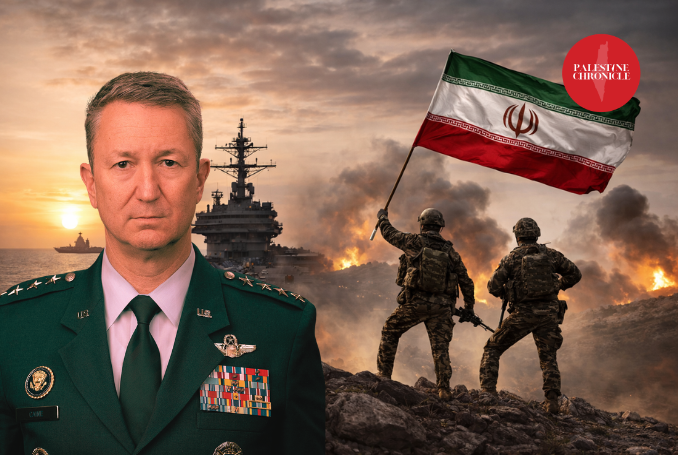 Gen. Dan Caine, Chairman of the Joint Chiefs of Staff, whose office reportedly issued a rare warning about the risks of a prolonged military campaign against Iran. (Photo: Wikimedia Commons. Illustration: The Palestine Chronicle)
Pentagon warns prolonged Iran war risks casualties and strain, as Tehran insists it seeks diplomacy but will defend itself if attacked.
Key Developments
- The Wall Street Journal reported that senior Pentagon officials warned President Donald Trump about risks of a prolonged military campaign against Iran.
- US military options range from limited strikes to a multi-day air campaign that could destabilize Iran’s leadership.
- Defense officials cautioned that extended operations could strain US air-defense systems and munitions stockpiles.
- Trump publicly denied reports suggesting internal opposition to military action but confirmed he prefers a deal if possible.
- Iran reiterated its commitment to the Nuclear Nonproliferation Treaty while warning it would respond forcefully to any attack.
Pentagon Raises Concerns
Senior US defense officials have cautioned President Donald Trump about the potential consequences of a prolonged military operation against Iran, according to a report by The Wall Street Journal.
The newspaper reported Monday that General Dan Caine, Chairman of the Joint Chiefs of Staff, has been among those voicing concerns during internal Pentagon discussions and National Security Council meetings. Other defense leaders, the paper noted, have echoed similar reservations regarding the scope and sustainability of several options under review.
According to current and former officials cited by the Journal, military leaders have warned that some of the proposed plans could expose US and allied forces to casualties, strain air-defense resources, and significantly stretch American military capacity.
The options being discussed reportedly range from limited, targeted strikes to a multi-day air campaign that could aim to destabilize or even topple Iran’s leadership.
While each scenario carries inherent risk, defense officials warned that an extended operation could “significantly drain U.S. munitions stockpiles and air-defense systems,” potentially complicating Washington’s ability to defend regional allies if Tehran retaliates.
The Journal further reported that heavy use of high-demand weaponry—particularly air-defense interceptors already in limited supply—could affect US readiness for other contingencies, including a potential confrontation with China.
According to the report, General Caine is widely regarded as a trusted adviser to the president, and his assessments are expected to factor into Trump’s ultimate decision. Military leaders, the paper noted, are tasked with outlining casualty estimates, logistical demands, and operational costs before any action is taken.
Trump, however, has not yet reached a conclusion.
White House spokeswoman Anna Kelly told the Journal that Trump values input from across his national security team and described Caine as a respected adviser. She added that the president considers a range of perspectives before determining what best serves US security interests.
Trump Denies Rift
The Pentagon’s caution comes amid reports that Trump has oscillated between military escalation and diplomatic engagement.
According to Al-Jazeera, Trump dismissed reports suggesting internal opposition to military action, stating that such accounts were “written wrong.” He emphasized that the decision to enter any war “belongs to him alone.”
Trump also rejected claims that General Caine opposed a strike on Iran, describing such reporting as “misleading news and pure fabrication.” He acknowledged that Caine, like other military leaders, “does not want war,” but asserted that “victory would be easy if a military decision is taken.”
Despite earlier indications that he was leaning toward military action, Trump has granted his envoys additional time to pursue negotiations with Iran. According to Axios, cited by Al-Jazeera, the president agreed to allow US envoy Steve Witkoff and senior adviser Jared Kushner more time for talks in Geneva, insisting on “exhausting all avenues” before resorting to force.
A senior US official told Reuters that Witkoff and Kushner are scheduled to meet an Iranian delegation in Geneva on Thursday.
Diplomacy, however, is unfolding against the backdrop of what US officials describe as the largest American military buildup in the Middle East since the 2003 invasion of Iraq.
US aerial refueling aircraft arrived at Israel’s Ben Gurion Airport on Monday evening, according to Israeli Channel 12 and Channel 13. The arrival coincides with heightened regional tensions and Trump’s warning that military action could follow if a deal is not reached within 10 to 15 days.
An aircraft carrier strike group is operating in the region, and a second carrier has been positioned in the Mediterranean, marking a significant projection of US air power.
Tehran Signals Defiance
Iran has rejected allegations that it is pursuing nuclear weapons and reiterated its commitment to international obligations.
Speaking at the Geneva Disarmament Forum, Deputy Foreign Minister Kazem Gharibabadi said Iran remains committed to the Nuclear Nonproliferation Treaty (NPT), describing it as the “cornerstone of the global nonproliferation and disarmament.”
Iran’s right to peaceful nuclear energy, he said, is “inherent, non-negotiable, and internationally guaranteed.” He insisted that Tehran “neither possesses nuclear weapons, nor has it sought to acquire them, nor does it intend to do so in the future.”
Gharibabadi emphasized that any sustainable negotiation must be based on “mutual respect, equal treatment, and the non-selective implementation of international rules.”
At the same time, he warned that Iran is prepared to “defend its sovereignty, territorial integrity, and its people,” including exercising its “inherent right of legitimate defense in accordance with the UN Charter.”
Iran’s Supreme Leader Ayatollah Ali Khamenei has also warned that Iranian forces could target US naval assets if attacked.
Meanwhile, Russia has expressed alarm at the prospect of military escalation.
Leonid Slutsky, head of the Russian parliament’s international affairs committee, warned that any US attack on Iran could trigger “dangerous collective confrontation.” He called for resolving disputes through negotiations rather than war and emphasized respect for state sovereignty and international law.
Slutsky stated that Russia seeks a multipolar global order and warned against unilateral military actions that bypass international institutions.
Strategic Assessment
The publication of internal Pentagon concerns in The Wall Street Journal, alongside similar reporting in other major US outlets including The Washington Post, is itself strategically significant.
The leaks come at a moment when the United States has nearly completed the visible stages required to carry out a major military operation: carrier strike groups are in position, aerial refueling assets have arrived in Israel, and regional force posture has reached levels not seen since the 2003 invasion of Iraq. In military terms, the operational architecture appears largely in place.
This raises an important question: does the surfacing of cautionary assessments signal that Washington is backtracking — or is it part of a calculated maneuver?
If it reflects genuine hesitation, then it suggests that new variables may be influencing decision-making inside the Pentagon and the White House.
The Wall Street Journal reported that defense officials warned a prolonged campaign could strain munitions stockpiles, expose US and allied forces to casualties, and complicate broader strategic readiness.
Those warnings imply that operational costs may be higher than initially assumed. There may also be classified intelligence assessments regarding Iranian retaliation capabilities, regional escalation dynamics, or vulnerabilities of US bases and assets that are not publicly known but are shaping internal deliberations.
A second possibility is that the publication of these risks serves a strategic purpose — a calibrated signal intended either to pressure Tehran diplomatically or to create ambiguity before a potential strike. Public debate over operational risks can sometimes function as part of a broader information strategy, especially when diplomacy and deterrence are unfolding simultaneously.
However, if this is intended as deception, its effectiveness is uncertain. The United States has previously conducted strikes during periods of negotiation, and Iranian officials have repeatedly warned that they are alert to the possibility of military action being launched under diplomatic cover. Tehran’s leadership has signaled that it views threats and negotiations as parallel tracks rather than mutually exclusive ones.
Iran has also publicly prepared for retaliation scenarios. Supreme Leader Ayatollah Ali Khamenei has warned that Iranian forces could target US naval assets if attacked. Such statements suggest that Tehran is not interpreting negotiations as a guarantee of restraint.
In that context, the leaks may indicate not strategic theater but genuine tension within US policymaking circles. Military planners are tasked with outlining worst-case outcomes, including escalation pathways that could expand beyond initial objectives. A limited strike could evolve into a sustained confrontation if retaliation triggers follow-on responses. A multi-day air campaign, as reported by the Journal, would risk deepening US entanglement in a conflict whose end-state remains uncertain.
At the same time, the visible military buildup increases pressure on all sides. It narrows diplomatic space while heightening the consequences of miscalculation.
Whether the Pentagon’s caution represents backtracking or tactical messaging, one reality remains clear: the infrastructure for war is largely in place. The decision now rests on political calculus — weighing deterrence credibility, domestic considerations, alliance coordination, and the unpredictable nature of escalation.
The coming days will reveal whether the published warnings reflect an internal brake on escalation or merely a pause before a decision already nearing its final stage.
(US Media, PC, AJA, Anadolu, Israeli Media, Iranian Media)

No comments:
Post a Comment