
By Palestine Chronicle Staff
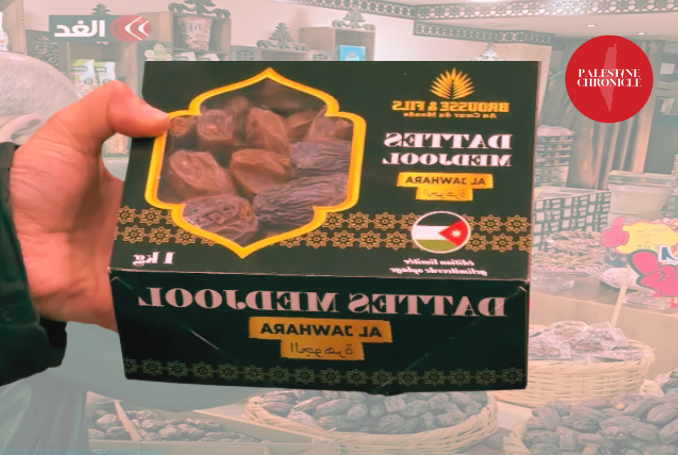 Although Israeli companies have misled consumers into buying settlement dates, there are still ways to tell the difference. (Photos: Al-Ghad, video grab, AJA. Design: PC)
From land to culture and now food, Israel continues to rebrand Palestinian heritage — with dates the latest example.
Key Takeaways
- Illegal settlement dates are relabeled to bypass boycott campaigns.
- Visual identification is unreliable; documentation and barcodes are crucial.
- The industry relies on occupied and confiscated land and restricted water access.
- Activists and trade bodies warn that purchases help sustain the genocide economy.
- Palestinian producers say verification systems now exist to protect consumers.
- The Date at Iftar
Made in the West Bank?
For millions of Muslims, Ramadan begins each evening with a single fruit — a date placed in the palm before prayer. The ritual symbolizes modest nourishment and continuity with centuries of tradition. But trade officials, farmers, and boycott activists now warn that the date appearing on the iftar table may conceal a far more complex origin.
Reports from Palestinian media and international agencies indicate that Israeli companies have increasingly marketed settlement-grown dates under misleading labels, including “Made in the West Bank” or packaging suggesting Palestinian origin. The practice intensified as boycott campaigns expanded across Europe and the Arab world, affecting sales of settlement agricultural products.
An investigation aired by Al-Ghad TV documented how labeling changed after boycott pressure. Boxes previously marked “Made in Israel” were rebranded to appear locally produced, allowing the goods to enter markets where consumers intentionally seek Palestinian products.
The shift does not alter geography — the fruit is still grown in settlements — but it alters perception at the point of purchase.
Hard to Distinguish
The deception works because consumers often cannot tell the difference.
Palestinian vendor Mohammad Kaid Salim explained in the same report that “dates are almost identical, and only a few people can distinguish settlement dates from Palestinian ones.” Climatic conditions across the Jordan Valley and Dead Sea basin produce similar textures and appearance.
Palestinian exporter representative Mohammad Sawafteh confirmed this in remarks to Anadolu Agency, stating that dates grown in the region “may be difficult to distinguish visually due to similar climatic conditions.” He stressed that buyers should rely on official documentation rather than appearance.
According to Sawafteh, Palestinian export shipments are sealed and accompanied by verified company data and technical certification confirming origin. These include health certificates issued by the Palestinian Ministry of Agriculture, customs documentation known as EUR.1, and certificates of origin issued by chambers of commerce.
Without these, origin claims should be treated cautiously.
The Barcode Test
Agricultural officials say the simplest indicator is often numerical.
Ibrahim Daeeq, head of the Palestinian Palm and Dates Council, told Anadolu that Palestinian products exported abroad carry a Jordanian barcode beginning with 625 alongside the label “Product of Palestine.” Israeli products typically begin with 729, and sometimes 871.
However, Daeeq warned that companies sometimes repackage products into new cartons bearing different distributor names, removing obvious identifiers. Israeli brands — including Jordan River, Mehadrin, Hadiklaim, King Solomon, Carmel Agrexco, Star Dates and others — may therefore appear under neutral branding in foreign markets.
“Verification of source depends on official documents and tracking systems,” Daeeq said, noting that Palestinian authorities monitor quantities produced in each farm and issue export permits accordingly.
Water and Land
Beyond labeling, Palestinian agricultural bodies say the production methods differ significantly.
Daeeq explained that Palestinian palms are irrigated with spring and clean well water, while settlement palms are irrigated using recycled wastewater, affecting taste and nutritional composition. Palestinian dates typically show a natural honey color and medium size, while settlement dates tend to be darker and larger.
More importantly, most settlement plantations operate on confiscated land in the occupied Jordan Valley — an area classified as Area C under the Oslo framework but still under Israeli military control decades later.
Around 400,000 palm trees grow in the Palestinian Jordan Valley, employing roughly 7,000 workers, making dates one of the largest agricultural sectors in Palestine.
Control over land and water, therefore, shapes not only agriculture but livelihoods.
The roots of the industry stretch back a century.
Historical records cited by Palestinian researchers show Zionist settlement agencies in the 1920s transferred palm varieties from Egypt, Iraq, Morocco, Algeria and Iran into plantations along the Jordan River and the Dead Sea basin.
Today, a large portion of that cultivation occurs in settlements considered illegal under international law.
The modern labeling strategy, activists argue, represents a continuation of the same process — not only producing crops on seized land but also obscuring their origin in global markets.
Boycott Campaigns
Ramadan significantly increases consumption, making the season economically critical.
The Palestinian BDS movement has urged consumers to boycott Israeli dates, stating they are grown on confiscated Palestinian land using appropriated water and contribute to sustaining the occupation and genocide. The group advises verifying country-of-origin labels and producer identities carefully, even when packaging suggests Palestinian origin.
European activists have raised similar concerns. French rights advocate Bernard Varela told Al-Jazeera that misleading labeling violates EU regulations requiring goods from occupied territories to be clearly identified. He described the commercial sale of settlement dates during Ramadan as effectively “financing genocide.”
Following increased scrutiny, labeling practices shifted rather than exports declining — suggesting adaptation rather than withdrawal from the market.
Palestinian authorities say monitoring has improved.
Sawafteh noted cooperation between security services, agricultural ministries, and exporters has “tightened the noose” on marketing settlement dates under misleading names and reduced the quantities traded from unclear sources.
Turkish inspection delegations now visit Palestinian farms directly before signing contracts, verifying production and storage conditions. Each farm’s output is registered, quotas assigned, pesticide residues tested, and certificates issued before export.
These measures, officials say, ensure Palestinian products are traceable and protect markets from deception.
A Political Supply Chain
The issue ultimately extends beyond agriculture.
The Jordan Valley lies roughly 350 meters below sea level, producing distinctive agricultural conditions and high-quality Medjool dates. Yet much of the region remains under Israeli military control, restricting Palestinian farmers’ access to land and water while enabling illegal settlement export industries.
As a result, the fruit circulating globally becomes part of a broader economic system shaped by territorial control.
A date purchased for religious tradition may simultaneously reflect a geopolitical reality — one shaped by labeling, supply chains, and military occupation.
Ramadan emphasizes intention, charity, and ethical consumption. For many families, choosing a date is a routine purchase. But trade officials now advise verifying origin documentation, barcodes, and company names before buying.
The fruit itself does not reveal its history, but its journey — from plantation to packaging — determines what it represents.
In markets across Europe and the Middle East, the same product can appear Palestinian, regional, or neutral depending on labeling. The meaning changes with the label, not the land.
The daily ritual, therefore, carries an unexpected dimension: breaking the fast may also mean choosing which agricultural system to sustain: that of occupied Palestine, or that of Aparthied Israel.
And in the context of ongoing genocide, activists argue that choice has become inseparable from politics.
(Al-Ghad, PC, AJA, Anadolu, Palestinian Media)

No comments:
Post a Comment