
By Ramzy Baroud & Romana Rubeo
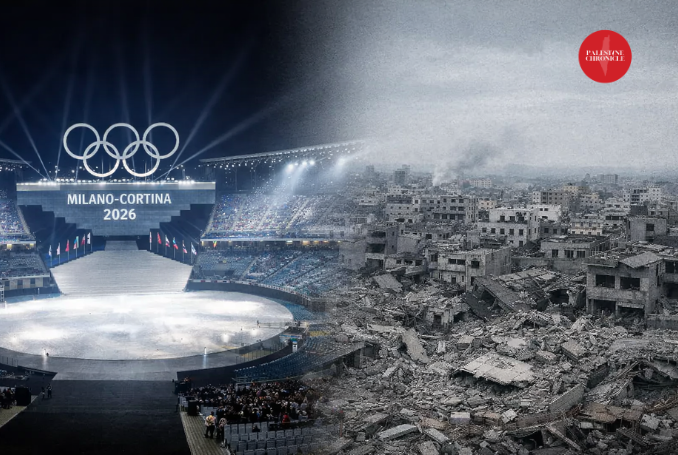 At the Milano–Cortina Winter Olympics, Gaza refused to remain outside the stadium. (Design: Palestine Chronicle)
The scale of popular participation in pro-Palestine campaigns signals a structural change: the issue can no longer be contained by diplomatic language or public relations campaigns.
At the Milano–Cortina Winter Olympics, Gaza refused to remain outside the stadium.
During a live broadcast of the two-man bobsleigh event, Swiss commentator Stefan Renna broke from routine sports narration to raise what he called “a legitimate question” about Israel’s presence at the Games.
Referring to Israeli pilot Adam Edelman, Renna noted that the athlete had posted messages on social media supporting Israel’s military campaign in Gaza and described him as “a Zionist to the core.” He added that this raised concerns about whether such positions aligned with International Olympic Committee (IOC) principles regarding neutrality and the participation of athletes linked to the ongoing genocide.
The clip circulated widely online before Swiss broadcaster RTS removed it, claiming that while it allowed space for debate, the commentary was “not appropriate in length and tone within the context of a sports broadcast.”
Days earlier, a retail employee at the Cortina Sliding Center was removed from his shift after repeatedly calling out “Free Palestine” as Israeli fans entered the venue. Organizers defended the decision, saying “it is not appropriate for Games staff or contractors to express personal political views while carrying out their duties” and emphasizing the need to preserve a “neutral, respectful and welcoming environment.”
These are but a few examples of a whole host of events related to Palestine that began with the official opening ceremony. Later, a large crowd of pro-Palestine activists rallied for Gaza, protesting the participation of a genocidal country in a sporting event meant to highlight global peace and unity.
In stadium corridors, in shops, and across social media feeds, the Games repeatedly drifted back to the same subject: the Gaza genocide. Booing during Israeli appearances, protest banners outside venues, and viral clips from inside Olympic spaces made clear that the genocide could not be sealed off from the spectacle of sport.
The Olympics were meant to function as a safe space for Israel — insulated from politics and detached from everything it has done and continues to do in Gaza. Instead, they revealed the opposite. Even tightly managed international events could not prevent the genocide from resurfacing spontaneously — through spectators, workers, commentators, and audiences.
The moment sport required enforced silence to proceed, the narrative had already escaped institutional control.
This is not a temporary communications failure. It is structural, and here is why:
First, every Palestinian victim has become a permanent witness.
More than 72,000 Palestinians have been killed since October 2023, according to Gaza’s Health Ministry. However, a broader examination of the death toll suggests significantly higher figures. A recent study by The Lancet, based on a population survey, estimated that 75,200 violent deaths occurred between October 7, 2023, and early January 2025. It concluded that violent deaths “substantially exceeded official figures.” Researchers noted that women, children, and older people comprised over half of those killed, and that violent deaths represented roughly 3–4 percent of Gaza’s pre-war population.
These are not abstract statistics. They exist as names, photographs, funerals, orphaned children, and destroyed neighborhoods. They circulate daily across digital platforms, carried not only by journalists but by survivors themselves.
When South Africa brought its case against Israel before the International Court of Justice, it argued that Israel’s actions were “genocidal in character,” citing statements by Israeli officials and patterns of destruction. Israel rejects the charge, insisting its operations target Hamas. But the legal contest runs parallel to a deeper transformation: global perception.
The story is no longer mediated exclusively by institutions. It lives in memory.
Second, the solidarity movement has fundamentally changed.
Over the past year, millions of ordinary people — students, academics, artists, union members, health workers — have mobilized outside traditional activist structures. University encampments spread across the United States, the United Kingdom, Germany, Australia, and beyond. Demonstrations drew hundreds of thousands in London, Paris, New York, and Washington.
This movement is not driven primarily by ideology. It is driven by moral perception — by what people have seen.
This shift in perception can only be described as a ‘moral earthquake’. Indeed, the scale of popular participation in pro-Palestine campaigns signals a structural change: the issue can no longer be contained by diplomatic language or public relations campaigns.
Third, Israeli leadership has not moderated the racist and dehumanizing rhetoric that marked the opening phase of the genocide.
In October 2023, Defense Minister Yoav Gallant announced a “complete siege” on Gaza, declaring: “There will be no electricity, no food, no water, no fuel. We are fighting human animals and we are acting accordingly.” The language was not rhetorical excess in isolation; it accompanied policies that cut off essential supplies to a civilian population of more than two million people.
Prime Minister Benjamin Netanyahu has repeatedly framed the genocide in civilizational and biblical terms, describing it as a struggle between “the children of light and the children of darkness,” and invoking the story of Amalek — language that, in Jewish scripture, refers to the total destruction of an enemy. Such statements were reported in international media and later cited in legal filings, including South Africa’s submission to the International Court of Justice, as evidence of intent.
Crucially, this tone did not recede as civilian deaths mounted. Israeli officials continued to speak in the same absolutist and dehumanizing terms while expanding the genocidal war across Gaza’s north and south. The language of siege, eradication, and total victory remained central to official messaging.
Fourth, the information environment has permanently shifted.
Despite content moderation policies and platform restrictions, images from Gaza — bombed hospitals, flattened neighborhoods, grieving parents — have circulated globally in real time. Amnesty International described Israel’s actions in Gaza as “a genocide in plain sight.” Human Rights Watch and other organizations have also accused Israel of ‘genocidal actions’, war crimes, and collective punishment.
Once such language enters mainstream human rights discourse, it cannot be erased through branding.
Social media ensures that no Olympic ceremony, no anthem, and no medal podium can fully displace those images. The brand of ‘Israel as a genocidal state’ continues to travel through time and space.
Fifth, mainstream Western institutions defending Israel face their own credibility crisis.
Public trust in governments and major media outlets has eroded across Europe and North America. When official statements insist on Israel’s right to defend itself while images of civilian devastation dominate global feeds, segments of the public interpret that defense not as authority but as bias.
The result is inversion. Institutional validation no longer guarantees legitimacy.
In the final analysis, we can say with certainty that genocide cannot be reputationally reversed.
Marketing campaigns, diplomatic tours, or carefully staged international appearances cannot undo mass extermination witnessed in real time by a globally connected public. Reputation follows reality.
At the Milano-Cortina Olympics, Israel sought normalcy. Instead, it encountered interruption.
The Games were designed to isolate sport from politics. But genocide is not a political opinion — it is a historical rupture. And historical ruptures do not remain politely outside stadium gates.
Israel’s global image crisis is not a messaging failure. It is the consequence of memory, collective memory.
The world has seen too much. And memory cannot be negotiated, rebranded, or cancelled.
– Dr. Ramzy Baroud is a journalist, author and the Editor of The Palestine Chronicle. He is the author of six books. His latest, ‘Before the Flood,’ was published by Seven Stories Press. His other books include ‘Our Vision for Liberation’, ‘My Father was a Freedom Fighter’ and ‘The Last Earth’. Baroud is a Non-resident Senior Research Fellow at the Center for Islam and Global Affairs (CIGA). His website is www.ramzybaroud.net
– Romana Rubeo is an Italian writer and the managing editor of The Palestine Chronicle. Her articles appeared in many online newspapers and academic journals. She holds a Master’s Degree in Foreign Languages and Literature and specializes in audio-visual and journalism translation.

No comments:
Post a Comment