Saturday, April 01, 2000

Exotic western view of Muslim women

Laila Hasib

The assumption that western culture is inherently superior to all other cultures is the vantage point from which all social and religious philosophies are judged by the west. Muslim societies are, thus, regarded with special interest, fear and ignorance. Hostility, however, is the west’s most prevalent attitude towards Muslims, due to Islam’s great political and military challenge to Christian Europe during the Middle Ages and the Renaissance. When, in the nineteenth century, the roles were reversed and the major European nations began making inroads into the Middle East, they came armed not only with technology and a belief in racial superiority, but with a predetermined set of ideas and prejudices about Islamic society and Muslims. The Middle East is perceived as the west’s cultural and spiritual opposite.
Due to hijab (in its various forms) and ‘seclusion’, Muslim women are ironically held as exotic sexual objects by the west, more so than other women in the world. This idea of the exotic has two dimensions: the lure of distant lands and people and the pursuit of the ‘other’. The fascination of the ‘untouchable’ Muslim woman reached its peak in the nineteenth century and has continued to this day.
The fantasy created by western man of the Middle Eastern woman is one of a forbidden world of women, of sexuality caged and inaccessible to him, surrounded by the barriers of the veil and seclusion. Yet behind this cage, men reign supreme, living in a sexual paradise "off our wives" and unlimited concubines. The notion that women wait in the harem only to serve men, imprisoned with a black eunuch guarding the door, has further intensified the desire to penetrate what is defended and forbidden to outsiders.
The word harem in Arabic means a sacred, inviolable place and its root, haram, means forbidden or sacred and protected. Haram and hurma are a respectful form of address to a married woman. In Turkey and Iran, the equivalent term is hanum or khanum. But the most common usage of the word harem (haremlik in Turkish) is to denote the space in the family home reserved for women’s privacy. Instead, the reason for the segregation of women and the control over their visibility was fabricated by the west due to what they perceived as Muslim women’s uncontrollable, powerful sexual passions. Christian Europe held (and still holds) the notion that women’s sexuality was dangerous (nuns who were celibate complemented the image of the Virgin Mary) and since Muslim women are on a lower rung in mankind’s hierarchy (according to the west) they are even more in need of control. Muslim women are seen as hbel al-shaitan (the devil’s leash), implying their capability of dragging men away from virtue and also of making them impotent. Muslim men, in the west’s disturbed understanding, were given many socially acceptable means to control their women - the harem, polygamy, child marriage and repudiation.
Only a small proportion of families - almost all urban upper-class - practised strict seclusion and few do so today. Most homes are much too small to allow true seclusion and many Muslim women have to travel outside the home for food or work. Patterns of sexual segregation vary greatly from one community and region to another. Such defiling of the word harem by the west is only one example of its stereotypical hatred of Islam.
Muslim women’s lives are viewed by the west in several ways: the life of the upper-class harem is indolent, boring, idle and without occupation; the rest are ignorant, enslaving and degrading. Either way, Muslim women are seen as passive victims. What is interesting is that upper-class western women, too, have little to do except relax, attend social functions and administer the running of their home, including the servants - much like upper-class women worldwide. The remaining women are overworked and underpaid often uneducated.
Another western view of Middle Eastern women is the proverbial ‘dancing girl’, an indispensable part of orientalist art, photography and Hollywood movies. As late as the 1950s, the French tourist office marketed pictures of the Ouled Nail women of Algeria, loaded with jewellery and cigarette, as the star attraction in the country. Dominated by the danse du ventre (belly dancer), this vision of the Middle Eastern woman conjures up notions of lasciviousness and sensuality, signalling their sexual availability.
Western feminists, from the 1920s onwards, began delving into the Middle East, seeing their fellow sisters as oppressed like themselves. Although they face inequality in their own countries, few feminists see western culture or the imperialistic attitudes of their countries as wrong. They use their own culture as a yardstick by which to judge other women.
Muslimedia - April 1996-August 1996

Thursday, December 16, 1999

Risks of working through un-Islamic political systems


Editor

One thing that revolutionary Islamic movements have largely been clear about since the Islamic Revolution in Iran is that trying to come to power through democratic processes in the political systems established and run by secularist politicians in Muslim countries is a waste of time. The repeated and total failure of the Jama’at-e Islami in Pakistan, the marginalization of Necmettin Erbakan’s Refah-led coalition government in Turkey, and the suppression of the Islamic Solidarity Front (FIS) in Algeria, when it was on the verge of a massive victory in the country’s elections of 1991, are just some of the various ‘democratic’ Islamic experiments and experiences pointing in the same direction.

However, some Muslims point to other experiences and try to reach other conclusions; in fact, some Muslims point to some of the same experiences and try to reach different conclusions. These include both some Islamic movements, and Muslim thinkers committed to democracy and democratic processes. The Islamic Party of Malaysia (PAS) is a case in point. It has ruled the state of Kelantan for some years, with considerable success, and in last month’s Malaysian general elections was also elected to run the important state of Terengganu. The ‘Islamist’ political parties in Turkey (Refah until it was banned, and Fazilat since then) have also built their reputations and records on the basis of successes in local government. In both cases, the reputations of the Islamic movements involved have been enhanced, as their successes have tended to demonstrate at least some of the advantages of Islamic social organization, values and administration.
The question which arises, therefore, is whether these successes disprove the Islamic movement’s general rejection of the political party approach, and justify working through existing political systems. The answer is a barely-qualified ‘no’, and the evidence of Turkey is all one needs to explain the point. Refah successes in local government encouraged Muslims to work through the mainstream political system at the national level. However, a Refah government was totally hemmed in by the institutions and norms of the secular state, and was powerless do anything of its own choosing. The same would have been the case even had Refah controlled a majority of seats in the parliament, rather than being in coalition with one of the most aggressively secular parties in the country. One unfortunate consequence of Erbakan’s failure in government has been that Islamic parties have also suffered in local politics.
The object of any Islamic movement must be the ‘total transformation’ of the society and state from one based on secular and western bases, as exist in virtually every Muslim country today, to one based on Islamic values, principles and norms. Such a transformation cannot be brought about from within a non-Islamic system.

This commitment naturally places limits on the long-term value of participation in local or regional politics. The arguments here cut both ways. Certainly there is the possibility of demonstrating the practicability of Islamic values in collective community affairs, to counter the common anti-Islam propaganda myths that Islam is out-of-date or has no relevance beyond that of a purely personal faith. The fact that Islamic government can make life much better for many people is also relevant; that, after all, is the object of the exercise. However, such local involvement must not become an end in itself, to the detriment of the longer term object of the ‘total transformation’ of the society. One possibility is that the movements become ‘moderated’ by involvement in ‘real politics’ and lose their revolutionary edge, becoming used to the relative ease and short-term rewards of mainstream politics. This process is, of course, encouraged by secular politicians and commentators. Another process leading to similar results is if the workers and activists of the movements are tempted by local successes to try to repeat them nationally.
PAS’s success in winning power in Terengganu, to go with their established record in Kelantan, is welcome, of course. What is worrying, however, is the news that PAS leader Ustad Fadhil Nur has been appointed leader of the national opposition in parliament by the four-party Alternative Front. PAS has long been warned of the dangers of working in the system; they are in danger of falling into familiar traps - again.
Muslimedia: December 16-31, 1999


Thursday, December 02, 1999

The hollowness of the west’s ‘democratic revolution’

Editor


West Germans on the Berlin Wall in 1989

The collapse of the communist bloc in 1989 is regarded in the west as the definitive triumph of democracy, a ‘Democratic Revolution’ to rank alongside the other great revolutions of western history, the French (1789), the Russian (1917) and the Chinese (1949). Dating revolutions is never easy, but for historic purposes the Democratic Revolution of 1989 is usually dated by the fall of the Berlin wall, on November 9, 1989. So it was that the 10th anniversary of that event last month was marked not only in Germany but around the world.
At the time, of course, the Democratic Revolution was greeted as a massive triumph, inspiring such grandiose theories as Francis Fukuyama’s ‘End of History’. It was also, inevitably, related to the coming millennium, with the third millennium of the Christian/western era being hailed by some commentators as a coming ‘age of democracy’. In the popular perspective, for the consumption of those who know no better, this triumphalist tone is maintained. Among more considered views, however, this triumphalism has been toned down somewhat, and it was the latter view which tended to prevail as the tenth anniversary of the Democratic Revolution was marked.
The reasons for this change of tone are many and varied. The main one, however, is the realization that the advent of democracy is hardly regarded as good news by most people in the former communist bloc, and that former communist parties, leaders and ideas are increasingly popular. Of course, this is not admitted in the west, where the former communist parties tend to be euphemistically dubbed ‘nationalist’ or ‘conservative’; however, the growth and popularity of these parties is a matter of grave concern to the west.
The reasons for this apparently paradoxical phenomenon are not difficult to find. The Democratic Revolution was based on a lie; the lie that life in the west was some sort of utopia where everyone could live in luxury. (Westerners were equally given a distorted picture of life under communism, focus on low ‘standards of living’ rather than facilities available to people from the state.) People in the communist bloc welcomed the fall of communism because they were promised a consumer revolution, with easy access to video recorders, satellite television, fancy cars, big houses and all the consumer items of modern life. Like any salesman, however, the west was careful to hide the downside of this rosy picture -- the costs and the risks. In the eastern bloc, housing, health care and jobs were guaranteed by the state. In the west, the good life is only available to the minority who can make their own way in a dog-eat-dog environment, and the losers have no safety net to fall back on.
Valdas Anelauskas’s book Discovering America as it is (reviewed in the last issue of Crescent) exposes the bitter realities of American society, where huge numbers of children go hungry, millions of people have no easy access to healthcare, and crime and other social disorders are tolerated as long as they affect only the ‘underclass’ - which underclass is rapidly growing to dominate society. Millions of people in the former communist world are making the same discovery themselves, not by seeing the realities state of western societies, but by experiencing them.
Anelauskas, a former anti-Soviet dissident who emigrated from his native Lithuania to the US shortly before the collapse of communism, now regards himself as a anti-American dissident; which begs the question: what happened to all the other heroes of anti-communism? Where are they now that their people are in so much strife as a result of the Democratic Revolution that they called for and welcomed? Some, like Polish Solidarity leader Lech Walesa, are still struggling for their people’s welfare; but far more, like Slovakian president Vaclav Havel, are living the good life as part of the former communist bloc’s new Elite, enjoying the fruits of their good relations with the west while ignoring the ideals and principles which they once claimed to hold so dear.
Small wonder, then, that most of those celebrating the tenth anniversary of the fall of the Berlin wall last month were those who have benefited from the Democratic Revolution; while the former east German masses, supposedly liberated, were too busy trying to feed themselves and their children to celebrate.
Muslimedia: December 1-15, 1999

Wednesday, June 16, 1999

Imam Khomeini’s legacy alive around the world

Editor


Imam Khomeini, the tenth anniversary of whose death on June 4, 1989, was marked by millions of Muslims all over the world this month, was undoubtedly the most important figure in recent Muslim history, the man whose thought and leadership effectively gave birth to what we now know as the global Islamic movement. As Vali-i Faqih and Rahbar of the Islamic Republic of Iran, the first Islamic state of the contemporary era (albeit, inevitably, a prototypical and experimental Islamic state), he was the nearest thing the Ummah has had to Khalifah al-Rasul since long before the end of the Uthmaniyyah Khilafah.
Uniquely among recent Muslim leaders, he rose to leadership by the consensus of his fellow Muslims, who recognised in him exceptional qualities of taqwa and spirituality. But he always spoke for Islam and the Ummah as a whole rather than for any partial understanding of Islam. This was why millions of Muslims, Shi’as and Sunnis alike, accepted him as their leader, and sought to follow the revolutionary path which liberated Iran. Ordinary Muslims all over the world instinctively recognised him as a leader from the deepest traditions of Islam as soon as they saw him, whether live, on television or even in a newspaper. For ordinary Muslims, he came to embody a quality of humility and a pureness of iman that transcended every faultline in the Ummah, be it racial, national, linguistic, cultural or sectarian.
It is this spirit that the Islamic movement today is often said to have lost. Inevitably, people look for it in the Islamic state that the Imam created. All too often, they do not find it. Iran, people say, has failed to export the Revolution, is diluting the spirit of the Revolution, has joined the western-dominated international order instead of fighting it, or has become a nationalist, Shi’a state instead of an Islamic one. This is harsh; the expectations which people had for an Islamic state which was bound to be embryonic and experimental, as well as being subjected to the most venomous hatred and enmity by the west, were not reasonable. Not all officials of the state can be expected to share the qualities of the Imam himself. Having said that, in terms of nationalism and sectarianism in particular, too many have failed to maintain even minimum standards. However, as long as the understanding and vision of the leadership remains sound and unwavering, Iran will remain the leading edge of the Islamic movement, thanks to the momentum generated by the Imam’s unique leadership, and that of Ayatullah Sayyid Ali Khamenei.
But the failure of the Islamic movement outside Iran has arguably been the greater. Where the Imam transcended all divisions of the Ummah, too many activists outside Iran have fallen into every one they could find. Where Islamic Iran has sometimes been guilty of failing to take a broad enough view of the movement, Muslims elsewhere have often been guilty of demanding too much and failing to understand the limitations under which the Islamic state operates, and its own needs and imperatives. Too many are guilty of demanding and expecting from the Islamic state instead of assisting and helping it at a time when Islamic Iran needed it most.
Twenty years after the Islamic Revolution, there are many people in the Islamic movement who cannot remember the world without Islamic Iran, or without Imam Khomeini. With each generation, perceptions change. Islamic Iran is no longer a marvel to be wondered at, but an established feature of the geo-political landscape. And, for some - even within the movement - Imam Khomeini is no longer quite the presence he once was. But the movement today exists and works in a world shaped by his achievement. The challenge we face demands that we all work in the spirit of brotherhood and unity that he showed in his every action.
Imam Khomeini took a global view, focusing on issues common to all the Ummah, even though he came from, and worked largely within, a particular part of it. This ethos, that the things we share as Muslims, the things that make us Muslim, transcend the differences among us - and Islam and Muslims were never a monolithic faith or community - is one the Islamic movement must embrace if we are to move forward on the path Imam Khomeini, may Allah be pleased with him, has shown us.
Muslimedia: June 16-30, 1999

Friday, April 02, 1999

Kalim Siddiqui Memorial Seminar: legacy of an intellectual giant

By Zafar Bangash

It is fitting that the first Kalim Siddiqui Memorial Seminar to be held in London, on April 11, should discuss the theme: “The Global Islamic Movement - 20 years after the Islamic Revolution.” The movement and the Revolution were close to Dr Kalim’s heart; indeed, they were the essence of his life’s work which his colleagues and associates will discuss during the Seminar.
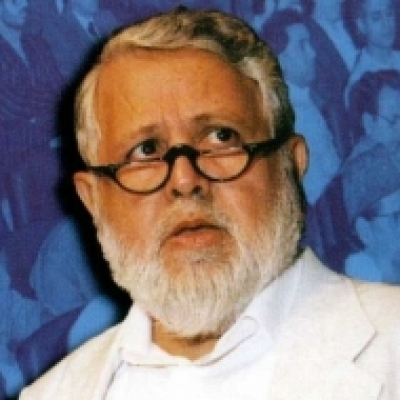
Through his writings and speeches, Dr Kalim (left) defined and analysed the concept of the global Islamic movement. He defined it as the “divine instrument of change”, its task in this era being to overthrow the present colonial- imposed order in Muslim societies through the process of Islamic Revolutions leading to establishment of Islamic States.
He postulated that the Islamic movement and the Islamic State are parts of a whole. The Islamic State, he pointed out, is the culmination of the struggle of the Islamic movement; it is the duty of every Muslim to strive to achieve it. Although the State can be destroyed, the Islamic movement cannot, for the movement, at its broadest level, consists of the Ummah itself, and all Muslims are its members and activist by definition.
Aware of his failing health, Dr Kalim described his last book, Stages of Islamic Revolution, as his ‘last will and testament.’ In it, he outlined the stages through which the Islamic movement must pass in order to establish an Islamic State. The Islamic Revolution he defined as that point in the struggle at which all forces converge to overthrow the previously established political order.
From Dr Kalim’s writings, two points stand out as essential for the Islamic movement: an intellectual revolution in Muslim political thought, and study of the Seerah of Allah’s Messenger from a power perspective. He devoted his life’s effort and writing to both. He was anxious to clear the fog of confusion that has engulfed Muslim thinking as a result of borrowing ideas of the west. He was unrelenting in his criticism of the nation-State structure, the political party approach and other accoutrements of western political thought. The consistency of his thought is striking. He did not have to adjust his postulates, because time and experience simply validated all of them. Kalim Siddiqui Memorial Conferences have been held regularly in South Africa over the last three years because that is where he passed away on April 18, 1996, shortly after attending an international conference on ‘Creating a New Civilization of Islam.’ He called South Africa his second home because of the respect and love that the Muslims of South Africa showed for him. Britain, where Dr Kalim lived throughout his adult life and where he did most of his academic work, has not had such conferences or seminars since his death. The only exception was the Memorial Conference jointly convened by the Muslim Institute and the Muslim Parliament of Great Britain in November 1996. Those familiar with events of the past three years in London would know the reasons for the lack of such activity since then.
Unfortunately, some of the institutions he left behind have become embroiled in disputes which remain to be fully resolved. The sorry state to which the Muslim Parliament has been reduced is perhaps the most depressing result of these disputes; it has had no session since 1996 and no meeting of members since 1997. Some institutions, like the Crescent International, have emerged unscathed; others are beginning to be nursed back to life. The important point is that at least some of the work has continued, alhumdulillah. The Institute of Contemporary Islamic Thought (ICIT) is a new vehicle establised to take up the work in the post-Revolution period. The new situation demands a fresh start. It takes up the development of Dr Kalim’s projects from where the Muslim Institute left off; the Institute’s work had, in any case, been largely overshadowed by the high-profile activities of the Muslim Parliament during the last years of Dr Kalim’s life. The 25-year history of Dr Kalim’s thought was dedicated to research into the contemporary, revolutionary Islamic movement, working in many different sectors all over the world. Essentially he wanted to generate an intellectual revolution in Muslim political thought as the foundation for Islamic revolutions which he expected would come decades later. Iran’s Islamic Revolution in 1978-79 changed the timescale of Muslim history. Dr Kalim and his team threw themselves into studying and understanding the phenomenon of Iran’s Islamic Revolution, and explaining it to Muslims outside Iran in terms easily understood by all Muslims.
The intellectual interpretation of the Islamic Revolution apart, Dr Kalim also set out to practically serve the Islamic Revolution and the global Islamic movement. This was done through relaunching the Crescent International as a ‘newsmagazine of the Islamic movement’ as well as holding seminars around the world. The seminars and conferences have continued since his death. Apart from the annual conferences in South Africa, the ICIT and Crescent International have organised conferences in Pakistan as well. Journalism courses have also been held for the past two years in South Africa. Plans are underway to extend these activities to Pakistan as well.
The most important task to which urgent attention needs to be paid is the Seerah Project. Dr Kalim was working on a proposal to organise a World Seerah Conference before he passed away. He had outlined a tentative programme for such a conference. This is the challenge facing those who wish to pursue his work and to take it to the next stage.
The Kalim Siddiqui Memorial Seminar in London this month is intended not only to pay tribute to him but to relaunch his intellectual work. He always emphasised that the movement and its work were more important than individuals and institutions. Relaunching his work for the service of the movement and the pleasure of Allah subhanahu wa ta’ala is the best tribute that could be paid to him. The Institute of Contemporary Islamic Thought and Crescent International invite all Muslims interested in any aspect of the Islamic movement, however broadly defined, to join us in this work.
[Zafar Bangash is Director of the Institute of Contemporary Islamic Thought.]
Muslimedia: April 1-15, 1999


Zafar Bangash

Wednesday, July 01, 1998

Time to reconsider the Seerah

By Muhammad H. al-'Asi


The phrase 'Islamic history' is a misnomer. Muslims do not really have Islamic history per se. There is history about Islam which is the product of non-Muslim, and often anti-Muslim, minds. This is true from the wars and battles of epic Islamic military encounters to the political and international relationships that extended from the dynasties of 1300 years ago to the present time.
The same is true about contemporary writings about the attempts to re-establish an Islamic world order, beginning with the Islamic Revolution in Iran, passing through the era of Islamic resistance and jihad in Afghanistan, Chechenya, Lebanon and the Balkans. Traversing the Islamic transformation afoot in Sudan to observing the fight-to-the-finish in Algeria (Muslims versus kuffar and munafiqeen), along with the meandering of Islamic tendencies in Turkey around the infamous legacy of Mustafa Kamal 'Ataturk' and secularism, one gets to the valiant Islamic confrontation with Israeli and Indian chauvinism and jingoism in Palestine and Kashmir. None of these recent and contemporary Islamic movements have never been effectively placed in an Islamic context and presented from an Islamic point of view. Even the records of the last semblance of Islamic political authority, represented by the Ottoman State with all its mistakes and deviations, is still inaccessible and thus non-presentable from an Islamic perspective. The archives are the best kept secret of the Turkish secular nation-State. Some pertinent information about the following issues is needed. Why Muslims fought at Yarmuk the way they did; why Muslims took on the Mongols at 'Ain Jalut the way and in the manner they did; why Muslims began to lose their grip on Andalusia (the Iberian subcontinent) which resulted in the infamous Inquisitions; why Muslims were forced to retreat from the outskirts of Vienna (Austria) twice; why Muslims failed to break the back of the caste system in the Indian subcontinent; and why Muslims expanded their belief/creed system to as far afield as Indonesia but lost their political/ideological system as close to home as in the land of the first Qibla and the third Haram (Palestine). We may never have accurate and detailed understanding of all these developments because Muslims have not been the gatekeepers of their own domain, or the spokepersons of their own affairs and their own destiny!
Whatever the ebbs and flows of history over this time span of some 1400 years, the fact remains that the details and particulars of the lifetime of our beloved and honourable Prophet, upon whom be peace, are still luminous and shining. We have volumes of detailed information and literature that expand upon his exemplary life. We have an abundance of narrations found in the books of hadith and Seerah: Ibn Hisham, Tabaqat Ibn Sa'd, Tarikh al-Tabari, Tarikh al-Ya'qubi, Maghazi al-Waqidi, al-Mas'udi, Ibn Kathir, and Ansab al-Balathuri to Al-Halabi, Abi al-Fida, al-Miqrizi, and Ibn al-Athir. In addition to these, there are contemporary commentators and narrators of the Prophet's Seerah such as the late Muhammad al-Ghazali, Mustafa al-Siba'i, Muhammad Izzat Darwazah, Jawad Ali, Muhammad Husein Heykel, and Muhammad Sa'id Ramadan al-Buti, among so many others.
The information that we have about the actions, movements and decisions of the Prophet is so overwhelming that putting all the pieces together has become something like a jig-saw puzzle, if we were to try to relate his calculations and determination to the reality and circumstances of his time and age.
What is conspicuously absent from this information pile-up is any analysis of the Prophet's decisions from a power perspective. It is because of this obvious delinquency on behalf of Muslim historians and writers that we have a conceptual vacuum into which the Orientalists rushed with their 'left' and 'right' theories to interpret to us, to the world at large, and the character, priorities, and objectives of our and mankind's last Prophet, upon whom be peace.
It is now time for the Muslims to take a disciplined and logical, and simulateously coherent and integrated, look at the prophetic decision-making process in light of the facts of 'power' that seldom change from one generation to the next.
Such well-known facts as the Prophet's seclusion before his heavenly commission in the grotto of Hira for as long as one month every year - according to some sources - have to be reconsidered in light of power considerations. These considerations are relevant to all who are active in society the way the Prophet, upon whom be peace, was before the age of 40 when he recieved his first words from heaven.
Note that the first people to become Muslims after the Prophet, upon whom be peace, received revelation from on high were his wife Khadijah (a female in the nomadic and tribal configuration of power), then his cousion Ali (who was no more than ten years old at the time, a boy in the same power configuration of nomadic Arabia), then Zaid ibn Harithah who was a former slave who had been set free and adopted by the Prophet... all these were individuals whose power in Makkan society was restricted, Khadijah as a female, Ali a mere boy, and Zaid, a slave!
Further down the road, and from a power perspective, why did the Prophet, upon whom be peace, stay for 13 years in Makkah without any visible power, power base, or power influence? What determined his asylum escape to Medina? Was it not sheer power as the power factions of Makkah finally, after 13 years of the Prophet's challenge to their vested interests and to their self-serving status quo, decided unanimously to assassinate the Prophet, upon whom be peace, which is another expression of the ultimate use of power: bloodshed.
Was the Prophet's move from Makkah to Medina a reaction to their power alliance to kill him; or was it his realization that he had exhausted all remaining means to win them (the Makkan society) to the divine programme of Islam? This meant a power shift from the aristocracy of Makkah to the pioneers of a new Islamic world order.
Another issue of power significance is the decision of hitherto inimical forces in Medina to form a full fledged political and military reality in Medina on the basis of the Qur'an, Islam, and the Prophet's leadership. Do Islam and the Prophet's Seerah advocate free-wheeling tabligh and da'wah, as many sincere but naive Islamic missonaries think today as they go from one land to the next for one week, 40 days, or even months on end without even once focusing on the issue of power? If the Qur'an, Islam and the Prophet are reduced to this open-ended tabligh we would never be able to consolidate the heavenly trust into the power structure that the Prophet finally anchored into Medina with all the sacrifices, battles, and wars on which it was built.
We also have to take a hard look at the Islamic relationships with the mushrikeen and Yahud in Medina and in the Arabian Peninsula from a power point of view. Was it necessary to expel Bani Qaynuqa', Bani al-Nadir, and Bani Qureitha from the Islamic State in Medina? Wouldn't the Muslim Gandhis want to tabligh these mushriks and Yahud to death? What else can Muslims do besides tabligh when there is no power concept to Islam, the Qur'an, and the Prophet?
Then why do we have a Prophet who launched, supervised and participated in scores of military operations, followed by hundreds of military expeditions and movements? Had his Seerah been free of the elements of power, there may be an excuse for some pacifist or conscientious objection here and there; but the hard fact of the Prophet's Seerah is that power is an integral and essential component of State and society building.
The exercise of power is implicit also in the Prophet's dispatched emissaries to the powers of his time: Byzantium, Persia, and Egypt towards the end of his reign... In fact, there is no aspect of the Prophet's example which cannot be better understood by factoring in the power consideration. This is because power is a fact of life.
There are many, if not all decisions of the Prophet that have to be reconsidered and reconstructed on the basis of an imminent power struggle that has never been absent when a Prophet or an Imam stands up and declares the superiority of Allah's power over all the man-made and man-imagined powers of the world.
If and when the Seerah and Sunnah of the Prophet, peace be upon him, are freed from the restricted framework in which they are presently studied, they will come alive with new dimensions and new frontiers. Until this is done, Muslims everywhere struggling for the establishment of Islamic societies and an Islamic world order will be handicapped and held-back by the failures of their own understanding of the message and example Allah has given his creations and servants.
The writer is Imam, Washington mosque, USA.


Muhammad H. al-'Asi

Monday, June 01, 1998

The road back to Palestine

By Kalim Siddiqui


This is a unique and historic occasion. By convening this conference, the Islamic Republic of Iran has fulfilled its role as the only Islamic State on the map of the world today. At present the Arab States are being herded into a so called 'peace conference' on Palestine. They will sooner or later, sign the formal surrender of Palestine to its zionist occupiers, but in fact to the United States of America.


Immediately after the victory of the Islamic Revolution in Iran, Imam Khomeini ordered that the last Friday in Ramadan be observed as Al-Quds Day. It was also a decade ago that the first Al-Quds conference was held in Tehran. In Iran at least there has been no confusion on the central issues of the conflict over Palestine. The same however cannot be said about the situation outside Iran.
The tragedy of the colonial period is not only that Muslim lands and peoples were colonised and that control over the physical assets of the Muslim Ummah passed to western powers; the greater tragedy is the fact that Muslims have also lost their once famous sense of history, sense of direction and clarity of thought and purpose. This is demonstrated by the difficulty even the people of Palestine have in defining their situation. Some regard it as a 'Palestinian Problem', others call it an 'Arab problem', and only a handful think of Palestine as the land of Islam and all Muslims. Even in Iran where this confusion does not exist, there is little understanding of the historical process that will eventually reclaim Palestine.
Palestine, as I understand it, is only an extreme case of a global phenomenon. This phenomenon is the penetration of the west into the House of Islam. Only in Palestine has this penetration taken the form of the replacement of a Muslim population under the flag of zionism. The history of zionist claims on Palestine is well known and does not require repetition or refutation but what is not generally known, or not often remembered and understood by the Muslims, is that the defeat and dismemberment of the Othmaniyyah State and the creation of the modern Arab nation States under client rulers such as the Al-Saud were all steps leading up to the creation of the State of Israel.
Ben Gurion once referred to the Arab States as 'Israel's first line of defence'. The implication is clear: the Arab States are not the enemies of Israel; the true enemy of Israel lies beyond the Arab States. Only this interpretation makes sense of the remark that the Arab States are Israel's first line of defence. Who, then, is the enemy?
Ben Gurion knew, and the western sponsors of Israel knew, that zionism is merely a flag of convenience for western occupation of Palestine. The west regards the occupation of Palestine essential for their long term goal of stopping and aborting any challenge to their world supremacy originating in Islam. Thus their Arab States are an effective barrier against Islam in this area and against Islam beyond the Arab world as well. It is Islam that the west regards as its enemy, not the Palestinians or Arabs or Ba'athists or any other permutation of Arab or Muslim nationalism.
Indeed, some of the nationalist movements are also part of the first line of defence for Israel and the west's penetration of the house of Islam. This is certainly the case with the PLO. Israel, by refusing to deal with the PLO [this was in 1990/91 - Editor], makes everyone, including the Palestinians believe that Palestinian nationalism is a real threat to the Israeli State; while the western powers, including the US and the [erstwhile]Soviet Union, by insisting that Israel must deal with the PLO, achieve the goal of keeping Muslims and world attention diverted from their enmity of Islam.
This western guile also helps to marginalise the 'Palestine problem' as a peripheral issue on the Mediterranean coast of the vast Arab world. In this way the fact that Israel is a dagger in the heartland of Islam is conveniently bypassed and hidden from public view. Non-Arab Muslim opinion has been conditioned to regard Palestine as an Arab problem, and the Arab States also insisting that PLO is the only representative of the Palestinian people, have succeeded in reducing it to a dispute over the sharing of land between the Jews and Palestinians.
It is important therefore, that the cloud of confusion is lifted and the problem is defined in its proper historical context. This is the west's hatred and enmity of Islam and the defeat and dismemberment of the House of Islam at the hands of the west. The creation of Israel was only the final and most arrogant act in political penetration and domination of the House of Islam by the west. It follows, therefore, that Palestine can only be reclaimed by reversing the process by which it was lost. This means that all parts of the House of Islam have to be reclaimed from western control and domination; the final act of this process of reclamation will be the dismantling of the Israeli State.
I have deliberately used the word 'reclamation' rather than 'liberation'. This is because 'liberation' implies a simple act of pushing out the colonialists while the task in hand is much more extensive. When, for instance, land is reclaimed from the sea it has to be desalinated and a fresh topsoil laid over it before it can be put to productive use. 'Liberation' or simple 'independence' leaves the land unfit for its original culture and civilisation. In all the post-colonial States the colonial culture and western civilisation have continued to flourish after 'liberation' or 'independence'.
Only in Iran has the Islamic Revolution gone on to complete the task of reclamation. This was possible because the political thought of the Islamic Revolution and its leadership owed nothing to the colonial period. Both the political thought and leadership of the ulama emerged from deep down the history and culture of Islamic Iran. Thus the Islamic Revolution was not an agreed or negotiated 'independence' but a forceful, powerful and uncompromising reassertion of the political culture and civilisation of Islam. Iran, therefore, is the only part of the House of Islam that has been totally reclaimed from the domination of western culture and civilisation.
Once the need for the reclamation of all parts of the House of Islam is understood, we also know that the only way to achieve this goal is through a succession of Islamic Revolutions. For Islamic Revolutions to occur in other parts of the world we have to come to terms with a new set of realities. These are summarised below:
  1. The 'Islamic' parties that emerged during the colonial period suffer from the same disabilities as the nationalist parties that achieved negotiated liberation or independence. Such 'Islamic' parties are now in the service of Al-Saud, and indirectly of the United States. They are therefore, irrelevant and can form no part of the new revolutionary Islamic movement.
  2. The new Islamic movement must flow directly from the conceptualisation of the experience in Iran. A new political thought derived from the Islamic Revolution in Iran alone can provide a solid foundation for the new global Islamic Movement.
  3. The Islamic State of Iran is the most successful manifestation of the political power of Islam achieved by Muslims anywhere in more than 1,000 years. This does not mean that the Islamic State of Iran has no faults or that the shape and form the Islamic State has taken in Iran is perfect. All this means is that the shape, form and structure the Islamic State has achieved in Iran is of sufficient power and stability that it has earned the right to our support over a prolonged period of improvement and growth.
  4. The power and stability achieved by the Islamic State in Iran is also of a sufficient quality to act as the central political reality in the Ummah. As such, the new Islamic State in Iran has taken the duty to act as leader of the new global Islamic movement for the reclamation of all parts of the House of Islam from the clutches of the house of kufr.
  5. Those Muslims in the world who recognise that an Islamic State of sufficient power and stability has come into being have a duty to give their total allegiance to that Islamic State and its leadership.
  6. It follows from this that the Vali-e-Faqih in Tehran is also the leader of the Global Islamic movement.
The six points outlined above are the foundations on which any plan to reclaim any part of the Ummah must be based, including the reclamation of Palestine. We must also remember that in some ways such nation-States as Egypt, Lebanon, Syria, Jordan, Iraq and Saudi Arabia are at present just as 'lost' to Islam as Palestine. Palestine cannot be reclaimed on its own; Palestine can only be reclaimed as part of the process of the total reclamation of the entire area.
Indeed, it may well be that Palestine can only be reclaimed after the heartland of Islam surrounding Palestine has first been reclaimed and reconsolidated into Islam. Thus victory in Palestine will mark the end of this struggle, not its beginning. The victory of Islam in Iran has been the first step on a long journey; the victory in Palestine will mark the final triumph of Islam over the west. To reach Palestine we must first reclaim the land surrounding Palestine. The Arab States, Israel's first line of defence, must be claimed before physical access to Palestine can be obtained.
This is the logic of history. There is no other road back to Palestine.
(This paper was first presented by the late author at a conference in Tehran in December 1990. Later it was presented at the Palestine Conference in Tehran in October 1991. Dr Kalim's observations are profound. He predicted the Arab regimes' formal surrender to the zionists years before these rulers actually did so).