
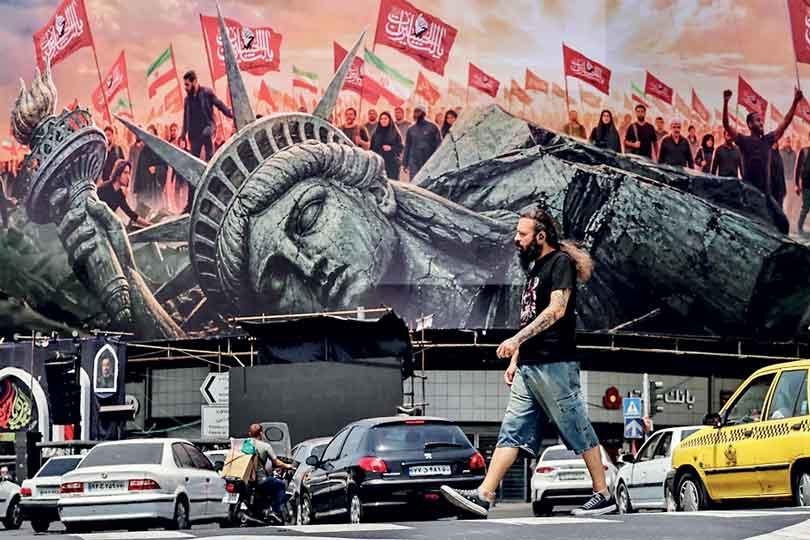
An Iranian man walks past an anti-US billboard at Inqilab Square in central Tehran. AFP
- Whatever rhetoric Trump utters—warning Iran he would unleash an attack unseen since World War II—or whatever claims he makes, insisting Iran is begging for a deal, the bottom line is that it is Trump who is desperate for an off-ramp. But the Iranians do not appear ready to hand him a deal on a platter
The longer the strait remains closed, the stronger Iran’s bargaining power will be and the deeper the political crisis into which the Donald Trump administration will be plunged—with a setback in the midterm election staring him in the face. If Democrats gain control of Congress, Trump will be unable to pass the national budget without conceding to their demands. This reality also spells disaster for the Republican Party in the 2028 presidential race. The pressure is on Trump to end the unpopular war and bring oil prices down, offering relief to the American middle class, who make up the bulk of the voting population. Oil was trading at US$ 80 yesterday as Iran and Oman held talks.
Whatever rhetoric Trump utters—warning Iran he would unleash an attack unseen since World War II—or whatever claims he makes, insisting Iran is begging for a deal, the bottom line is that it is Trump who is desperate for an off-ramp. But the Iranians do not appear ready to hand him a deal on a platter. After all, it was Trump, together with Israeli Prime Minister Benjamin Netanyahu, who launched an unprovoked war of aggression against Iran, in clear violation of the United Nations Charter, even as a nuclear deal mediated by Oman was ready for signature. The attacks on the very first day of the war killed Iran’s Supreme Leader Ayatollah Ali Khamenei, some 170 primary school girls and their teachers, and thousands of civilians across the country.
The United States remains a far stronger military power than Iran, but in asymmetrical warfare it is not armaments alone that decide the fate of a war or a nation’s power—it is political will to resist. If political will could be quantified, Iran would stand far ahead of its adversaries. Its determination to resist aggression is rooted in two factors: first, Shiite Islamic principles that emphasise sacrifice and perseverance for a better life in the hereafter; second, nationalism nurtured by a glorious civilisation with at least five millennia of history.
An Iranian surrender is therefore unlikely, even if the mercurial Trump, in desperation or sudden anger, were to order a nuclear strike on Iran.
But Iran’s advantage in political will for perseverance does not mean it can afford to be overconfident. Such a foolhardy stance can misfire. Iran is seen as stretching beyond the breaking point its advantage over the Strait of Hormuz, its missile reach, and its proxy forces—especially the Houthis in Yemen. The Houthis are ratcheting up pressure with attacks on Saudi-linked ships and threats to close the Bab al-Mandeb waterway. Iran’s position is also bolstered by reports that the US faces a munitions shortage, though Trump denies such reports.
Iran may be raising its bargaining stakes in a calculated manner, but miscalculation remains a constant danger. Of course, Iran is the wronged party, with the right to demand war reparations. Any international tribunal would likely rule in Iran’s favour if the dispute was brought for arbitration. Yet Iran must be cautious not to overuse its advantage or place unrealistic demands. Such a stance risks triggering a wider war with far worse consequences for the world.
This is why peace talks are strategically imperative, but weaponising them is unacceptable. Iran entered peace talks—not once, but twice—in good faith, only to be stabbed in the back by the US, raising questions about American trustworthiness.
Is the US a nation of its word? Lies and deception have long been part of its war diplomacy and visible not only in Trump’s nuclear talks deceit on Iran but also in President George W. Bush’s false claims about weapons of mass destruction before the 2003 Iraq invasion, and in multiple false flag operations, including the Gulf of Tonkin incident in 1964.
It is indeed praiseworthy that Iran is negotiating a deal through third parties with an untrustworthy power. But it has no choice, because perpetual war is not an option. Nor can it sustain for long the economic harm caused by the conflict. Of course, the longer the war continues, the happier the US and Israeli military‑industrial complex will be—about which President Dwight D. Eisenhower warned in 1961. The arms dealers, also known as agents of death, were surely elated to learn that Trump is pushing for an unprecedented US$1.5 trillion defence expenditure.
As Iran’s talks with Oman on the Strait of Hormuz were heading for a breakthrough yesterday, America’s wavering stance was a major concern. Leaked details indicate that the deal—a 60‑day arrangement—will chart two passages for ships: vessels entering the strait must use the northern lane along Iran’s coast, while those departing must take the southern lane along Oman’s coast. No toll will be charged, but a fee to cover security services, environmental costs, and demining activities is under consideration—similar to the arrangement in the Malacca Strait, which connects the Indian Ocean with the Pacific. At Malacca, however, the fee is voluntary, a donation to a body managed by littoral states including Malaysia, Singapore, and Thailand.
The Iran‑Oman deal requires US endorsement, though Tehran insists it is not an agreement with Washington, despite the Trump administration’s efforts to portray it as such. The deal fills gaps left by the vaguely worded memorandum of understanding signed in mid‑June. That MoU, though intended to last 60 days, collapsed within weeks—not only because it lacked a mechanism to resolve disputes but also because of the Trump administration’s afterthoughts once a ‘victorious’ Iran began reaping benefits and flaunting its control of the strait under clause 5 of the MoU.
Iran’s actions have raised questions about the United Nations Convention on the Law of the Sea, which seeks to balance state sovereignty with the principle of innocent passage. Yet the new security realities in West Asia after the US‑Israeli war of aggression have prompted Iran to interpret UNCLOS provisions more in favour of sovereignty and control over territorial waters. Concerns are also mounting about the Houthis’ attempt to levy charges on ships crossing the Bab al‑Mandeb.
Given the deals within deals and battlegrounds within battlegrounds, optimism is increasingly difficult. When hostilities persist, deals only postpone the next round of conflict.

No comments:
Post a Comment